
Rolling resistance data shows 30km extra range
A bespoke Continental tire built for Renault Group slashes rolling resistance by up to 35% below EU A rating mandates. This isn't incremental; it's a structural rethinking of how rubber meets road. By fusing virtual simulation with driver-in-the-loop testing, engineers accelerated development while holding the line on grip and braking performance.
Here is the math: 20% to 30% of an EV's energy budget vanishes to rolling resistance. On a 500km range vehicle, Continental's 35% reduction unlocks an extra 30km per charge. That is the distance from Paris to Versailles gained without adding a single battery cell. The secret lies in the EcoContact 7 base, reshaped via a new tread compound, sidewall design, and optimized construction.
Development skipped the traditional mountain of physical prototypes. Instead, teams leveraged Continental's driver-in-the-loop simulator alongside Renault Group's Roads driving simulator. These tools replicated real-world chaos digitally, allowing engineers to tune tire characteristics before molding a single unit. The result addresses the industry's persistent headache: maximizing efficiency without sacrificing the friction required to stop the car.
The Critical Role of Rolling Resistance in Electric Vehicle Efficiency
Rolling Resistance Physics and EV Energy Loss
Rolling resistance is the tax paid every time a tire deforms and recovers as it rotates. Between 20% and 30% of a vehicle's total energy consumption disappears to this force, regardless of the drivetrain. Lowering this resistance stops energy from turning into heat, preserving battery charge for actual propulsion. For EV architects, tire selection is no longer an afterthought; it is a primary lever for range extension.
Engineers fight these losses by tweaking tread compounds and structural geometry to minimize hysteresis. Yet, tires remain the sole interface between vehicle and road, where friction dictates braking capability and handling stability. The challenge is binary: balance efficiency targets against handling precision.
| Factor | Impact on Efficiency | Impact on Safety |
|---|---|---|
| Tread Compound | Lowers hysteresis loss | Provides grip for braking |
| Sidewall Design | Reduces deformation | Affects handling feel |
| Inflation Pressure | Optimizes footprint | Alters wear rates |
The engineering trap is obvious: suppress heat generation too aggressively, and you lose the friction needed for braking. Successful deployment demands proof that efficiency gains haven't eroded the safety margins of standard catalog tires. This tread compound optimization converts saved energy into distance, adding roughly 30km to a 500km battery charge. The mechanism relies on minimizing hysteresis within the rubber matrix while maintaining structural integrity for load bearing.
| Metric | Standard A-Rating | Continental Bespoke |
|---|---|---|
| Rolling Resistance | Baseline Requirement | Significantly Reduced |
| Range Impact | Baseline | +30km per charge |
| Development | Generic OEM Spec | Co-Engineered Fitment |
The tire-road interface remains the only thing keeping the vehicle safe, creating an inherent tension between efficiency and grip. Precise calibration of sidewall design and tread compound is non-negotiable to maintain effective braking. Virtual simulation allows engineers to evaluate and optimize tire characteristics under realistic driving conditions at an early stage of development. This approach ensures that energy efficiency gains do not erode critical safety margins during emergency maneuvers. Such highly specific co-engineered solutions are developed through long-standing collaborations in original equipment to deliver added value.
Drivers prioritizing maximum range benefit from low rolling resistance tires, which reduce energy consumption and extend driving range. The friction between the tire tread and asphalt provides the grip necessary for effective braking and stable handling, creating a direct engineering tension with efficiency goals. Extremely low rolling resistance is key to enhancing the range of electric vehicles, while tires must simultaneously provide the adhesion required for safety.
| Feature | Low Rolling Resistance | High Rolling Resistance |
|---|---|---|
| Primary Goal | Maximize EV Range | Maximize Mechanical Grip |
| Energy Loss | Minimal Deformation | High Hysteresis |
| Safety Trade-off | Requires Careful Calibration | Superior Wet Traction |
| Ideal Use Case | Highway Cruising | Performance Driving |
Operators must weigh rolling resistance against the specific duty cycle of the fleet. Manufacturers like Continental address the balance between grip and efficiency by developing bespoke solutions that apply virtual simulation rather than simple material swaps. This approach allows sustainability metrics to improve without compromising the fundamental safety envelope. Network planners must recognize that tire selection depends on balancing range extension with the specific operational needs of the vehicle.
Virtual Simulation and Driver-in-the-Loop Testing Methodologies
Continental's Driver-in-the-Loop Simulator Mechanics
Continental's driver-in-the-loop simulator evaluates tire characteristics under realistic driving conditions during early development stages. This architecture integrates human input with digital models to assess how a specifically modified tread compound behaves before physical molding occurs. Renault Group complements this hardware with its Roads driving simulator, which digitally replicates real-world environments for reproducible virtual testing sequences. Engineers iterate rapidly because these linked systems share data instantly. Test scenarios transfer across both platforms to accelerate development processes while reducing the volume of physical test tires required. Virtual testing improves tire development by isolating variables that physical tracks cannot control consistently. Engineers adjust parameters like sidewall stiffness or construction geometry and immediately observe the impact on energy loss. Fidelity of the digital twin remains a constraint; if the virtual road surface does not match reality, the optimized tire may underperform on actual asphalt. Validation still requires selective physical runs to confirm simulation accuracy. This hybrid workflow ensures that efficiency gains do not compromise the grip required for safe braking.
Optimizing Tread Compounds for the EcoContact 7
Reducing rolling resistance in tire design starts with a specifically modified tread compound that minimizes energy loss during deformation. Continental achieved this on the EcoContact 7 by combining three distinct structural changes: a customized sidewall design, an optimized tire construction, and the aforementioned compound adjustment. This triad allows engineers to target efficiency without sacrificing the grip required for safe braking. A guide to using simulators in this context involves linking material science directly to virtual driving dynamics. Engineers apply a driver-in-the-loop simulator to evaluate how the new compound behaves under realistic stress before any physical mold is cut. This method replicates test scenarios smoothly, accelerating the refinement of the customized sidewall while reducing the need for physical prototypes. The tension here lies in balancing extreme efficiency against the sheer mass of the vehicle; lowering resistance too aggressively can compromise handling stability if the construction is not equally tuned. This performance leap translates to roughly 30km of additional range on a 500km battery pack. Operators must recognize that such gains require co-engineering; a catalog tire simply cannot match the specific flexible needs of a modern electric platform. The limitation is clear: virtual optimization demands precise digital twins, or the physical results will diverge from the model.
Virtual Scenario Replication vs Physical Test Tires
Virtual scenario replication eliminates the logistical latency inherent in shipping physical test tires between global proving grounds. Engineers deploy driver-in-the-loop simulators to evaluate tire characteristics under realistic driving conditions long before a prototype mold exists. This approach allows Continental and Renault Group to smoothly replicate test scenarios, notably accelerating development processes while reducing the raw material waste associated with physical iterations. The shift from physical to digital validation changes how teams balance speed against fidelity. Traditional testing requires building hundreds of physical variants to map a single variable, whereas virtual environments permit infinite parameter sweeps without extra cost.
However, virtual models remain approximations of reality and cannot fully replace the unpredictable friction coefficients found on actual asphalt. The industry continues to rely on physical validation for final sign-off despite the efficiency gains of digital twins. This hybrid workflow ensures that the tread compound optimizations predicted by software hold true when the rubber meets the road. The reduction in physical tire usage also aligns with broader sustainability goals, such as those supported by the ISCC Plus initiative for recycled materials. Ultimately, the decision to use virtual simulation depends on the development phase, with early stages benefiting most from rapid digital iteration.
Balancing Energy Efficiency with Grip and Braking Performance
Defining the Grip-Efficiency Trade-off in Low-Resistance Compounds
Limiting natural rubber deformation saves energy but inherently lowers the friction coefficient needed for safe braking distances. The specific mechanism reducing energy loss by restricting polymer movement also diminishes mechanical interlocking with road asphalt. Pushing efficiency metrics too far without advanced simulation risks compromising vehicle stability during emergency maneuvers. Aggressive compound hardening introduces specific physical drawbacks that engineers cannot ignore.
- Reduced wet-weather traction occurs due to lower surface adhesion levels.
- Stopping distances lengthen notably on cold pavement surfaces.
- Lateral grip diminishes during high-speed cornering events.
- Tire wear rates accelerate, altering handling dynamics over the service life.
Maximizing range cannot come at the expense of fundamental safety margins. Virtual development tools now allow teams to isolate specific polymer chains that maintain grip while resisting deformation, breaking the traditional linear correlation between efficiency and traction. A tire designed solely for low resistance fails its primary duty as the sole contact point between the car and the road if calibration is imprecise. This physical reality dictates whether an electric vehicle can stop safely after extending its range. The physical mechanism reducing energy loss through lower hysteresis simultaneously diminishes the friction coefficient required for immediate road grip. Virtual simulation optimizes compound efficiency, yet the resulting tire may fail to generate sufficient heat during emergency stops on cold, wet asphalt. Operators face a choice between maximum range extension and consistent safety margins across variable weather conditions.
- Reduced tread compound adhesion increases stopping distances on slick surfaces.
- Optimized sidewall designs for efficiency may compromise cornering stability under heavy loads.
- Extreme efficiency gains often rely on softer rubber that wears quicker, altering handling dynamics over time.
- Thermal management becomes more difficult during repeated high-stress braking events.
Dr Christian Strübel notes that tailor-made tires notably increase range, yet this benefit relies on sacrificing the universal grip levels found in standard all-season designs. Laboratory efficiency does not translate directly to real-world safety without performance degradation. A tire engineered primarily to minimize deformation energy lacks the inherent stickiness needed for sudden evasive maneuvers. Fleets prioritizing this level of efficiency must implement stricter monitoring of tire age and temperature conditions. Extreme efficiency introduces a conditional safety profile demanding heightened operator awareness rather than offering unconditional performance.
Validating Tread Compound Optimization for EV Range and Safety
Engineers must verify tread compound hysteresis against wet-braking baselines before approving any EV-specific tire design. The collaboration between Dr Christian Strübel's team and Renault Group demonstrates that bespoke formulations can drastically cut energy loss while preserving safety margins. Virtual driver-in-the-loop simulators allow developers to test these customized sidewall designs under reproducible stress conditions without physical prototypes.
| Validation Metric | Standard Catalog Tire | Bespoke EV Optimization |
|---|---|---|
| Rolling Resistance Target | Meets EU A-Rating | Exceeds A-Rating notably |
| Development Method | Physical Prototyping | Virtual Simulation Heavy |
| Compound Hysteresis | Fixed Formulation | Tailored Low-Loss Mix |
Prioritizing efficiency introduces hidden costs regarding thermal stability during emergency maneuvers.
- Reduced heat generation may impair grip on cold, wet surfaces.
- Narrower operating windows demand precise vehicle calibration.
- Supply chain complexity increases for non-standard compounds.
- Material recycling streams face contamination risks from specialized polymers.
Extreme efficiency gains often narrow the safety envelope available for unexpected road conditions. Linear performance scaling across all temperatures is an invalid assumption for these specialized components. Validating these bespoke engineering solutions requires rigorous testing beyond standard regulatory minimums to ensure braking distances remain acceptable. Skipping this validation produces a tire that maximizes range but fails during critical safety events. Engineers must balance the desire for maximum efficiency with the non-negotiable requirement for consistent braking performance.
Executing Collaborative OEM and Tire Manufacturer Development Projects
Defining the EcoContact 7 Adaptation Framework
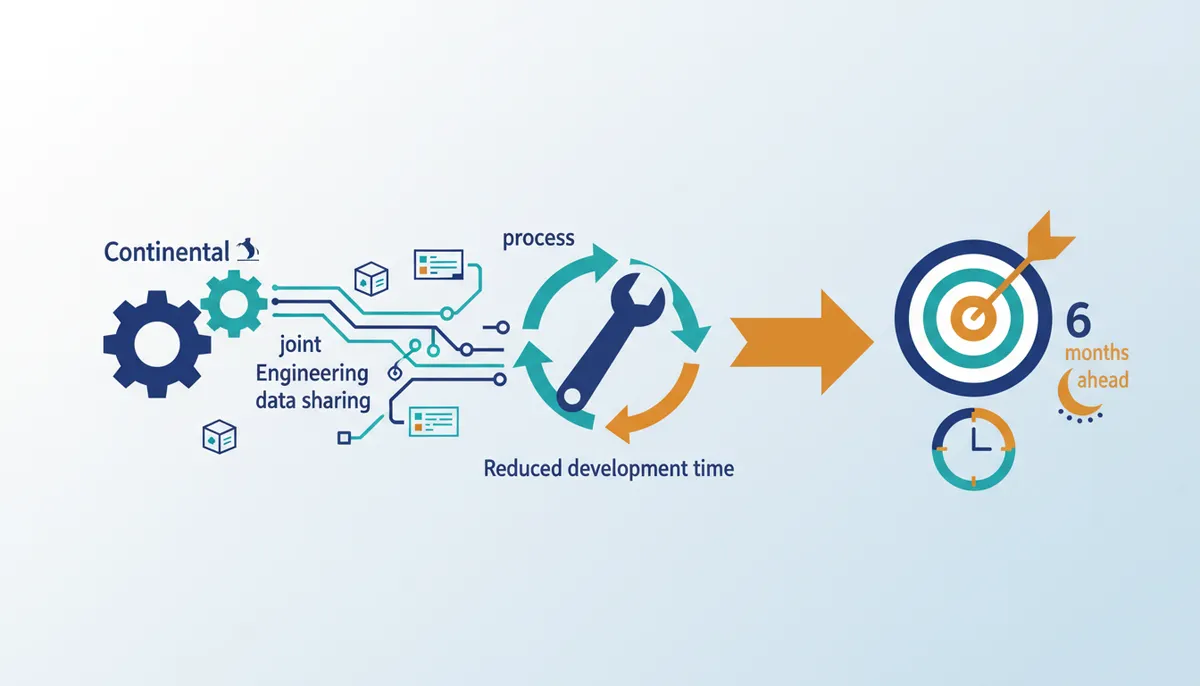
Continental's EcoContact 7 serves as the baseline architecture for a bespoke solution tailored to Renault Group specifications. Three distinct technical adjustments enable this performance gain: a specially modified tread compound, a customized sidewall design, and optimized tire construction. Balancing extreme efficiency with necessary safety grip creates the primary engineering tension. Lower resistance extends range, yet the friction required for effective braking cannot diminish. Virtual development methods, including driver-in-the-loop simulators, allow teams to evaluate tire characteristics under realistic driving conditions early in the process. This strategy accelerates the delivery of tailor-made tires that notably increase electric vehicle range. Energy consumption drops while the contact patch maintains performance necessary for stable handling.
Executing Joint Engineering for 30km Range Gains
Measurable range extensions emerge when OEMs and tire makers convert virtual simulation data into physical reality. A vehicle with a battery range of 500km gains an additional 30km per charge through this collaboration, covering roughly the distance from Paris to Versailles. Adapting the EcoContact 7 baseline drives these gains via three specific modifications: a specially modified tread compound, a customized sidewall design, and optimized tire construction. Driver-in-the-loop simulators evaluate characteristics under realistic conditions before physical prototyping begins. Such bespoke tire development meets strict efficiency targets without compromising safety metrics. The project integrated Continental's driver-in-the-loop simulator with Renault Group's Roads driving simulator to digitally replicate real-world driving conditions. Combining both systems allowed test scenarios to be replicated smoothly, accelerating development processes and reducing the need for physical test tires. Every kilowatt-hour stored in the battery pack delivers maximum utility in the final asset.
Validating Bespoke Requirements Against EU A-Rating Thresholds
Verification measures rolling resistance against the strict baseline for the EU tire label's top A rating. The bespoke tire development process targets performance notably below this standard threshold to guarantee genuine efficiency gains. Custom compounds exceed standard A-rating criteria rather than merely meeting them. Tires function as the only points of contact between the vehicle and the road, making them vital for safety. Friction generated between the tire tread and the asphalt provides the grip required for effective braking. Stable handling depends entirely on this interaction. Less energy is lost through natural deformation and friction as the tire rolls along the road when resistance decreases. Electric cars benefit directly since lower rolling resistance reduces energy consumption and extends driving range.
About
Anna Petrova is a B2B Auto Parts Market Analyst at KZMALL, where she specializes in market sizing and demand trends for the independent automotive aftermarket. Her daily work involves analyzing how technical innovations, such as rolling resistance improvements, impact global parts sourcing and fleet efficiency. Petrova connects these engineering breakthroughs to practical B2B implications, explaining how reduced energy loss translates to tangible range extensions for electric vehicles. At KZMALL, a global wholesale platform offering over 50,000 SKUs including JOYGROUND tires, she evaluates how such advancements shift procurement strategies for distributors and repair shops. By bridging the gap between OEM R&D and independent market needs, Petrova provides critical insights on how high-efficiency components influence the broader supply chain and vehicle maintenance economics.
Conclusion
Custom tire programs reveal a hard truth: digital validation cannot fix mismatched maintenance protocols. While custom compounds deliver efficiency, the bottleneck shifts to upkeep. If replacement cycles don't align with original deformation tolerances, range capabilities regress. Fleets must mandate strict adherence to the original tire specification used during homologation.
Start by auditing current inventory against the spec sheet before the next rotation. Verify stock levels match the customized sidewall designs and tread compounds required to maintain EU A-rating performance. Neglecting this turns a high-efficiency asset into a standard vehicle with premium costs. The value of digital simulation means nothing if physical upkeep reverts to legacy standards. Prioritize inventory accuracy to lock in the energy savings promised by advanced engineering.
Frequently Asked Questions
A 35% reduction adds roughly 30km to a 500km charge. This gain equals the distance from Paris to Versailles, proving that tire specification choices directly impact daily driving limits without battery changes.
Between 20% and 30% of total energy consumption stems from rolling resistance. Minimizing this loss preserves battery charge for propulsion rather than heat, making it a primary lever for extending electric vehicle range effectively.
Low rolling resistance tires must still provide friction for effective braking. Engineers balance efficiency gains with safety by optimizing tread compounds to ensure the tire-road interface maintains sufficient grip for stable handling during emergencies.
Virtual simulations replicate real-world scenarios to optimize characteristics digitally. Using driver-in-the-loop systems reduces the need for physical prototypes while ensuring the final product meets safety standards before any actual road testing occurs.
Manufacturers modify the tread compound, sidewall design, and construction. These changes achieve up to 35% lower rolling resistance than standard A-rating requirements by minimizing hysteresis within the rubber matrix while maintaining structural integrity.