
Pirelli Cinturato Gravel RH Cuts Rolling Resistance 17%
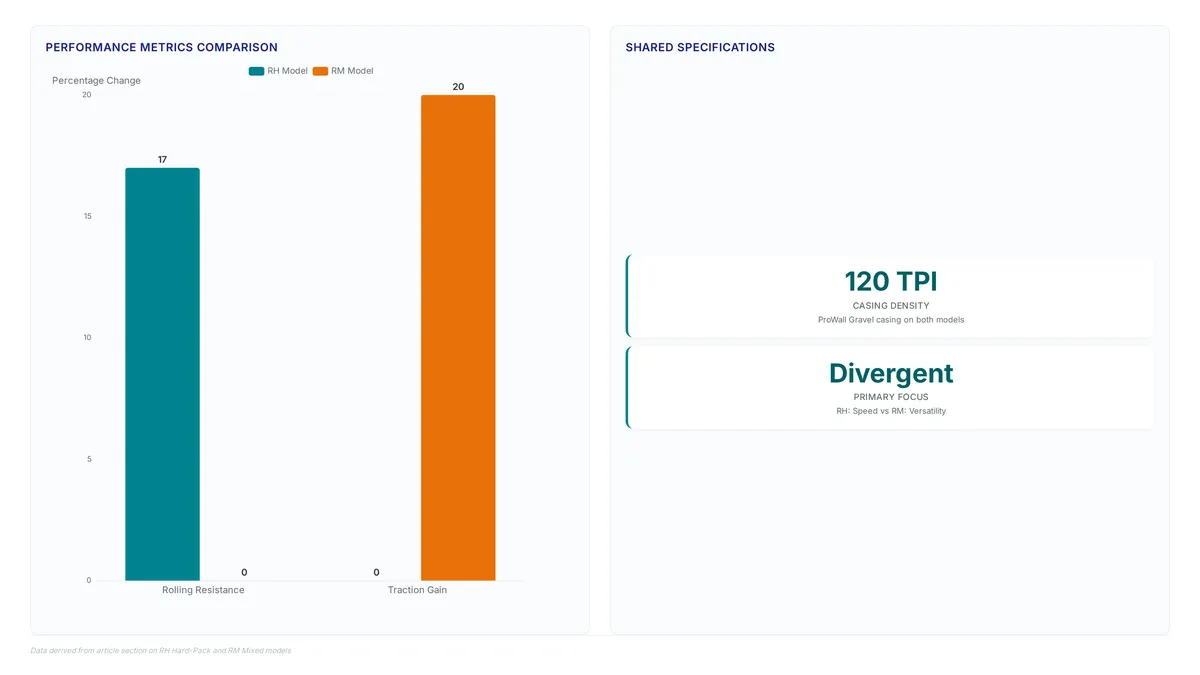
Pirelli's internal testing confirms the Cinturato Gravel RH delivers a 17% reduction in rolling resistance against equivalent Performance Line models. This tire does not attempt to be everything to everyone; it targets race-oriented efficiency through a design philosophy that prioritizes speed on hard-packed surfaces. The High-Performance Line addition leverages cross-country mountain biking expertise to redefine expectations for gravel racing rubber.
The SmartEvo GR compound balances wet and dry grip while maintaining the low resistance required for competitive riding. Below the tread, the 120 TPI ProWall Gravel casing architecture derives directly from Pirelli's XC racing tires to enhance puncture protection and ride feel. We also compare the RH model against the Cinturato Gravel RM, which offers a 20% rolling resistance improvement for riders needing versatility across mixed technical terrain.
Manufactured at the Milan-Bollate facility using FSC-certified natural rubber, these tires represent a calculated shift toward specialized performance tiers. The distinct nomenclature clarifies intent, with the R denoting race focus and the H specifying optimization for hard terrain conditions. Every component, from the slick center section to the pronounced shoulder knobs, serves a singular purpose for the competitive gravel rider.
Defining the Race-Oriented Design Philosophy of Pirelli's New Gravel Range
Decoding Pirelli's R, H, and M Nomenclature System
Speed drives the construction logic behind the letter R found in the manufacturer's off-road portfolio. This designation marks equipment built for competitive riders who need maximum efficiency on specific course profiles. Hard surfaces demand the H suffix, whereas M signals optimization for Mixed terrain conditions where variables change rapidly. These codes govern the new Cinturato Gravel RH and Cinturato Gravel RM models launched by Pirelli.
Selecting the wrong suffix creates a mismatch that hinders performance on loose or technical ground. A cyclist choosing the RH variant gains a tire engineered for fast, hard-packed tracks where low rolling resistance dictates race outcomes. The RM model instead addresses fluctuating course conditions where consistent grip outweighs pure velocity. Compound selection creates a distinct tension; a tire built for hard ground often lacks conformity in mud, while a mixed-terrain option may roll too slowly on smooth hardpack. Riders must match the suffix to the dominant track characteristic rather than an average of all conditions. Such precise labeling allows the High-Performance Line to deliver predictable behavior aligned with specific race demands.
Manufacturing Origins of the Cinturato Gravel RH and RM
Production takes place at the Milan-Bollate facility, placing the Cinturato Gravel RH and Cinturato Gravel RM firmly within Pirelli's Italian manufacturing network. These models belong to the premium High-Performance Line (HP-Line), a tier separated from the standard Performance Line by its exclusive use of motorsport-derived engineering and FSC-certified natural rubber. Concentrating production in one location helps design intent translate directly into physical output.
Measurable efficiency gains distinguish HP-Line tires from their standard counterparts. Internal testing reveals the RH model achieves a 17% reduction in rolling resistance compare valent, while the RM variant delivers a 20% improvement. Such deltas indicate that the HP-Line construction uses the latest-generation SmartEvo GR compound to combine low rolling resistance with reliable grip. This formulation helps balance speed, efficiency, and control across a wide range of surfaces, differentiating it from the baseline performance of the standard line.
| Feature | HP-Line (RH / RM) | Performance Line |
|---|---|---|
| Primary Focus | Race efficiency | Baseline performance |
| Rubber Source | FSC-certified | Standard blend |
| Rolling Resistance | Significantly lower | Baseline |
| Design Origin | Motorsport derived | General purpose |
Buyers weighing immediate speed against specific riding requirements face a clear choice. Reliance on specialized compounds and specific tire manufacturing protocols at the Italian plant ensures consistency for competitive applications. This production approach positions the HP-Line as a high-specialization product segment designed for performance-focused riders.
HP-Line Gravel Tires Versus Standard Performance Models
Casing density and compound derivation separate the HP-Line from standard Performance Line offerings. Development uses specific expertise gained in motorsport and cross-country mountain biking to define this tier. The 120 TPI casing, derived directly from XC racing tires, prioritizes ride feel and precise handling. This construction difference creates a tangible gap in rolling efficiency between the two product lines.
Cyclists choosing the standard line may prioritize different attributes than those required for competitive events. The limitation is clear: the race-oriented architecture uses a 120 TPI ProWall Gravel casing to contribute to ride feel, enhanced puncture protection, and precise handling, whereas standard models apply different construction parameters. This distinction means the High-Performance Line serves athletes needing every watt saved, while casual riders may prefer the construction of the standard range. The Cinturato Gravel RH exemplifies this focused approach by featuring a fully slick center section to maximize contact patch and rolling efficiency on hard-pack. Conversely, the Cinturato Gravel RM applies similar logic to mixed variables with a proven tread pattern previously known as RC. Operators must decide if their course profile demands the efficiency of the HP-Line or the durability of the standard option.
Analyzing the SmartEvo GR Compound and 120 TPI Casing Architecture
SmartEvo GR Compound Mechanics for Wet and Dry Grip
Pirelli formulated the SmartEvo GR compound to deliver reliable grip in wet and dry conditions while keeping rolling resistance low. This chemical architecture targets the conflicting needs of speed and traction on variable gravel terrain. The material eliminates the need for riders to select different compounds based on weather forecasts, as it performs consistently across changing surfaces. Engineers tuned this blend specifically for high-performance gravel riding rather than single-condition extremes. Such optimization prevents unnecessary energy loss while maintaining the contact patch adherence required for cornering stability. Consistency over long distances across mixed surfaces becomes the primary benefit of this approach. Internal testing validates the efficiency gains derived from this specific chemical makeup.
120 TPI ProWall Casing Benefits on Hard-Pack Terrain
Construction derived from Pirelli's XC racing tires translates cross-country architecture into tangible efficiency gains on hard-pack surfaces. The 120 TPI ProWall Gravel casing contributes to ride feel, enhanced puncture protection, and precise handling. Tarmac connectors often elevate rolling resistance, yet this design helps maintain consistent control and a smooth, balanced ride. Optimizing the contact patch shape under load directly addresses resistance problems on paved sections. FSC-certified natural rubber integrates sustainability with performance within the tire matrix. This sourcing ensures the premium tire line maintains environmental standards without compromising structural integrity required for race-oriented duties. Racing-derived geometry combines with sustainable materials to create a specific profile for the High-Performance Line (HP-Line) designed and manufactured in Italy. The 120 TPI density contributes to the precise handling characteristics expected from a race-oriented tire.
| Feature | Benefit | Constraint |
|---|---|---|
| 120 TPI Density | Precise handling | Derived from XC racing architecture |
| ProWall Tech | Puncture resistance | Part of HP-Line design |
| FSC Rubber | Sustainable sourcing | Sourced from certified suppliers |
A responsive platform emerges where every watt counts through the use of this casing in the Cinturato Gravel RH. The casing dictates how grip is delivered to the ground while the SmartEvo GR compound manages surface adhesion. Acceleration feels immediate with the 120 TPI structure supporting the tire's focus on speed and efficiency. Race-derived casings offer distinct advantages for speed-focused riders on maintained trails according to this architecture.
Cinturato RH Versus RM Rolling Resistance Reduction Metrics
A fully slick center section minimizes energy loss on tarmac for the Cinturato Gravel RH, directly addressing rolling resistance problems on hard surfaces. This design maximizes the contact patch for efficiency where the Cinturato Gravel RM relies on a proven tread pattern previously known as RC for mixed terrain versatility. Both models integrate the SmartEvo GR compound to balance speed with grip across variable conditions.
| Feature | Cinturato Gravel RH | Cinturato Gravel RM |
|---|---|---|
| Primary Terrain | Hard-pack and fast tracks | Mixed and technical rough trails |
| Center Tread | Fully slick for efficiency | Proven pattern (ex-RC) for balance |
| Shoulder Design | Pronounced knobs for grip | Stabilized for cornering control |
| Casing Type | 120 TPI ProWall Gravel | 120 TPI ProWall Gravel |
Pure speed on paved connectors drives the RH configuration with its fully slick center section to maximize rolling efficiency. The RM model sacrifices marginal tarmac efficiency to maintain dependable traction under acceleration on loose surfaces. Riders must choose between maximizing tarmac velocity or ensuring stability on unpredictable technical sections given this distinction. The 120 TPI ProWall Gravel casing supports both approaches by providing a consistent foundation derived from XC racing tires. Linear speed favors the RH while the RM offers broader adaptability for courses demanding frequent transitions between surface types. Selection ultimately depends on whether the race profile favors consistent hard-pack velocity or variable terrain mastery.
Comparing Terrain Suitability Between the RH Hard-Pack and RM Mixed Models
Tread Architecture: Slick Center RH vs Proven RC Pattern
The Cinturato Gravel RH employs a fully slick center section to maximize the contact patch on hard-packed surfaces. This low-drag profile serves riders prioritizing pure speed on consolidated gravel or during tarmac transitions. The Cinturato Gravel RM takes a different approach by using a proven tread pattern previously known as RC, which delivers a necessary balance between grip and rolling efficiency for mixed terrain. Distinct block arrangements on the RM ensure cornering stability alongside dependable traction under acceleration and braking across loose and mixed surfaces. Both tires incorporate the latest-generation SmartEvo GR compound, a formulation developed specifically to combine low rolling resistance with reliable grip in both wet and dry conditions. Performance Line |
Engineers designed these specific tread patterns to address divergent surface requirements, with the RH focusing entirely on speed and the RM targeting versatility across loose and mixed surfaces.
Terrain Selection: Fast Hard-Pack Efficiency vs Technical Mixed Grip
This configuration excels on consolidated surfaces where efficiency is paramount. Riders tackling a mix of fast tracks and more technical, rougher terrain find a versatile solution in the Cinturato Gravel RM. The RM uses pronounced shoulder knobs and specific design elements ensuring cornering stability under acceleration across mixed terrain.
Pure speed contrasts sharply with versatile control in this pairing. The SmartEvo GR compound helps balance speed, efficiency, and control across a wide range of surfaces for both models. Matching tire architecture to actual course demands becomes straightforward with this distinction. The RH prioritizes momentum preservation on hard surfaces, while the RM balances drag reduction with traction for variable tracks. Riders select the model aligning best with their specific terrain requirements, supported by the 120 TPI ProWall Gravel casing derived from XC racing tires for enhanced puncture protection and precise handling in both options. Each tire brings 120 threads per inch to the ride quality equation.
Selecting the Optimal Tire Configuration for Race Performance and Mixed Terrain
Application: Defining Hard-Pack Efficiency and Mixed Terrain Versatility
Hard-pack efficiency describes surfaces where the Cinturato Gravel RH maximizes speed through a fully slick center section. The operational definition here prioritizes low hysteresis over aggressive biting edges, suiting riders who encounter firm fire roads or dry, compacted tracks. Mixed terrain versatility conversely defines the domain of the Cinturato Gravel RM, which balances grip across loose and technical sections. The distinction lies in shoulder engagement: the RM relies on its specific tread design to penetrate variable substrates, delivering dependable traction under acceleration and braking across loose and mixed surfaces.
| Feature | Hard-Pack Focus (RH) | Mixed Terrain Focus (RM) |
|---|---|---|
| Center Tread | Fully slick for contact patch | Balanced block pattern |
| Primary Goal | Minimum rolling resistance | Grip consistency |
| Surface Type | Compressed, dry, firm | Loose, technical, variable |
The RH model is engineered specifically for hard-packed and fast terrain where efficiency is paramount. In contrast, the RM serves as a versatile option for riders tackling a mix of fast tracks and more technical, rougher terrain without sacrificing speed. The RM uses a proven tread pattern previously known as RC, which delivers a balance between grip and rolling efficiency.
Applying Slick Center Treads vs RC Patterns to Course Conditions
Race applications matching tire architecture to surface hardness often prioritize the fully slick center section for tarmac-heavy stages. This design maximizes the contact patch on compressed surfaces, eliminating the vibration and energy loss associated with knobby treads on pavement. Riders facing courses with significant paved connectors benefit from this specific geometry, as it maintains momentum where aggressive patterns induce drag. Conversely, loose surface traction demands the proven RC pattern found on the mixed-terrain variant. This configuration balances grip and speed, providing the biting edges necessary for acceleration on gravel while retaining stability during braking. A tension exists between pure speed and technical control; the RH features pronounced shoulder knobs for added grip, while the RM ensures cornering stability across loose and mixed surfaces. The 120 TPI ProWall Gravel casing supports both patterns, yet the tread choice dictates the operational envelope. While the RH focuses on hard-packed efficiency, the RC pattern offers a balanced approach for variable conditions, ensuring dependable traction under acceleration and braking.
| Feature | Slick Center (RH) | RC Pattern (RM) |
|---|---|---|
| Primary Surface | Tarmac/Hardpack | Mixed/Loose |
| Tread Design | Continuous center rib | Discrete blocks |
| Efficiency Focus | Maximum | Balanced |
Verifying course profiles before finalizing wheel builds helps ensure the selected tire matches the intended terrain.
Tire Selection Checklist: Balancing 120 TPI Casing and Shoulder Knob Grip
Riders must evaluate course surface characteristics before selecting between the hard-pack optimized Cinturato Gravel RH and the versatile mixed-terrain model. This decision dictates whether maximum speed or cornering stability becomes the primary performance metric for the upcoming event. The 120 TPI ProWall Gravel casing provides a consistent structural baseline, yet the tread geometry creates divergent handling characteristics on loose versus compressed surfaces.
- Assess if the route consists primarily of tarmac or hard-packed fire roads to justify the fully slick center section.
- Determine if technical corners require the pronounced shoulder knobs found on the RH for added grip.
- Verify that the selected SmartEvo GR compound meets the need for reliable grip in both wet and dry conditions while maintaining low rolling resistance.
- Confirm wheel clearance allows for the broader ETRTO 55-622 sizing available in the mixed-terrain variant.
Prioritizing the wrong tread pattern sacrifices momentum on straightaways or traction in deep ruts. The trade-off is binary: efficiency on firm ground compromises bite in mud, while aggressive treads induce drag on pavement. Understanding this tension ensures the shoulder knob grip aligns with specific course demands rather than general assumptions. Matching tire architecture to the dominant surface type maximizes race-day performance.
About
Dmitry Volkov serves as a Senior Automotive Technical Writer at KZMALL Auto Parts, where he specializes in translating complex engineering specifications into actionable industry insights. His daily work involves rigorous analysis of manufacturing processes, material standards, and component performance across KZMALL's extensive catalog, including the JOYGROUND tire line. This technical expertise makes him uniquely qualified to evaluate Pirelli's new Cinturato Gravel RH and RM models. By using his deep understanding of tire construction, from FSC-certified rubber sourcing to motorsport-derived tread designs, Dmitry provides a precise breakdown of how these Italian-made tires meet high-performance demands. His role requires constant evaluation of global supply chains and product quality, allowing him to connect Pirelli's advanced production at the Milan-Bollate facility to the practical needs of professional distributors and repair shops. Through this lens, he delivers factual, technically sound analysis necessary for B2B stakeholders navigating the evolving gravel tire market.
Conclusion
Scaling from single-race selection to season-long logistics reveals that maintaining two distinct tire inventories creates unnecessary operational drag for teams and retailers alike. Riders often overestimate the frequency of pure tarmac sections, leading to choices that sacrifice safety in technical corners for marginal straight-line speed. This mismatch becomes critical when weather conditions alter surface traction unexpectedly during an event.
Commit to a single-tire strategy based on the dominant terrain of your primary racing calendar rather than hoping for ideal conditions. If your schedule includes more than thirty percent loose or muddy sectors, the mixed-terrain architecture provides a safer performance floor without catastrophic efficiency losses. Only deploy the specialized hard-pack model when course data confirms sustained firm surfaces where aerodynamic drag outweighs grip requirements.
Start by mapping the surface composition of your next three target events to calculate the actual percentage of tarmac versus loose gravel. Use this data to validate whether the efficiency benefits of a slick center truly outweigh the versatility of a block pattern before purchasing additional wheels or tires.
Frequently Asked Questions
The RH model rolls significantly faster than standard equivalents. Internal testing confirms a 17% reduction in rolling resistance, allowing racers to maintain higher speeds on hard-packed courses with less effort.
Riders gain substantial efficiency improvements with the versatile RM variant. Tests show a 20% reduction in rolling resistance compared to the standard line, benefiting those tackling mixed technical terrain.
Select the RH model specifically engineered for hard and fast terrain. It delivers a 17% rolling resistance drop versus standard tires, ensuring maximum speed where grip demands are lower.
The RM model balances grip and speed effectively for varied courses. It achieves a 20% rolling resistance improvement over standard options, proving versatility does not require accepting slow performance.
The compound ensures reliable grip across both wet and dry surfaces.