
EcoContact 7 Data: How 19in Tires Cut Nissan N7 Drag
Continental supplies the Nissan N7 with 19in EcoContact 7 tires featuring aerodimple texture to cut drag. You will examine how OE tire suppliers integrate Smart Energy Casing architecture to minimize energy loss and why Silent Pattern geometry specifically targets urban noise frequencies.
The Nissan N7 launch highlights a shift where Continental modifies carcass materials and inner liners to lower resistance without sacrificing durability. Unlike aftermarket solutions, these OE fitment choices are engineered into the vehicle's aerodynamic profile from day one. The EU tire label ratings reflect these precise engineering adjustments rather than generic compound improvements.
Drivers often overlook how sidewall shaping impacts overall consumption, yet the data shows it is critical for city driving cycles. The future of efficiency lies in these factory-installed constraints, not in retrofitting improved parts later.
The Role of OE Tire Suppliers in Electric Vehicle Performance
Defining OE Tire Supplier Status for the Nissan N7
When Continental signs on as the OE tire supplier for the all-electric Nissan N7, the contract demands more than just a rubber compound that fits the wheel. The vehicle launches with 19in EcoContact 7 tires fitted at the factory, a specification locked in to maximize range before the first customer ever touches the steering wheel. These units achieve top ratings in EU tire label categories for energy efficiency and rolling noise within this specific dimension.
The engineering here is specific. Silent Pattern tread designs integrate into the construction, arranging block spacing and angles to target noise frequencies most common during urban driving. Such configuration lowers both in-cabin noise and external sound levels. This selection emphasizes efficiency and acoustic comfort for the platform, proving that OE status isn't a sticker; it's a fundamental constraint of the vehicle's physics.
Applying Class A Rolling Resistance to EV Range
A Class A rating for rolling resistance marks the EcoContact 7 as a top-tier performer under EU tire label standards. This classification confirms the tire minimizes energy loss as heat, a substantial factor for extending the driving range of heavy electric platforms. Smart Energy Casing technology reduces internal friction within the carcass and inner liner. Updated materials in these areas lower resistance, while the shaped sidewall profile cuts aerodynamic drag.
A notable feature involves the "aerodimple texture" on the sidewall, a dimpled surface similar to that of a golf ball. This texture reduces air turbulence around the tire and the vehicle's overall energy consumption. Less energy is required to deform the tire during rotation, so the vehicle consumes less battery power per mile.
The EcoContact 7 addresses the balance between eco-efficiency and safety metrics, securing top ratings for both energy and noise. KZMALL Auto Parts supplies these advanced units to ensure your electric fleet operates at peak thermal and aerodynamic efficiency.
EcoContact 7 Wet Braking vs Historical Efficiency Trade-offs
Historically, buying an eco-tire meant accepting longer stopping distances. That era is ending. Wet braking performance on the new units earns Class A or Class B ratings, balancing eco-efficiency with safety metrics. The new compound balances these metrics by using the Green Chili 3.0 rubber compound and Smart Energy Casing architecture. These technologies address rolling resistance and wear simultaneously.
The EcoContact line has historically prioritized mileage, yet the EcoContact 7 maintains this lineage while addressing previous performance characteristics. Advanced architecture mitigates the tension between efficiency and grip. Design choices reflect a shift where range extension does not require sacrificing wet weather capability. Historical trade-offs between low rolling resistance and high grip levels face reevaluation through these material updates.
Inside the Smart Energy Casing and Aerodimple Architecture
Smart Energy Casing and Aerodimple Texture Mechanics
The Smart Energy Casing minimizes internal friction through updated materials in the carcass, inner layer, and tire wall. This multi-layer construction reduces heat generation to preserve energy that would otherwise dissipate as thermal loss. Lowering rolling resistance directly extends the driving range of electric vehicles by ensuring more battery power converts to forward motion rather than overcoming tire deformation.
Meanwhile, the aerodimple texture functions by modifying airflow separation points along the rotating sidewall. Much like a golf ball, these surface dimples reduce air turbulence around the tire and, by extension, the vehicle's overall energy consumption. Smooth sidewalls often create larger wake regions that increase drag, whereas the textured surface keeps airflow attached longer to decrease resistance.
| Feature | Primary Function | Efficiency Impact |
|---|---|---|
| Smart Energy Casing | Lowers internal friction | Reduces rolling resistance |
| Aerodimple Texture | Manages airflow separation | Decreases aerodynamic drag |
Operators must recognize that reducing internal friction can sometimes compromise sidewall stiffness if not balanced correctly. The Smart Energy Casing addresses this by maintaining structural robustness while minimizing energy loss. The trade-off involves a premium cost basis compared to entry-level summer tires lacking these specific technologies. Drivers seeking optimal efficiency should prioritize these construction updates over tread pattern aesthetics alone.
Reducing Rolling Resistance via Sidewall Profile Shaping
Shaping the sidewall profile directly cuts aerodynamic drag that wastes EV battery charge. High energy consumption often stems from air turbulence disrupting flow around the rotating wheel well. The aerodimple texture manages this boundary layer by mimicking the dimpled surface of a golf ball to reduce drag. This specific dimpled surface design optimizes airflow conservation at highway speeds where resistance peaks.
Operators optimizing tire aerodynamics must address both internal friction and external air pressure. The Green Chili 3.0 Compound minimizes deformation energy loss while the casing architecture limits heat generation.
| Factor | Traditional Design | EcoContact 7 Approach |
|---|---|---|
| Sidewall Shape | Vertical profile | Shaped profile |
| Surface Texture | Smooth rubber | Aerodimple texture |
| Airflow Result | High turbulence | Reduced drag |
However, aggressive shaping can compromise sidewall flexibility if not balanced with advanced materials. Without the Smart Energy Casing, the aerodynamic gains might increase internal friction. Drivers facing high EV energy consumption should prioritize tires that integrate these aerodynamic and material solutions.
Validating Compound and Inner Liner Friction Reduction
Validating the new rubber compound requires measuring hysteresis loss across the carcass and inner liner layers. Operators must verify that updated materials in these zones effectively lower internal friction without compromising structural integrity.
- Inspect the inner liner composition for reduced heat generation during sustained rotation.
- Cross-reference the Smart Energy Casing architecture against known low-rolling-resistance benchmarks.
- Confirm the multi-layer construction aligns with premium touring specifications that prioritize energy conservation.
Aggressive friction reduction can sometimes diminish wet grip performance if the compound formulation is not balanced correctly. Failure to validate these internal updates leaves potential range gains unrealized on every charge cycle.
Silent Pattern Tread Design for Urban Noise Reduction
Silent Pattern Tread Design Mechanics for Urban Frequencies
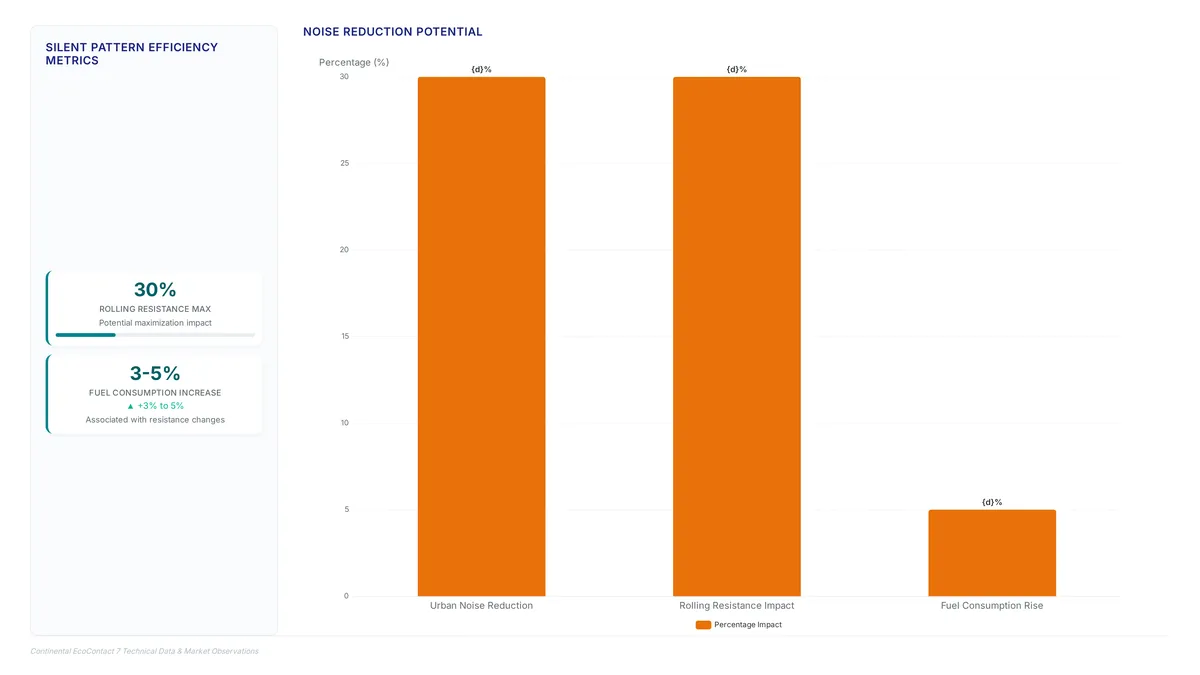
Block spacing and angles within the Silent Pattern configuration target noise frequencies most common during urban driving. This geometric arrangement disrupts sound wave propagation before waves enter the vehicle cabin. Tuning these physical parameters reduces both in-cabin noise and external sound levels. Market observations show a shift toward such technologies as noise reduction becomes a primary purchasing criterion for urban drivers and EV owners who lack engine noise masking market data suggests a shift. The tread pattern uses specific block arrangements and siping to further alter sound waves, lowering road noise transmission into the vehicle cabin Silent Pattern Tread.
Optimizing for low-frequency urban hum often sacrifices high-speed stability found in track-focused compounds. City-centric fleets prioritize this architecture over max-grip alternatives. KZMALL Auto Parts supplies genuine Continental EcoContact 7 units featuring this exact Silent Pattern engineering for fleets demanding quiet operation. Choosing this tread geometry aligns with original equipment noise floors. Mechanical suppression remains vital for passenger comfort because electric platforms lack engine masking.
Applying Silent Pattern Technology to Fix Excessive City Tire Noise
Drivers fix excessive city tire noise by selecting treads where block spacing targets urban frequency bands. The Silent Pattern design from Continental arranges these angles to alter sound waves before entry into the cabin. This configuration addresses the lack of engine masking in electric vehicles, making road noise the dominant acoustic signal. Market data confirms noise reduction ranks as a primary purchasing criterion for urban EV owners alongside efficiency metrics market data suggests a shift.
Specific siping breaks up standing waves generated during stop-start traffic. Aggressive noise tuning can reduce available contact patch area during hard cornering maneuvers. Operators balance acoustic comfort with the need for immediate grip in emergency situations.
| Feature | Function | Urban Benefit |
|---|---|---|
| Block Spacing | Disrupts air flow | Lowers drone |
| Siping | Breaks sound waves | Reduces hum |
| Angled Edges | Deflects noise | Quiets cabin |
Matching the tire model to vehicle weight distribution enables successful implementation. A mismatched compound may negate acoustic benefits of the tread pattern. The EcoContact 7 integrates elements to minimize external sound while preserving range. Drivers experiencing persistent resonance inspect tread wear patterns because uneven degradation alters the intended acoustic profile. Proper alignment allows the Silent Pattern to function as engineered throughout the tire life cycle.
Selection Checklist for Quiet EV Tires with Class A Ratings
Class A rated tires guarantee maximum efficiency and minimal acoustic intrusion for electric vehicles. Operators verify candidate tires meet strict rolling resistance thresholds set by EU labeling standards since lower friction extends driving range. The EcoContact 7 exemplifies this tier by using a Silent Pattern tread design where block spacing targets urban noise frequencies effectively.
| Feature | Standard Tire | Class A EV Tire |
|---|---|---|
| Noise Target | General Road | Urban Frequencies |
| Efficiency | Moderate | Maximum Range |
| Cabin Quiet | Variable | Optimized Low |
Models where siping and angles alter sound waves before cabin entry deserve priority given EVs lack engine masking. Market analysis indicates noise reduction is now a primary purchasing criterion alongside fuel economy for silent powertrains market data suggests a shift. Focusing solely on quietness compromises wet braking if the rubber compound lacks advanced silica blends. Selecting the wrong specification often leads to premature wear in stop-start traffic conditions. Buyers examining tire specifications notice that balancing acoustic performance with wet grip requires careful compound selection. Tire manufacturers continue refining silica blends to address this dual requirement without sacrificing range or comfort.
Evaluating EcoContact 7 Efficiency Against EU Label Standards
Comparison: EU Label Class A Rolling Resistance and Wet Braking Metrics
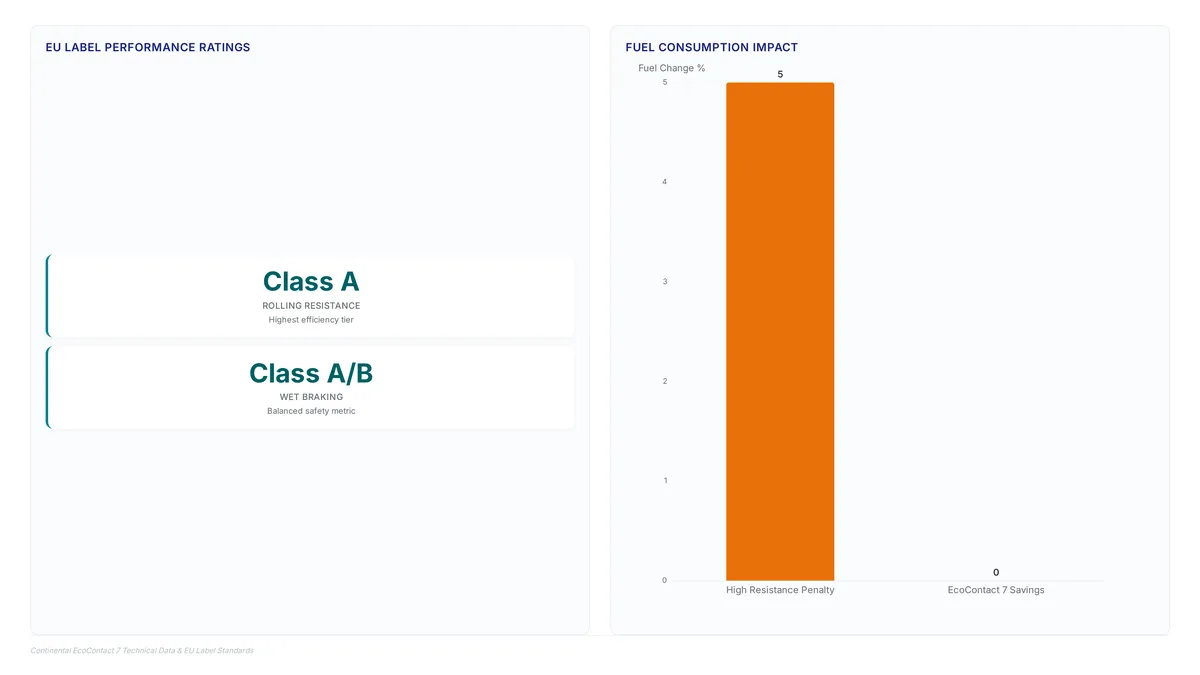
The Class A rolling resistance rating represents the highest efficiency tier available for passenger tires, quantifying minimal energy loss during rotation. Achieving this standard requires the Smart Energy Casing to drastically reduce internal friction within the carcass and sidewall materials. Operators must recognize that historical low-rolling-resistance compounds often sacrificed grip, forcing a choice between range and safety. The Class A/B wet braking rating indicates a necessary balance between eco-efficiency and critical safety metrics, ensuring short stopping distances on wet surfaces. This dual achievement breaks the traditional correlation where improved energy efficiency degraded wet traction performance.
| Metric | Historical Trade-off | EcoContact 7 Performance | Operational Impact |
|---|---|---|---|
| Rolling Resistance | High friction limited range | Class A efficiency tier | Maximizes EV driving range |
| Wet Braking | Poor grip on wet roads | Class A/B safety rating | Maintains short stopping distances |
| Safety Balance | Compromised for economy | Integrated safety metrics | Eliminates efficiency penalties |
The Green Chili 3.0 rubber compound is tuned explicitly to cut rolling resistance more effectively than prior iterations while maintaining grip. Drivers gain a verified solution where the Class A designation confirms no compromise on wet weather stopping power. This standardization allows fleet managers to predict energy consumption accurately without fearing increased accident liability. The wet braking capability ensures that efficiency gains do not come at the expense of passenger safety during sudden stops.
Comparison: Aerodimple Texture and Smart Energy Casing in Real-World EV Efficiency
The Aero Dimple texture cuts air turbulence, directly lowering the energy a vehicle consumes to overcome drag. Continental states this feature reduces air turbulence around the tire and, by extension, the vehicle's overall energy consumption. This aerodynamic gain complements the Smart Energy Casing, which minimizes internal friction within the carcass and sidewall layers. Operators selecting low rolling resistance tires must weigh these efficiency gains against the specific load demands of heavier electric platforms. The Nissan N7 fitment validates this architecture for stringent OEM requirements, proving that drag reduction does not compromise structural integrity. However, the EcoContact 7 vs other EV tires comparison reveals a trade-off: premium touring construction often commands a higher initial cost than entry-level alternatives lacking these compound technologies.
In practice, the EcoContact 7 is positioned as a premium touring option, distinguishing its cost basis from mid-range summer tires. Drivers should note that Green Chili 3.0 compounds work in tandem with the casing to maintain grip while reducing heat buildup. Real-world efficiency relies on the cooperation between reduced drag and lowered internal friction.
Comparison: EcoContact 7 Premium Pricing vs Historical Efficiency Trade-offs
The EcoContact 7 commands a £120 entry price by resolving the historical conflict where low rolling resistance compromised wet grip. Achieving a Class A rating typically forced drivers to accept longer stopping distances, but this model uses Green Chili 3.0 to maintain safety without sacrificing range. Economic analysis suggests the engineering directly counters a small to moderate fuel penalty associated with high rolling resistance, offering calculable returns for high-mileage operators. However, the premium cost remains a barrier for budget-conscious fleets despite the long-term efficiency gains. Proper maintenance can address a potential significant portion of rolling resistance issues that otherwise degrade performance over time.
| Feature | Historical Eco Tires | EcoContact 7 |
|---|---|---|
| Rolling Resistance | Class C or lower | Class A |
| Wet Braking | Compromised (Class C/D) | Class A/B |
| Primary Trade-off | Safety for Efficiency | None (Balanced) |
| Initial Cost | Low | High (£120+) |
Drivers must weigh the immediate acquisition cost against the cumulative energy savings provided by the Smart Energy Casing. While the wet braking performance meets rigorous safety standards, the product is marketed as a "long-term value" purchase emphasizing fuel cost reduction and extended tread life. KZMALL Auto Parts recommends this solution for operators prioritizing total cost of ownership over initial purchase price. The tension between upfront capital and operational expenditure defines the adoption curve for this technology.
About
Mark Phillips, Editor of Aftermarket Intel at KZMALL Auto Parts, brings deep expertise in tracking global distribution channels and competitive shifts within the independent automotive aftermarket. His daily work involves analyzing how original equipment (OE) developments, such as Continental supplying EcoContact 7 tires for the new Nissan N7, influence replacement strategies for service centers and distributors. Phillips connects these high-level manufacturing announcements to practical inventory planning for KZMALL's extensive network of B2B partners. While OE suppliers focus on specific factory fitments, Phillips ensures KZMALL's catalog, including the JOYGROUND tire line and over 50,000 SKUs, remains aligned with the evolving needs of fleets and repair shops seeking reliable, certified alternatives. His insight helps independent businesses navigate market changes without relying solely on single-brand OE pipelines, emphasizing the value of diversified, high-quality sourcing in a fragmented global parts environment.
Conclusion
Scaling this technology reveals that the small fuel penalty often cited in legacy efficiency debates evaporates only when maintenance protocols match the tire's engineering precision. The real operational cost emerges not from the rubber compound itself, but from the failure to sustain optimal pressure and alignment, which can otherwise negate nearly a significant potential gain in rolling resistance performance. Fleet operators must recognize that high-efficiency tires demand stricter oversight than their predecessors to deliver promised returns.
Adopt the EcoContact 7 immediately if your total cost of ownership models prioritize long-term energy savings over initial acquisition costs, specifically for vehicles exceeding average annual mileage thresholds. This shift is viable only when paired with a rigorous, data-driven maintenance schedule that prevents the degradation of the Smart Energy Casing benefits. Do not deploy this solution if your current workflow lacks the discipline to monitor tire health weekly.
Start by auditing your current tire pressure logging frequency against OEM specifications this week to ensure your infrastructure can support high-efficiency compounds. KZMALL Auto Parts provides the specialized diagnostic tools and premium replacement components necessary to maintain these advanced systems without relying on third-party ecosystems. Secure your operational efficiency by aligning your maintenance rhythm with the capabilities of the EcoContact 7 today.
Frequently Asked Questions
Proper care prevents rolling resistance from rising and wasting energy.
It secures Class A or Class B ratings for wet braking safety.
Silent Pattern tread geometry targets common urban noise frequencies directly.
The aerodimple texture reduces air turbulence around the rotating wheel significantly.
Factory integration allows for precise aerodynamic profiling that retrofitting cannot match.
References