
Fitment Intelligence: Mapping 5M Parts Right
The average U. S. Vehicle age hitting 12.8 years proves fitment data is the aftermarket's only viable infrastructure.
Without this shift, the sector remains paralyzed by a data crisis where millions of parts are effectively invisible to modern commerce engines. You will learn how agentic AI is fundamentally altering discovery by 2027, with Google predicting agents will proactively seek compatible products rather than waiting for passive search queries. We will also examine why current manual cataloging methods fail to capture complex variables like trim and engine type, rendering traditional databases obsolete.
Finally, the analysis details how to build a fitment intelligence system capable of eliminating the costly returns that currently plague retailers. As noted in recent marketing predictions from Google, the era of simple keyword matching is ending; AI agents now require precise, machine-readable attributes to function. Motormia's approach of rebuilding the data layer from the ground up demonstrates that without accurate compatibility checks, consumer confidence in aftermarket parts, which often cost half as much as OEM equivalents, will never fully materialize. The path forward requires treating data not as an administrative burden, but as the core product itself.
The Critical Role of Structured Fitment Data in Modern Commerce
Defining Structured Fitment Data and ACES Standards
Structured fitment data resolves the "will it fit" question across a $300 billion market by mapping parts to spec. Precise attribute alignment replaces generic make-model matching because fitment hinges on Year, Trim, Engine type, and Transmission. Aftermarket Catalog Exchange Standard protocols structure these relationships so retailers avoid inconsistent catalog data that drives returns. Inventory stays invisible to search engines and AI systems without such standards for machine-readable attributes.
VCdb 2.0 updates arrive March 26, 2026 to unify databases and prevent listing suppression. Data quality now rivals product quality in commercial importance as compliance with evolving standards becomes mandatory. Static fitment models fail to account for vehicle modifications over time, creating gaps even in certified databases. Operators must treat fitment as a flexible intelligence layer rather than a fixed catalog to capture real-world compatibility. This shift reduces the hidden costs of mismanagement detailed in parts connectivity reports while enabling scalable commerce.
Motormia's proprietary digital knowledgebase resolves fitment ambiguity by mapping 5 million parts against 75,000+ vehicle configurations. This scale transforms static attributes into a flexible intelligence layer capable of validating complex compatibility chains that standard databases miss. The system cross-references engine displacement, transmission type, and trim levels to generate over 50 million fitment records, ensuring precision where generic catalogs fail.
Enthusiast-level build data enters the equation unlike legacy ACES files that treat fitment as fixed. Competitors often lack the granular combinations required for modified vehicles, creating blind spots in search results. Motormia aggregates these community sources to capture real-world variations. The sheer volume of unstructured legacy data still held by smaller distributors remains a limitation. Their inventory stays invisible to algorithmic discovery engines without digitization. Misidentified parts erode margins quicker than data migration expenses cost. Retailers must verify that their providers apply thorough fitment records rather than superficial matches. Accuracy determines whether a part sells or sits on a shelf. Search engines cannot index items lacking machine-readable tags for potential buyers. Incorrect fitment details trigger unnecessary returns that create hidden expenses from data mismanagement. ACES/PIES standards help the industry categorize parts accurately across fragmented distributor catalogs. Compatibility matrices remain broken without these protocols, causing shoppers to abandon carts due to uncertainty. Static lists fail to capture flexible vehicle modifications that alter part requirements over time.
Revenue may shift to data-driven services rather than physical inventory sales alone by 2035. Algorithms prioritize structured datasets for recommendations so operators ignoring this shift risk obsolescence. The financial risk escalates when legacy systems cannot communicate with modern AI agents. Precision in fitment attributes determines whether a part sells or remains digital dead stock.
Transitioning Vehicle Compatibility from Static Attributes to Flexible Systems
Static Catalogs vs Flexible Vehicle Evolution
Fixed databases fail because the average U. S. Vehicle now reaches 12.8 years old, accumulating modifications that break static compatibility models. Traditional fitment data relies on Aftermarket Catalog Exchange Standard attributes mapped to factory specifications, assuming a vehicle never changes after leaving the dealership. This approach works for new inventory but collapses as cars age and owners install non-OEM components. The disconnect creates a binary failure mode: either the part fits the original specification but not the modified car, or the system returns no result at.
| Data Model | Vehicle State | Failure Trigger |
|---|---|---|
| Static Catalog | Factory Original | Post-purchase modification |
| Flexible System | Evolved/Modified | Missing build-history context |
The limitation is structural; static tables cannot account for the compounding variables of real-world usage. By 2026, ADAS adoption will reach 71% of the fleet, layering software dependencies onto mechanical fitment requirements. A simple brake pad swap now requires calibration data that fixed catalogs do not store. Operators must transition from matching parts to VINs toward validating parts against actual vehicle states. The cost of ignoring this shift is invisible inventory loss where compatible parts remain unsold due to false-negative fitment checks. Flexible systems ingest real-world build data to resolve these conflicts, whereas legacy models simply reject the query. Without this evolution, the gap between available stock and verified compatibility widens as the fleet ages.
Motormia's Feedback Loop for Real-World Build Data
Motormia transforms vehicles into flexible systems by training the Mia AI agent on a proprietary database of successful custom builds sourced from YouTube, websites, and forums. Unlike static catalogs relying on manual ACES/PIES lookups prone to human error, this architecture validates real-world compatibility across verified part combinations. The mechanism operates through a continuous feedback loop where every search, installation, and correction refines the underlying compatibility pathways. 1.2. Multimodal models analyze visual and textual build data to predict performance gains. 3. Installation outcomes feed back into the dataset, reducing future uncertainty. This approach addresses the limitation of factory specifications, which fail to account for the 12.
Generic AI tools generate textually plausible but mechanically dangerous advice for 17% of shoppers planning to use them in 2026. These models predict the next token based on syntax, ignoring physical constraints like mounting points or ECU firmware versions. The result is a recommendation engine that sounds confident while suggesting incompatible parts. Motormia avoids this hallucination risk by training its Mia agent on_verified custom builds_ rather than generic web text. This approach validates real-world compatibility across verified part combinations found in enthusiast forums and video logs. The system prioritizes mechanical truth over linguistic fluency.
| Feature | Generic Chatbot | Motormia Agent |
|---|---|---|
| Training Data | General web corpus | Successful build logs |
| Validation | Statistical probability | Physical fitment rules |
| Error Mode | Plausible fiction | No recommendation |
| Scope | Static factory specs | Modified vehicle states |
The critical distinction lies in the failure mode. A generic model might invent a bracket shape that fits the sentence structure but not the chassis. Motormia's architecture refuses to answer if the build data does not support the specific configuration. This constraint limits coverage area but eliminates costly return shipments caused by false positives. Operators relying on unstructured LLM outputs face hidden liability when algorithmic suggestions damage customer vehicles. Precision requires sacrificing the appearance of universal knowledge.
Building a Fitment Intelligence System to Eliminate Compatibility Errors
Defining Living Intelligence vs Static Fitment Catalogs
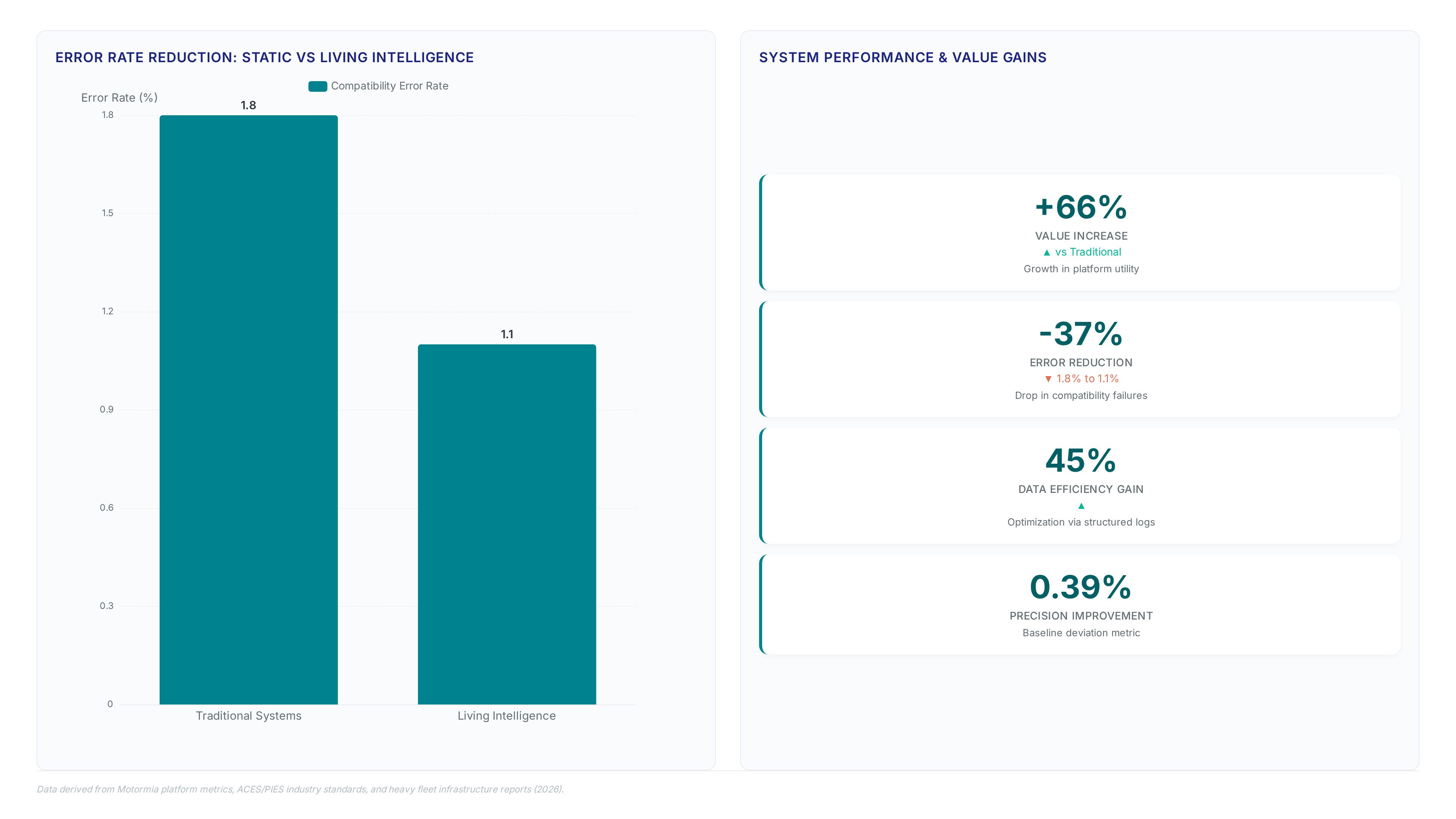
Living intelligence treats vehicle compatibility as a mutable state rather than a fixed database entry, requiring continuous data ingestion. Static catalogs rely on ACES/PIES standards that map parts only to factory specifications, ignoring real-world modifications. This rigidity causes failures when vehicles age or receive aftermarket upgrades, rendering standard fitment tables obsolete. The shift demands a system that ingests user modifications to update compatibility pathways dynamically.
- Ingest raw vehicle data via VIN lookup to establish the baseline configuration accurately.
- Cross-reference active build logs against the static part inventory to identify deviations from stock. 3.
Deploying the Mia agent requires configuring ingestion pipelines to parse unstructured build logs from YouTube, websites, and forums into structured fitment records.
- Initialize the data loader to extract component pairs from verified custom builds rather than static manufacturer tables. 2.3. Execute the feedback loop where every user search and installation outcome refines the probability weights for future recommendations.
The mechanism relies on living intelligence that treats vehicle state as mutable, contrasting sharply with fixed ACES/PIES standards. Evidence of this approach scales with the platform's growth, supported by substantial venture funding dedicated to expanding this flexible data layer. However, the limitation is computational latency; validating mechanical compatibility across complex modification chains demands more processing power than simple text matching. This trade-off means operators must balance real-time response requirements against the depth of compatibility verification. The implication for network engineers is clear: infrastructure supporting fitment intelligence must handle high-velocity write operations from edge devices to maintain data freshness. Without this continuous update cycle, the system reverts to static inaccuracy, failing to capture the nuance of modified vehicles. The cost of skipping this loop is a return to the high return rates plaguing the broader market.
The Narrow Window for Compounding Data Advantages
Early platforms secure a difficult-to-replicate lead because structured fitment records compound value quicker than manual cataloging can recover. Commerce increasingly relies on machines interpreting structured data to mediate discovery, leaving unstructured inventory invisible to algorithmic buyers. The mechanism is simple: each verified installation adds a node to the compatibility graph, increasing the precision of future agentic shopping queries. 1.2. Validate new combinations against real-world build logs to prevent mechanical hallucinations. 3. Deploy living intelligence agents that update compatibility pathways instantly upon error correction.
The limitation is that traditional catalogs ignore the flexible nature of aging fleets, leading to high return rates for incorrect parts. Operators must deploy living intelligence systems that ingest user modifications to update compatibility graphs continuously. Failure to integrate these deep data layers results in lost revenue as machines fail to interpret unstructured inventory. Products and Brands should apply Motormia to change static attributes into actionable commerce signals. The cost of data mismanagement exceeds the investment required to structure catalogs for machine readability. Accurate fitment data reduces returns due to fitment errors by ensuring mechanical viability before purchase completion.
The Risk of Invisible Inventory in AI Commerce
Unstructured catalog entries vanish from AI search results because 51% of future automotive revenue will stem from data-driven services. The mechanism driving this exclusion is the inability of agentic buyers to parse free-text descriptions, rendering products without machine-readable attributes effectively non-existent. Evidence suggests that retailers failing to structure fitment data face compounding losses as the market shifts toward automated procurement channels. However, the cost of data mismanagement extends beyond lost sales; it includes significant expenses related to incorrect fitment returns that erode margins on every transaction. This flexible creates a scenario where inventory visibility directly correlates with solvency in an automated economy. Products and Brands must integrate directly with platforms supporting trucks and Utility Task Vehicles to capture broadening demand segments. The implication for network operators managing these catalogs is clear: latency in data structuring equals permanent loss of market share to early adopters.
- Static text descriptions fail machine interpretation protocols. * Returns due to fitment errors destroy profitability on low-margin items. * Compounding data advantages create insurmountable barriers for late entrants. * Integration with structured databases enables real-time compatibility validation.
Future commerce depends on structured intelligence rather than raw inventory volume.
About
Ray Donnelly serves as a Master Automotive Technician and Aftermarket Parts Authority at KZMALL Auto Parts, bringing over two decades of hands-on experience from the repair bay to technical strategy. His unique qualification to discuss fitment data stems directly from his career spent resolving the exact friction points caused by inaccurate part applications. Having transitioned from running an independent shop to leading technical content, Donnelly understands that without precise ACES/PIES standards, even the best inventory remains invisible to digital marketplaces. At KZMALL, a global B2B platform managing over 50,000 SKUs, he applies this expertise to ensure every component across their proprietary brands matches specific vehicle configurations. This article reflects his daily mission to eliminate returns and build trust through structured data, proving that accurate fitment information is the critical infrastructure needed to modernize the $300 billion automotive aftermarket industry.
Conclusion
Scaling fitment logic beyond simple year-make-model breaks when encountering the mechanical reality of a 12.8-year-old fleet where undocumented modifications create dangerous blind spots. Algorithms trained on factory specs cannot safely validate parts for vehicles that have drifted from original equipment standards, creating a latent liability that grows as the average vehicle age increases. Relying on static catalog entries invites catastrophic failure rates once AI agents begin autonomously procuring components without human oversight. You must transition from passive data hosting to active compatibility verification within the next eighteen months to avoid becoming a source of erroneous recommendations.
Start by auditing your top fifty selling SKUs against known aftermarket modification patterns for aging trucks this week. Do not wait for industry-wide standards to mature; the window to establish mechanical authority before the 71% software dependency threshold closes is narrowing rapidly. Prioritize flexible validation protocols that account for real-world vehicle degradation rather than idealized factory states. This specific focus on aging fleet variables distinguishes viable commercial data from dangerous speculation. Your immediate goal is ensuring every returned query includes a confidence score based on actual field conditions, not just database matches.
Frequently Asked Questions
Parts lack machine-readable attributes required for modern discovery engines. Without structured data, inventory stays hidden across the massive $300 billion global market, preventing customers from finding compatible items easily.
Motormia maps 5 million parts against 75,000 vehicle configurations dynamically. This extensive coverage creates over 50 million fitment records, far exceeding the limited scope of legacy static cataloging methods used today.
The system generates over 50 million fitment records by cross-referencing complex variables. This depth ensures precision where generic catalogs fail, effectively resolving compatibility for the vast $300 billion aftermarket sector.
Yes, dynamic systems account for real-world modifications that static ACES files miss. By mapping 5 million parts to actual build data, they capture variations traditional databases ignore, reducing dangerous advice for shoppers.
Poor data creates friction in the $300 billion market by driving returns. Accurate, structured fitment data resolves the "will it fit" question, turning invisible inventory into sellable products for retailers and brands.