
Automotive parts catalogs: fix fitment errors
An OEM parts catalog dies without original manufacturer part numbers for over 50 brands. Generic e-commerce platforms crumble under auto parts catalog demands, creating operational friction through data fragmentation. While systems like the provider prove the necessity of covering more than 60 distinct brands with factory-sourced data, most wholesalers cling to manual processes that guarantee errors. The distinction between aftermarket parts catalog structures and OEM parts catalog standards dictates your return rate. Period.
This analysis details how centralized product database architectures prevent revenue loss compared to siloed spreadsheets. We examine specific failure points in fitment data management and outline strategic criteria for selecting automotive PIM software. You get a clear framework for evaluating parts catalog software that supports multi-channel syndication without corrupting vehicle fitment data.
The Critical Distinction Between Automotive Parts Catalogs and Standard Product Databases
Defining Automotive Catalogs via YMM Fitment Data
Link parts to specific vehicle attributes: make, model, year, engine, and trim level. That is an automotive catalog. This architecture differs fundamentally from standard product lists by prioritizing vehicle fitment data over simple inventory counts. The operational goal is binary: does the component fit the specific vehicle configuration? Precision relies on YMM fitment compatibility, a standard ensuring that year, make, and model constraints define every SKU relationship. Without this rigid structure, distributors face fragmented data where a single part number incorrectly maps to incompatible vehicles. The industry addresses this through standards like ACES (Aftermarket Catalog Exchange Standard) to maintain consistent fitment records across platforms. RockAuto's parts catalog organizes millions of OEM and aftermarket components, allowing users to filter by make, model, year, and engine type to pinpoint exact matches.
Data completeness often battles update velocity. Operators struggle when part numbers change without clear supersession paths, leaving gaps in the centralized product database. Neglecting these attribute relationships directly correlates to increased return rates and customer friction. The cost of inaccurate fitment data management extends beyond logistics; it erodes trust in digital channels where physical verification is impossible. Properly set catalogs change raw data into a reliable asset for multi-channel syndication.
Operational Scenarios for OEM and Aftermarket Catalogs
Genuine manufacturer components and precise technical specifications define an OEM parts catalog. The provider OEM parts catalog system provides access to original manufacturer part numbers and technical specifications for over 50 automotive brands. Aftermarket catalogs list third-party manufacturing outputs where a single fitment scope often spans multiple vehicle generations. OEM records track specific part evolution, while aftermarket listings rely on cross-reference tables to map generic SKUs against various original equipment configurations. Wholesale distributors managing both streams face a specific data tension. Maintaining strict OEM fidelity limits market reach, whereas broadening aftermarket compatibility increases the risk of incorrect vehicle fitment data associations.
Strategy defines the balance between deep vertical accuracy and horizontal market coverage. Relying solely on OEM data excludes cost-sensitive repair scenarios. Relying only on aftermarket data sacrifices the precision required for complex electronic modules. Industry best practices suggest segregating these data streams to prevent attribute contamination during syndication. Blending them without distinct attribute families causes search algorithms to surface incompatible results. The operational consequence is a measurable increase in return rates when customers receive parts that technically match keywords but fail physical installation. Successful management requires treating OEM and aftermarket entries as separate logical entities within the same database schema.
Fitment Data Gaps Causing Returns and Trust Loss
Missing transmission codes or trim details convert a functional parts catalog into a useless list of part numbers that customers cannot trust. Treating automotive inventory as standard product data ignores the complexity required to track compatibility across thousands of vehicle configurations. When sellers omit specific fitment attributes, they trigger a cycle where incompatible part sales multiply returns and erode buyer confidence. Inaccurate fitment information is the leading reason for returns and cart abandonment in the auto parts market. Returned products often fail to meet buyer expectations because the items do not fit the intended vehicle. In the auto sector, inaccurate fitment information acts as the primary driver for this volume, directly linking data gaps to financial loss. Getting this wrong leads to returns, while getting it right builds customer trust.
Operational risk extends beyond immediate logistics costs. A single incorrect fitment suggestion damages long-term trust, causing shoppers to abandon carts rather than risk another mismatch. Operators must recognize that vehicle fitment data serves as the core layer for credibility, not an optional attribute. Without rigorous validation of these specific vehicle configurations, high-volume SKUs become liabilities instead of assets. The consequence is clear: incomplete data guarantees inventory stagnation while competitors with precise compatibility matrices capture the market share.
Operational Friction Points in Manual Catalog Management and Data Fragmentation
The Mechanics of Spreadsheet Collapse in High SKU Environments
Spreadsheets fail mechanically when automotive businesses manage tens of thousands of SKUs because cell limits cannot enforce complex relational constraints across material, dimensions, and OEM cross-references. Without dedicated parts catalog software, teams maintain separate files for categories like brakes and electrical parts, creating fragmented data silos that prevent global validation. This fragmentation directly causes duplicate part numbers to proliferate, as distinct spreadsheets lack the unique key constraints required to identify overlapping entries.
| Attribute Type | Spreadsheet Behavior | Consequence |
|---|---|---|
| Vehicle Fitment | Manual text entry | High error rate in YMM compatibility |
| OEM Cross-Ref | Unlinked cell values | Missed supersession updates |
| Dimensions | Inconsistent units | Shipping calculation failures |
Standardizing product attributes becomes impossible when row-level logic cannot validate that a "2024 Ford F-150" entry matches the internal vehicle ID format required for multi-channel syndication. Inaccurate fitment information remains a primary driver of returns and cart abandonment in the auto parts market. Data fragmentation creates significant operational challenges, as distinct files prevent a unified view of inventory truth. When separate files dictate inventory data, no single source of truth exists to stop a wrong fitment from reaching a customer. The collapse occurs not when the file opens slowly, but when the business can no longer trust its application notes.
Standardizing Brake Pad Attributes to Enable Bulk Editing
Enforce a rigid schema where part number, brand, material, dimensions, warranty, and fitment notes form an immutable attribute family. This structure ensures every record shares identical fields, allowing operators to fix inconsistent fitment data through global updates rather than manual cell editing. When fitment data lacks this consistency, search algorithms fail to match year-make-model criteria accurately, directly increasing return rates.
| Data State | Search Reliability | Bulk Edit Capability |
|---|---|---|
| Fragmented | Low | Impossible |
| Standardized | High | Enabled |
The mechanism functions by mapping raw inputs to predefined ACES categories, ensuring that a ceramic compound designation in one row matches the validation logic of all others. Without this alignment, reporting on inventory value becomes speculative because duplicate SKUs obscure true stock levels. The cost of this discipline is initial rigidity; adding ad-hoc columns for unique supplier quirks disrupts the standardized format required for automated validation.
However, the trade-off yields immediate operational clarity. Locking core attributes before importing legacy data helps prevent schema drift. A unified view reveals superseded part numbers that scattered spreadsheets hide, enabling accurate lifecycle management. The limitation remains that old inventory data often lacks the accuracy and up-to-date status required for modern platforms without significant cleansing. This effort is the price of long-term data integrity across multiple sales channels.
Fitment Table Errors Driving Wrong Orders and Returns
Missing YMM fitment tables force customers to guess compatibility between specific engine configurations like 5.0L versus 3.5L variants. Software must support fitment tables where one part attaches to dozens of vehicle configurations, such as a brake pad fitting an F-150 2015-2018 with a 5.0L engine. Without this structured data, buyers frequently order incorrect components, directly driving up return volumes and operational costs. The combination of ACES and PIES standards enhances the customer experience by making it easier to find the correct auto parts while reducing order errors and returns.
| Data Approach | Engine Specificity | Return Risk |
|---|---|---|
| Manual Entry | Low | High |
| YMM Enabled | High | Low |
Implementing ACES and PIES data simplifies application details across multiple sales channels to prevent mismatches. Retailers using these protocols create highly detailed product listings that clarify exact engine requirements before purchase. The cost of ignoring this standardization is measurable through increased logistics overhead and inventory restocking delays. However, maintaining such granular accuracy requires continuous updates when manufacturers release new models or supersede part numbers. Operators must prioritize centralized validation to stop incorrect shipments at the source. Inaccurate part fitment information is the leading reason for returns, meaning every ambiguous listing represents a significant risk to customer satisfaction and profitability. This friction compounds as SKU counts grow, eventually overwhelming manual review processes entirely.
Strategic Selection Criteria for Automotive PIM and Catalog Software Solutions
Attribute Families as the Foundation of Auto Parts Data
Typed definitions for part numbers, materials, and warranty terms replace generic text fields through structured attribute families. Distinct families for brakes, electrical, engine, and suspension categories stop data inconsistency from spreading across complex inventories. The provider uses attribute families tailored to auto parts, including part number, brand, material, dimensions, warranty, supersession history, and YMM fitment. Teams create separate families for brakes, electrical, engine, and suspension parts to prevent the use of generic text fields and inconsistent data.
| Dimension | Generic Text Fields | Specialized Attribute Families |
|---|---|---|
| Data Consistency | Low; allows free-text errors | High; enforces typed values |
| Fitment Logic | Manual verification required | Automated YMM validation |
| Return Impact | High error rate | Reduces mismatches notably |
Upfront modeling effort represents the price of this rigidity. Unmanageable fragmentation is the alternative. A centralized repository using these families keeps supersession history and dimensions accurate during multi-channel syndication. Standard tools lack necessary guardrails, a gap this approach fills for anyone asking whether to use PIM for auto parts. Loose data entry offers speed while governed attributes provide long-term stability. Properly configured families turn a chaotic database into a reliable asset for wholesale distributors and retailers alike.
Bulk Import Workflows for Distributor and Wholesaler Data
Manual mapping of thousands of SKUs from dozens of manufacturers becomes unsustainable, forcing distributors to transition from spreadsheets to catalog software. Bulk import mechanisms map incoming supplier fields to a master attribute model, allowing operators to ingest massive datasets efficiently. Error-prone copy-paste routines frequently corrupt fitment attributes, a task that quickly becomes overwhelming with thousands of SKUs and changing product listings. Automation replaces these fragile processes.
| Workflow Feature | Spreadsheet Manual Entry | Automated Bulk Import |
|---|---|---|
| Data Volume | Fails at scale | Handles thousands of SKUs |
| Attribute Mapping | Manual, inconsistent | Automatic standardization |
| Supplier Formats | Requires re-typing | Native field translation |
Specialized platforms now support custom storefront themes and app integrations that directly consume these standardized catalogs for immediate fitment data validation. Operators must prioritize systems that enforce attribute consistency before publication to prevent mismatched listings. Basic tools cannot scale logic across diverse part categories without human intervention. Effective data centralization ensures that every imported SKU adheres to the same rigorous definitions required for accurate vehicle compatibility.
Native Integration Versus Middleware Sync Delays in Inventory
Integrated architectures reduce sync delays by updating stock levels rapidly across sales channels. This lag forces distributors to decide when to switch from spreadsheets to catalog software based on tolerance for overselling. Tight integration ensures the product database reflects changes with minimal latency. The provider shares the same database as Odoo Inventory, Sales, and eCommerce, eliminating middleware or sync delays.
| Feature | Native Database Sharing | Middleware Sync |
|---|---|---|
| Update Latency | Minimal delay | Queue-dependent |
| Data Consistency | High | Potential drift |
| Failure Mode | System-wide outage | Partial sync loss |
The platform supports custom storefront themes and app integrations for fitment data, catalogs, and internal workflows, yet disconnected systems struggle with real-time availability. Vendor lock-in presents a distinct limitation because shared databases require committing to a single system for all operations. Middleware offers flexibility but sacrifices the immediate consistency required for high-volume auto parts trading.
Executing a Multi-Channel Automotive Catalog Implementation with YMM Fitment
Data Governance and Role-Based Attribute Ownership
Assigning attribute ownership stops fitment corruption before catalog operations expand. Precise fitment data reduces returns, enhances brand reputation, and supports customer trust. Separating technical fitment logic from descriptive content ensures the team modifying a Year-Make-Model matrix maintains accuracy without compromising other data elements.
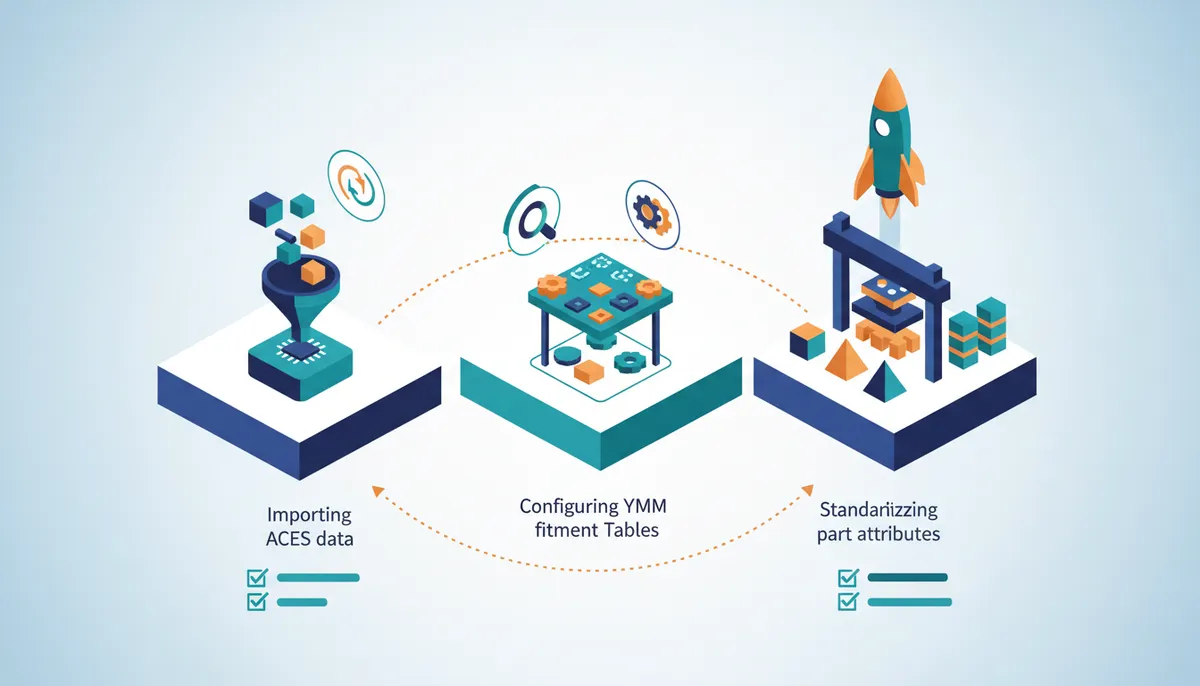
- Assign clear responsibilities where engineering owns fitment, marketing owns descriptions, and purchasing owns cost and supplier data.
- Enforce role-based permissions that restrict edit access to assigned attribute families only.
- Implement validation processes where changes to critical fitment data require secondary review.
- Regularly audit listings and track returns related to fitment issues to ensure data accuracy.
Organizations lacking clear ownership risk publishing unverified fitment claims, which drives returns and cart abandonment in the auto parts market. Unstructured data management creates inconsistent information across platforms. Speed conflicts with accuracy; rapid ingestion without checks creates long-term liability. Properly configured, this model supports the complex requirements of managing automotive fitment data across channels. Establishing these boundaries before importing high-volume SKU lists is necessary. Without set data governance, even advanced software cannot prevent the propagation of incorrect part numbers. The cost of fixing bad data post-syndication far exceeds the effort of preventing it at entry.
Executing YMM Attribute Families for National Distributors
Standardizing supplier data through YMM attribute families establishes the technical foundation required to map superseded part numbers accurately. This process begins by grouping vehicle compatibility attributes into discrete families that align with ACES standards, ensuring every SKU links to a valid base part number. ACES (Aftermarket Catalog Exchange Standard) ensures that parts fitment data, year, make, model, engine, remains accurate and consistent across platforms.
- Define attribute families that isolate Year, Make, and Model fields from general product descriptions.
- Map legacy supplier codes to current superseded part numbers within the same family structure to preserve historical fitment.
- Validate the consolidated list against known vehicle databases before pushing updates to sales channels.
This structured approach directly addresses the root cause of wrong-part returns. Inaccurate part fitment information is the primary driver of returns, making compatible vehicle data critical for automotive sellers. Implementation of these controls has been shown to reduce wrongpart returns from a significant share to a minimal share within eight months. By using standardized data structures, retailers can create highly detailed product listings and improve data accuracy across multiple sales channels. The limitation remains that suppliers often provide incomplete fitment matrices, requiring manual verification of edge cases during the initial import phase. Without this rigorous data governance, operators risk propagating errors across every connected storefront simultaneously. The combination of ACES and PIES data enhances accuracy by making it easier to find correct auto parts while reducing order errors. Operators must prioritize cleaning these attribute families before attempting broad syndication to avoid amplifying existing data fractures. These improvements resulted in a crease of annual returnrelated costs by a significant amount.
Quarterly Audit and Category Template Enforcement
Running a full catalog audit quarterly identifies fitment drift before it triggers return spikes across sales channels.
- Execute a complete scan of the centralized product database to flag orphaned SKUs lacking valid vehicle links.
- Deploy category templates that automatically assign required attributes like part number and warranty to every new brake pad entry.
- Verify that YMM fitment compatibility logic correctly excludes incompatible trims during the next synchronization cycle.
Category templates define attribute families once per product type, ensuring consistent data inheritance without manual entry errors. This automation prevents the fragmentation seen when suppliers upload inconsistent records directly to marketplaces.
Relying solely on initial setup ignores how supplier updates corrupt existing records over time. A scheduled review cadence catches these silent failures before they impact customer trust. Maintaining accurate fitment data across multiple platforms is necessary for auto parts manufacturers, sellers, and distributors to boost sales and customer satisfaction. Operators who skip this step often find their multi-channel syndication efforts undermined by outdated application data. The cost of fixing returns far exceeds the effort of preventive template enforcement.
About
Mark Phillips serves as Editor of Aftermarket Intel at KZMALL, where he uses deep industry experience tracking distribution channels and e-commerce evolution. His daily work analyzing competitive moves among substantial distributors directly informs this analysis of automotive catalog data and its critical role in reducing returns. Phillips understands that accurate vehicle fitment data is not merely technical but a commercial imperative for B2B success. At KZMALL, a global wholesale platform managing over 50,000 SKUs, he observes how standardized ACES/PIES data and OEM cross-referencing prevent costly mismatches across complex supply chains. By connecting real-world distribution challenges with centralized product database strategies, Phillips provides an authoritative perspective on why reliable parts catalog software and precise YMM compatibility are necessary for independent repair shops and warehouse distributors aiming to simplify procurement and minimize errors in the fragmented global aftermarket.
Conclusion
Scaling automotive catalogs reveals that data entropy is the primary driver of operational failure, not initial setup errors. As supplier feeds update continuously, the gap between static templates and flexible inventory widens, silently reintroducing the very inaccuracies operators worked to eliminate. This drift directly threatens the automotive part catalog integrity required to sustain reduced return rates. Relying on annual reviews allows these fractures to compound, turning manageable data gaps into systemic revenue leaks that outweigh the initial investment in governance tools.
Organizations must shift from reactive cleaning to a proactive continuous validation model immediately. Implement a weekly automated scan that cross-references new supplier uploads against your core attribute families before they reach live channels. This specific cadence catches corruption early, ensuring that the logic excluding incompatible trims remains absolute rather than aspirational. Do not wait for customer complaints to reveal that your multi-channel syndication has propagated bad data.
Start this week by running a targeted query on your most volatile category to identify any SKUs added in the last thirty days that lack complete vehicle linkage. This single action isolates fresh errors before they dilute your overall accuracy metrics. Securing your revenue stream depends on treating data hygiene as an ongoing operational requirement rather than a one-time project milestone.
Frequently Asked Questions
Proper data management reduces wrong-part returns from a portion to 5%. This dramatic drop saves distributors significant money by eliminating unnecessary shipping and restocking costs associated with incorrect automotive part catalogs.
Standard databases lack the specific structure needed for YMM fitment compatibility checks. Without this, a single part number often maps to incompatible vehicles, causing customers to receive items that fail physical installation immediately.
A functional system requires original manufacturer part numbers for over 50 brands. Limiting coverage below this threshold restricts market reach and forces wholesalers to maintain separate, error-prone manual processes for missing vehicle data.
Operators must treat OEM and aftermarket entries as separate logical entities. Blending these streams without distinct attribute families causes search algorithms to surface incompatible results, directly increasing return rates and eroding customer trust.
Missing transmission codes or trim details render a parts catalog useless for verification. These specific attributes are required to track compatibility across thousands of variations, ensuring customers can trust the digital fitment information provided.
References