CAPA parts: Why 1987 insurance rules still matter
Insurance carriers built the CAPA certification program in 1987 to break the OEM pricing stranglehold on collision repairs. They didn't ask for permission; they created a verified substitute for expensive original equipment and mandated rigorous testing for aftermarket components. The logic is cold and practical: enforced competition cuts industry expenses while strict quality assurance protocols keep vehicles safe.
This isn't about generic "aftermarket" labels. It is about validating parts across five material categories, metals, plastics, foam rubber, lights, and bumpers, using hard procedures from the American Society for Testing and Materials. We are looking at the CAPA 101 specification for metal, the CAPA 201 for plastics, and the CAPA 301 for lighting. These aren't suggestions. They are the difference between a fender that fits and one that rusts or cracks.
The economic engine here is a non-profit model designed to lower consumer costs without sacrificing structural integrity. By contrasting these certified alternatives with OEM alternatives, we see how third-party validation bridges the trust gap between repair facilities and insurance adjusters. Adhering to nationally recognized test methods ensures cost-saving measures don't result in substandard repairs. It balances fiscal responsibility with the technical demands of modern vehicle restoration.
The Role of CAPA in Aftermarket Automotive Quality Assurance
CAPA Certification Definition and 1987 Founding History
The Certified Automotive Parts Association (CAPA) is a non-profit entity born in 1987 to oversee rigorous testing programs for aftermarket automotive parts. Its sole purpose is validating that non-OEM components meet specific material and fitment standards before they ever reach a repair shop floor.
Automobile insurance companies created CAPA to seize control of the parts market used by their contracted collision shops. Faced with high-priced OEM inventory, insurers needed an alternative that reduced industry expenses while assuring part quality through standardized verification. The resulting framework forces marketplace competition rather than relying on manufacturer claims.
Generic aftermarket definitions don't cut it. This certification program demands adherence to ASTM and SAE test procedures for every single approved item.
| Feature | CAPA Certified | Generic Aftermarket |
|---|---|---|
| Oversight | Non-profit association | Manufacturer self-declared |
| Testing | ASTM/SAE validated | Variable or none |
| Origin | 1987 insurance initiative | Market driven |
Critics argue that while CAPA provides a vital quality baseline, the organization's constant expansion to include new materials means older definitions might miss modern composite structures. That is a fair concern. However, the historical shift from pure cost-cutting to rigorous quality assurance defines the modern collision repair environment. The alternative, unverified parts, is a gamble most shops cannot afford.
Applying ASTM and SAE Test Procedures to Aftermarket Materials
CAPA certification validates replacement metals, plastics, lights, foam rubber, and bumpers against strict ASTM and SAE benchmarks. The mechanism is simple: use nationally recognized test procedures to generate objective, measurable quality standards for every material category. Every certified part features a distinctive yellow and blue seal with a unique numerical code and barcode for verification. This scientific approach replaces guesswork with data-driven validation.
| Material Category | Specific Standard Reference | Validation Focus |
|---|---|---|
| Metals | CAPA 101 | Corrosion resistance and structural integrity |
| Plastics | CAPA 201 | Impact tolerance and flexibility retention |
| Lighting | CAPA 301 | Photometric output and housing sealing |
Independent verification exposes a critical gap: non-CAPA parts often rely solely on manufacturer claims without external audit. CAPA parts are guaranteed to fit, perform, last, and be as safe as original equipment. Non-certified parts vary wildly. At KZMALL Auto Parts, we prioritize components that survive this rigorous gauntlet because fitment depends on material consistency. A fender bracket molded from sub-par plastic will not hold torque like the original.
Material scope defines repair longevity far more than visual appearance. The limitation? Market availability of verified stock. The rigorous inspection and testing process ensures parts meet quality standards before the seal is applied. This trade-off ensures that installed parts withstand real-world road loads.
CAPA Parts Versus High Priced OEM Components
CAPA certified alternatives replace costly OEM inventory while maintaining verified fit and function for collision repairs. The organization gave insurance companies an alternative to high priced OEM parts, creating a competitive market that benefits the final payer. By design, this program encourages competition in the marketplace to reduce expense to the consumer and the industry while increasing and assuring part quality. Vehicle owners shopping for aftermarket parts use the presence of the yellow and blue CAPA seal as a primary decision-making tool to distinguish high-quality components from the crowded array of options.
| Feature | CAPA Certified Part | High Priced OEM Component |
|---|---|---|
| Origin | Aftermarket Manufacturer | Vehicle Builder |
| Validation | Independent Third-Party | Internal Factory Control |
| Cost Driver | Competitive Market Pricing | Brand Licensing Fees |
| Warranty | CAPA Program Guarantee | Manufacturer Limited |
Some argue that higher price equals improved safety. Independent testing invalidates that perception. Insurers originally formed the group to manage the costs of parts used in collision repairs while maintaining quality standards. The economic implication is clear: CAPA-certified parts offer substantial savings over OEM pricing while meeting or exceeding Original Equipment standards for fit, form, finish, and material integrity.
Inside CAPA Testing Procedures and Material Standards
CAPA 101, 201, and 301 Specification Frameworks
A hood rusting through within six months signals a breakdown in material validation protocols. The Certified Automotive Parts Association prevents such failures by dividing component validation into three distinct technical specifications. CAPA 101 governs metal components and requires rigorous corrosion resistance alongside structural integrity tests. CAPA 201 addresses plastic parts, focusing on impact absorption and flexibility under thermal stress conditions. CAPA 301 covers lighting assemblies to ensure optical clarity and water tightness match original equipment levels. Each specification mandates strict testing protocols that force objective measurement rather than subjective approval.
| Specification | Material Class | Primary Failure Mode Addressed |
|---|---|---|
| CAPA 101 | Metal | Corrosion and structural fatigue |
| CAPA 201 | Plastic | Brittle fracture and warping |
| CAPA 301 | Lighting | Seal leakage and lens hazing |
These standards apply nationally recognized procedures to evaluate fit, form, finish, and material integrity without bias. A Technical Committee continually reviews these benchmarks as manufacturing science advances to close new loopholes. This segmentation ensures a bumper cover meets different physical demands than a headlamp housing because they face different hazards. KZMALL Auto Parts stocks only components meeting these specific material definitions for reliable repairs. Verify the specification number on your repair order matches the part material before installation begins.
Verifying Authenticity via Yellow and Blue Seal Codes
Every certified unit displays a yellow and blue seal containing a unique numerical code for immediate identification by repair staff. This physical marker separates verified inventory from untested alternatives that often fail fitment checks during final assembly. The authentication process relies on four specific visual elements present on every genuine part to prevent fraud.
- Distinctive yellow and blue color scheme on the label.
- Unique numerical code printed clearly for manual entry.
- Scannable barcode linked to certification databases.
- Perforated tear-off tab for shop records.
Body shops apply the tear-off tab as a critical workflow step to prove installation of approved components to insurance adjusters. This tear-off tab serves a specific procedural function, allowing body shops to verify the part's authenticity and retain proof of certification after installation. This feature allows shops to retain proof of certification after installation, a step not available with non-certified alternatives lacking the mechanism.
The system relies on independent verification rather than manufacturer self-reporting which can hide defects. A single bad run can slip through if the physical label is not cross-referenced with the unique numerical code during intake inspection. Relying on box art alone invites error since counterfeiters replicate packaging but rarely forge the complex tear-off tab mechanism correctly.
Independent Testing Protocols for Fit, Form, and Finish
Manufacturer self-reporting often hides material defects until a painted bumper cracks in freezing weather conditions. Third-party validation solves this by mandating independent verification against established protocols rather than accepting factory data sheets at face value. The mechanism requires physical samples to pass rigorous stress tests for fit, form, finish, and material integrity before any seal is issued to the manufacturer. This process ensures parts meet or exceed Original Equipment (OE) standards through blind sampling methods that remove bias. The cost is time; independent labs add days to the supply chain compared to self-certified goods rushing to market.
| Feature | Self-Reported Part | Independently Tested Part |
|---|---|---|
| Data Source | Manufacturer claims | Blind lab results |
| Standard | Internal specs | Industry Standards |
| Verification | None | Third-party audit |
| Risk | High variance | Validated consistency |
- Submit raw material samples to an accredited independent laboratory.
- Execute specific test procedures for the material class.
- Compare physical results against OE performance baselines.
- Receive certification only after passing all integrity checks.
KZMALL Auto Parts advises buying the part the vehicle was engineered for, verified by independent data, not the one that simply looks close.
CAPA Certified Parts Versus OEM Alternatives for Collision Repair
Defining CAPA Certified Parts Versus OEM Standards
Gap drama disappears when the fender fits right the first time. CAPA certified parts are aftermarket components validated by the Certified Automotive Parts Association, a non-profit established in 1987 to oversee rigorous testing programs. These parts undergo independent verification instead of relying on manufacturer self-reporting common with OEM alternatives built to original factory specs. Automobile insurance companies created the system to control the market on parts used by insurance company contracted collision shops while ensuring quality parity.
Every certified part displays a distinct yellow and blue seal with a unique numerical code and tear-off tab for proof of installation. This physical authentication separates verified inventory from generic replacements that may lack consistent material integrity.
Verifying the tear-off tab exists before authorizing repair work confirms the part's authenticity. OEM parts guarantee factory exactness yet CAPA standards provide a verified safety net for collision repair where budget constraints exist without sacrificing structural performance.
Comparison: Verifying Authenticity Using Yellow and Blue Seal Codes
Locate the distinctive yellow and blue seal on the component packaging to identify the correct replacement. Every certified part must display this marker featuring a unique numerical code, a scannable barcode, and a tear-off tab for verification. Body shops actively use the tear-off tab to verify authenticity and retain proof of certification after installation, a workflow step that helps distinguish certified components from non-certified alternatives. Vehicle owners shopping for aftermarket options use the presence of this seal as a primary decision-making tool to distinguish high-quality components from the crowded market. Non-CAPA alternatives lack this standardized identification system entirely.
Visual inspection alone ignores the critical data encoded in the scannable barcode. Selecting parts verified by the seal ensures adherence to established quality benchmarks rather than relying on appearance alone. Authentication involves scanning the code or physically removing the tab to confirm the supply chain integrity. This process ensures the material standards match the original design intent.
Comparison: Economic Impact: CAPA Alternatives Versus High Priced OEM Components
CAPA-certified parts offer substantial savings over Original Equipment Manufacturer (OEM) parts, helping consumers and fleets control the total cost of ownership. The organization gave insurance companies an alternative to high priced OEM parts, creating a competitive market where cost-effective alternatives drive down total repair expenses. This origin story explains why the organization was formed to manage the costs of parts used in collision repairs while maintaining quality standards. Fleet operators apply these certified components to achieve substantial savings over OEM pricing without sacrificing the safety required for driver protection.
| Dimension | CAPA Certified Aftermarket | High Priced OEM Components |
|---|---|---|
| Primary Cost Driver | Competitive market pricing | Brand premium and tooling amortization |
| Verification Method | Independent third-party testing | Manufacturer self-reporting |
| Warranty Scope | Parts-only replacement coverage | Thorough system guarantees |
The economic trade-off involves accepting a parts-only warranty instead of the thorough system guarantees often bundled with dealer purchases. OEM parts carry the original manufacturer's branding yet the certified aftermarket option provides verified performance at a fraction of the acquisition cost. Selecting the CAPA seal for collision repairs allows for budget management while maintaining verified quality standards. Choosing the right component requires balancing immediate cash flow against long-term value retention. Buy the part the vehicle was engineered for, not the one that looks close.
Implementing CAPA Standards for Certification and Verification
Implementation: Mapping Material Specifications CAPA 101, 201, and 301
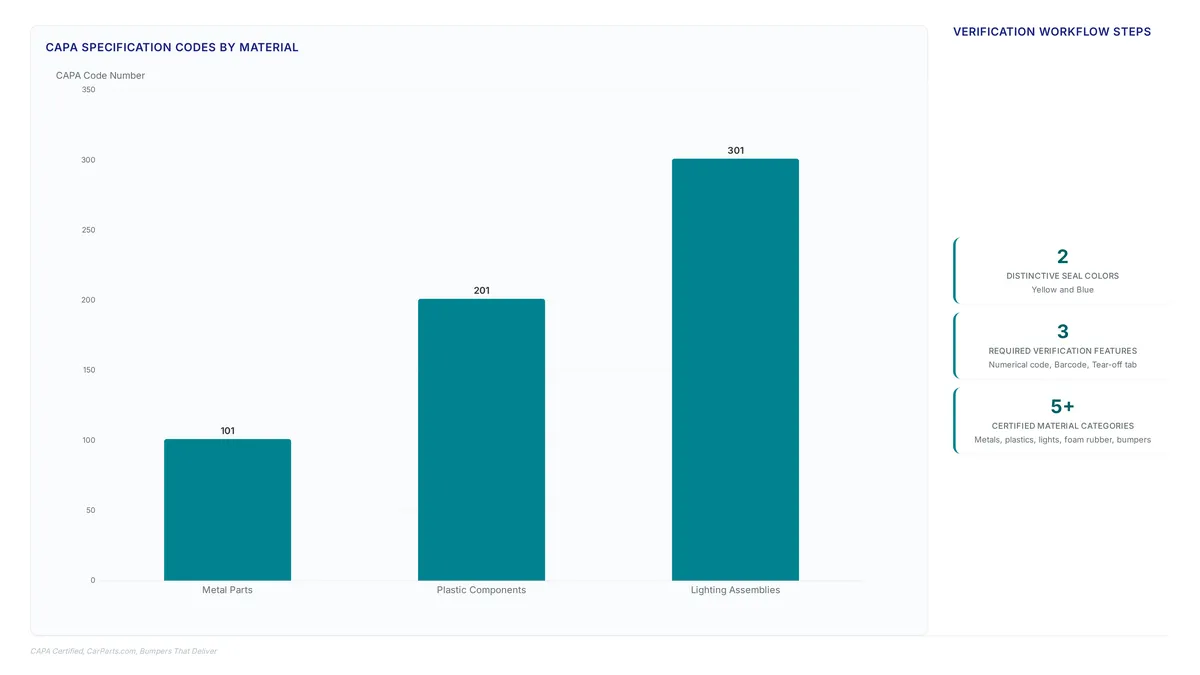
Match the raw material to its specific CAPA specification code before ordering replacement components. The program divides certification scope into three distinct categories: CAPA 101 governs metal parts, CAPA 201 covers plastic components, and CAPA 301 applies to lighting assemblies. Where possible, all test procedures refer to nationally recognized tests such as those of ASTM and SAE. These standards force every certified item to meet rigorous benchmarks for fit, form, finish, and material integrity. CAPA quality standards apply to various types of parts made from different materials. The organization is constantly expanding the certification program to include more parts and new materials.
- Identify the component material as metal, plastic, or lighting.
- Cross-reference the part against the active CAPA 101, CAPA 201, or CAPA 301 specification.
- Confirm the presence of the unique numerical code on the certification seal.
Test procedures receive updates to reflect advances in technology, manufacturing, and the science of testing.
Executing the Tear-Off Tab Verification Workflow
Inspect the yellow and blue seal on every replacement component before beginning installation to confirm the presence of a unique numerical code. This distinctive marking serves as the primary visual indicator that the part has undergone rigorous validation for material quality and durability. Technicians must locate the integrated tear-off tab on this seal, a feature specifically engineered to allow body shops to verify the part's authenticity and retain proof of certification after installation. Follow this workflow to authenticate the component and secure your repair documentation:
- Scan the barcode located on the seal to digitally verify the specific part unit against the database.
- Remove the tear-off tab to retain physical proof of certification for the repair file.
Unlike standard aftermarket options, only certified units provide this standardized, verifiable identification system for immediate authentication. Retaining the tab creates an audit trail that documents the use of verified components. Using CAPA parts reduces company liability by ensuring strict safety standards are met, a protection not inherently offered by non-certified aftermarket alternatives.
Validating Independent Testing Against Self-Reporting
The CAPA certification process relies on rigorous, independent testing rather than manufacturer self-reporting. Shops must distinguish between parts merely resembling OEM specifications and those proven to meet them through independent validation.
| Feature | Independent Testing | Self-Reporting |
|---|---|---|
| Validation Source | Third-party laboratory | Manufacturer internal |
| Standard Reference | ASTM and SAE protocols | Proprietary metrics |
| Risk Profile | Verified material integrity | Unverified claims |
| Market Trust | High (Insurer accepted) | Low (Liability risk) |
Follow this checklist to confirm part authenticity before installation:
- Inspect the component for the distinctive yellow and blue seal containing a scannable barcode.
- Verify the unique numerical code matches the database entry for that specific batch.
- Remove the tear-off tab to retain physical proof of certification for the repair file.
- Cross-reference the material type against CAPA 101, CAPA 201, or CAPA 301 specifications.
Sourcing only verified components helps guarantee fit and safety by adhering to established industry standards.
About
Ray Donnelly, Master Automotive Technician and Aftermarket Parts Authority at KZMALL Auto Parts, brings over two decades of hands-on experience to the discussion on the CAPA certification program. Having transitioned from running an independent repair shop to leading technical content strategy, Ray understands the critical balance between cost control and part quality that CAPA was designed to address. His daily work involves analyzing fitment data, evaluating OE versus aftermarket standards, and preventing comebacks through precise parts selection. This practical background allows him to explain how CAPA's rigorous testing protocols directly impact shop efficiency and customer satisfaction. At KZMALL Auto Parts, a global B2B distributor committed to ISO and IATF certified components, Ray uses his expertise to guide partners through complex certification landscapes. He connects the historical mission of CAPA, created by insurers to ensure reliable alternatives to OEM parts, with modern procurement strategies, ensuring distributors and repairers alike can trust the quality and compatibility of the aftermarket components they supply.
Conclusion
Reliance on visual inspection alone creates unacceptable liability gaps when material science evolves quicker than technician recognition. The operational cost of installing a part that merely resembles an original equipment component far exceeds the time required to scan a barcode and verify independent test data. Shops must transition from assuming compliance to demanding proof of material integrity before any installation occurs. This shift is not about brand loyalty but about enforcing a chain of custody that protects the business from unverified manufacturer claims.
Adopt a strict policy where no plastic structural component enters the bay without a validated CAPA 201 designation or equivalent independent verification. This standard ensures that impact absorption characteristics match engineering requirements rather than marketing descriptions. Implement this verification protocol immediately for all incoming inventory to establish a defensible repair process.
Start by auditing your current stock of plastic body parts this week to ensure every unit displays the distinctive yellow and blue seal with a scannable code. Cross-reference these physical units against the database to confirm the numerical codes match specific batch entries. This single action creates the audit trail necessary to demonstrate due diligence and reduces exposure to liability risks associated with unverified aftermarket alternatives.
Frequently Asked Questions
CAPA enforces CAPA 101 for metals and CAPA 201 for plastics to ensure structural integrity. These standards utilize ASTM and SAE procedures to validate that aftermarket components match original equipment performance levels.
Shops verify certification by checking for a unique numerical code on the yellow and blue seal. This distinct marking confirms the part passed rigorous testing protocols required by the non-profit association.
Insurers created the program in 1987 to control parts markets and reduce high OEM expenses. This initiative fosters marketplace competition while assuring part quality for collision shops contracted by insurance carriers.
Parts failing ASTM or SAE procedures cannot receive the distinctive certification seal. Without this validation, components lack the guaranteed fit and performance required for reliable collision repair scenarios.
The program covers metals, plastics, lights, foam rubber, and bumpers through specific specifications. This scope ensures diverse aftermarket materials undergo strict validation before reaching repair facilities for vehicle restoration.
References