
CAPA certification standards for lights, metals, and fitment
Over millions of replacement parts have earned CAPA Certification by meeting strict quality benchmarks.
Generic assurances don't cut it in collision repair. The program distinguishes itself by mandating objective, measurable Quality Standards for diverse materials including metals, plastics, and foam rubber. These protocols apply nationally recognized tests from the American Society for Testing and Materials and the Society of Automotive Engineers to verify structural integrity and safety.
Material-specific protocols govern Metal Parts through requirements for adhesive integrity, coating performance, and proper production methods. The discussion extends to Electromagnetic Compatibility mandates for electronic components like LED lights, ensuring these devices do not interfere with vehicle systems or surrounding traffic. Finally, the text details how the program adapts to market demands by certifying part assemblies lacking a direct car company service number, provided they demonstrate comparability to original material properties.
Industry experts refine these standards continuously. This ensures certified components maintain fit and function amidst rapid manufacturing advances. By adhering to these publicly available specifications, the collision repair industry secures a verifiable chain of quality that protects both repairers and consumers from substandard imports.
The Role of CAPA Certification in Aftermarket Quality Assurance
CAPA Certification Scope for Metals Plastics and Lighting
The Certified Automotive Parts Association emerged in 1987 as a non-profit entity dedicated to rigorous testing programs for aftermarket components. This framework establishes objective, measurable Quality Standards for replacement parts covering metals, plastics, lights, foam rubber, and bumpers.
| Material Category | Primary Standard Focus |
|---|---|
| Metals | Coating performance, weld integrity, and dimensional accuracy |
| Plastics | Assembly fit, adhesive bonding, and material composition |
| Lighting | Photometry, color stability, and electromagnetic compatibility |
Test procedures rely on nationally recognized protocols from the American Society for Testing and Materials (ASTM) and the Society of Automotive Engineers (SAE) to validate part quality. These publicly available specifications confirm that every certified component meets strict functional requirements before reaching the repair shop floor.
A structural limitation exists for components lacking a corresponding car company service part number. Manufacturers must demonstrate material comparability rather than direct specification matching. Fitment relies heavily on the Validator's assessment of adjacent part interaction instead of legacy blueprints. Stocking CAPA certified items reduces return rates driven by fitment disputes. Buyers must verify assembly-level status in the database for non-standard applications. The program's ongoing expansion into new material categories matches modern vehicle complexity. Operators should prioritize parts where the Technical Committee has updated standards to address specific failure modes like electromagnetic interference in lighting systems.
Using the CAPA Database Search for Assembly Verification
The CAPA Database Search serves as the primary verification tool for assemblies lacking a direct Car Company Service (CCS) part number. This capability addresses complex repair scenarios where original equipment manufacturers did not assign a specific identifier to a sub-assembly unit. Manufacturers face a binary decision when certifying these non-CCS assemblies. They must either certify every component individually or demonstrate material property comparability to the original CCS specification. The Validator then evaluates the complete assembly to confirm proper fit against adjacent parts within the certified structure. This process ensures that even without a direct OE counterpart, the material properties align with required performance.
| Verification Path | Requirement Focus | Validator Action |
|---|---|---|
| Component Certification | Individual part compliance | Verify each piece meets standard |
| Material Comparability | Property equivalence to CCS | Assess fit to adjacent assemblies |
Component status within a certified assembly is not always uniform. The database reveals whether specific sub-components hold independent certification or rely on the assembly-level approval. Insurance auditors often require granular data to approve claims involving partial assembly replacement. Over a vast number of replacement parts have earned certification. The database remains the sole authority for validating complex, multi-part configurations. Visual inspection cannot confirm internal material composition. The search result provides the only proof of comparability. Technicians relying solely on physical fitment risk rejecting compliant parts. Non-compliant substitutes that merely appear similar might get accepted. The database entry acts as the definitive legal and technical record for the part's provenance.
CAPA Quality Standards Versus OEM Part Requirements
CAPA standards align aftermarket output with OEM durability by mandating nationally recognized tests from ASTM and SAE. This approach ensures material composition and mechanical properties match original equipment specifications without relying solely on the car company service part number. The Technical Committee, comprising experts in collision repair and quality control, continually refines these benchmarks to address manufacturing advances. OEMs dictate fit based on original tooling. The independent committee adjusts quality standards as testing science evolves. This structure prevents stagnation where original designs might lack modern material improvements.
Suppliers must invest notably in physical checks for paint adhesion and weld integrity to satisfy the independent validator. Certified parts often incorporate updated material formulations that the original design never specified. Durability of the legacy component gets exceeded in many cases. The value proposition shifts from mere replication to functional improvement.
Material-Specific Standards and Testing Protocols for Auto Parts
CAPA 101 Metal Part Adhesive and Coating Integrity Rules
Should you stock OE, premium aftermarket, or both for this application? Here's the math. The CAPA 101 standard mandates physical verification of fit, finish, paint adhesion, coating to guarantee metal parts match original specifications. This protocol diverges from CAPA 201 plastic standards by prioritizing structural continuity over assembly flexibility. While plastic components focus on snap-fit tolerance and electromagnetic shielding, metal applications demand rigorous scrutiny of weld integrity to prevent corrosion and structural failure.
Metal parts require destructive testing samples for every production run to validate weld integrity, increasing per-unit validation costs compared to non-structural plastic items. Operators must recognize that skipping these specific adhesive checks invites premature return rates due to finish degradation. Inventory lacking this specific coating performance data risks higher long-term liability despite lower upfront acquisition costs.
Applying CAPA 202 Moisture Absorption and Sound Tests to Fabric
Nonwoven fabric certification hinges on the CAPA 202 standard, which mandates rigorous moisture absorption and sound absorption protocols to guarantee cabin comfort. Unlike metal components governed by CAPA 101, textile parts require validation of physical properties like thickness and chemical resistance rather than weld integrity. The testing sequence evaluates how materials react to humidity and attenuate noise, ensuring they meet original equipment specifications for acoustic performance.
| Test Parameter | CAPA 202 Requirement | Operational Impact |
|---|---|---|
| Moisture Absorption | Limits water uptake to prevent mold | Preserves interior air quality |
| Sound Absorption | Validates noise reduction coefficients | Maintains cabin quietness |
| Chemical Resistance | Verifies stain durability | Extends part service life |
Parts failing these metrics due to inferior density or poor construction are rejected, preventing costly re-work after installation. This grueling process addresses the risk of unpredictable quality found in non-certified alternatives. While electrodeposition primer suits metal attachment parts, fabric applications rely on intrinsic material stability instead of surface coatings. The Technical Committee updates these standards as manufacturing science advances, ensuring continued relevance.
- Validators measure sample thickness against strict tolerances.
- Laboratories expose materials to controlled humidity cycles.
- Acoustic chambers verify sound dampening capabilities.
Specialized testing equipment is required, which smaller manufacturers may lack without third-party validation. Consequently, sourcing from certified suppliers mitigates the risk of component failure in critical comfort systems.
CAPA 501 Bumper Crash Testing and EMC Verification Steps
Decide between component or assembly certification by evaluating bumper energy absorption needs against electronic interference risks. The CAPA 501 standard mandates crash testing to verify that bumper reinforcements and energy absorbers replicate original equipment density and compression resistance. This protocol applies strictly to front and rear bumpers, requiring validation of weld strength and hitch dimensions before market entry. Operators must choose to certify individual brackets or the complete assembly, a decision influencing inventory complexity and validation scope.
Electromagnetic compatibility verification becomes mandatory when bumpers house active devices like parking sensors or LED fog lamps. These components undergo emissions and immunity testing to prevent signal distortion in surrounding vehicle systems. The organization operates as a non-profit entity with no vested interest in the sale of parts, ensuring unbiased validation of material composition.
| Verification Step | Component Strategy | Assembly Strategy |
|---|---|---|
| Crash Dynamics | Tests individual rebars | Validates total system collapse |
| EMC Scope | Isolates sensor modules | Checks whole-bumper interference |
| Fit Validation | Measures bracket gaps | Confirms full fascia alignment |
| Inventory Risk | Higher SKU count | Lower SKU count |
Sourcing flexibility conflicts with validation cost. Certifying only the metal rebar reduces testing expenses but forces buyers to source non-certified brackets separately, potentially compromising the vehicle test fit. Conversely, full assembly certification guarantees performance but increases the administrative burden on manufacturers.
Electromagnetic Compatibility and Lighting Performance Requirements
Defining EMC Testing for HID and LED Vehicle Components
Active electronic devices like HID and LED components must operate without disrupting adjacent vehicle systems. All electronic devices emit electromagnetic energy which may interfere with normal operation, a risk magnified in modern fleets dense with sensitive controllers. CAPA requires this verification on parts containing motors or active circuits to guarantee systems function properly together. The mechanism measures both emissions and immunity, ensuring that the systems in a vehicle are functioning properly together, and that the systems in surrounding vehicles are not causing interference.
| Test Focus | Operational Risk | Validation Goal |
|---|---|---|
| Emissions | Signal distortion in radios | Limit radiated noise floor |
| Immunity | Erratic sensor behavior | Resist external field spikes |
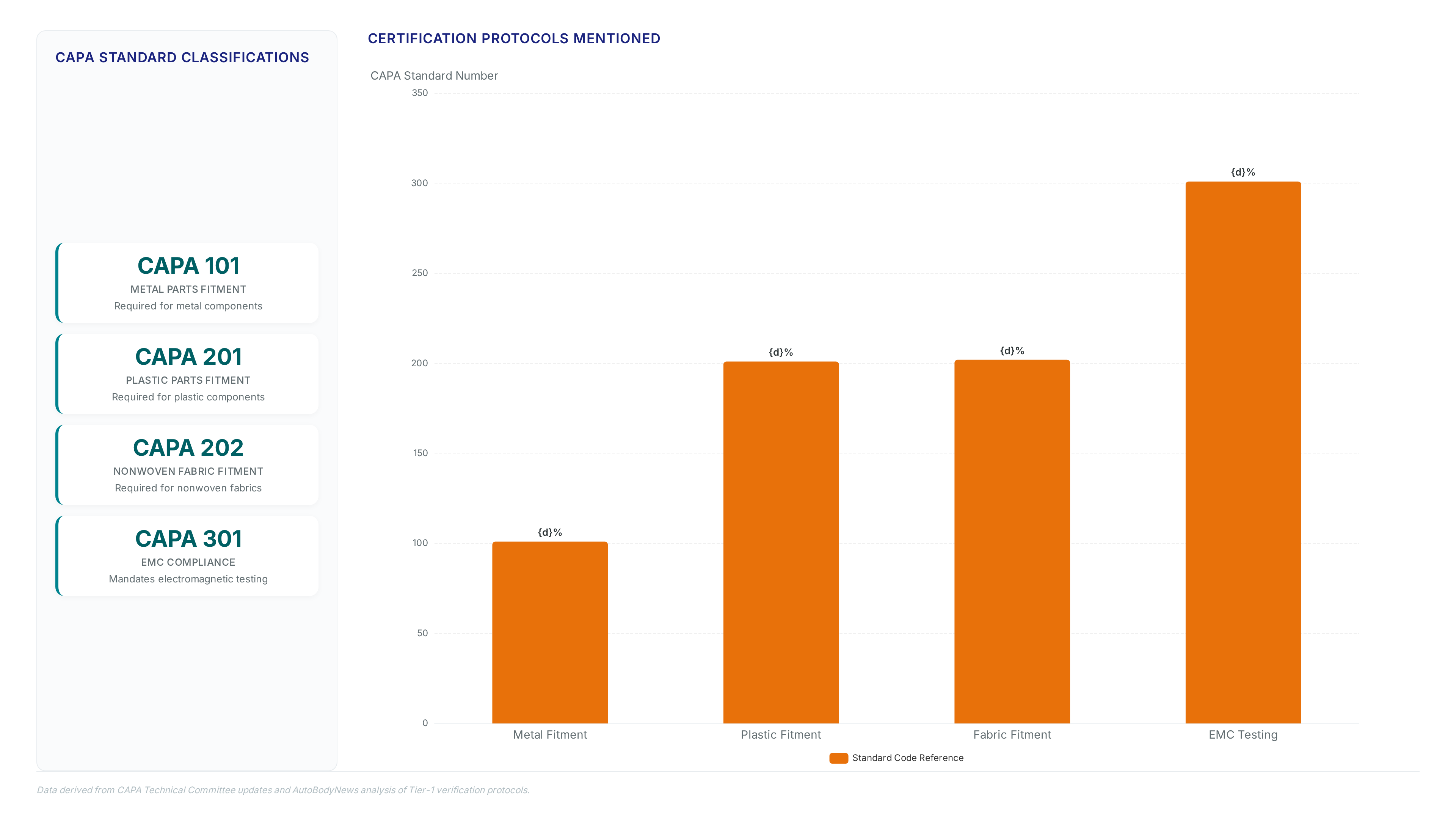
Physical fit checks under CAPA 101 do not automatically confer electromagnetic compliance since distinct protocols apply. A visually perfect lens could induce fatal errors in collision avoidance radars without this step. Buyers should prioritize parts where the validation report explicitly cites EMC clearance for the specific vehicle platform.
Applying CAPA 301 Photometry and Color Standards to Lighting Parts
Verifying photometry and color under CAPA 301 starts with measuring the effective projected luminous lens area against FMVSS 108 baselines. The standard mandates rigorous checks for gaskets, adhesives, and sealants to prevent moisture intrusion that degrades optical performance over time. Unlike passive body panels, lighting assemblies require EMC testing to ensure active LED or HID circuits do not emit interference. This validation step guarantees that vehicle systems function properly together without disrupting surrounding electronic controllers.
| Verification Step | CAPA 301 Requirement | Operational Risk |
|---|---|---|
| Lens Area | Match dimension precisely | Illegal beam pattern |
| Color | Meet chromaticity coordinates | Safety violation |
| EMC | Pass emissions/immunity | System noise |
Passing a bench test does not guarantee fitment because Vehicle Test Fit remains a required component of the CAPA 101, 201, and 202 standards for metal, plastic, and nonwoven fabric parts respectively. Rapid inventory turnover often conflicts with the time required for full photometric mapping on every production batch. Shop owners should consult CAPA Technical Committee updates as experts continually refine these specifications to match advancing automotive technology. Parts lacking proper certification risk rejection for being too thin or having poor fit, causing costly re-work delays. This dual-layer security ensures that the part installed matches the component originally evaluated for safety and performance.
Risks of Electromagnetic Interference in Non-Compliant LED Lights
| Failure Mode | Root Cause | Operational Consequence |
|---|---|---|
| Signal Corruption | Unfiltered emissions on power lines | Erratic dashboard warnings |
| Radio Static | Poor shielding in housing | Loss of communication clarity |
| Module Reset | Voltage spikes during ignition | Intermittent system shutdowns |
The CAPA 301 standard mandates EMC testing specifically to prevent these disruptions by validating that parts function properly together. Operators must stock only validated components to avoid the hidden cost of comebacks. The pricey nature of OEM replacements drives the search for alternatives, yet skipping certification undermines the entire repair quality.
Executing the Certification Process for Replacement Components
CAPA 401 and 402 Scope for Attachment and Front Support Parts
Differentiating CAPA 401 from CAPA 402 begins with the specific material categories and attachment methods each standard governs. CAPA 401 applies to metal or plastic attachment parts, mandating strict dimensional inspection and weld quality checks for laser, arc, and resistance spot welds. Conversely, CAPA 402 targets front support parts, extending requirements to include rivet and clinch fastener validation alongside tensile strength testing.
| Feature Focus | CAPA 401 Scope | CAPA 402 Scope |
|---|---|---|
| Primary Application | Attachment Parts | Front Support Parts |
| Fastener Types | Standard Fasteners | Rivets and Clinch Fasteners |
| Material Checks | Hardness and Galvanization | Tensile Strength and Impact |
| Documentation | Coating Specifications | Safety Labels and Markings |
Submitting a part for certification requires manufacturers to follow a numbered validation path to guarantee fit and function.
- Define the part category as either an attachment or front support assembly based on its vehicle location.
- Prepare samples for dimensional inspection and vehicle test fit (VTF) against original equipment baselines.
- Submit material specimens for composition analysis to verify hardness or impact resistance properties.
- Receive final approval only after passing all mechanical and appearance criteria outlined in the standard.
While CAPA 401 emphasizes coating integrity for primed surfaces, CAPA 402 prioritizes structural labels often omitted in generic aftermarket sourcing. Ignoring this distinction risks stocking front supports that lack mandatory safety markings, creating liability gaps even if the metal thickness matches original equipment specifications.
Executing Vehicle Test Fit and Dimensional Inspection Protocols
Start the validation sequence by aligning mounting holes against the vehicle frame before securing any fasteners. Technicians must verify that slots and openings on primed metal or uncoated plastic components match original equipment dimensions exactly. The process requires checking weld quality and attachment point locations to prevent stress fractures during installation.
- Measure dimensional inspection points using calibrated gaels against the manufacturer's blueprint.
- Confirm attachment points align without requiring forceful modification of the vehicle structure.
- Inspect weld integrity for laser, arc, and resistance spot welds to ensure structural safety.
Minor variances in raw material thickness can cause fitment failures even when weld quality passes. Shops fix poor fit in a certified part by re-validating the specific assembly batch rather than assuming universal compatibility. Unlike visual checks, this method catches hidden misalignments that cause long-term corrosion or paint cracking. Skipping these steps results in a return rate that erodes the financial benefit of using aftermarket inventory. Operators must prioritize physical verification to maintain fleet readiness.
Material Hardness and Weld Quality Failure Modes in Certification
Immediate rejection of attachment components occurs when material hardness deviates from specified ranges or weld integrity fails initial physical inspection. CAPA 401 mandates rigorous verification of hardness, thickness, chemical analysis, and the presence of galvanized material to prevent premature structural failure. Technicians must confirm that laser weld, arc weld, and resistance spot weld locations match original equipment counts exactly. A single missing spot weld or incorrect arc penetration depth compromises the entire assembly, rendering the part unfit for certification regardless of visual appearance.
The validation protocol requires distinct checks for fastener hardware and general appearance alongside these mechanical properties. Facilities approved for production undergo regular random inspections to verify that quality standards remain consistent over time regular random inspections. This ongoing oversight ensures that the initial sample approval reflects sustained manufacturing capability rather than a one-time pass.
| Test Parameter | Required Verification | Failure Consequence |
|---|---|---|
| Material Properties | Hardness, chemical analysis, thickness | Structural weakness, corrosion risk |
| Weld Quality | Location, number, type (laser/arc/spot) | Catastopic joint separation under load |
| Hardware | Fastener specification and count | Improper mounting, vibration failure |
Operators submitting parts must address poor fit issues by re-evaluating dimensional data before requesting physical vehicle test fits. The process for submitting a part demands complete documentation of these material-specific tests to avoid automatic disqualification.
About
Priya Raman serves as the Aftermarket Category and Supply-Chain Strategist at KZMALL Auto Parts, where she oversees supplier qualification and quality-tier strategies. Her fifteen years of experience in parts sourcing and B2B distribution make her uniquely qualified to explain the critical importance of CAPA certification. In her daily work, Priya evaluates replacement parts against rigorous international benchmarks, ensuring that KZMALL's extensive catalog meets the precise needs of independent repair shops and distributors. She understands that objective, measurable standards are not just technicalities but necessary tools for reducing risk and ensuring fitment accuracy across complex supply chains. By using her expertise in supplier audits and data governance, Priya connects the technical details of CAPA's testing procedures to real-world procurement decisions. At KZMALL Auto Parts, a global leader in standardized aftermarket distribution, her insights help buyers navigate quality assurance programs that guarantee parts perform to ASTM and SAE specifications, ultimately protecting both repair shop reputations and consumer safety.
Conclusion
Scaling quality assurance reveals that visual conformity cannot substitute for metallurgical integrity. As the program broadens its scope to include diverse materials and complex assemblies, the operational cost of failure shifts from simple rework to total liability exposure. A single deviation in weld penetration or chemical composition creates a latent defect that visual inspections miss entirely. This reality demands that facilities treat material science data as the primary gatekeeper before any physical fitment occurs.
Organizations must mandate pre-submission metallurgical validation for every new part number starting immediately. Relying on supplier certificates of analysis without independent verification invites catastrophic joint separation under load. The window for correcting these errors closes once the sample enters the review queue, where rejection resets the entire timeline.
Start by auditing your current incoming inspection protocol this week to ensure it explicitly tests for laser and arc weld penetration depth against original equipment counts. Verify that your team measures hardness and galvanized coating presence before assembling test units. This specific focus on internal mechanical properties prevents the submission of parts that appear correct but lack the structural durability required for long-term safety. Prioritizing these hidden variables ensures that production readiness reflects sustained manufacturing capability rather than success.
This massive volume demonstrates the program's widespread adoption across the collision repair industry for ensuring reliable aftermarket component performance.
Q: What material categories does the certification program currently cover?
A: The program establishes standards for metals, plastics, lights, foam rubber, and bumpers. These specific categories ensure that diverse automotive materials undergo rigorous testing to verify their structural integrity and safety before use.
Q: Why is electromagnetic compatibility testing required for certain auto parts?
A: Electronic devices like LED lights must pass EMC testing to prevent interference. This ensures that active components do not alter vehicle systems or surrounding traffic while maintaining proper electronic functionality.
Q: How are part assemblies handled without a direct car company number?
A: Manufacturers can demonstrate material comparability to original specifications for these assemblies. The Validator then assesses fitment against adjacent parts to ensure the non-standard assembly functions correctly within the vehicle structure.
Q: Which organizations provide the testing protocols used for validation?
A: Tests apply protocols from the American Society for Testing and Materials and Society of Automotive Engineers. These nationally recognized standards provide objective, measurable data to confirm part quality and safety.
Frequently Asked Questions
Over 197 million replacement parts have earned certification by meeting strict quality benchmarks. This massive volume demonstrates the program's widespread adoption across the collision repair industry for ensuring reliable aftermarket component performance.
The program establishes standards for metals, plastics, lights, foam rubber, and bumpers. These specific categories ensure that diverse automotive materials undergo rigorous testing to verify their structural integrity and safety before use.
Electronic devices like LED lights must pass EMC testing to prevent interference. This ensures that active components do not disrupt vehicle systems or surrounding traffic while maintaining proper electronic functionality.
Manufacturers can demonstrate material comparability to original specifications for these assemblies. The Validator then assesses fitment against adjacent parts to ensure the non-standard assembly functions correctly within the vehicle structure.
Tests utilize protocols from the American Society for Testing and Materials and Society of Automotive Engineers. These nationally recognized standards provide objective, measurable data to confirm part quality and safety.
References