
Aftermarket sales growth: Why 13-year vehicles matter
The U.S. Light-duty sector projects 5.2% growth, and TERREPOWER isn't waiting around to see what happens. They've installed Michelle Allen to command the Independent Aftermarket Sales division. This isn't a ceremonial baton pass. It's a strategic necessity. The average vehicle on American roads is nearly 13 years old, a statistic Wire Reports confirms is driving unprecedented demand for repair services. Older cars don't just need oil changes; they need constant, expensive intervention. Allen, succeeding the retiring Chris Garner, brings the commercial acumen required to monetize this aging fleet.
Garner spent twenty years scaling this division from a regional player into a global engine serving 90 countries. That momentum is hard to keep. Allen's job isn't just to preserve Garner's legacy; she has to deploy operational frameworks that work in a fragmented market where personalization dictates consumer behavior. Her background suggests a pivot toward aggressive channel diversification, moving beyond the traditional boundaries that defined the last two decades.
We need to look past the press releases and examine the strategic role these sales organizations actually play. How do legacy structures adapt when the market refuses to behave? The answer lies in the high-performance teams executing the vision. When the average vehicle refuses to quit, the distribution model can't afford to either.
The Strategic Role of Independent Aftermarket Sales in Modern Distribution
Defining Independent Aftermarket Sales and the EVP Role at TERREPOWER
Independent Aftermarket Sales channels move non-OEM parts through third-party networks, bypassing manufacturer dealerships entirely. The pressure here is real. Advocates are pushing hard for equitable data rights so repair shops can compete against original equipment manufacturers. In this context, the Executive Vice President title isn't just a label; it denotes full profit-and-loss accountability for diverse distribution streams. Michelle Allen takes the helm at TERREPOWER, succeeding Chris Garner upon his planned retirement. Her appointment secures continuity while the company scales across 64 countries. History tells us that large-scale acquisitions often reduce costs through economies of scale, but only if the integration doesn't stall.
The U.S. Light-duty automotive aftermarket projects 5.2% year-over-year growth in 2026, driven squarely by the aging fleet. An average vehicle age nearing 13 years directly spikes demand for repair and maintenance. This demographic reality forces distributors to prioritize DIFM in automotive sales, a model where professional installers execute repairs using supplied parts. Older vehicles break more often, creating a revenue baseline that ignores new car sales volumes. But sustaining this growth requires access to proprietary vehicle telematics that OEMs guard jealously.
The Executive Vice President role demands deep channel experience spanning distribution, professional installer, and retail sectors. Duncan Gillis cites a customer-first mindset as instrumental for leading this complex commercial environment. Success requires navigating the strategic shift toward sustainable manufacturing to mitigate tariff risks. Geopolitical pressure makes local production a critical advantage for margin preservation.
| Requirement | Strategic Function | Operational Impact |
|---|---|---|
| Channel Diversity | Balances installer and retail volume | Stabilizes revenue during OEM shocks |
| Commercial Acumen | Drives P&L accountability | Optimizes mix across 90 countries |
| Supply Chain Insight | Uses near-shoring trends | Reduces lead times and duty costs |
Michelle Allen brings two decades of leadership to execute this multi-channel strategy. She faces the classic tension: expand global reach or maintain agile local responses? You can't do both perfectly. Prioritizing short-term volume over the structural benefits of sustainable parts is a trap; those parts offer long-term cost insulation. The goal is to build on Chris Garner's foundation while adapting to supply chain realities. Cross-channel expertise is no longer optional; it's a defensive necessity against market fragmentation.
Leadership Transition Dynamics Between Michelle Allen and Chris Garner
Michelle Allen's Valvoline DIFM Sales Leadership Profile
Michelle Allen brings more than two decades of leadership experience across the automotive aftermarket. Her most recent role was as Vice President of North America Sales, DIFM at Valvoline Global, where she held P&L responsibility for a substantial North American business. She led a large commercial organization delivering sustained growth across installer, service center, dealership, and distribution channels. This specific background in DIFM sales addresses a critical gap. The industry faces a technician shortage; currently, only 3% of automotive technicians are proficient in electric vehicle maintenance. Fewer than 10% of technicians are qualified to work on EV batteries, creating a bottleneck for sustainable manufacturing initiatives. Allen's tenure at Valvoline required navigating similar channel complexities, distinguishing her profile from traditional OEM executives.
Her appointment signals a shift toward aggressive channel diversification rather than pure volume growth. But channel expertise alone cannot resolve the underlying labor deficit without parallel investment in training infrastructure. Her strategy at Valvoline focused on professional installer networks, suggesting TERREPOWER will prioritize these partners over direct-to-consumer models. This stabilizes revenue but increases reliance on third-party capacity. Chris Garner's tenure began January 1, 2006, following the December 2005 acquisition of Garner Electric. This specific start date anchors a twenty-year scaling event that transformed a regional distributor into a global commercial engine.
Allen's appointment prioritizes multi-channel commercial optimization over the geographic scaling that defined Chris Garner's tenure since 2006. Garner transformed a regional entity into a global commercial engine through aggressive acquisition, a strategy evidenced by the December 2005 purchase of Garner Electric. This expansion model relied on integrating disparate units into a unified distribution network to capture market share across 64 countries. However, rapid scaling often creates operational silos that dilute margin efficiency despite revenue growth. The implication for stakeholders is a shift from volume-based metrics to channel-specific profitability as the primary success indicator.
The strategic pivot favors sustainable manufacturing. Production of 17 million remanufactured units demonstrates capacity, yet the bottleneck remains skilled technician deployment. Operators must now decide if their supply chains support deep channel penetration or wide geographic coverage.
Operational Frameworks for Leading High-Performance Aftermarket Teams
Application: Defining P&L Leadership for DIFM and Retail Channels
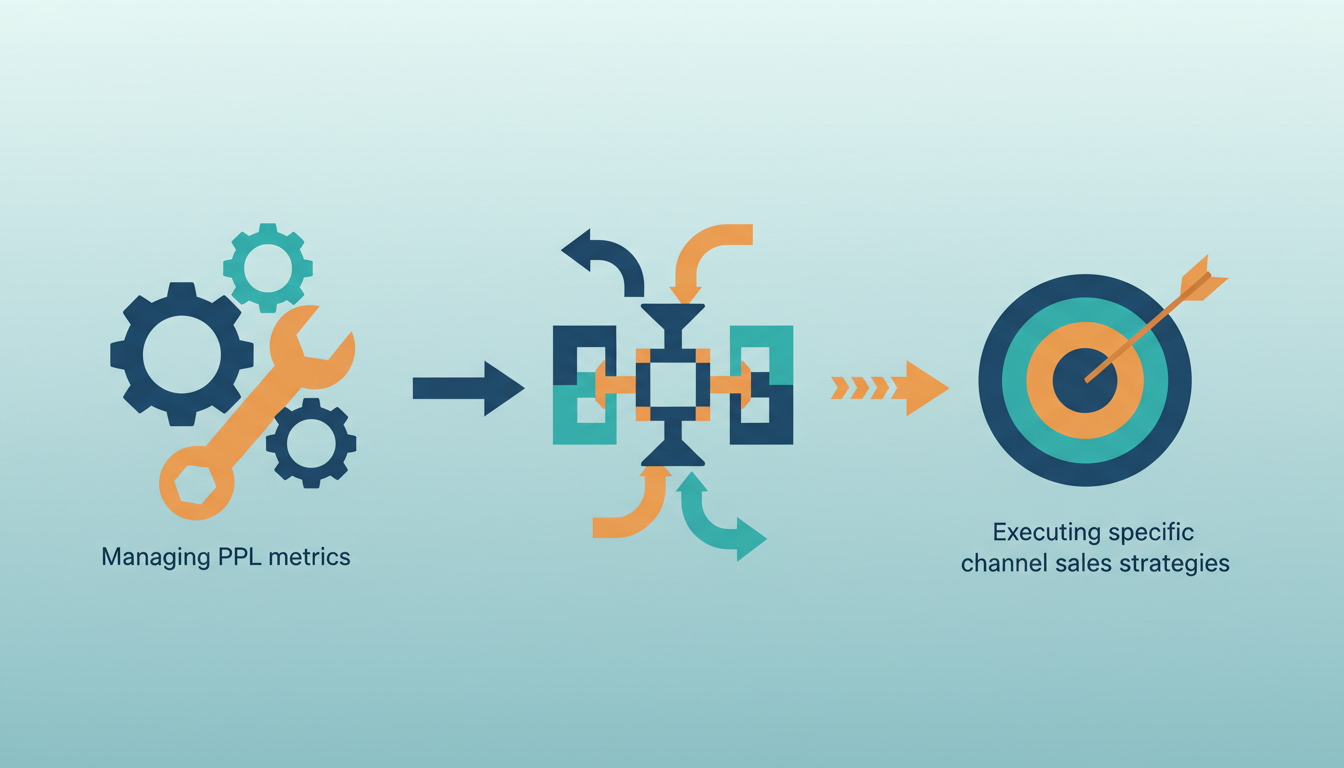
P&L leadership in automotive sales demands unifying ERP data streams to expose margin leakage across distribution and retail channels. Proven management requires linking commercial acumen directly to operational efficiency metrics rather than relying on aggregate revenue growth. A mid-market distributor eliminated $650,000 in annual overhead by implementing governed architecture to unify commerce operations. This financial discipline enables leaders to fund strategic expansions, such as launching 60 new applications for Electric Power Steering portfolios. However, aggressive cost consolidation risks alienating professional installers who require flexible, localized support structures. Centralized efficiency often conflicts with the decentralized agility needed for rapid field response. Operators must balance these competing forces to sustain profitability.
| Channel Flexible | P&L Lever | Risk Factor |
|---|---|---|
| Distribution | Volume discounts | Margin erosion |
| Retail | Shelf placement fees | Inventory bloat |
| Professional Installer | Technical training ROI | Technician shortage |
Ignoring this balance creates a fragile cost structure unable to absorb supply chain volatility. Leaders must prioritize data visibility over raw scale expansion.
Executing Portfolio Expansion with 168 New Heavy-Duty SKUs
On January 19, 2026, TERREPOWER announced the addition of 168 new SKUs to its heavy-duty portfolio, mandating immediate workflow recalibration. The mechanism for integration requires mapping these specific parts, comprising 122 turbochargers, 34 hydraulic components, eight alternators and starters, and four brake calipers, into existing distribution channels without disrupting legacy inventory logic. Evidence from the 2026 expansion data shows a deliberate technical focus on turbochargers and hydraulics rather than broad-spectrum coverage. Adding depth in specific heavy-duty categories creates a tension: inventory carrying costs rise if sales workflows do not strictly align with verified demand signals from professional installers. Generic stocking models fail here; operators must deploy targeted commercial acumen to move these specialized units.
| Component Type | Count | Integration Priority |
|---|---|---|
| Turbochargers | 122 | High |
| Hydraulic Components | 34 | Medium |
| Alternators/Starters | 8 | Low |
| Brake Calipers | 4 | Low |
Successful execution demands that sales teams distinguish between high-volume light-duty turnover and the slower, higher-value cycle of heavy-duty hydraulic components. A failure to segment these workflows results in misplaced stock and missed revenue opportunities in the industrial sector. The mechanism for risk mitigation involves redirecting capital from broad hiring toward targeted upskilling programs that address specific high-voltage gaps. Industry data indicates shops must invest heavily in training infrastructure over the next two years to bridge the proficiency gap. However, the cost of delaying this transition is measurable lost revenue as older internal combustion vehicles continue dominating the average vehicle age statistics near 13 years. Operators face a tension between maintaining profitable legacy repair volumes and funding the expensive certification required for future electric fleets. Ignoring this workforce deficit forces reliance on external specialists, eroding margin control. Strategic leadership must prioritize building internal capability rather than outsourcing complex electrical diagnostics. The implication for sales teams is clear: product portfolios must align with current technician skill sets while gradually introducing electrified components. Failure to synchronize inventory with workforce readiness results in stranded stock and idle bay capacity.
Strategic Playbook for Executive Succession and Sales Continuity
Defining the Strategic Window for Executive Succession in Sales
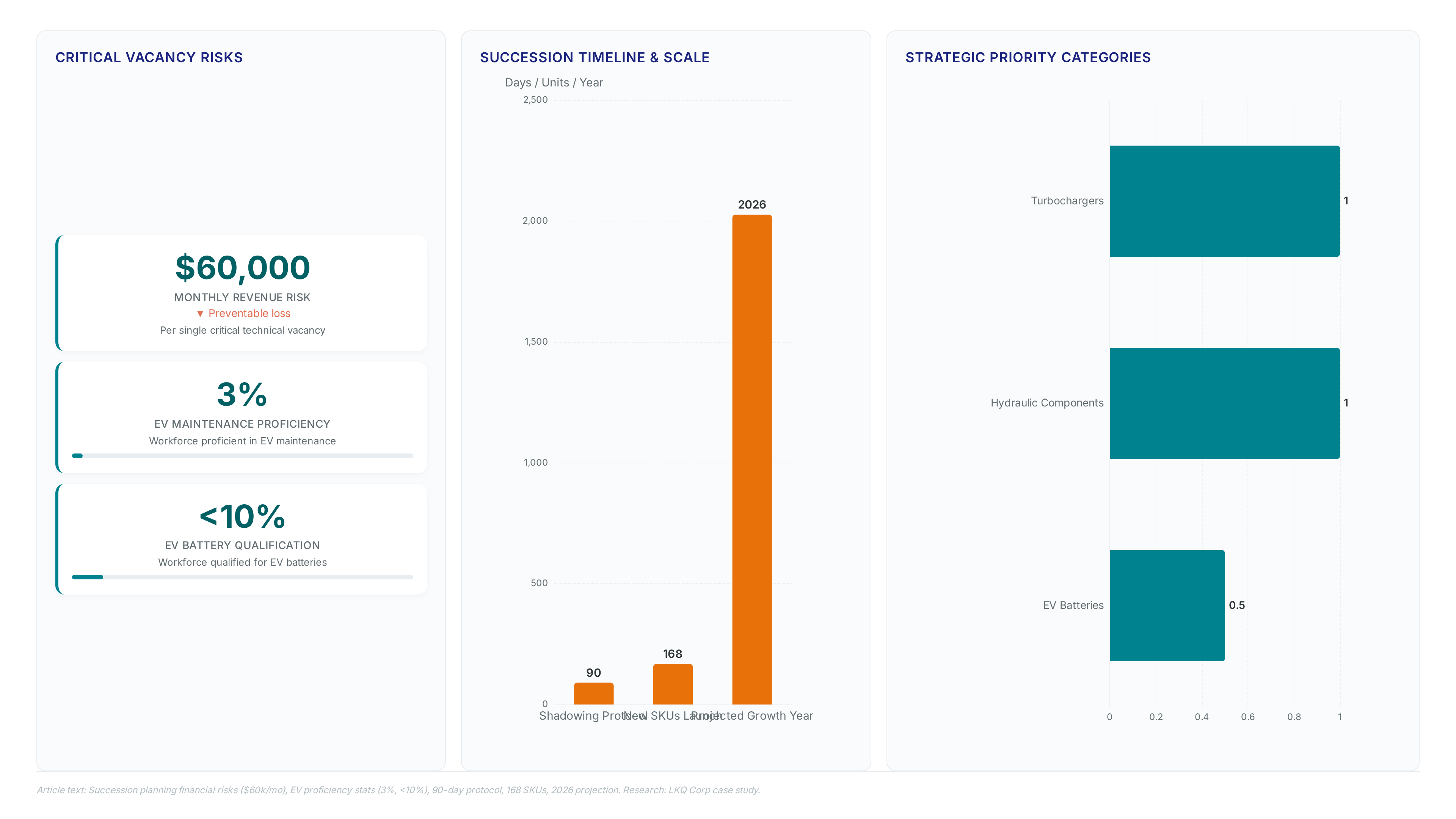
Succession planning must activate immediately upon a leader's retirement announcement to prevent operational drift during the handover period. Chris Garner's departure at year-end marks a fixed deadline that demands immediate workflow restructuring rather than passive observation. A proactive transition framework mitigates the risk of revenue loss, which can reach $60,000 per month for single critical vacancies in technical leadership roles. The mechanism for continuity involves overlapping tenure where the incoming executive assumes P&L responsibility before the incumbent exits. This approach captures institutional knowledge regarding the complex distribution network built over two decades.
Executing a leadership transition while launching 168 new SKUs requires embedding the incoming EVP into supply chain workflows before the incumbent departs.
- Map the 168 new SKUs directly to existing distribution channels to prevent inventory logic conflicts during the handover.
- Assign P&L responsibility to the successor immediately, using prior experience from substantial North American business units to stabilize revenue streams.
- Prioritize turbochargers and hydraulic components in training modules, as these specific categories drive the bulk of the heavy-duty expansion volume.
Unlike competitors expanding via thousands of parts for 600 million vehicles, this focused approach demands deeper product knowledge per SKU rather than broad coverage. A significant limitation is that shifting focus to heavy-duty restoration processes can temporarily slow inventory turnover if logistics teams lack specific training on remanufactured core flows. Operators must recognize that delaying this integration risks creating a knowledge vacuum where no single leader understands both the legacy independent aftermarket relationships and the new heavy-duty SKU mechanics. Products and Brands recommends synchronizing executive onboarding with product launch calendars to avoid these disjointed operational states.
Succession Validation Checklist for Electrification and Circular Manufacturing Strategies
Incoming leadership must validate readiness against tariff volatility and the electrification shift.
- Verify supply chain durability by confirming component restoration processes that bypass imported raw material costs.
- Audit technician training pipelines to address the severe shortage of personnel qualified for high-voltage systems.
- Align product portfolio expansion with near-shoring strategies to mitigate global trade friction risks.
| Validation Area | Legacy Approach | Required Strategy |
|---|---|---|
| Sourcing | Global raw materials | Local component restoration |
| Workforce | Generalist mechanics | High-voltage specialists |
| Risk Model | Cost-plus pricing | Tariff-immune modeling |
Relying on competitor hires often fails because external leaders lack specific knowledge of circular manufacturing workflows unique to TERREPOWER. The sustainable manufacturing model demands internal process mastery that generic sales experience cannot replicate. A leader hired from a traditional OEM may struggle to value restored parts equally against new inventory, creating friction in commercial strategy. External recruits frequently underestimate the complexity of validating worn cores versus machining new substrates. This specific operational nuance determines margin stability more than broad sales channel relationships. Failure to validate this technical fluency results in misaligned incentives during quarterly planning cycles.
About
Ray Donnelly, Master Automotive Technician and Aftermarket Parts Authority at KZMALL Auto Parts, brings over two decades of frontline experience to the analysis of independent aftermarket sales dynamics. Having transitioned from running a busy independent repair shop to leading technical content strategy, Ray understands the critical pressure points facing distributors and shop owners alike. His daily work involves validating fitment data across 50,000+ SKUs and ensuring accurate application for global markets, directly connecting him to the operational challenges discussed in leadership transitions like TERREPOWER's recent appointment. This practical background allows Ray to articulate why strategic executive moves are vital as the U.S. Market evolves. At KZMALL, where the focus remains on single-source supply chain efficiency for the independent channel, Ray's insights bridge the gap between high-level corporate strategy and the reality of the repair bay, offering readers a grounded perspective on industry evolution.
Conclusion
Scaling circular manufacturing exposes a critical fracture: generalist sales leadership cannot accurately value restored cores against new inventory, leading to margin erosion that traditional cost-plus models fail to predict. As the average vehicle age climbs, the operational bottleneck shifts from parts availability to the valuation accuracy of worn substrates. Without internal leaders who understand the nuance of core validation, organizations risk mispricing assets and losing competitive ground to entities that treat restoration as a science rather than an afterthought. The hidden cost isn't just lost revenue; it's the strategic drift that occurs when commercial incentives clash with technical realities.
Organizations must mandate that all succession candidates complete a 90-day shadowing protocol focused specifically on core validation workflows before any leadership transition occurs. This is not optional training; it is a prerequisite for maintaining pricing integrity in a volatile market. Do not rely on external hires from traditional OEM backgrounds to intuitively grasp these workflows, as their instinct to prioritize new manufacturing will undermine your restored parts strategy.
Start this week by auditing your current leadership pipeline to identify which candidates lack direct exposure to core grading and restoration processes. Schedule their immediate rotation into the validation floor to bridge this knowledge gap before the next quarterly planning cycle begins.
Frequently Asked Questions
TERREPOWER targets the sector's projected 5.2% annual growth. This expansion is fueled by an aging vehicle fleet requiring constant maintenance interventions across independent distribution channels globally.
Maintaining momentum is vital after Chris Garner's twenty-year tenure scaling operations. The organization must preserve its global engine serving ninety countries while adapting to new regulatory data landscapes.
An average vehicle age nearing thirteen years directly increases repair needs. This demographic shift forces distributors to prioritize professional installer models over traditional retail parts distribution strategies.
Allen brings over two decades of leadership experience across commercial landscapes. Her background includes managing profit and loss for major North American business units within the automotive aftermarket sector.
Restricted access to proprietary vehicle telematics limits diagnostic capabilities. Without equitable data rights, independent shops cannot effectively compete against authorized manufacturer dealer networks for complex repair services.