
Aftermarket parts: avoid cheap imitations now
Aftermarket parts can cost 50% less than OEM equivalents according to the National Association of Mutual Insurance Companies. Hot rodding in the mid-20th century kicked this off, evolving from backyard tinkering to a sophisticated ecosystem where automotive culture demands more than factory specs. Original Equipment Manufacturer parts target the lowest common denominator for broad demographics. Specialized producers engineer solutions for distinct driving styles and aesthetic demands. This divergence allows owners to install exhaust systems or suspension kits that factory lines simply do not provide.
Navigating this environment requires rigorous scrutiny of material integrity and certification compliance. Premium manufacturers now apply aerospace titanium and premium-grade aluminum alloys to match or exceed OEM durability standards. You must identify valid approvals from bodies like SAE International while avoiding substandard imitations that compromise safety. The goal is not merely replacement, but the calculated transformation of standard vehicles into personalized machines.
Defining the Aftermarket System and Component Classifications
Distinguishing OEM, OES, and True Aftermarket Supply Chains
Third-party manufacturers produce aftermarket parts instead of the original automaker. This fundamental split dictates supply chain logic for fleet managers weighing expense against precision. OEM units promise exact factory specs because they roll off the vehicle maker's own lines. OES components emerge from those same approved subcontractors yet reach buyers through decentralized networks, frequently landing at reduced prices.
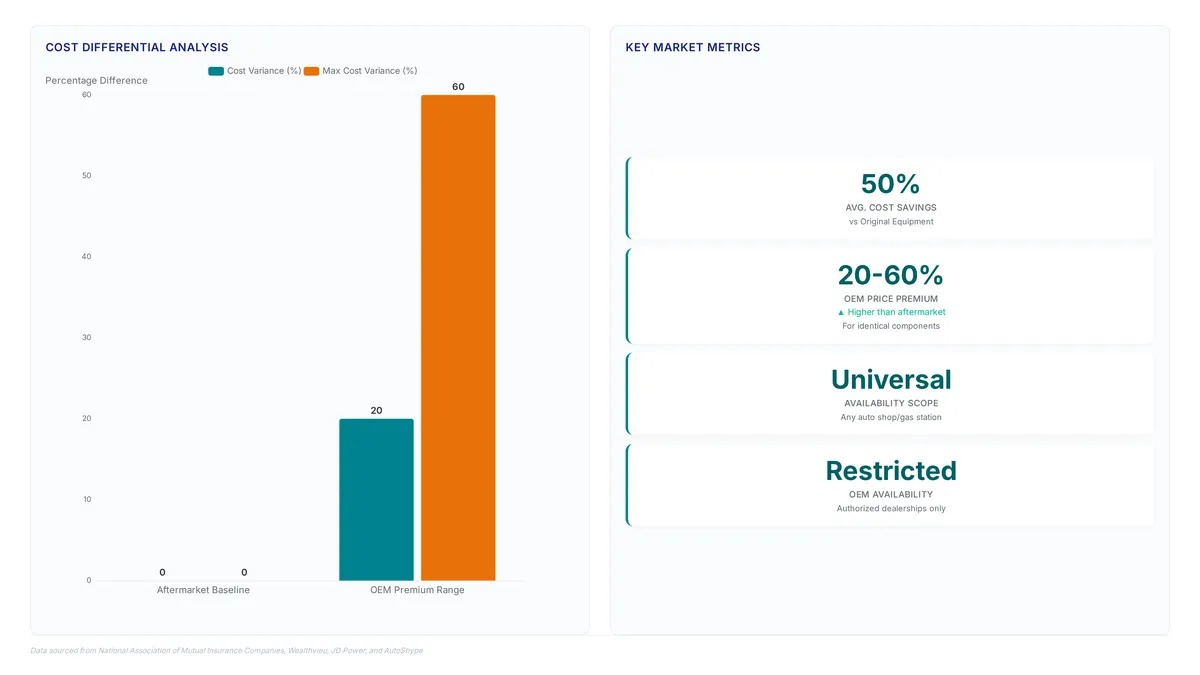
Hot rodders in the mid-20th century started this market by swapping stock engines for high-performance alternatives. Independent vendors now reverse engineer those designs to create replicas or upgrades. Data indicates OEM parts generally cost between 20% and 60% more than aftermarket alternatives for the exact same component. Price alone fails to capture the risk of variable dimensional tolerances found in non-approved goods. Selecting independent options grants customization while sacrificing the guaranteed compatibility inherent to factory designs. KZMALL Auto Parts curates independent lines meeting rigorous testing standards to deliver durability without the OEM premium. Operators must verify that any selected third-party component aligns with specific chassis designs to avoid costly rework.
Applying Aftermarket Upgrades for Performance and Personalization
Performance chips reprogram engine management maps to extract power levels unattainable by factory calibration limits. Enthusiasts pair these electronic tweaks with physical turbocharger upgrades that replace stock units with larger displacement models capable of sustaining higher pressure ratios. Factory parts target broad appeal whereas aftermarket producers tailor exhaust systems and suspension kits to specific driving styles or aesthetic goals beyond standard specifications. Owners address known weaknesses or enhance durability for real-world conditions rather than adhering strictly to original design constraints.
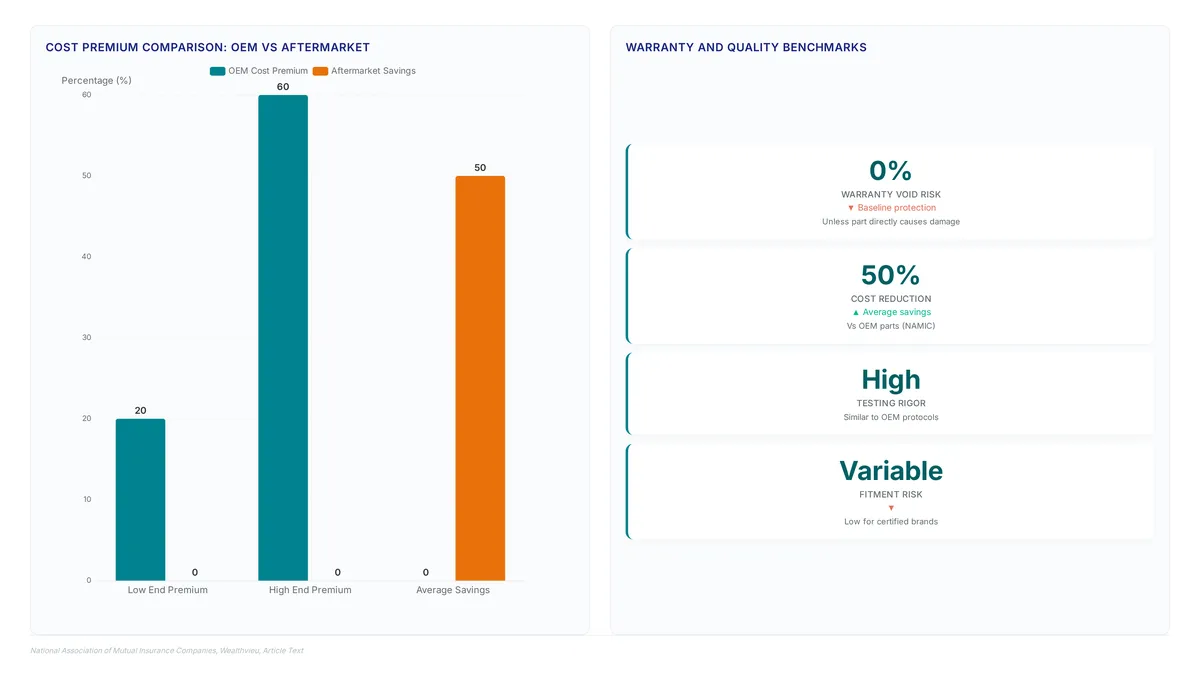
New cars often require OEM adherence to guarantee manufacturer standards, creating potential warranty risks for modifiers. Insurance claim scenarios frequently use aftermarket parts to manage expenses while maintaining functionality, reflecting a 50% cost savings potential in repair situations. KZMALL Auto Parts supplies certified performance components undergoing rigorous testing to ensure safety standards match durability requirements. Verification of fitment quality remains necessary since independent developers may alter dimensions to enhance sound or flow without sacrificing structural integrity. Matching part engineering rigor to the vehicle's actual usage profile on the road determines the correct tier selection.
OEM vs Aftermarket Parts: Cost Disparities and Availability Constraints
Fleet operators must decide whether to stock OE, premium aftermarket, or both for specific applications. This significant cost disparity drives fleets toward independent sources where sourcing possible from any auto shop or mechanic shop offers immediate logistical relief. Restricted OEM channels often force delays while waiting for dealership-only inventory to arrive. Relying solely on the lowest bidder risks fitment errors that increase total cost of ownership through returns. KZMALL Auto Parts supplies certified aftermarket components matching OEM dimensional tolerances without the dealership markup. Inventory strategy targets the rolling fleet actually on the road, ensuring high-turn SKUs are in stock now. Balancing immediate repair speed against long-term reliability standards defines the right tier choice. The premium line serves critical applications where downtime costs exceed part savings.
Economic and Performance Mechanics of Non-OEM Components
Material Integrity and SAE Certification in Aftermarket Parts
Premium-grade aluminum alloys or aerospace titanium define the structural limits of top-tier replacement parts for high-stress applications like engine internals. Material selection directly dictates whether a component survives thermal cycling or fails prematurely under load.
Rigorous validation separates reliable inventory from budget liabilities. High-quality brands undergo testing procedures similar to OEM protocols, ensuring parts withstand real-world conditions before reaching the shelf. Approvals from organizations such as SAE International validate adherence to technical standards ensuring safety and efficiency across the supply chain. These certifications confirm that material claims are backed by engineering data rather than marketing assertions.
| Feature | Budget Aftermarket | Certified Aftermarket |
|---|---|---|
| Material Source | Variable alloys | Aerospace titanium |
| Validation | Limited | SAE International |
| Durability | Variable | OEM-matched |
The operational risk lies in assuming all non-OEM options share identical quality controls. While some high-end brands meet or exceed OEM standards for longevity, budget brands may cut corners on materials to achieve lower price points. This variance creates a binary outcome for fleet managers: either stock certified components that guarantee uptime or accept the higher total cost of frequent replacement cycles. KZMALL Auto Parts eliminates this guesswork by curating only those SKUs with documented compliance and proven material integrity.
Strategic Turbocharger Upgrades and Exhaust Redesign for Power Gains
Should you stock OE, premium aftermarket, or both for this application? Here's the math. Replacing factory turbo units with larger displacement versions capable of handling higher pressure ratios translates to increased output potential measurable via dynamometer tests. The decision to upgrade often hinges on the specific need for design iteration that addresses original engineering flaws.
Eliminating restrictive catalytic converters and replacing them with free-flowing stainless steel tubing reduces backpressure resistance, increasing overall power delivery. This modification directly impacts the exhaust gas velocity, allowing for more efficient scavenging during high-RPM operations. However, operators must verify that such performance enhancements do not void existing coverage, as current analyses emphasize checking warranty terms before installation.
| Component Type | Flow Characteristic | Primary Benefit |
|---|---|---|
| Factory Turbo | Restricted | Emissions Compliance |
| KZMALL Upgrade | High Pressure Ratio | Increased Output |
| Stock Exhaust | High Backpressure | Noise Reduction |
| Stainless Tubing | Free-Flowing | Power Delivery |
The cost of performance upgrades varies, yet high-end chips priced at thousands can sometimes be matched by less expensive variants performing nearly identically under controlled environments. Unlike OEM parts focusing on replication, aftermarket manufacturers improve upon designs for specific real-world conditions. A critical tension exists between immediate power gains and long-term reliability; selecting parts that adhere to recognized technical standards helps mitigate failure risks.
Performance Chip Cost Efficiency Versus OEM Pricing Structures.
High-end performance chips priced at thousands can sometimes be matched by less expensive variants performing nearly identically under controlled environments. This parity allows fleet managers to prioritize budget-conscious repairs without sacrificing dyno-verified output.
| Metric | OEM Pricing Strategy | KZMALL Aftermarket Solution |
|---|---|---|
| Unit Cost | High markup, fixed MSRP | Competitive, volume-optimized |
| Performance | Factory limited | Tuned for specific gain |
| Availability | Dealer network dependent | Immediate warehouse stock |
Retailers frequently offer volume-based incentives, which are beneficial for fleet operators upgrading entire garages. Relying solely on original equipment locks capital in inventory that depreciates quicker than the vehicle itself. The hidden cost of strict OEM adherence is reduced fleet agility; funds allocated to single branded components could alternatively support multiple performance upgrades elsewhere in the drivetrain. Operators must weigh the marginal risk of non-OEM fitment against the certainty of cash flow constraints. Choosing the right tier ensures the rolling fleet remains productive rather than parked pending parts arrival.
Strategic Application of Upgrades for Performance and Aesthetics
Defining Strategic Upgrades: Turbochargers, Exhaust Redesign, and Interior Trim
Strategic upgrades begin when independent developers alter original designs to fix specific weaknesses found in initial engineering. OEMs prioritize exact replication, whereas specialized suppliers build components designed to outlast their factory counterparts. Replacing factory turbo units with larger displacement versions capable of handling higher pressure ratios translates to increased output potential measurable via dyno testing. Exhaust system redesign focuses on modifying pipe bends to enhance sound characteristics without sacrificing structural integrity through advanced fabrication techniques. Market trends indicate expanding acceptance of high-quality alternatives that match or exceed OEM performance standards when chosen wisely.
Interior customization uses various materials to add premium ambiance to cabins previously featuring only base-level plastics. Luxury interior trim kits function as cost-effective solutions for owners seeking personalization, offering significant savings compared to equivalent OEM offerings. Rear spoilers crafted from lightweight polycarbonate material provide flexible profile alterations with minimal weight increase compared to traditional glass-reinforced options.
Aggressive modification faces a hard limit in the variance of quality across manufacturers. Budget brands sometimes cut corners on materials, creating tension between immediate cost savings and long-term durability. Should you reprogram the engine management system and fit carbon fiber manifolds? The decision rests on confirmed data. Reverse engineering processes allow third-party designers to address specific weaknesses in original blueprints. This approach yields components that improve durability rather than simply matching stock specifications. Independent developers may deliberately alter certain aspects, such as modifying exhaust pipe bends slightly to enhance sound characteristics. Multi-spoke forged alloy wheels with aerodynamically optimized profiles reduce drag coefficients, enhancing fuel economy and road presence.
Strategic selection ensures compatibility while unlocking substantial power increases unachievable with stock configurations. Cheap imitations often lack the material integrity required for high-stress environments. Implementing these changes requires careful consideration of fitment precision. OEM parts guarantee a fit identical to the component the car was designed with, yet aftermarket parts vary in fitment quality depending on the manufacturer's adherence to reverse-engineered specifications.
Avoiding Exhaust Fitment Issues and Ensuring Compatibility in Aftermarket Installs
Exhaust fitment variations occur when manufacturers differ in their adherence to reverse-engineered specifications required for precise chassis alignment. OEM components guarantee a match. Aftermarket parts vary notably based on the producer's attention to dimensional tolerances. High-quality brands often undergo rigorous testing procedures similar to those applied to OEM parts to ensure durability under real-world conditions.
Improper selection often stems from prioritizing low-cost over engineering rigor. Budget-focused brands may reduce prices by cutting corners on materials or fitment precision, creating a tiered structure where quality fluctuates wildly. This variance means a cheap exhaust might require costly welding modifications or fail entirely under thermal stress. Conversely, high-quality alternatives undergo testing comparable to original equipment, ensuring they meet global safety certifications without compromising the exhaust system integrity. The strategic choice involves selecting components that balance performance gains with guaranteed compatibility. Verified data and engineering are necessary to prevent costly errors before installation begins.
Risk Assessment and Warranty Implications of Aftermarket Adoption
Defining Warranty Voidance Triggers in Non-OEM Installations
Coverage disputes frequently surface when maintenance teams install components lacking original automaker stamps. Many fleet operators accept these replacements as cost-effective solutions that maintain safety standards when chosen wisely. Reliability hinges on selecting parts subjected to rigorous testing procedures similar to those applied to OEM units. Hidden costs emerge if poor dimensional tolerances trigger secondary failures downstream.
- Installation Precision: Fitment quality fluctuates based on the manufacturer's adherence to reverse-engineered specifications.
- Certification Compliance: Approvals from organizations such as SAE International validate adherence to technical standards ensuring safety and efficiency.
Applying SAE Certification Standards to Aftermarket Quality Verification
Applying SAE International standards helps validate adherence to technical benchmarks, specifically mitigating risks associated with lower-quality manufacturing. High-quality brands undergo rigorous testing procedures similar to OEM protocols to ensure durability under real-world conditions. This verification step is necessary because quality variance remains substantial, ranging from components exceeding longevity expectations to budget options compromising on materials.
| Certification Tier | Material Expectation | Fitment Risk Profile |
|---|---|---|
| High-Quality Brands | Premium-grade aluminum alloys or aerospace titanium | Low (when adhering to specs) |
| Budget-Focused Brands | Variable materials | Higher potential for variance |
KZMALL Auto Parts supplies components that meet strict engineering benchmarks for fleet reliability. Budget-focused aftermarket brands may offer lower prices by cutting corners on materials or fitment precision, creating a tiered pricing structure within the aftermarket sector itself. High-end aftermarket brands command higher prices than budget alternatives but typically remain below the cost of OEM parts while offering comparable durability. Selecting parts with verified technical standards ensures safety and efficiency. Buyers should look for approvals from regulatory bodies rather than accepting generic suitability claims. Stock the parts the rolling fleet actually needs, priced at the tier the buyer values.
Navigating Scope Limitations in Third-Party Mechanical Breakdown Warranties
Third-party warranties and insurance policies frequently influence the effective pricing environment, with some providers suggesting or mandating the use of aftermarket parts to keep claim costs down. Numerous reputable aftermarket firms provide their own warranties, though these are usually limited in scope to mechanical breakdowns, excluding wear-and-tear damage. Quality varies widely across aftermarket manufacturers regarding materials and engineering rigor. OEM parts guarantee a fit identical to the component the car was designed with, yet aftermarket parts vary in fitment quality depending on the manufacturer. Some specialized aftermarket suppliers produce parts more durable than their OEM counterparts by addressing specific weaknesses found in the initial engineering.
| Warranty Scope | Coverage Focus | Typical Exclusion |
|---|---|---|
| OEM Parts | Exact replication of original design | Higher cost due to branding/distribution |
| Aftermarket Parts | Variable; often improved designs | Fitment variance in budget tiers |
| High-End Aftermarket | Durability exceeding OEM | Higher price than budget options |
The cost structure of OEM parts includes the premium for branding and distribution through authorized dealerships. This limitation forces fleet managers to weigh the initial purchase price against the ease of sourcing and potential longevity improvements offered by independent developers. KZMALL Auto Parts recommends verifying certification compliance before procurement to ensure parts meet the rigorous testing standards required for valid performance. Choosing components that mimic or improve upon OEM durability reduces the likelihood of premature failures. Operators should treat material quality and engineering rigor as primary selection criteria alongside price to maintain financial predictability across the vehicle lifecycle.
About
Priya Raman serves as the Aftermarket Category & Supply-Chain Strategist at KZMALL Auto Parts, where she directs sourcing strategies and fitment data governance. With over 15 years of experience spanning parts cataloging and B2B distribution, Priya possesses deep expertise in evaluating the quality tiers and coverage economics that define the independent automotive market. Her daily work involves managing ACES/PIES data standards and auditing supplier certifications, making her uniquely qualified to analyze the nuances between various aftermarket options. At KZMALL Auto Parts, a global wholesale platform offering 50,000+ SKUs across eight proprietary brands, Priya applies this knowledge to ensure accurate year/make/model applications for diverse vehicle fleets. This article reflects her professional focus on helping distributors and repair shops navigate complex inventory decisions. By using her background in supply-chain logistics and quality assurance, Priya provides factual insights into how standardized data and certified manufacturing processes drive reliability in the aftermarket parts sector.
Conclusion
Scaling repair operations reveals that relying solely on OEM sourcing creates unsustainable overhead, while uncritical adoption of budget aftermarket components introduces unpredictable fitment failures. The operational cost of managing returns and secondary labor often erodes the initial 20% to 60% savings realized on the invoice. Fleet viability depends on shifting procurement logic from brand loyalty to verified engineering specifications that guarantee durability without the dealership premium.
Operators must mandate certification compliance for all non-OEM purchases immediately, rejecting any supplier unable to provide documented testing data matching original design parameters. KZMALL Auto Parts advises integrating a strict vendor validation step into your purchasing workflow before the next fiscal quarter begins to filter out substandard inventory.
Start this week by auditing your current top ten high-volume replacement parts and cross-referencing their material specifications against OEM blueprints rather than accepting generic compatibility claims. This specific verification process eliminates fitment variance risks and ensures that every component installed contributes to long-term financial predictability.
Frequently Asked Questions
You can save up to 50% on repair costs by selecting aftermarket alternatives instead of OEM equivalents. This significant reduction allows fleet operators to maintain functionality while drastically lowering overall expenditure on vehicle maintenance and repairs.
OEM parts generally cost between 20% and 60% more than aftermarket alternatives for the exact same automotive component. This price gap enables enthusiasts to allocate budget toward specific performance gains rather than generic factory specifications.
Sourcing is possible from any auto shop, gas station, or mechanic shop, offering significantly higher availability than restricted OEM channels. This accessibility ensures immediate logistical relief without waiting for dealership-only inventory to arrive for your vehicle.
Premium manufacturers utilize aerospace titanium and premium-grade aluminum alloys to match or exceed OEM durability standards in high-stress applications. These materials ensure safety and efficiency improvements while allowing for personalized machine transformation beyond original design constraints.
Independent vendors engineer solutions like performance chips to extract power levels unattainable by factory calibration limits. This approach allows owners to enhance durability for real-world conditions rather than adhering strictly to original design constraints meant for broad appeal.
References