
ACES Fitment Logic: Stop Wrong-Part Returns Now
The U.S. Automotive aftermarket will hit $855 billion by 2028, yet most sellers fail because their fitment data is broken.
Your thesis is simple: mastering ACES fitment logic and PIES product attributes is the only way to capture revenue in a market where a brake pad for a 2018 Honda Civic might not fit a 2017 model. Spark Shipping projects this massive growth, but incorrect data guarantees returns and lost customers rather than market share. You cannot build a scalable operation on guesswork when the cost of error is a rejected shipment and an angry driver.
This guide dissects the internal architecture of these schemas, specifically how VCdb and PCdb databases interact to validate vehicle compatibility. We look at ACES 4.2 (Rev. 2), which the provider confirms supports both XML and JSON formats as of October 2024. You will learn why distinguishing between fitment logic and attribute data is critical for search visibility.
Finally, we quantify the return on investment from reducing return rates through precise Qualifier database implementation. Stop treating data standards as bureaucratic hurdles. They are the universal language required to translate inventory into sales without the friction of incompatibility errors destroying your reputation.
The Distinct Roles of ACES Fitment Logic and PIES Product Attributes
ACES 4.2 and VCdb: The Compatibility Language for Vehicle Fitment
A part fitting the shelf instead of the engine bay creates immediate waste. ACES (Aftermarket Catalog Exchange Standard) stops this mismatch by acting as the strict compatibility language for the entire industry. The ACES 4.2 revision mandates precise mapping via XML or JSON to handle tens of millions of distinct vehicle configurations. This standard relies on the VCdb (Vehicle Configuration database), a core technical component containing detailed attributes like year, make, model, and engine type required for accurate fitment mapping. Without this granular data, a brake pad listed for a 2018 model might incorrectly ship for a 2017 variant, triggering immediate returns.
Three specific databases work in concert to manage these relationships:
- VCdb: Defines the specific vehicle identity and engine parameters.
- PCdb: Standardizes part terminology and categorization logic.
- Qdb: Provides qualifying notes regarding position or specific trim requirements.
- ACES Updates: Reflects new vehicles entering the market monthly.
The Auto Care Association updates these standards to reflect new vehicles and parts entering the market, ensuring the standard stays current as automotive technology advances. This discipline ensures the vehicle fitment data powering your "Check Fit" tool reflects actual road configurations rather than approximations. Accurate implementation here acts as consumer protection, preventing the legal liability associated with selling incompatible safety components.
PIES Standardization for Digital Assets and Hazardous Material Compliance
PIES defines the product attributes, digital assets, and compliance data that fitment logic ignores. Customer needs the hazard class before the box ships. While ACES handles vehicle matching, the Product Information Exchange Standard governs the physical and regulatory details of the part itself. This includes digital assets like high-resolution images and technical diagrams alongside critical shipping specifications. Manufacturers apply these standardized formats to cut catalog setup time notably when launching products on new platforms. The standard also manages hazardous material classifications and packaging configurations required for legal transport.
Compliance carries operational considerations beyond simple data entry. Annual access costs vary depending on company size, representing an investment that must be weighed against the operational costs of not having standardized data, as the time saved in catalog management often justifies the expense. PIES data structures include specific attributes such as weight, country of origin, dimensions, and warranty information alongside basic part numbers.
Neglecting these fields can lead to significant logistical challenges, as accurate hazardous material declarations are required for legal transport. Validating every shipping specification against carrier requirements before publishing is necessary to prevent delays. The constraint is clear: invest in proper data infrastructure to ensure smooth operations and avoid the costs associated with stalled shipments and returned freight. Precise attribute mapping prevents the warehouse from becoming a graveyard for non-compliant inventory.
ACES vs PIES: Distinguishing Vehicle Configuration from Product Attributes
ACES defines vehicle compatibility while PIES describes the physical part itself. This distinction separates the question of "will it fit" from "what is it." ACES relies on the VCdb to map year, make, and engine attributes to specific parts. Conversely, PIES manages product weight, digital assets, and hazardous material certifications independent of the vehicle.
The U.S. Incorrect fitment data leads to returns, negative reviews, and lost customers when these standards overlap poorly. However, PIES implementation cuts catalog setup time notably by standardizing how manufacturers share product details across platforms. Successfully using these standards requires understanding that ACES and PIES serve as distinct technical domains: one for vehicle configuration and one for product attributes. Operators must treat vehicle configuration and product attributes as distinct technical domains to ensure data integrity across the supply chain. Buy the part the vehicle was engineered for, not the one that looks close.
Internal Architecture of Automotive Data Schemas and XML Transmission
VCdb, PCdb, and Qdb: The Three Databases Driving ACES Fitment Logic
Fitment logic fails when the vehicle configuration lacks specific engine codes. The VCdb (Vehicle Configuration database) stores year, make, model, and engine type to define the target vehicle scope precisely. This database acts as the primary index for compatibility checks. Manufacturers relying on broad categories miss the nuance required for modern engines. The PCdb (Parts Configuration database) standardizes part terminology across the supply chain. It links specific part numbers to valid VCdb entries, ensuring a brake pad maps only to compatible chassis codes. Data interoperability between manufacturers and retailers collapses without this standardized categorization. Confusion reigns when part names vary by supplier. The Qdb (Qualifier database) adds necessary granularity for complex applications. It specifies position, notes, or submodel restrictions that broad categories miss. These three databases interact dynamically to filter tens of millions of distinct vehicle configurations down to a single valid match. Precision here prevents the wrong part from reaching the driveway.
| Database | Primary Function | Data Content |
|---|---|---|
| VCdb | Vehicle Definition | Year, make, model, engine type |
| PCdb | Part Standardization | Categories, terminology, part types |
| Qdb | Fitment Qualifiers | Position, notes, submodel details |
Operators must verify that their XML transmission includes all three database references. Missing a qualifier from the Qdb often results in a "fits most" error rather than a confirmed fit. KZMALL Auto Parts technicians verify these links before listing any inventory to prevent costly returns. Incomplete data sets invite fitment errors that damage customer trust. The Auto Care Association mandates review periods for updates to keep these databases current. Precise mapping reduces returns by confirming compatibility before the sale occurs. Buyers get the right part the first time.
From Monthly Batches to Daily Updates: Implementing the New Auto Care API
Legacy monthly batch cycles delay fitment corrections until after customers order wrong parts. The Auto Care Association released a new API in November 2024 to enable daily database synchronization for subscribers. This shift eliminates the latency where incorrect VCdb mappings persist for weeks, driving up return rates. Speed matters when vehicle specs change overnight. Implementing this requires moving from static file uploads to continuous endpoint polling. The process involves four distinct technical steps:
- Authenticate using credentials provided in the 15-page API Usage Guide.
- Query the endpoint for delta changes since the last successful sync timestamp.
- Parse incoming JSON payloads to update local PCdb references.
- Validate new vehicle configurations against existing Qdb qualifiers before publishing.
| Feature | Legacy Batch Process | New Daily API |
|---|---|---|
| Update Frequency | Monthly | Daily |
| Data Latency | High (up to 30 days) | Low (24 hours) |
| Error Resolution | Delayed until next cycle | Immediate next-day fix |
| Bandwidth Usage | High ( | Low (incremental only) |
Operators often overlook that daily synchronization demands stricter local validation logic to prevent corrupt data from propagating quickly. A single malformed XML record in a daily stream can break category filtering quicker than a monthly dump. The Auto Care Association mandates this architectural shift to support modern eCommerce velocity. Older systems relying solely on XML may require schema updates to handle the new stream format efficiently. This transition reduces the window where inaccurate fitment data causes customer friction. Y Monthly Daily Data Latency High up to 30 days Low 24 hours Error Resolution Delayed u ily Data Latency High up to 30 days Low 24 hours Error Resolution Delayed until next cyc. The clock stops ticking on bad data with daily syncs.
XML vs JSON Encoding in ACES 4.2: Selecting the Right Transmission Format
Legacy XML parsers struggle with the verbosity required for complex fitment matrices in high-volume catalogs. ACES 4.2 (Rev. 2) explicitly supports JSON formats to address this, offering a lighter payload for real-time API calls. The shift from exclusive XML usage reflects a broader industry move toward flexible web-based data integration. Bandwidth savings add up over millions of transactions.
| Feature | XML Legacy | JSON Modern |
|---|---|---|
| Payload Size | High overhead | Compact syntax |
| Parsing Speed | Slower validation | Native JavaScript |
| Use Case | Batch uploads | Live queries |
However, migrating existing VCdb mappings to JSON requires rigorous schema validation to prevent data loss. The constraint is that while JSON reduces bandwidth, legacy ERP systems often lack native JSON decoders, forcing a dual-format maintenance strategy. This limitation means smaller distributors might delay adoption despite the efficiency gains. Accurate encoding directly lowers return rates by ensuring part compatibility data transmits without truncation errors. Without strict adherence, suppressed listings occur when marketplace validators reject malformed vehicle configuration tags. The cost of incorrect encoding exceeds the effort of format migration.
Measurable ROI from Reduced Returns and Enhanced Search Visibility
ROI Mechanics: How Fitment Accuracy Drives Reduced Returns
Exact fitment data stops returns by confirming compatibility before a shopper finishes checkout. Cash flow improves immediately when reverse logistics costs drop because the right part reaches the right customer. This operational change turns data management from paperwork into a profit engine. Search engines depend on this precision to match specific vehicle queries, so retailers using structured standards gain organic visibility. Ignoring these protocols invites listing errors across the tens of millions of distinct vehicle configurations in the current market. Annual access fees represent a substantial investment, yet the cost of unchecked returns often dwarfs this initial expense.
KZMALL Auto Parts advises buying the part the vehicle was engineered for, not the one that looks close. Incorrect fitment data creates returns, negative reviews, and lost customers without rigorous validation. A catalog filled with invisible or returned inventory is the penalty for skipping validation. Products appear where buyers search and fit when they arrive only through proper schema adherence.
Amazon Parts Finder Template and eBay Motors Compatibility Systems
Amazon mandates ACES data submission, requiring it to be received directly from a manufacturer, brand owner, or an approved third-party data provider. This specific configuration prevents incompatible purchases before they occur. EBay Motors uses fitment specificity as a primary driver for search visibility within its compatibility system. Retailers ignoring these distinct platform rules lose organic traffic to competitors with cleaner data structures.
Substantial marketplaces increasingly prefer data originating directly from manufacturers or approved providers rather than generic submissions. Simple data translation is no longer sufficient for long-term stability because of this shift toward verified provenance. Sellers relying on unverified mapping risk listing errors when platforms tighten enforcement protocols. Rapid catalog expansion creates tension with the rigorous validation required to maintain search engine optimization performance. Consistency meets the unique structural demands of each sales channel without duplicating effort through this approach. Precise implementation here directly reduces the reverse logistics burden caused by fitment errors.
Legal Exposure from PIES Non-Compliance and Hazardous Material Errors
The PIES standard mandates specific fields for regulatory data, including hazardous material information and compliance certifications. Accurate vehicle fitment acts as a primary consumer protection layer; errors here directly enable product liability issues and warranty disputes. Incorrect listings could lead to warranty claims or product liability issues. Retailers face severe legal action when mishandling causes property damage or injury. Operators ignoring safety certifications face compounded risks beyond simple returns, as standardized data is becoming necessary for protecting profit margins.
Search algorithms now penalize non-compliant catalogs, making data quality non-negotiable for SEO. The hidden cost involves more than shipping; it includes the legal defense required when a part fails catastrophically due to bad data. Failure to validate these attributes leaves inventory exposed to fitment errors and customer dissatisfaction.
Executing a Compliant Migration to ACES 4.2 and PIES Formats
The Five-Step ACES 4.2 Adoption Roadmap
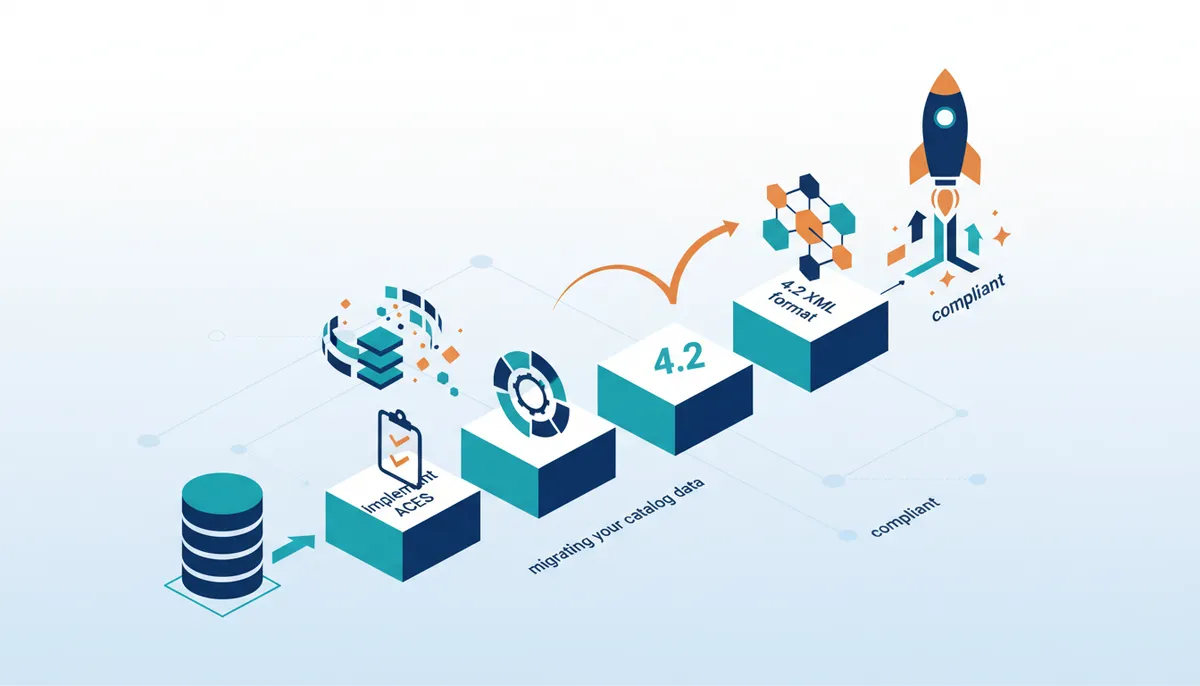
Successful migration begins with Step 1: Assessment and Planning to inventory existing fitment records against current vehicle configurations. This initial audit reveals gaps before technical work starts, preventing wasted effort on corrupted data. Step 2: Choose Approach determines whether your team builds internally or uses partners for complex transformations. Covering over 20,000 part types requires dedicated Product Information Management (PIM) systems. Step 3: Data Preparation focuses on cleaning and normalizing records to meet strict schema requirements. The industry shifted toward JSON support in late 2024, offering flexible web integration alongside traditional XML structures. You can review the official API Usage Guide to understand specific implementation paths. Step 4: Technical Integration connects your cleaned data to eCommerce platforms using these updated standards. Finally, Step 5: Validation and Optimization tests the customer experience to ensure accurate search results. Monitoring key performance indicators like reduced returns validates the investment. While the upgrade demands resources, accurate fitment data is non-negotiable for search engine optimization and organic visibility.
Managing Data Volume with PIM Systems for Large Catalogs
Managing data for tens of millions of distinct vehicle configurations presents significant complexity. Attempting to manage this Data Volume and Complexity without strong systems increases the risk of fitment errors that drive up return rates. A PIM system acts as the central truth source, ingesting raw manufacturer data and mapping it to the correct VCdb vehicle configurations before export. Without this layer, maintaining consistency across multiple marketplaces becomes increasingly difficult as the catalog scales. Operators should implement validation rules that ensure records include critical PIES attributes like hazardous material status or package dimensions. This approach prevents the propagation of bad data into your eCommerce feed, protecting your brand reputation on platforms with strict compliance mandates. The cost of ignoring this governance is a fragmented catalog that confuses customers and increases support tickets. Technical teams should configure their PIM to handle both XML and JSON outputs to maximize compatibility with diverse retailer requirements. Regular updates via the Auto Care Association standards ensure your fitment data remains current.
- Ingest raw supplier data into the PIM staging area.
- Apply transformation rules to align with ACES 4.2 schema requirements.
- Validate fitment against the latest Vehicle Configuration Database.
- Export standardized feeds to sales channels and marketplaces.
Failure to automate these steps leaves revenue vulnerable to preventable fitment mismatches.
Validation Checklist: Governance, Automated Error Checking, and Monthly Updates
Buy the part the vehicle was engineered for, not the one that looks close; your data pipeline needs the same discipline. Start by establishing governance procedures that include regular validation and clear protocols for data maintenance. This prevents bad fitment logic from reaching customers and causing returns.
| Check Frequency | Focus Area | Required Action |
|---|---|---|
| Daily | Digital Assets | Verify image links match part numbers |
| Monthly | VCdb Updates | Sync new vehicle configurations |
| Quarterly | Governance | Audit team access and roles |
The Auto Care Association releases monthly updates to the Vehicle Configuration Database that must be integrated to maintain accuracy. Adhering to these cycles ensures your catalog reflects new models and removes obsolete parts. Companies using structured data report that accurate fitment ensures the right part reaches the right customer, directly reducing return volume. However, relying solely on automation misses context clues that a trained technician spots during manual review. The cost of skipping this dual-layer validation is measurable in lost trust and increased logistics fees. Implement this validation loop in your system configuration:
Planning for these monthly updates is necessary to keep inventory data current and.
About
Ray Donnelly serves as the Master Automotive Technician and Aftermarket Parts Authority at KZMALL Auto Parts, bringing over two decades of hands-on experience from the repair bay to global parts distribution. His unique qualification to discuss ACES and PIES data standards stems directly from his daily work preventing costly fitment errors for B2B partners worldwide. Having transitioned from running an independent shop to managing technical content for KZMALL's 50,000+ SKUs, Ray understands that precise Year/Make/Model/Engine matching is the difference between a successful installation and a returned part. At KZMALL, a global B2B brand owned by Hangzhou Kuaizhun, he uses these exact standards to ensure accurate cataloging across eight proprietary brands. His expertise bridges the gap between complex data protocols and real-world application, helping distributors and repair shops avoid the pitfalls of incorrect fitment data that plague the industry.
Conclusion
Scaling auto parts distribution breaks when data latency creates a thirty-day blind spot between vehicle releases and catalog availability. While the market expands toward an $855 billion valuation, operational friction increases exponentially for sellers relying on delayed error resolution cycles. The hidden cost is not merely a returned item but the permanent erosion of customer confidence when fitment logic fails. You must transition from reactive correction to proactive governance immediately. Treat your data pipeline with the same engineering rigor as the components you sell.
Implement a dual-layer validation strategy that combines automated schema alignment with manual technical review before any monthly VCdb sync. Do not wait for the next quarterly audit to address access roles or image mismatches. Start by mapping your current transformation rules against the latest ACES 4.2 schema requirements this week to identify gaps in your vehicle configuration coverage. This specific alignment ensures your system recognizes new models before customers attempt invalid purchases.
Prioritize reducing your data latency window from thirty days to under twenty-four hours to capture early adopter demand. Companies that enforce daily digital asset verification alongside monthly database updates eliminate the ambiguity that drives return rates. Your immediate focus must be establishing a governance protocol that mandates these frequent checks rather than relying on sporadic manual intervention. Secure your share of the expanding aftermarket by ensuring your fitment data remains the single source of truth for every transaction.
Frequently Asked Questions
Standardized formats cut catalog setup time by 50%. This speed allows brands to launch products on new platforms much faster than competitors using manual entry methods. (formats)
The sector will reach $855 billion by 2028. Sellers with broken fitment data will fail to capture this massive revenue potential despite the overall industry growth. (massive)
Incorrect data guarantees returns and lost customers immediately. A brake pad listed for a 2018 model might ship for a 2017 variant, causing customer anger and wasted shipping costs. (data)
ACES defines vehicle compatibility while PIES describes the physical part. Confusing these two distinct standards prevents accurate search visibility and causes logistical challenges with hazardous material declarations. (standards)
VCdb defines vehicle identity while PCdb standardizes part terminology. These databases work in concert to validate compatibility across tens of millions of distinct vehicle configurations accurately. (databases)
References