
ACES fitment data: stop costly catalog errors
Managing thousands of SKUs without standardized data formats invites critical fitment errors and reputation damage.
The automotive aftermarket industry relies exclusively on ACES and PIES standards to define vehicle compatibility and product specifications respectively. While ACES manages complex fitment attributes like engine and transmission types, PIES handles the actual product details, pricing, and digital assets required for machine-readable formats. Failure to maintain these distinct data streams results in poor customer experiences and inflated return rates that erode profit margins.
You will learn the distinct operational roles of fitment data versus product specifications and why conflating them creates inventory chaos. Finally, we discuss how centralizing governance prevents the fragmentation that plagues retailers who lack reliable internal infrastructure.
The Distinct Roles of ACES Fitment and PIES Product Specifications
ACES Fitment Data and PIES Product Specifications Set
Stop treating fitment and product data as a single stream. ACES maps parts to specific Year, Make, Model, and Engine attributes found in the vehicle configuration database. This standard isolates application logic so a component matches precise mechanical constraints instead of generic descriptions. Defining these four dimensions stops incompatible sales that drive return rates in the aftermarket sector.
PIES governs product data like part numbers, pricing, digital assets, and detailed specifications independent of vehicle applicability. This separation creates a modular architecture where product attributes stay distinct from fitment matrices. Retailers update descriptions without altering compatibility rules. The technical division ensures XML file exports maintain integrity across disparate inventory systems and online marketplaces.
| Feature | ACES Focus | PIES Focus |
|---|---|---|
| Primary Data | Fitment (Year/Make/Model/Engine) | Product Attributes & Pricing |
| Function | Application Logic | Part Description |
| Output Goal | Vehicle Compatibility | Product Detail Accuracy |
Distributors rely on this dual-standard structure to eliminate catalog friction. Operational risk emerges when teams treat these streams as interchangeable. Merging them prematurely corrupts the data structure and invalidates cross-references. Precise segregation allows infrastructure to scale part counts without exponential growth in fitment errors. Clean, structured fitment data reduces returns and improves conversions. Customers find exact parts without confusion. Maintaining discrete streams for fitment data and product information supports the accuracy required for high-volume catalog management.
Applying ACES and PIES Standards in North American Aftermarket Catalogs
Participants deploy ACES and PIES standards to harden catalog integrity across the United States, Canada, and Mexico. These protocols ensure vehicle configuration database entries align with regional requirements rather than generic global templates. Operators using these protocols gain improved fitment precision. The XML format acts as the structural spine for this exchange. Machine-readable XML file transfers bypass manual entry errors inherent in legacy spreadsheet workflows.
Rigid adherence to these schemas creates friction for retailers lacking automated validation tools. Lost shelf space and increased return rates measure the cost of this fragmentation due to fitment ambiguity. Effective management resolves tension by enforcing strict schema compliance at the ingestion layer. Every auto parts catalog entry meets exacting requirements of regional specificity. This approach reduces guesswork in automotive aftermarket data management.
Distinct Data Domains: ACES Vehicle Configuration vs PIES Product Attributes
Standards enforce a strict separation where ACES manages the automotive application matrix while PIES governs detailed product attributes. This architectural divide isolates fitment logic from descriptive data. Part specifications remain safe from corruption by vehicle compatibility rules. The separation helps maintain catalog integrity across complex inventory systems. Industry standards maintain these as exclusive formats. Vehicle configuration updates do not inadvertently alter product definitions.
| Domain | Primary Function | Data Focus |
|---|---|---|
| ACES | Fitment Logic | Year, Make, Model, Engine |
| PIES | Product Details | Attributes, Pricing, Assets |
Fitment tables scale independently without re-indexing entire product libraries. Businesses update digital assets in the XML format without recalculating thousands of vehicle matches. Modularity reduces the risk of systemic errors during high-volume data exchanges. Proper segregation ensures fitment data remains agile. Product information stays consistent across all sales channels.
Operational Challenges in Maintaining Data Accuracy Across Channels
Volume-Driven Friction in ACES and PIES Data Management
High-volume SKU catalogs create structural friction because a single part can match hundreds of vehicle configuration database combinations. This mechanical complexity escalates when manual workflows attempt to synchronize ACES fitment logic with PIES product attributes across fragmented systems. The separation of fitment and product data represents a modular architectural trend that demands specialized handling to prevent operational errors. Without centralized governance, these disjointed processes generate conflicting records that directly degrade inventory accuracy.
| Workflow State | Data Outcome | Operational Risk |
|---|---|---|
| Manual Entry | Inconsistent attributes | High return rates |
| Siloed Systems | Fragmented listings | Lost sales revenue |
| Centralized PIM | Unified truth | Compliance assurance |
Siloed architectures remain a primary barrier where ERP, PIM, and ecommerce platforms fail to communicate smoothly. When these systems do not communicate smoothly, data management becomes fragmented, leading to inconsistencies in product data, fitment information, and product listings across channels. The sheer volume of parts data often leads to critical pricing or fitment errors that cascade into reputation damage. A significant challenge persists here: newer updates to PIES standards support more flexible formats beyond traditional XML format, increasing the need for adaptable data management systems. Operators face ongoing challenges in migrating legacy product data into new structures and maintaining compliance across multiple databases as the Auto Care Association updates specifications. The cost of inaction is measurable through increased returns and diminished customer trust in digital catalogs.
Resolving Fitment Errors in Multi-Database Automotive Catalogs
The sheer volume of product data involved in managing thousands of SKUs creates critical errors in fitment information or pricing when accuracy lapses across systems. These issues often cascade into returns, poor customer experience, and long-term reputation damage within the automotive aftermarket industry as noted by Credencys. Retailers rely on precise fitment and product information to prevent incompatible purchases, yet fragmented databases frequently serve conflicting attributes.
| Failure Mode | Root Cause | KZMALL Solution |
|---|---|---|
| Missing vehicle years | Incomplete fitment data | Automated VCDB gap analysis |
| Conflicting attributes | Siloed product databases | Unified PIES attribute mapping |
| Wrong classifications | Outdated standard versions | Real-time Auto Care Association sync |
Common issues include incomplete fitment data, conflicting product attributes across databases, outdated digital catalogs not aligned with the current version of standards, and incorrect product classification database mapping. Even small gaps in data accuracy can lead to incorrect purchases, returns, and poor customer experience. This approach ensures that every XML format export contains verified compatibility paths.
Reputation Damage from Evolving PIES Standards and Fragmented Systems
A single vehicle can have thousands of compatible parts, creating massive surface area for data accuracy issues when systems fail to synchronize. Fragmented architectures prevent the rigorous fitment logic required to prevent returns, as ACES and PIES are exclusive standards tailored specifically for the complexities of vehicle compatibility which general standards do not address. This mechanical disconnect allows incorrect purchases to slip through, directly fueling customer dissatisfaction and brand erosion in the aftermarket sector.
Siloed systems remain one of the biggest barriers in managing ACES and PIES effectively, often requiring manual reconciliation that struggles to keep pace with evolving specifications.
| Failure Mode | Operational Consequence |
|---|---|
| Asynchronous Updates | Divergent fitment data across sales channels |
| Format Mismatch | Lost product attributes during transfer |
| Legacy Limits | Inability to adopt new standard versions |
Reliance on disjointed tools leaves operators exposed to the chaos of mismatched part numbers that plague non-specialized inventory systems. The cost of inaction extends beyond immediate returns; it fundamentally compromises the digital foundation required for modern parts distribution.
Centralizing Automotive Data Governance with PIM Systems
PIM Systems as the Single Source of Truth for Automotive Parts
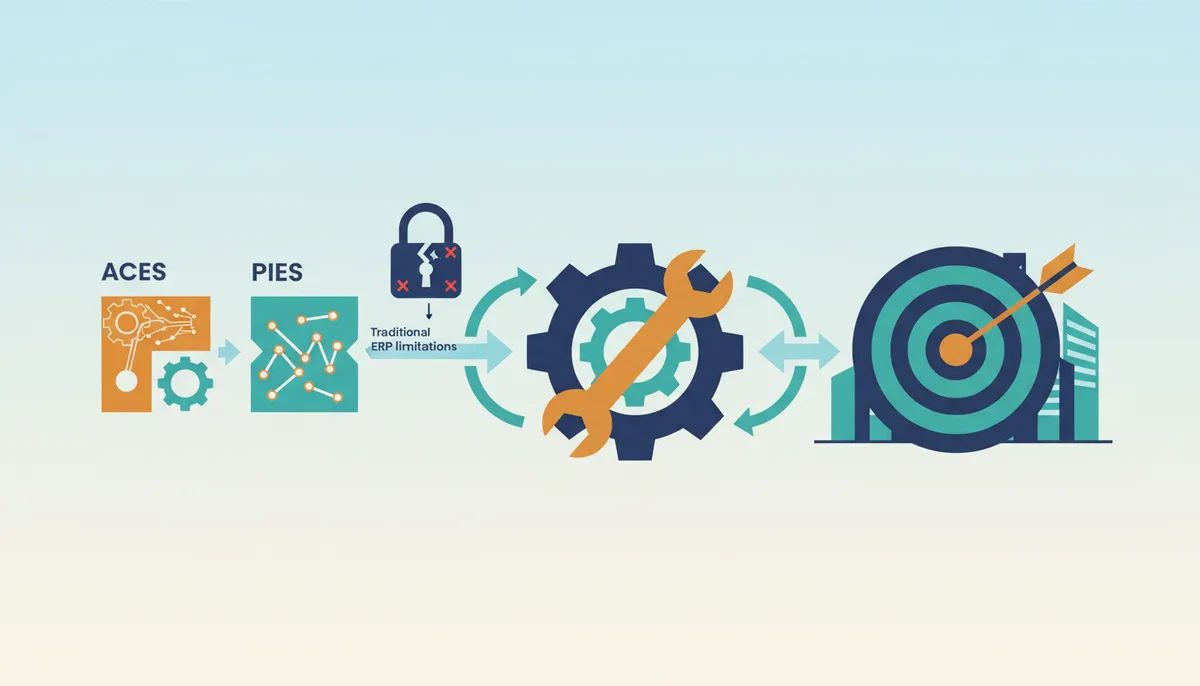
Disparate databases create chaos when automotive parts lack a central home. A Product Information Management system functions as a central repository for ACES and PIES data, helping to consolidate information that might otherwise exist in disconnected systems. Generic formats often lack the specific functional separation required here because ACES manages specific fitment data while PIES handles distinct product data attributes. This architectural divide ensures inventory systems receive consistent signals rather than conflicting reports. Data management becomes fragmented when ERP, PIM, and ecommerce platforms fail to communicate, leading to inconsistencies in product data and fitment information across channels.
Operators often assume standard ERPs suffice for high-volume parts catalogs. Managing thousands of SKUs across automotive parts catalogs can lead to critical errors in fitment information or pricing when data accuracy is not maintained. The complexity is significant. A single part can match hundreds of vehicle configuration database combinations. A single vehicle can have thousands of compatible parts. Businesses struggle to align product specifications with current vehicle configuration database entries without a unified layer, leading to incompatible part recommendations. Effective management requires transforming physical constraints into machine-readable formats that drive digitalization across the entire supply chain. Centralized governance models aim to eliminate the friction caused by disjointed data workflows.
Deploying PDM Automotive PIM for Real-Time ACES Validation
Specialized tools verify ACES and PIES records against the latest vehicle configuration database standards through direct integration. This application supports accuracy by confirming Year, Make, Model, and Engine compatibility. Clean, structured fitment data reduces returns and improves conversions. Generic tools often miss the detailed distinction where ACES governs fitment while PIES defines product attributes, leading to cross-channel listing failures. Their PIM solution has been shown to reduce fitment errors through automated audits and centralized data management.
Catalog scale determines whether a business needs a dedicated PIM for ACES PIES. Large-scale product listings involve significant complexity stemming from the volume of parts data and evolving standards. Digital catalogs require strong validation loops to maintain data integrity across disparate sales channels. Operational tension exists between rapid SKU onboarding and strict adherence to evolving exchange formats. Incomplete fitment data, such as missing vehicle years or configurations, can lead to incorrect purchases and returns. Fragmented systems create barriers to managing ACES and PIES effectively. Automated audits reduce the manual burden of checking thousands of XML file entries against current VCDB codes. This shift allows technical teams to focus on complex mapping issues rather than routine syntax errors. Conflicting product attributes across databases and outdated digital catalogs not aligned with the current version of standards remain common issues.
PIM vs ERP: Specialized Governance for Digital Catalog Management
Traditional systems often face challenges when mapping complex ACES and PIES relationships. Enterprise resource planning systems excel at financial tracking yet may treat product attributes as static fields rather than flexible, vehicle-specific variables. Fitment data fractures when synced across multiple sales channels under these conditions. Specialized PIM platforms function as a single source of truth, supporting the hierarchical structures needed for accurate aftermarket cataloging. Fragmented data management systems contribute to the complexity of managing large-scale product listings.
The technical divergence lies in how each system handles the digitalization of physical part constraints into machine-readable formats. This capability ensures that product attributes remain consistent regardless of the downstream marketplace. Operators managing high SKU counts must recognize that generic tools may not replicate the semantic precision required for modern auto parts commerce.
Executing a Compliant ACES and PIES Implementation Strategy
Defining the PIM-Driven Workflow for ACES and PIES Compliance
A PIM-driven workflow creates a single source of truth to bridge the gap between fitment logic and product attributes. ACES handles application data while PIES manages product specifications, creating distinct streams that need specialized handling within a unified architecture. This modular design prevents vehicle configuration database updates from corrupting static product descriptions during synchronization cycles.
Siloed systems create substantial hurdles when managing ACES and PIES effectively. Disconnected ERP, PIM, and ecommerce platforms cause data fragmentation, resulting in inconsistent product data, fitment information, and listings across channels.

- Manage high volumes of SKUs where a single part can match hundreds of vehicle configuration database combinations.
- Map fitment data against VCDB standards to validate year, make, model, and engine type compatibility.
- Enforce product attribute rules to address conflicting attributes across databases and outdated digital catalogs.
- Distribute verified records to sales channels to ensure consistent product listings across online retailers and marketplaces.
Disconnected systems frequently cause critical errors in fitment information or pricing when accuracy slips across multiple databases. These mistakes trigger returns, damage customer experiences, and harm long-term reputations within the automotive aftermarket industry. Businesses risk listing parts that fit technically but fail compliance checks due to outdated attribute definitions without tight coupling between data domains. Such errors degrade trust with online retailers who demand high-precision inventory management beyond simple return costs. Centralization turns raw data into a reliable commercial asset.
Automation tools reduce manual entry errors notably. Cloud-based repositories sync inventory levels instantly across all sales channels. Version control tracks every change made to product specifications over time. Role-based access limits who can modify critical fitment attributes.
Executing Data Audits and Mapping Attributes to PIES Standards
Effective data audits start by isolating fitment logic from static product attributes to find structural gaps before mapping begins. Technical architecture separates these domains since ACES handles application data while PIES manages part specifics, requiring distinct validation streams to prevent cross-contamination of errors. Managing these standards across large-scale product listings involves complexity from the volume of parts data, evolving PIES standards, and fragmented data management systems.
- Address incomplete fitment data, such as missing vehicle years or configurations, to prevent incorrect purchases.
- Map fitment data against the latest vehicle configuration database to ensure year-make-model accuracy.
- Validate product attributes like specifications and brand information against current PIES schemas for marketplace compliance.
- Execute automated audits to flag incorrect product classification database mapping or malformed XML structures before distribution.
This structured approach stops manual entry from creating cascading failures in downstream catalogs. Centralized management solutions handle the sheer volume of product data involved in managing thousands of SKUs, reducing critical errors that human reviewers often miss during high-volume updates.
Rapid catalog expansion conflicts with strict adherence to evolving PIES standards because rushing uploads often bypasses necessary schema validation. Network operators face a clear reality: without rigorous pre-mapping audits, businesses publish incompatible parts that trigger costly returns and erode buyer trust across digital channels.
Missing vehicle years confuse buyers immediately. Conflicting product attributes appear across different databases. Outdated digital catalogs fail to align with current standard versions. Incorrect product classification database mapping breaks search functions. Legacy systems struggle to parse modern XML file formats.
Validating Implementation Success via Return Rate and Update Efficiency Metrics
Validation starts by tracking return rate reduction to quantify fewer returns caused by incorrect product fitment or poor fitment information. Operators must measure how quickly new product details move from source to live listings via catalog update efficiency. This dual-metric approach confirms that integrating ACES with eCommerce platforms directly addresses root causes of customer dissatisfaction.
- Monitor return rate reduction trends to verify that updated fitment data prevents mis-matched purchases across the United States, Canada, and Mexico.
- Measure the latency between receiving supplier specifications and publishing accurate product attributes to maintain competitive precision.
- Track error identification rates to ensure customers receive accurate and consistent data that reduces dissatisfaction and returns.
| Metric | Focus Area | Operational Goal |
|---|---|---|
| Return Rates | Fitment Accuracy | Minimize logistics costs from wrong parts |
| Update Speed | Data Freshness | Accelerate time-to-market for new SKUs |
| Error Rates | Validation Logic | Prevent bad data from reaching storefronts |
Implementing these standards supports inventory management systems by keeping data provided to customers accurate and consistent. Reducing returns often requires stricter validation that may initially slow down catalog update efficiency, presenting a tangible constraint. Teams must balance speed against accuracy based on their specific volume of ACES and PIES transactions.
About
Dmitry Volkov serves as a Senior Automotive Technical Writer at KZMALL Auto Parts, where he specializes in translating complex engineering specifications into precise, actionable catalog data. His daily work involves rigorously validating ACES and PIES standards to ensure that KZMALL's extensive portfolio of over 50,000 SKUs maintains flawless vehicle fitment across global markets. This deep, hands-on experience with vehicle configuration databases and product attribute mapping makes him uniquely qualified to address the challenges of aftermarket data management. At KZMALL, accurate data is not merely an administrative task but the foundation of their single-source supplier model, ensuring that independent repair shops and distributors receive reliable parts for every application. By using his expertise in standardizing fitment information, Volkov helps KZMALL deliver the high-quality, certified components that define their competitive edge in the fragmented global automotive aftermarket.
Conclusion
Scaling automotive data operations reveals that manual validation collapses under the weight of complex vehicle configurations, turning catalog update efficiency into a primary operational bottleneck. While initial strictures on fitment data may slow ingestion speeds, the long-term cost of unchecked errors far exceeds the investment in reliable automation. Relying on sporadic checks rather than systemic integration guarantees that return rates will remain unacceptably high as inventory depth increases.
Organizations must commit to a full migration toward automated ACES and PIES compliance within the next two quarters to remain viable. This transition requires replacing legacy parsing tools with solutions capable of handling modern XML complexities without human intervention. Do not attempt to patch existing spreadsheets; the structural integrity of the data demands a dedicated engine designed for these specific industry.
Start this week by auditing your current error identification rates against your product attributes volume to establish a baseline for improvement. This single metric will expose whether your current workflow can handle increased scale or if it requires the specialized architecture that KZMALL Auto Parts provides. Only by securing this foundation can distributors ensure that customers receive accurate information that prevents dissatisfaction before the sale occurs.
Frequently Asked Questions
ACES data manages four critical dimensions for precise fitment. These attributes include Year, Make, Model, and Engine type to ensure parts match mechanical constraints accurately.
These standards cover three specific North American countries for implementation. The geographic scope includes the United States, Canada, and Mexico to align with regional requirements.
The standards distinguish between two primary data domains for clarity. ACES handles automotive application data while PIES manages product information like part numbers.
Merging these streams prematurely corrupts the data structure entirely. This error invalidates cross-references and causes system-wide failures in high-volume catalogs.
This separation isolates fitment logic from descriptive product attributes safely. It allows updates to descriptions without altering compatibility rules or breaking integrity.
References