
Fitment platforms stop auto parts returns now
The global automotive eCommerce market will hit $343 billion by 2032. Generic storefronts cannot handle the load.
Success here demands OroCommerce to manage complex fitment data and massive SKU counts that break standard solutions. We are replacing fragmented legacy systems with specialized B2B platforms. The payoff lies in multi-level permissions and custom pricing models that generic tools simply cannot replicate.
Market analysis forecasts for the automotive B2B e-commerce sector cover a specific projection window from 2026 through 2030, indicating a structured timeline for industry growth and standardization (market analysis). Competitors like Admark Automotive try to simplify operations by stitching together third-party integrations with SEMA Data and Turn 14 Distribution. That approach adds friction. True scalability comes from an integrated foundation built for repair shops, fleets, and global distributors.
The Role of Specialized B2B Platforms in Modern Auto Parts Distribution
Defining the Five-Layer Automotive B2B ECommerce System
Forget the old silos. Modern automotive B2B eCommerce demands five interlocking layers: product and fitment data standards, ordering platforms, live inventory visibility, invoicing automation, and vehicle data access. This unified architecture replaces a patchwork of disconnected tools. Without ACES, PIES, or TecDoc compliance, buyers doubt part compatibility. Returns spike. Margins evaporate.
Specialized platforms bake CPQ directly into these fitment layers. Generic platforms lack the deep catalog logic needed for complex vehicle applications, leaving gaps in the buyer experience. Accurate fitment data is the differentiator. Year/Make/Model selectors must prevent incorrect orders before checkout, not after.
| Layer Component | Primary Function | Critical Standard |
|---|---|---|
| Fitment Data | Ensures part compatibility | ACES, PIES |
| Ordering Platform | Enables complex B2B transactions | CPQ, RFQ |
| Live Inventory | Prevents overselling across channels | Real-time Sync |
| Invoicing | Automates financial reconciliation | EDI, e-invoicing |
| Vehicle Data | Anchors catalog to specific assets | VIN Lookup |
Three pillars hold up fitment data management: ACES, PIES, and TecDoc. Distributors use these to map parts to specific Year/Make/Model configurations, achieving accuracy generic catalogs miss. Integrating these layers directly eliminates the manual cross-referencing that causes shipping errors.
The mechanism requires strict adherence to data schemas. ACES manages vehicle attributes while PIES handles product descriptions. This separation keeps search results precise in high-volume environments. Fitment data management dies without these three pillars. The definition of CPQ in auto parts goes beyond price; it validates configuration rules against live fitment tables before a quote ever generates.
| Standard | Function | Impact on Returns |
|---|---|---|
| ACES | Vehicle mapping | Reduces wrong-fit claims |
| PIES | Product attributes | Improves search precision |
| TecDoc | Global compatibility | Expands market reach |
Syncing these standards demands constant updates as new vehicle models release. Non-compliance costs show up in logistics waste, not software fees. Operators ignoring this face margin erosion from preventable restocking events. Embedding these protocols natively ensures every SKU carries verified fitment metadata. Fitment becomes a competitive moat, not a compliance checkbox.
B2B vs B2C Auto Parts Sales: Scalability and Catalog Complexity
B2B auto parts sales need hierarchical pricing and bulk order logic. B2C models cannot support this natively. Consumer transactions chase single-unit velocity. Distributor workflows require complex permission structures and negotiated contract terms. Capturing value here takes more than a standard storefront. Managing large catalogs and real-time inventory is the baseline for earning repeat business from fleets and repair shops.
Generic platforms stumble over the catalog complexity inherent in automotive distribution. They often need third-party apps just to handle fitment attributes. Specialized architectures manage massive SKU counts natively without performance degradation. Some entities build proprietary engines to improve catalog precision while geolocating stock.
| Feature | B2C Retail Model | B2B Distributor Model |
|---|---|---|
| Pricing Logic | Static MSRP | Tiered, Contract-Based |
| Order Volume | Single Unit | Bulk/Pallet Quantities |
| Checkout Flow | Immediate Payment | Quote-to-Cash Workflow |
| Catalog Depth | Simplified View | Full Technical Hierarchy |
Effective platforms balance an intuitive front end with the technical attributes required for accurate fitment data. Solutions that expose deep technical hierarchies only to authorized users ensure scalability without sacrificing accuracy.
Inside the Architecture of OroCommerce for Complex Automotive Catalogs
Centralizing ERP, WHMS, and PIM Data via APIs
OroCommerce centralizes external system data from ERP, WHMS, and PIM sources using strong APIs. This eliminates the high costs and risks of manual entry. Complex pricing calculations and product updates flow digitally, removing error-prone human intervention.
| Data Source | Function | Integration Benefit |
|---|---|---|
| ERP | Financials & Orders | Centralizes contract management |
| WHMS | Inventory Location | Enables multi-site fulfillment logic |
| PIM | Fitment & Attributes | Supports massive SKU scalability |
Digitizing these workflows allows the system to handle contract management and negotiations automatically. Unlike generic retail solutions, this approach addresses the complexity of managing compatibility data across diverse catalogs. New specialized tools are emerging as differentiators here. The platform supports custom storefront themes, ensuring branding consistency while integrating heavy app integrations for fitment data.
- Ingest master product data from PIM systems.
- Sync real-time stock levels from warehouse management.
- Apply customer-specific pricing rules from ERP.
The operational consequence is clear: when customers order from a personalized self-service portal open 24/7, order processing costs drop notably. The platform accommodates the complex pricing logic inherent to wholesale automotive trade, supporting bulk ordering capabilities and tiered pricing structures. Distributors benefit from digitized workflows that manage custom prices and pre-negotiated terms efficiently.
Deploying 24/7 Self-Service Portals to Cut Order Costs
Mechanics need access now, not during business hours. Order processing costs drop notably when they access a personalized self-service portal open 24/7. OroCommerce deploys this architecture to resolve slow catalog search performance and fix inventory sync issues across distributed warehouses. The mechanism relies on native API centralization of ERP and WHMS data, ensuring real-time stock visibility without manual entry risks.
| Workflow State | Manual Process | OroCommerce Automated Portal |
|---|---|---|
| Catalog Search | Static PDF lists | Real-time VIN lookup |
| Order Entry | Phone/Email delays | 24/7 Self-service |
| Data Sync | Daily batch updates | Instant API sync |
This approach empowers sales teams with a mobile-friendly CRM system natively integrated into the eCommerce platform. Representatives manage complex pricing negotiations while buyers self-serve. The industry is moving toward a standardized five-layer system that integrates product data and invoicing, shifting away from siloed solutions. Geolocation services further optimize this model by mapping inventory proximity to the customer for real-time delivery network efficiency.
The platform supports the volume required for the expanding online parts market by enabling bulk orders by SKU while maintaining strict contract-based rate structures. Automating these workflows removes friction. Digital tools handle routine replenishment, freeing human capital for high-value strategic accounts.
Validating Multi-Website Hierarchy and KPI Replication
Should you stock OE, premium aftermarket, or both for this application? Here's the math. OroCommerce validates multi-website hierarchy by replicating internal organizational structures from a single admin console. This ensures distinct storefronts for OEMs and aftermarket resellers. The architecture monitors KPI replication across the system, preventing data silos that plague generic sellers using disjointed front-ends.
| Deployment Scope | Generic Aggregation | OroCommerce Unified Admin |
|---|---|---|
| Hierarchy | Manual per-site config | Centralized replication |
| KPI Visibility | Fragmented dashboards | Unified system view |
| Fitment Logic | Basic attribute mapping | Complex compatibility rules |
Many parts sellers apply hybrid models where the selling surface lacks deep catalog logic, requiring integration to handle fitment data effectively. The quote-to-cash workflow functions by automating negotiations and contract rates within these hierarchies. Bulk ordering triggers correct tiered pricing without manual intervention. Operators manage multiple websites from a single admin, allowing for the replication of internal hierarchies and monitoring of KPIs. The industry shift toward a standardized five-layer system demands rigorous validation of how product data interacts with invoicing automation. OroCommerce ensures every replicated site inherits the correct pricing structures and permission sets automatically. This eliminates the risk of selling parts at retail prices to wholesale accounts due to configuration drift.
Strategic Advantages of OroCommerce Over Generic eCommerce Solutions
Defining B2B-First Architecture vs Generic eCommerce Foundations
Here's the math. B2B-first architecture embeds unlimited SKU management and custom pricing logic into the database schema rather than applying them as surface-level plugins. Software built from the ground up for B2B complexities ensures that contract rates and volume discounts execute natively. The industry projection of a $343 billion global market by 2032 demands a foundation that handles massive scale without performance degradation. Pivoting smoothly between business models accommodating wholesale distributors, retail consumers, and government fleets remains a core architectural tenet rather than an afterthought. Specialized systems offer inherent capabilities necessary for complex hierarchies. This structural difference determines whether your digital storefront scales with your inventory or struggles to maintain efficiency.
Deploying Multi-Language Portals for Global Auto Parts Expansion
Enter new markets by offering components in multiple languages, currencies, and location-specific payment options. This approach directly addresses the complexity of B2B selling for gears and accessories across desktop, tablet, and smartphone devices. The platform allows for managing an unlimited number of SKUs and inventory for wholesale business-to-business buyers and retail consumers. Operators must verify that localized payment gateways integrate effectively to support location-specific options.
A generic storefront might display prices correctly but fail to process the specific debit or credit instruments preferred in the target region. This friction causes cart abandonment even when the catalog is perfectly translated. Rushing rapid deployment often breaks deep localization. Distributors must also consider that custom pricing structures vary by region, requiring a system that handles complex hierarchies natively rather than through fragile overrides. Failure to align payment methods with local norms renders the entire expansion effort moot regardless of catalog size. Investing in a purpose-built architecture addresses these requirements from the start. Choose a platform that treats regional nuance as a core database attribute rather than an afterthought.
Generic Platforms vs OroCommerce: Scalability and Future-Proofing Metrics
As vehicle counts rise globally, the density of automotive fitment data requires strong management. KZMALL Auto Parts recommends purpose-built architecture to handle this specific volume without performance decay. Native B2B complexities support smooth pivots between B2B, B2C, and B2G models. This flexibility is vital because there are more cars, trucks, and other vehicles than ever, demanding partners that offer genuine future-proofing rather than temporary fixes. Operators relying on static systems risk losing share as buyers demand the custom pricing and real-time inventory visibility that only specialized hubs provide. Unlike adapted retail tools, the platform delivers necessary performance boosts designed specifically for high-volume automotive distribution. Maintaining a unified, scalable foundation ensures data integrity as catalog depth increases. KZMALL Auto Parts ensures your digital infrastructure grows with the rolling fleet, securing revenue through architectural alignment with industry demands.
Implementing a Scalable Auto Parts Storefront with Integrated ERP
OroCommerce Architecture for Unlimited SKU Management
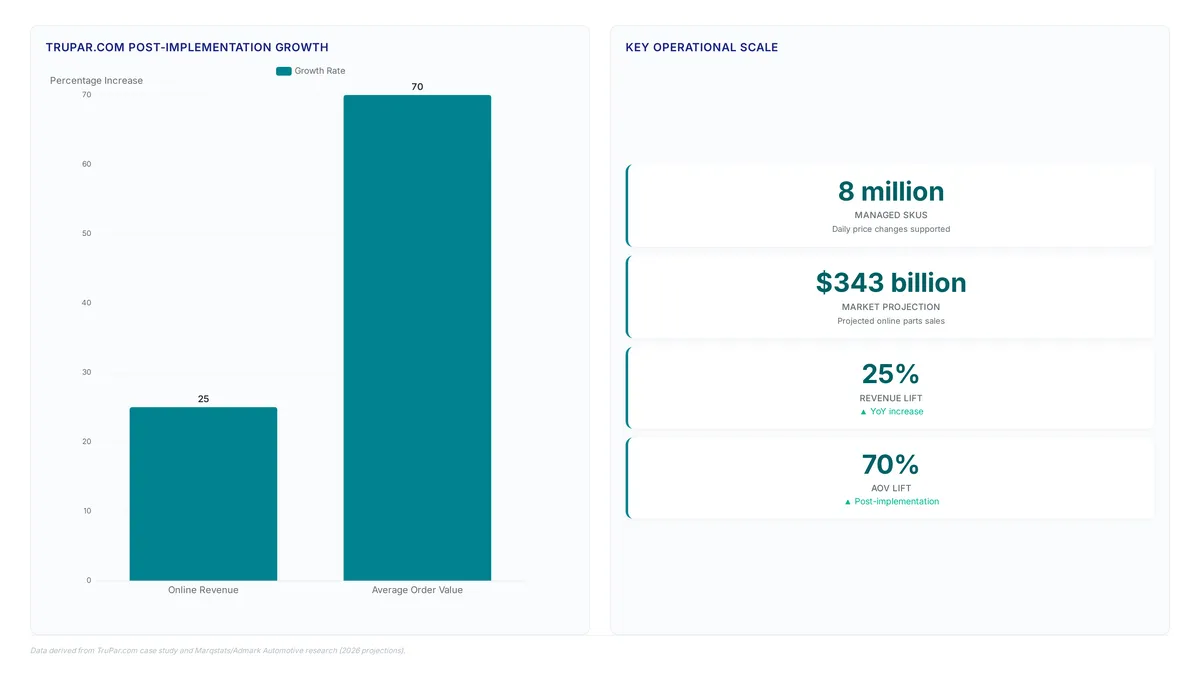
Start by configuring the platform to ingest massive datasets. This is a necessity for managing the unlimited number of SKUs required by wholesale buyers and retail consumers. Generic storefronts often stumble when rendering complex fitment hierarchies, forcing many parts sellers to rely on disjointed third-party apps for basic catalog logic. Solutions that unify these data streams natively ensure part attributes drive search and filtering without external patches.trupar.com manages 8 million SKUs and daily price changes, a scale that was impossible with other eCommerce systems prior to using OroCommerce.
- Ingest raw manufacturer data into a centralized product information hub before mapping to storefront categories.
- Configure flexible pricing engines to process fluctuations across regional sites instantly.
Generic platforms often fail to synchronize complex volume discounts with live inventory levels, creating margin leakage during peak demand. Native logic that evaluates contract rates and tiered pricing without external plugins supports the bulk ordering and custom pricing necessary for the auto parts sector. This approach addresses the need for transparent and custom pricing that keeps business dealerships and merchants coming back.
- Define regional pricing rules that account for location-specific payment options and currencies.
- Integrate geolocation services to map customer proximity against warehouse stock for accurate delivery windows.
- Validate ERP synchronization by confirming real-time data flows before replicating hierarchies across websites.
Prioritizing this sequence helps prevent inventory drift during high-volume transactions by centralizing data from external systems such as ERP, WHMS, PIM, and.
- Verify that product data updates from your ERP reflect instantly on all regional storefronts.
- Confirm that internal business hierarchies mirror the buyer's organizational structure for accurate approval workflows.
- Test custom pricing logic to ensure volume discounts apply correctly without manual intervention.
Generic platforms often struggle with the complex data requirements needed for precise parts compatibility, whereas specialized management ensures consistency across vehicle models. Failure to align these hierarchies results in incorrect pricing visibility for wholesale buyers.trupar.com achieved a 25% increase in online revenue and a 70% increase in AOV after implementation.
| Feature | Native Logic | Standard Connectors |
|---|---|---|
| Hierarchy Depth | Multi-level permission-based access | Flat or limited tiers |
| Price Updates | Complex pricing calculation workflows | Scheduled batch jobs |
| Regional Rules | Multiple languages and currencies | Global override only |
Operators must recognize that managing multiple websites from a single admin panel requires strong API architecture to avoid data silos. While some sellers rely on external tools for fitment data, native integration reduces the risk of mismatched listings. A misaligned hierarchy during this expansion creates friction that drives B2B buyers to competitors with clearer purchasing paths.
About
Priya Raman, Aftermarket Category & Supply-Chain Strategist at KZMALL Auto Parts, brings 15 years of specialized experience in parts cataloging and B2B distribution to the discussion on automotive eCommerce platforms. Her daily work managing over 50,000 SKUs across eight proprietary brands requires rigorous governance of ACES/PIES fitment data, directly aligning with the critical need for accurate digital catalogs in the industry. At KZMALL Auto Parts, a global wholesale platform for the independent aftermarket, Priya oversees the integration of standardized fitment data that ensures precise year/make/model applications for customers ranging from repair shops to fleet operators. This deep operational involvement in sourcing, inventory economics, and digital catalog architecture qualifies her to analyze how reliable eCommerce foundations drive repeat business. By using KZMALL's single-source supplier model and certified quality standards, she illustrates how proper data management transforms complex parts knowledge into tangible margin for B2B buyers navigating the fragmented global market.
Conclusion
Scaling automotive B2B operations reveals that data silos become the primary bottleneck when hierarchy logic fails to match buyer organizational structures. The operational cost of misalignment is not merely technical; it directly erodes trust when volume discounts fail to apply instantly during checkout. Success requires shifting from reactive connector patches to native architecture that enforces complex pricing workflows and multi-level access controls without manual intervention.
Distributors must prioritize validating real-time ERP synchronization before attempting further regional expansion or multi-site replication. This approach ensures that product data updates reflect immediately across all storefronts, preventing the friction that drives buyers to competitors. You should start this week by testing your current volume discount logic against a simulated multi-tier buyer account to identify any latency or calculation errors before they impact revenue. Only platforms built with deep, native integration can sustain the transaction velocity required to capture the expanding online share of the aftermarket. Securing your data foundation now prevents the compounding errors that occur when scaling without a unified administrative core.
Frequently Asked Questions
Specialized platforms drive significant online revenue increases for auto parts distributors.trupar.com achieved a 25% increase in online revenue after implementation, proving that targeted architecture directly boosts financial performance for wholesalers.
The correct digital foundation substantially raises the average value of each transaction. Data shows a 70% increase in AOV after implementation, indicating that better fitment data and search tools encourage larger bulk purchases.
Generic tools often crash under the weight of massive SKU counts and complex fitment data. Without native support for ACES and PIES standards, these systems cannot prevent the returns that erode profit margins.
The massive global market volume demands robust infrastructure to handle complex distribution needs. With the sector projected to hit $343 billion by 2032, only scalable solutions can manage the required catalog depth.
Adhering to fitment standards prevents incorrect orders before they occur, saving logistics costs. This accuracy reduces restocking events and ensures that every SKU carries verified metadata for buyer confidence.
References