
ACES fitment data: Stop manual errors now
Over 60,000 vehicle combinations rely on accurate product fitment data to function within modern digital supply chains. Ignore these protocols, and inventory chaos follows. Customer dissatisfaction isn't a risk; it's a certainty.
This guide dissects how the ACES data standard governs compatibility for light, medium, and heavy-duty vehicles alongside off-highway equipment. We strip down the ACES XML file structure powering these lookups to show why manual entry collapses at scale. You'll see strategic workflows for auto parts fitment that cut human error while expanding catalog coverage.
Spreadsheets and ad-hoc updates cannot handle this volume. Industry research on product fitment data confirms that the sheer count of vehicle configurations demands architectural discipline. Proper ACES fitment management converts raw part numbers into reliable commerce assets. The roadmap below navigates this environment without fragile, outdated methods.
The Role of ACES in Modern Automotive E-commerce
ACES Definition: The Aftermarket Catalog Exchange Standard
ACES (Aftermarket Catalog Exchange Standard) is the definitive data protocol for structuring automotive product fitment. It replaces fragmented manual lookup tables with a unified Year Make Model system accepted by channel partners universally. A rigid schema forces part numbers to map accurately to specific vehicle configurations, removing ambiguity. The current iteration, ACES 5.0, incorporates updated supporting reference database schemas to handle modern vehicle complexity. Retailers and distributors rely on this format as the industry baseline for categorizing parts so components match key attributes correctly. E-commerce operations depending on inconsistent data without this shared language generate catalog errors and returns.
| Data State | Result |
|---|---|
| Unstructured | Manual verification required |
| ACES Compliant | Automated listing accuracy |
Adopting this specification is not a formatting exercise; it is a prerequisite for scalable inventory management. The initial data conversion effort conflicts with the long-term reduction in customer support tickets regarding wrong fits. Operators must choose between maintaining brittle custom spreadsheets or investing in the standardized XML file structures that power modern automotive sales.
ACES Application: Enabling YMM Lookups on Substantial Platforms
Precise Year Make Model lookups emerge when ACES maps part numbers to vehicle combinations across light medium and heavy-duty segments. Substantial online retailers apply this data standard to validate compatibility before purchase. The mechanism functions by allowing businesses to exchange fitment data among subscribers, ensuring that a listed component matches the specific chassis code in the consumer's query. Automated verification logic replaces error-prone manual checks through this structured approach.
Sellers providing inaccurate fitment information face high return rates that erode margins on low-margin inventory. Smaller distributors lacking automated tools encounter a barrier because the requirement to maintain compliant data exists. Manual entry scales poorly, yet full automation demands upfront investment in XML file generation software.
| Feature | Manual Lookup | ACES Standard |
|---|---|---|
| Accuracy | Variable | High |
| Scalability | Low | High |
| Exchange | Proprietary | Open |
A listing without verified fitment data effectively remains invisible to filtered search results. This invisibility acts as a silent revenue blocker for non-compliant catalogs. Initial data conversion effort required to align legacy part numbers with current reference databases presents a limitation. The system allows smooth tracking of part numbers across multiple sales channels simultaneously once aligned.
Manual Data vs ACES: Efficiency Gains in Auto Parts Trading
'Mashed up' spreadsheets lacking a unified schema for vehicle compatibility previously supported manual fitment management. Operators manually cross-referenced part numbers against disparate manufacturer lists in historical workflows, creating high latency and frequent mapping errors. This fragmented approach stands in sharp contrast to the Aftermarket Catalog Exchange Standard, which structures data into a universally accepted format. Eliminating redundant data entry across multiple sales channels drives the efficiency gain.
| Feature | Manual Data Approach | ACES Standardized File |
|---|---|---|
| Data Structure | Fragmented spreadsheets | Unified XML schema |
| Vehicle Coverage | Limited scope | Extensive combinations |
| Update Speed | Days per change | Near real-time |
| Error Rate | High human error | Automated validation |
Fitment data for vehicle combinations covering light medium and heavy-duty vehicles alongside powersports equipment falls under management by the standard. A single file serves diverse inventory needs without custom reformatting for each retailer due to this breadth. Operators gain immediate access to precise Year Make Model attributes that manual lists cannot dynamically resolve.
Low upfront cost of manual entry conflicts with the long-term scalability of automated standards. Small catalogs might survive on spreadsheets, but expansion inevitably breaks non-standardized workflows. Migrating to structured fitment data prevents the compounding technical debt of legacy systems. Manual methods fail to scale because adding new vehicles to a manual list requires extensive re-validation, whereas the standard absorbs new entries smoothly. Strong data architecture allows a business to anticipate market changes rather than react to them.
Inside the ACES Data Architecture and XML Structure
VCdb and Qdb: The Core Databases Driving ACES Logic
Hierarchical relationships of year, make, model, and engine configurations live inside the Vehicle Configuration Database (VCdb), assigning a unique identifier to every potential vehicle combination. ACES functions as a compatibility language yet depends on these separate repositories to organize vehicle attributes instead of the product identity data stored in PIES. The Qualifier Database (Qdb) manages specific sub-attributes like drive type or body style that further refine part applicability. Distinct variations requiring different parts remain separable from base vehicle records through this architectural division.
| Feature | VCdb Role | Qdb Role |
|---|---|---|
| Primary Function | Defines core vehicle identity | Specifies detailed vehicle attributes |
| Data Scope | Year, Make, Model, Engine | Drive type, Body style, Fuel type |
| Dependency | Required for all fitment records | Refines fitment for specific configurations |
Parts ordered by customers must match their vehicles, making accurate fitment data necessary for operational success. Granular architecture brings increased complexity in data maintenance because the standard covers light, medium, and heavy-duty vehicles alongside powersports and off-highway equipment. Vehicle-centric tables govern where a part fits rather than describing the part itself through weight or images. Catalog errors common in manual lookup systems face prevention through this rigid structure. Return rates caused by incorrect fitment assumptions drop directly when mapping within these databases remains accurate.
Generating ACES XML: Schema Validation and Coded Data Entry
Coded XML files and schema updates replace free text to guarantee machine-readable accuracy throughout the supply chain. Cascading errors associated with manual entry face prevention because rigid structural rules enforce compliance before data leaves the operator's environment.
- Map part attributes to the current Vehicle Configuration Database (VCdb) identifiers.
- Apply specific qualifiers from the Qualifier Database (Qdb) where base records lack precision.
- Validate the output file against the official XSD schema to catch syntax violations.
- Submit the verified file to the target marketplace or distribution channel.
Precision becomes paramount when coded values drive the system since consistency across the entire supply chain depends on strict adherence to these.
| Feature | Coded Entry | Free Text Entry |
|---|---|---|
| Machine Readability | High | None |
| Error Rate | Low | High |
| Validation | Automatic | Manual |
| Scalability | Excellent | Poor |
Speed of catalog expansion often conflicts with the precision required for schema compliance, creating a distinct operational tension. Rushing the mapping process without proper validation tools risks non-compliance with industry standards. Listing integrity depends on prioritizing schema compliance so manufacturers, distributors, and retailers speak the same language when identifying and selling automotive parts.
Validating Vehicle Combinations Against the 60,000+ VCdb Entries
Firms determine which components and accessories fit specific cars by referencing vehicle identifiers present in the master database. Inventory mapping against the over 60,000 vehicle combinations maintained within the standard must occur before distribution attempts begin.
Strict adherence to coded values rather than free text descriptions defines the verification process.
- Cross-reference part applications against current VCdb identifiers to confirm existence.
- Apply Qdb qualifiers like drive type only when the base record supports them.
- Validate the resulting XML file structure against the published schema rules.
- Ensure all mappings align with the central repository.
| Validation Step | Input Source | Failure Mode |
|---|---|---|
| Identifier Check | VCdb List | Invalid YMME Tuple |
| Qualifier Match | Qdb List | Ambiguous Fitment |
| Schema Check | XSD Document | Syntax Error |
Manual lookup introduces significant risk given the sheer scale of supported configurations. Rapidly evolving vehicle technologies and an expanding spare parts portfolio drive the need for consistent updates within the automotive aftermarket.
Strategic Approaches to Managing Fitment Data Workflows
Manual ACES Entry vs DIY Fitment Strategies
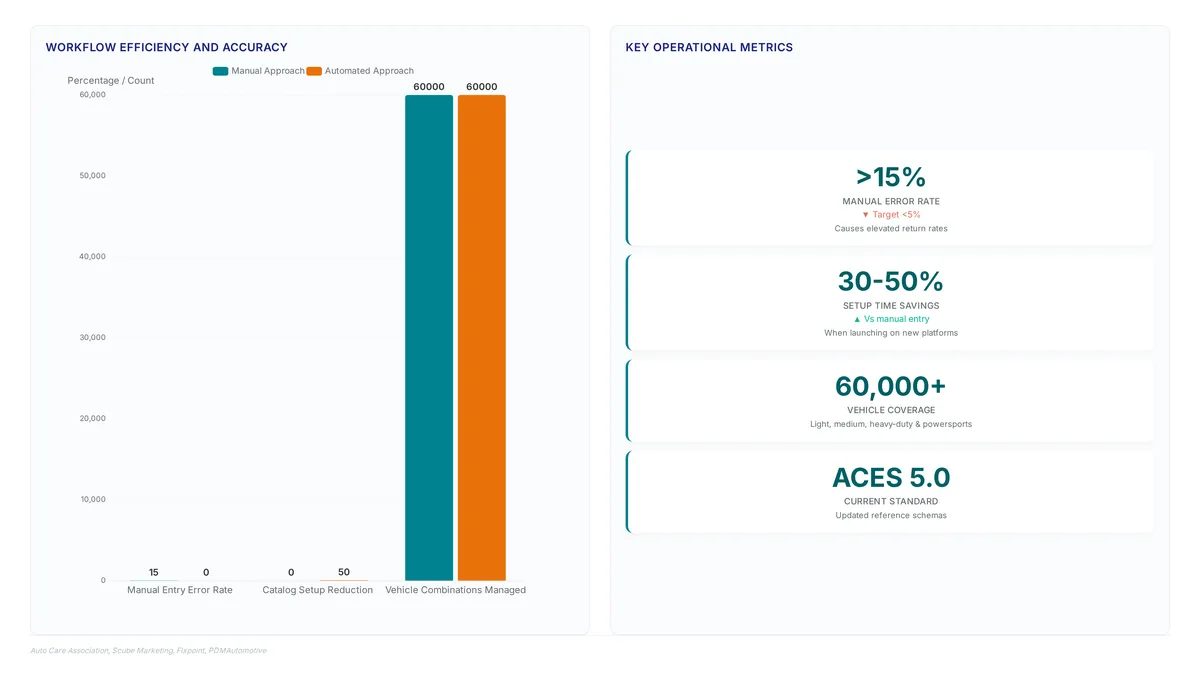
Hand-building inventory catalogs forces retailers into a cycle of constant, tedious maintenance. Individuals possessing specific fitment knowledge often attempt a 'Do It Yourself' approach, manually linking every single product to ACES fitment data. This labor-intensive method stands in stark contrast to automated workflows that extract Year Make Model attributes directly from standardized sources.
| Dimension | Manual Entry | DIY Strategy |
|---|---|---|
| Labor Intensity | Extremely High | High |
| Error Potential | Significant | Moderate |
| Scalability | Limited | Constrained |
Scalability remains the primary failure point for manual entry. As catalog depth expands, the likelihood of human error grows proportionally while accuracy stagnates. DIY methods provide direct oversight of product-vehicle mapping yet frequently result in elevated return rates caused by misfits when data consistency slips. Dependence on internal resources for data creation restricts e-commerce growth as part volumes swell. Staff hours consumed by verifying individual fitments represent lost opportunities for customer engagement or inventory planning. ACES manages fitment data for over 60,000 vehicle combinations across light, medium, and heavy-duty vehicles, making manual freshness maintenance a formidable obstacle for expanding operations.
Automating Fitment Workflows with Specialized Tools
Software automation handles the management of over 60,000 vehicle combinations by using standardized data structures. This technique enables the conversion of part numbers into compliant ACES XML files, eliminating the need for manual calculation. Operators bypass the fatigue of repetitive data association by using tools that ingest standardized fitment databases directly. The mechanism functions by matching internal SKUs against established vehicle databases to generate compliant records automatically.
| Dimension | Manual Entry | Automated Tools |
|---|---|---|
| Processing Speed | Low | High |
| Error Rate | High | Low |
| Scalability | Poor | Excellent |
Automation introduces a dependency on source database quality; flawed inputs produce flawed outputs regardless of the tool employed. Reduced visibility into specific edge cases occurs where human intuition might otherwise catch an algorithmic oversight. Supplier data must align with current Year Make Model standards before bulk uploading to marketplaces. This verification step blocks catalog pollution that automated systems might otherwise propagate unchecked.
Speed of deployment often conflicts with long-term data hygiene.
DIY vs DIFM: Evaluating Outsourcing for ACES Data
Internal data teams encounter significant hurdles when catalog depth surpasses manageable thresholds, necessitating a choice between labor-intensive manual entry and external specialization. The choice to outsource depends on whether internal staff can uphold the ACES data standard without sacrificing velocity.
| Dimension | Internal DIY | Outsourced DIFM |
|---|---|---|
| Initial Setup | Slow | Rapid |
| Ongoing Maintenance | High Burden | Managed Service |
| Error Correction | Reactive | Proactive |
Outsourcing transfers the burden of fitment data validation to specialists who navigate the complexity of vehicle attribute mapping. This strategy removes the requirement for retailers to train staff on complex XML file structures or protocol updates. External partners introduce dependency risks should communication channels falter during peak seasons.
Maintaining total control over SKU associations frequently clashes with the speed required for multi-channel expansion. Companies attempting to manage thousands of parts internally often witness accuracy decline as volume increases. The hidden cost of the DIY model includes not time, but the opportunity cost of delayed market entry. Operators must weigh the immediate flexibility of internal handling against the scalable precision of a dedicated external workflow. Success demands matching the strategy to the current catalog size rather than projected growth.
Deploying ACES Compliance Across Amazon and eBay Channels
Application: Defining DIY vs DIFM ACES Data Management Strategies
This Do It Yourself approach forces operators to manage complex Year Make Model matrices without automated validation, increasing the risk of catalog errors during data submission procedures. Conversely, Do It for Me strategies apply software solutions to automate attribute mapping and XML generation. These platforms convert raw part numbers into standardized ACES XML files, ensuring smooth data sharing across multiple sales channels. A significant tension exists between initial cost savings of DIY methods and the long-term operational burden of maintaining data accuracy as vehicle models change annually. Operators must recognize that while DIY offers immediate control, it lacks the structural robustness needed for multi-channel e-commerce growth.
Executing Flat File Exports for eBay and Amazon Channels
Automated tools enable this translation, transforming raw inventory lists into validated fitment data ready for channel distribution. This process eliminates the manual entry errors common in complex export workflows. Software bridges the gap between internal SKU systems and external marketplace requirements.
Operators should note that ACES fitment data serves as the necessary compatibility language for the automotive aftermarket, directly enabling scalable e-commerce operations. The reliance on precise file structures means that even minor deviations in the ACES file standard prevent successful data sharing across platforms. This structural rigidity creates a tension between rapid deployment and data integrity, where speed often compromises accuracy without strong software mediation.
Risks of Manual Entry Errors in Large-Scale Fitment Catalogs
Human error spikes when operators manually map parts across over 60,000 vehicle combinations without automated validation. The limitation of human-scale management is absolute; maintaining accuracy across such diverse inventory types presents a significant challenge. Operators who rely on spreadsheets rather than automated tools frequently miss subtle configuration differences between model years. This gap forces teams to choose between slow, error-prone updates or risking incorrect shipments that damage seller ratings.
The cost of correcting these mistakes far exceeds the initial investment in proper fitment data infrastructure. Financial losses accumulate from return shipping, restocking labor, and lost marketplace visibility.
About
Mark Phillips, Editor of Aftermarket Intel at KZMALL Auto Parts, brings deep industry insight to the complexities of ACES fitment data. His daily work involves tracking global distribution channels and e-commerce trends, giving him a unique vantage point on why accurate product fitment data is critical for B2B success. At KZMALL, Phillips oversees content that supports a platform managing over 50,000 SKUs across eight proprietary brands, where precise year/make/model lookup capabilities are necessary for serving independent repair shops and distributors. This direct exposure to the challenges of manual vs automated fitment management informs his analysis of the ACES data standard. By connecting real-world procurement hurdles with technical ACES XML file requirements, Phillips explains how standardized data drives efficiency in the automotive aftermarket. His expertise ensures that KZMALL's global partners understand how to use fitment data sharing to reduce returns and simplify operations across diverse markets like Amazon and eBay.
Conclusion
Scaling beyond initial inventory loads exposes a critical fracture: manual processes cannot sustain the velocity required by annual vehicle model updates. As the industry shifts toward standardized XML files for data exchange, relying on static spreadsheets creates an unsustainable operational debt that grows with every new model year. The rigid structure of modern compatibility standards means that even minor formatting deviations trigger total rejection across substantial marketplaces, halting sales instantly. Operators must transition from reactive error correction to proactive infrastructure investment immediately.
Adopt automated XML validation tools within the next quarter to replace flat file exports. This shift ensures your product fitment data aligns with the predefined codes now dominating technical exchanges. Do not wait for a spike in return rates to justify this expense; the margin erosion from restocking labor and lost visibility already outweighs the software cost.
Start this week by auditing your current export workflow for manual touchpoints where vehicle configurations are mapped by hand. Identify any process where a human manually verifies a part against a specific year or model, as these are your highest risk zones for silent failures. Replace these specific manual checks with an automated validation layer that enforces structural compliance before any file leaves your system. This targeted intervention secures data integrity without requiring a full platform migration today.
Frequently Asked Questions
Non-compliant data causes invisible listings and high return rates. Unstructured data requires manual verification, leading to inevitable inventory chaos and customer dissatisfaction across the supply chain.
ACES replaces variable manual checks with high accuracy automated logic. This structured approach ensures part numbers match specific chassis codes, preventing the mapping errors common in fragmented spreadsheet workflows.
The XML structure enables high scalability unlike low scalability manual entry. It allows smooth tracking of part numbers across multiple sales channels simultaneously, removing the need for redundant data entry.
ACES governs compatibility for light, medium, and heavy-duty vehicles. It also includes off-highway equipment, ensuring that a single unified system handles diverse automotive sectors without ambiguity.
ACES 5.0 incorporates updated reference database schemas for complexity. This current iteration serves as the industry baseline, forcing part numbers to map accurately to specific vehicle configurations.
References