
VIN Decoding: Why 99.8% Fitment Beats Year/Make
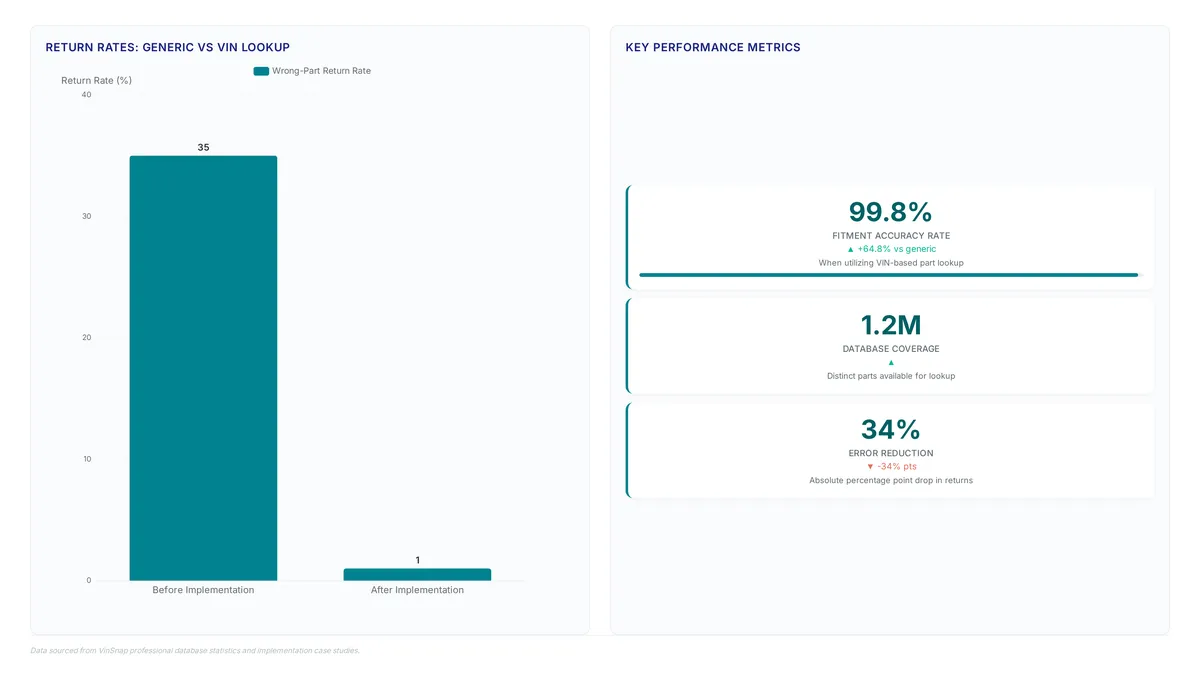
VIN-based searches achieve a 99.8% fitment accuracy rate, vastly outperforming traditional year-make-model selection methods. Relying on broad model years invites costly errors that modern data solutions eliminate entirely.
Standard retail vehicle pickers fail to account for specific engine trims and production dates. Specialized VIN databases cross-reference over a million distinct parts to ensure exact matches. Industry data from the provider confirms that VIN-based searching reduces return rates by identifying the correct OEM part number instantly.
This analysis details how to execute a precise parts lookup using VIN data rather than guessing based on visual inspection. Professionals must adopt these VIN decode tools to avoid the pitfalls of incomplete car part fitment records. Ignoring this shift toward data-driven sourcing leaves shops vulnerable to preventable inventory mistakes.
The Critical Role of VIN Decoding in Modern Parts Fitment
The 17-Character VIN as Vehicle DNA for OEM Fitment
That Vehicle Identification Number functions as a standardized 17-character unique code serving as the vehicle's DNA. This specific structure encodes the exact build of a vehicle, making matching parts to the VIN the single most accurate method for identification. Traditional year/make/model selectors often miss critical trim and engine variations that define an OEM part. Retail vehicle pickers rely on broad categories where a single model year might cover dozens of configurations. A customer searching by model alone risks selecting a component designed for a different engine block or suspension package. VIN-based part search eliminates this guesswork by decoding specific factory options. KZMALL Auto Parts advises technicians to buy the part the vehicle was engineered for, not the one that looks close. Relying on generic selectors invites returns when subtle production changes occur mid-year. The 17-character string reveals these hidden specifications instantly. Precision requires access to databases mapping characters to build sheets. Without this depth, the code is merely a serial number. Operators must verify their tools translate these characters into actionable fitment data rather than simple model names. This distinction separates professional-grade lookup from consumer-grade filtering.
Why Year-Make-Model Fails: High Wrong-Part Return Rate
Standard dropdown menus miss critical build data, driving a high wrong-part return rate across the industry. These selectors rely on broad year and model ranges that cannot distinguish between specific engine codes or regional trim packages. Vehicle fitment requires precise compatibility based on engine type and options that simple menus ignore. Approximately one third of auto parts are returned due to these exact discrepancies in factory specifications. Year/make/model dropdown menus provide an accuracy rate of only 70, 80% because they group distinct vehicle configurations together. A single model year often encompasses multiple suspension setups or brake caliper sizes that look identical externally. This lack of granularity forces customers to guess at hidden variables like transmission output shaft counts or mounting point variations. Dramatic improvement occurs because the decoder reads the specific factory build sheet rather than assuming a standard configuration. KZMALL Auto Parts prioritizes this granular data to prevent the financial bleed of reverse logistics. Ignoring the VIN leaves the repair shop vulnerable to ordering components that physically fit the model but fail on the specific vehicle. The cost of a returned part exceeds the component price when labor time and shipping fees accumulate. Precise identification protects both the technician's schedule and the customer's budget.
Deploying VIN Decoding to Access Distinct Parts
Entering the 17-character code unlocks access to over a vast array of distinct parts tailored to exact factory build sheets. This VIN-based part search bypasses the ambiguity of generic model selectors that often group disparate engine families. Technicians at KZMALL Auto Parts verify fitment by decoding specific trim levels and optional packages hidden within the string. The process requires four precise actions to guarantee compatibility before purchase:
- Input the full identifier into the decoder to reveal hidden configuration data.
- Filter results by the decoded engine code and transmission type.
- Cross-reference the generated OEM number against the aftermarket equivalent.
- Confirm brake caliper size and suspension code match the vehicle record.
The provider reports a fitment accuracy rate of 99.8% when using VIN-based parts searching compared to traditional selection methods. Relying on broad year ranges forces buyers to guess at internal component variations that visual inspection cannot confirm. The operational cost of a single wrong guess exceeds the time saved skipping the decode step. Professional databases link the decoded attributes directly to specific part numbers, removing human error from the equation. This precision ensures the ordered component matches the vehicle as it left the assembly line. Data scope remains limited to model year without exact build returns. Accuracy becomes variable when operators ignore the full string. Generic lookups fail to capture the nuance of factory options. Specificity drives the difference between a successful repair and a returned box. Technicians gain confidence when the part number aligns with the decoded attributes. Customers save money when the first part installed is the correct one. The industry moves toward higher standards by demanding improved tools. Old methods create waste while new data streams eliminate it. Every character in that string holds value for the careful observer.
Comparing Retail Vehicle Pickers Against Specialized VIN Databases
Retail Vehicle Pickers vs Catalog-Agnostic VIN Databases
Broad year/make/model selectors often fail to distinguish between engine variants or trim levels. Retailers such as AutoZone, O'Reilly, and RockAuto allow users to enter a VIN or pick a vehicle to filter for fitting parts, often backed by a fitment guarantee. Some tools accept a VIN input, yet the underlying logic may still filter matches against a specific inventory rather than the full market. Professional operations frequently apply thorough databases to decode the complete 17-character string against global fitment data. Professional-grade, catalog-agnostic databases like TecDoc serve as the core data source for platforms like the provider to match exact vehicle specification. These systems help match exact vehicle configurations by using deep fitment data. The structural difference lies in data depth: while some tools optimize for immediate inventory availability, thorough platforms prioritize fitment accuracy across all possible OEM equivalents. A comparison of capabilities reveals distinct operational trade-offs:
| Feature | Retail Vehicle Picker | Thorough Database |
|---|---|---|
| Data Source | Store Inventory | Global Fitment Catalogs |
| Fitment Precision | Variable | High Accuracy |
| Scope | Limited to Stock | Thorough Cross-Reference |
| Primary Goal | Inventory Selection | Exact Part Verification |
The limitation of basic selectors becomes apparent when a vehicle requires a specific engine-code variant not captured by year/make/model alone. Technicians are advised to buy the part the vehicle was engineered for, rather than one that simply appears compatible. Relying on restricted pickers increases the risk of ordering components that physically bolt on but functionally fail due to subtle calibration differences. True VIN decoding exposes these hidden variables, ensuring the selected part matches the factory build sheet rather than a generic model year range. This precision eliminates costly returns and downtime associated with incorrect inventory selection.
Using VIN Tools to Decode Trim and Optional Packages for Parts
Decoding the full 17-character string reveals specific optional packages that generic selectors often ignore. Simple year/make/model filters frequently miss critical engine variants, leading to incorrect OEM part number retrieval. Specialized tools treat the VIN as unique vehicle DNA to eliminate ambiguity in parts matching. Retailers may offer basic lookups, yet professional workflows demand access to deep build sheets to ensure compatibility. These systems cross-reference factory data to identify exact trim levels and drivetrain specifications.
| Feature | Basic Picker | Specialized VIN Tool |
|---|---|---|
| Data Scope | Store Inventory | Global Fitment Catalogs |
| Trim Detection | Limited | Precise |
| Engine Variants | Broad Grouping | Exact Match |
| Bias | Inventory-Driven | Data-Driven |
Operators using broad selectors risk ordering sensors that fit the chassis but not the engine. A specialized decode prevents this by confirming factory-equipped features instantly. Free resources, such as available VIN lookup tools, verify specifications such as engine size and optional equipment. This step ensures the selected component matches the vehicle's original configuration. Buying the part the vehicle was engineered for, rather than one that looks close, is critical for success. Ignoring specific build codes invites returns and installation delays. Precise decoding transforms a vague search into a targeted procurement action. Always verify the build sheet against the physical vehicle before finalizing orders.
Fitment Data Gaps in Marketplace Garage Filters
Marketplace garage filters often miss specific engine codes, leading to incorrect OEM vs aftermarket parts selection. Platforms like Amazon and Walmart apply a saved-vehicle garage and fitment data, often powered by integrations like the provider, to indicate if a listing fits. These integrations power basic selection, yet they frequently lack the depth to distinguish between critical trim levels or production dates. A comparison reveals that marketplace tools often rely on broad categorization rather than precise build sheets. This gap forces buyers to perform a manual final check to ensure the part references the exact vehicle configuration. Relying solely on a generic selector risks receiving a component that physically mounts but functionally fails due to missing sub-model details.
| Dimension | Marketplace Garage | Specialized VIN Lookup |
|---|---|---|
| Data Granularity | Year/Make/Model Only | Full Build Specification |
| Seller Dependency | High Variance | Standardized Accuracy |
| Return Risk | Elevated | Minimized |
The structural weakness lies in the delegated responsibility for data accuracy; the platform often displays what the seller claims, not necessarily what the factory built. Technicians advise buying the part the vehicle was engineered for, not the one that looks close. Verify fitment first by cross-referencing the vehicle identification against factory records before trusting a generic garage match.
Executing a Precise Parts Lookup Using VIN Data
Decoding the 17-Character VIN to Reveal Exact Build Specifications
The 17-character Vehicle Identification Number functions as a unique DNA code that standard year-make-model selectors frequently misread. This identifier captures specific factory data like engine displacement, trim level, and optional equipment packages that generic catalogs miss entirely. The VIN serves as the most reliable starting point when searching for the correct OEM part number before ordering components. Follow this workflow to guarantee fitment:
- Locate the 17-character string, which serves as the vehicle's unique identifier.
- Input the code into a VIN lookup tool to decode factory specifications.
- Cross-reference the revealed engine size and drivetrain details against the replacement part.
- Confirm the build specifications match your vehicle's exact configuration.
A part might fit the chassis but fail on sensor placement due to a specific trim package. Decoding the VIN eliminates this guesswork, ensuring the selected component matches the vehicle's original engineering. Relying solely on year and make ignores critical build variances. Generic filters assume uniformity where none exists. The Vehicle Selector identifies parts generally compatible with a year, make, and model, yet it does not account for specifics like color or cab size. Using the full VIN string prevents these mismatches by locking the search to the specific vehicle build.
Executing the Three-Step Verification Workflow Before Checkout
Decode the VIN first to lock exact engine and trim details. This step prevents ordering a component designed for a different drivetrain configuration.
- Enter the 17-character code into a VIN lookup tool to reveal factory specifications.
- Filter results by the decoded engine displacement rather than model year alone.
- Match the listing against the revealed build before adding items to the cart.
Generic selectors often miss subtle production changes that affect mounting points or fluid capacity. The verification method remains consistent regardless of the purchasing option chosen. Decode the VIN to confirm the exact engine, trim, and build. Relying on year and make alone leaves fitment uncertain when factory options vary.
| Method | Specificity | Return Risk |
|---|---|---|
| Year/Make/Model | Low | High |
| VIN Decoded | Exact | Minimal |
VIN-based matching helps reduce returns, prevent installation issues, and save time during repairs. A precise match eliminates the guesswork associated with mid-year production updates. Verifying factory specifications reduces the risk of ordering incorrect parts, especially for repairs requiring exact specifications such as sensors, engine components, or emissions-related parts. The cost of a returned heavy component exceeds the time spent checking the data. Buy the part the vehicle was engineered for, not the one that looks close.
Implementation: Selecting Between Retailer VIN Pickers and Catalog-Agnostic Databases
- Input the code into a VIN lookup tool to decode the exact engine configuration.
- Compare the retailer's filtered list against a broader database to find the genuine OEM part number.
- Select the component that matches the decoded specifications rather than the closest visual approximation.
Specialized databases cross-reference these subtle variations across the entire manufacturer catalog. Ordering OEM via a dealer is recommended for guaranteed factory parts when local stock lacks the specific build data. A local picker offers speed but risks returning a unit that fits the model year yet fails on the specific trim. This approach ensures the vehicle fitment aligns with the original engineering constraints before any hardware is ordered.
Reducing Return Rates Through Verified Fitment Strategies
Defining Verified Fitment Through Catalog-Agnostic VIN Decoding
A standard year/make selector ignores mid-year production changes, leaving trim variations unverified. True verified fitment requires decoding the full 17-character string to reveal exact build attributes. This method decodes specific engine codes and option packages that generic filters miss entirely. Relying on broad categories causes fitment errors, whereas precise decoding achieves significantly higher fitment accuracy before an order ships. The distinction lies in data depth; basic tools guess based on model years, while professional systems read the vehicle's unique build sheet. This rigorous standard helps stop returns before they happen.
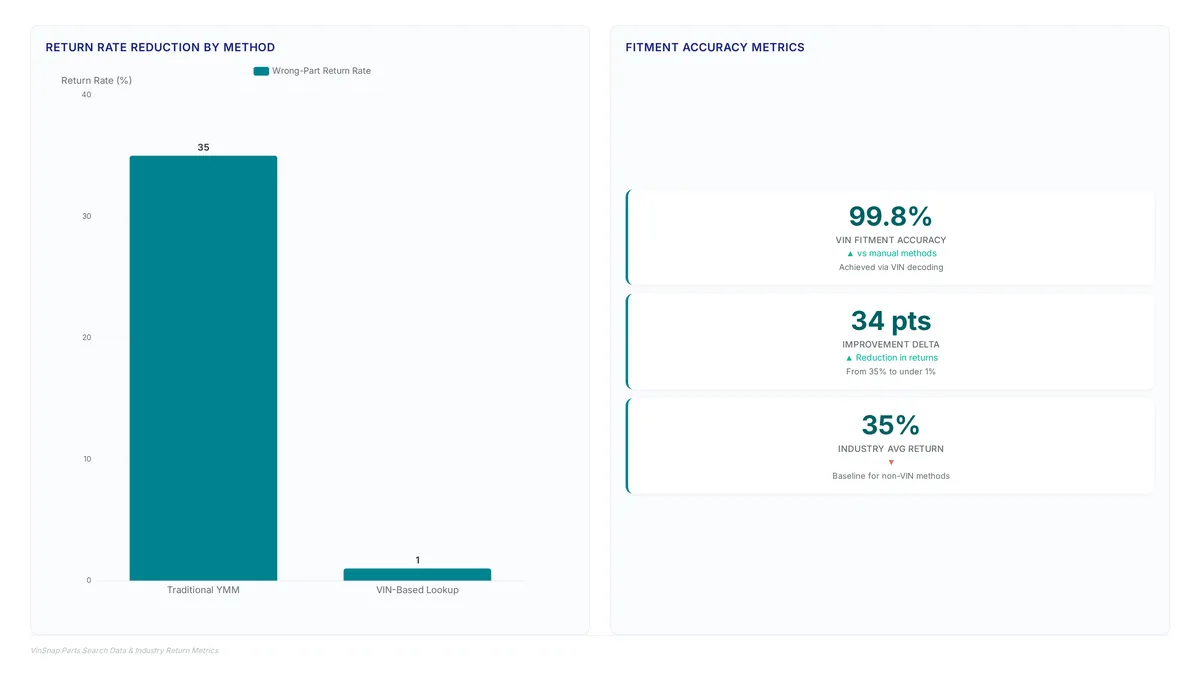
The financial implication is stark; avoiding a single part return due to fitment errors often covers the cost of premium lookup tools for a month. However, this precision requires access to detailed databases rather than simplified retailer widgets. Technicians should verify the engine code against the build sheet before shipping any component. While basic tools guess based on model years, professional systems read the unique vehicle identity to prevent costly restocking fees and lost shop time. The trade-off is time spent decoding versus time spent processing returns. Most operators find the upfront verification step eliminates the administrative burden of reversing transactions. This approach transforms fitment from a guessing game into a verified specification check.
Validating Exact Build Specifications Against Thorough Databases
Customer says the steering clunks, yet the bracket sits unused because the year-make selector missed a mid-year engine change. True validation requires matching your VIN decode results against a thorough database to catch rare trims. Without this depth, you risk ordering an OEM equivalent that lacks the specific mounting points for your chassis code.
Verifying optional packages before checkout helps avoid the cost of a second repair cycle.
| Search Method | Package Detection | Fitment Confidence |
|---|---|---|
| Year/Make/Model | Partial | Variable |
| VIN Lookup | Complete | Absolute |
Use this checklist before purchasing:
- Confirm the tool reveals specific engine codes and not displacement.
- Verify access to free VIN lookup tools that decode factory equipment lists.
- Cross-reference the generated OEM part number with your physical sample.
A generic filter assumes all V8s are identical, while a professional decoder knows which ones received the heavy-duty suspension.
About
Ray Donnelly, Master Automotive Technician and Aftermarket Parts Authority at KZMALL Auto Parts, brings over two decades of hands-on repair and distribution expertise to the critical issue of parts fitment. Having transitioned from running an independent shop to leading technical content, Donnelly understands that relying solely on year, make, and model often leads to costly returns and customer dissatisfaction. His daily work involves interpreting complex ACES/PIES data and performing precise OE cross-referencing for KZMALL's global B2B network. By using his background in comeback prevention and diagnostics-driven parts selection, Donnelly explains how professional distributors and repair shops can apply VIN-based search tools to verify part compatibility before purchase. At KZMALL Auto Parts, this precision supports their commitment to supplying certified hard parts and consumables that fit correctly the first time, minimizing downtime for independent repairers worldwide.
Conclusion
Generic decoding fails when vehicle configurations diverge within a single model year, creating hidden operational drag that simple return metrics miss. The ongoing cost is not merely the shipping fee but the erosion of customer trust when a technician installs a component that physically fits yet functionally fails due to a missed factory package. Relying on broad data scopes forces shops to absorb the risk of mid-year production changes that standard catalogs ignore. You must transition to catalog-agnostic verification systems that decouple search logic from rigid manufacturer lists to ensure true build accuracy.
Implement a strict protocol where no order proceeds without validating the specific engine code and factory equipment list against the VIN. This shift eliminates the ambiguity of displacement-only matching and secures the correct mounting points for unique chassis codes. Start by auditing your current lookup tool against a known complex vehicle this week to see if it identifies the exact heavy-duty suspension or optional braking package before you commit to a purchase. If the system cannot distinguish between these critical variances, it remains a liability rather than an asset. Precision in the initial lookup phase prevents the compounding errors of incorrect restocking and delayed repairs.
Frequently Asked Questions
Standard pickers miss build data, causing a 35% wrong-part return rate. Technicians must use VIN decoding to identify exact engine trims and avoid costly reverse logistics fees associated with incorrect orders.
VIN-based searches achieve a 99.8% fitment accuracy rate compared to traditional methods. Shops should adopt this technology to eliminate guessing games and ensure every ordered component matches the specific factory build sheet.
Year-make-model selectors offer only 70–80% accuracy because they group distinct configurations. Professionals must avoid these broad categories to prevent errors caused by unseen variations in suspension or brake caliper sizes.
Specialized databases provide access to over 1.2 million distinct parts for precise lookup. Technicians should utilize this depth to cross-reference OEM numbers against aftermarket equivalents for guaranteed compatibility before purchasing.
The 17-character code reveals exact trim, engine, and optional package data. Mechanics must decode these specifics to distinguish between identical-looking models that possess different transmission outputs or mounting point variations.
References