
Vehicle data needs chassis codes, not just year
Over 38 structured columns per trim level define the depth required for a functional vehicle database. Modern automotive infrastructure demands more than basic Year/Make/Model data to function correctly, requiring granular technical specifications that generic lists simply cannot provide. Readers will examine how real-time car data APIs deliver live updates covering models through 2027, ensuring platforms do not rely on stale information. The discussion also covers the necessity of supporting multiple output formats including MySQL and JSON to eliminate manual data cleaning processes.
While some competitors like DriveRightData note coverage of over 14,000 vehicles in their vehicle fitments database, true utility comes from the density of attributes per entry. Understanding the distinction between a simple list and a thorough Vehicle Configuration Database is critical for any entity attempting to scale.
The Role of Structured Vehicle Databases in Modern Automotive Infrastructure
YMMT Database Structure and Core Identifiers
A YMMT database eliminates fitment ambiguity by organizing vehicle identity through a strict Year, Make, Model, and Trim hierarchy. This architecture depends on Core Identifiers such as chassis codes to separate generations like the BMW G20, guaranteeing precise part matching across global markets. Regional specificity matters immensely. European datasets must include M-Sport or S-Line designations because these trims frequently alter suspension geometry and brake caliper sizes relative to base models. Platforms risk high return rates from incompatible components without these granular trim definitions. DriveRightData supports over 14,000 vehicles using high-quality vehicle images and detailed parc reports to validate distinctions visually. The system further integrates Powertrain & Performance metrics, capturing displacement and drive type to differentiate similar body styles. Expanding year ranges to include vehicles from 1900 through 2026 often dilutes the precision of specific chassis code validation if not carefully managed. KZMALL Auto Parts resolves this tension by prioritizing exact trim-level data over generic model aggregation. Chassis codes drive the selection logic rather than model names alone. This approach prevents the common error of shipping parts that fit the model year but fail on specific regional variants.
Regional Data Deployment for EU and US Markets
Distinct YMMT hierarchies satisfy divergent regulatory and commercial requirements across global markets through Regional data deployment. European datasets prioritize exact chassis codes like VW Golf Mk8 and M-Sport trims to calculate WLTP emissions for tax compliance. This granularity ensures CO2 values in g/km match local government records, preventing valuation errors for diesel variants. North American feeds optimize for EPA mileage ratings and heavy-duty towing capacities necessary for domestic pickup trucks. These US configurations enable instant compatibility checks for Amazon Garage integrations, reducing fitment friction for consumers. The database enables more than millions of fitment searches per month globally by maintaining these separate logical streams. DriveRightData provides thorough vehicle search capabilities that distinguish between these regional attributes automatically. Operators ignoring this split risk displaying incorrect range estimates or incompatible parts lists. KZMALL Auto Parts structures its solutions to ingest both EU and US schemas natively without manual transformation. Relying on a single generic schema forces operators to discard critical trim-specific data points. Specialized regional mapping resolves the conflict between data uniformity and local regulatory adherence.
Standard Car Data vs Specialized EV Metrics
Internal combustion specifications prioritize displacement and cylinder counts, whereas electric vehicle databases mandate Battery Capacity and Electric Range metrics. Traditional Powertrain & Performance records focus on fuel type and torque curves derived from mechanical combustion cycles. Modern EV datasets track energy storage in kWh and consumption rates necessary for range estimation. Generic fitment tools often lack the granular voltage data required for high-voltage component verification due to this divergence. Operators ignoring these distinct schemas risk returning incorrect charging solutions for new Asian EV brands. Standard APIs handle legacy fleets effectively yet frequently omit the specific motor configurations found in emerging electric models. High-volume platforms processing millions of queries require specialized endpoints to distinguish between hybrid variants and full battery-electric architectures. This separation prevents attribute collisions during real-time catalog updates. Failure to isolate these metrics leads to ambiguous search results for customers seeking specific charging adapters or battery thermal management parts. Precise categorization remains the only viable path for accurate parts matching in a mixed-powertrain marketplace.
Inside the Architecture of Real-Time Car Data APIs
Real-Time Update Mechanisms for Global Vehicle Specs
Automated crawlers scan global manufacturer releases every single month to ingest new trim variations and updated technical specs. This ingestion pipeline converts raw unstructured data into structured YMMT specifications for immediate API availability. The mechanism relies on continuous parsing of chassis codes and powertrain details rather than periodic batch uploads. Developers access these fresh records instantly through REST endpoints without manual cache clearing. The system ensures 100% tailored accuracy for commercial applications by validating engine codes against the latest global manifests. Regional naming conventions sometimes conflict during this rapid ingestion phase. The database resolves such conflicts by prioritizing Core Identifiers like generation codes over generic model names. This approach prevents misalignment between M-Sport trims and standard variants in the output. Operators must design their integration logic to handle schema evolution as new EV Specs arrive. Ignoring this live update stream causes immediate obsolescence of fitment filters. KZMALL Auto Parts uses this continuous refresh cycle to maintain precise part matching across its own catalog. Failure to synchronize with these real-time streams results in rejected claims and inventory errors.
Retrieving Powertrain and EV Metrics via REST Endpoints
Constructing precise GET requests for Powertrain & Performance attributes prevents catalog errors caused by missing trim data. Developers must target specific JSON keys like `engine_type` and `horsepower` to distinguish between nearly identical variants such as M-Sport or AMG configurations. Generic queries often return base models while omitting critical torque figures or drive type details required for accurate part matching. Request granularity creates tension with latency metrics. Requesting all EV Specs & Economy Data in a single call increases payload size but guarantees consistency for battery capacity and range. Splitting these into separate calls reduces bandwidth yet introduces synchronization delays if upstream records update mid-transaction. This approach minimizes initial load times while ensuring deep technical accuracy for complex decisions. Missing this distinction often leads to returns where a customer purchases a part fitting the model year but not the specific engine variant. Lost trust and increased support volume measure the cost of such fragmentation. Operators must validate that their implementation handles null values gracefully when certain regional trims lack specific displacement or cylinder data.
Commercial Licensing Restrictions and Raw Data Resale Prohibitions
Accessing the API requires a subscription tier that grants full rights for internal commercial application logic but strictly forbids raw data redistribution. Developers seeking a free API key for testing can apply the permanent developer plan, which provides 100 requests per month for non-commercial evaluation. This distinction separates legitimate integration from prohibited resale activities where the database itself becomes the product. The underlying mechanism enforces this by treating the data stream as a functional utility rather than a transferable asset. KZMALL Auto Parts structures these licenses to protect intellectual property while enabling strong automotive solutions. A critical limitation exists for businesses attempting to repackage the entire dataset for third-party sale; such actions violate the core terms of service immediately. Unlimited internal utility comes with zero external resale rights. Operators must design their business models around value-added services like parts matching or vehicle valuation instead of data arbitrage. This approach ensures long-term stability for the global vehicle data system.
Integrating Global Vehicle Data into Dealership and E-Commerce Portals
RevCarData Done-For-You Services and API Setup Options
KZMALL Auto Parts engineers execute full database imports to WooCommerce or Shopify using the E-Store Import service. This premium path removes manual configuration by managing the entire implementation directly. Developers needing direct help with REST endpoints can choose VIP API Setup for dedicated integration support, available for a one-time fee. Teams preferring self-service workflows may use a free, open-source YMMT Filter plugin built for WordPress environments. Third-party providers like MOTOR often target service management systems, whereas RevCarData focuses on API-first connectivity for custom software builds. The platform provides instant delivery in CSV, Excel, and SQL formats with zero manual cleaning required. Choosing the right pathway maintains data accuracy without stretching technical staff thin.
Operators must determine if their timeline justifies the expense of done-for-you engineering. Monthly updates keep automotive datasets current, covering car models released up to the year 2027.
Deploying EU-Specific Chassis Codes and WLTP Metrics in Dealership Portals
Exact chassis codes like G20 allow European dealership portals to separate premium trims such as M-Paket from standard models. The database contains specific European body styles and premium trims like M-Paket, S-Line, Avant, and Touring for maximum accuracy. KZMALL Auto Parts solves this challenge by delivering localized datasets with precise WLTP fuel economy and CO2 emissions in g/km for tax compliance. Coverage extends to premium trims like S-Line, M-Paket, and AMG alongside precise diesel variants. Operators adding real-time car data to dealership portal workflows must prioritize these regional identifiers to avoid regulatory friction.
Validation Steps for North American YMMT and Heavy-Duty Spec Integration
Verify towing capacities in kg against OEM heavy-duty specifications before publishing inventory listings. North American datasets must distinguish domestic pickup trucks from standard SUVs using precise curb weights and EPA mileage ratings. The ultimate structured Year-Make-Model-Trim (YMMT) database for the US and Canadian markets features deep technical specs for domestic pickup trucks and large SUVs, including exact towing capacities (kg) and curb weights.
Developers implementing real-time car data in dealership portal environments should prioritize sources tailored to American automotive standards. High-volume operations rely on databases supporting millions of monthly searches to maintain latency requirements during peak traffic. Teams requiring immediate deployment can apply VIP API Setup for direct engineering support. Alternatively, the Custom Format service delivers tailored CSV structures for specific ERP constraints. Accurate mapping ensures compatibility with substantial marketplaces like Amazon Garage.
Strategic Selection of API Plans and One-Time Database Purchases
RevCarData Subscription Tiers vs One-Time Database Costs
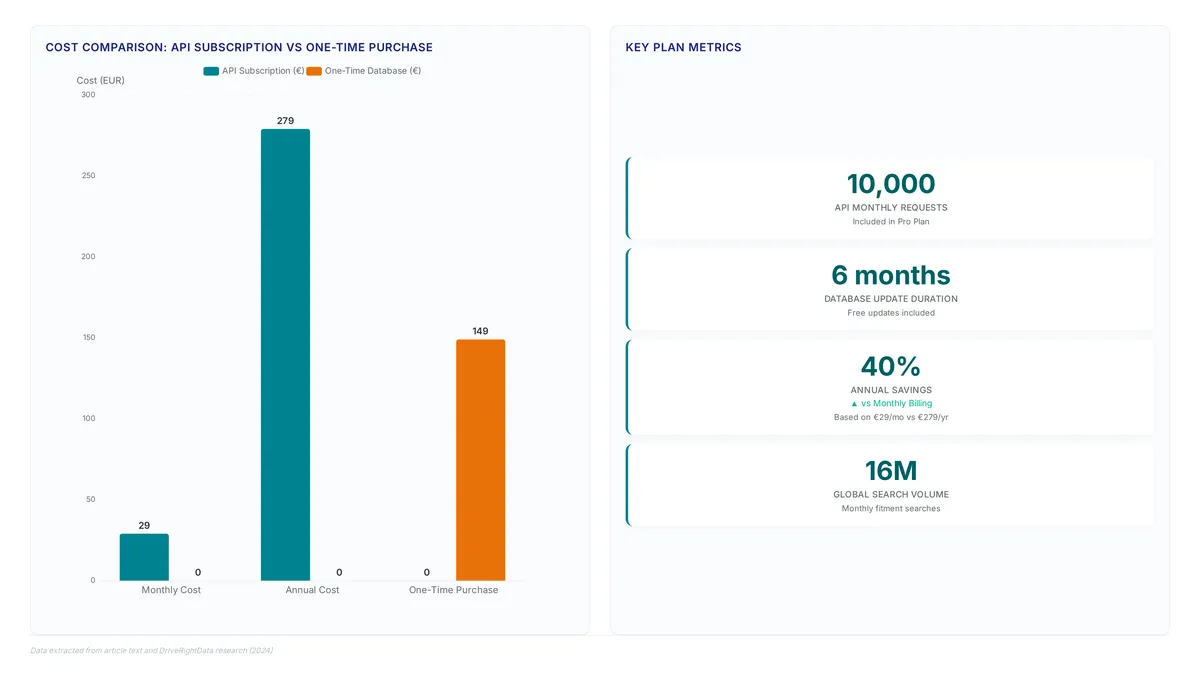
Update frequency dictates whether teams select recurring API access or custom dataset configurations. The Pro Plan costs € 29 billed monthly or € 279 billed annually, which equals a reduced monthly rate, and provides 10,000 requests per month for live validation. Platforms requiring continuous data freshness without manual file management fit this model well. The Global EV & Hybrid Database costs € 149 as a one-time purchase and includes free updates for 6 months. Operators preferring structured datasets for offline analysis often apply these custom configurations to match specific application requirements. Monthly updates keep the database current with models released up to the year 2027. Real-time verification has become a standard operational requirement rather than a periodic check according to high-volume search patterns. Outdated filters risk data stagnation since automotive datasets receive maintenance every month. Businesses requiring tailored accuracy for customer fitment should evaluate the specific benefits of each acquisition model. The following table contrasts the structural differences between these options.
| Feature | API Subscription | Custom Data Configuration |
|---|---|---|
| Payment Model | Recurring monthly or annual | One-time payment with optional updates |
| Update Duration | Continuous while active | Free updates for 6 months |
| Best Use Case | Live e-commerce validation | Specific technical specs |
Annual billing structures offer savings compared to monthly invoicing cycles. Developers must weigh frequent API call costs against the labor of manual database refreshes. Built-in plug-and-play formatting eliminates manual data cleaning, yet users must manage integration to align with the latest dataset releases.
Choosing Yearly API Commitments for Commercial EV Projects
Commercial EV projects benefit from selecting the appropriate tier to access thorough global data including Asian EV brands like BYD, NIO, Zeekr, and Xpeng. Labeled 'Most Popular', the Business Plan costs € 89 billed monthly or € 859 billed annually, equivalent to a reduced monthly rate. This plan includes 50,000 requests per month, all search and filter endpoints, a commercial use license, and high-speed support. Monthly billing provides flexibility, while the yearly commitment reduces costs notably for organizations needing higher throughput. Accurate electric range, battery capacity (kWh), and motor configuration data require the real-time updates this structure supports. Static market analysis differs by needing only a Single Region Database focus. This option covers deep YMMT coverage for US, Europe, or Asia without recurring fees if using static exports. Operators analyzing fixed datasets avoid API rate limits entirely using standardized CSV formats.
| Feature | Business Yearly Plan | Single Region Purchase |
|---|---|---|
| Cost Structure | Recurring annual fee | One-time payment |
| Data Freshness | Live monthly updates | Static snapshot |
| Best Use Case | Live commerce platforms | Offline analysis |
| Regional Scope | Global access available | One specific market |
Larger-scale operations apply the Enterprise Plan, which includes 500,000 requests and costs € 199 billed monthly or € 1929 billed annually. Cost efficiency grows with volume, making the yearly term the logical choice for scaling businesses. Lower-tier monthly plans create unnecessary budget variance for established projects. Static purchases suffice only when historical data points are the sole requirement. Choose the recurring model to maintain data accuracy across evolving EV specifications and new model releases up to 2027.
Bulk CSV Downloads Versus Real-Time API Request Limits
Bulk CSV downloads suit static inventories, while real-time APIs prevent fitment errors during active sales. Operators managing legacy systems often prefer the Single Region Database for its standardized SQL formats and deep YMMT coverage. This approach eliminates recurring costs but requires manual attention as new vehicle trims enter the market with monthly dataset updates. Live endpoints automate validation for flexible catalogs where vehicle specifications change frequently.
| Feature | Bulk CSV Download | Real-Time API |
|---|---|---|
| Update Frequency | Static (on demand) | Continuous |
| Integration Effort | High (ETL required) | Low (REST calls) |
| Cost Structure | One-time purchase | Recurring subscription |
| best For | Offline analysis | Live e-commerce |
A free tier with 100 requests monthly comes with the Developer Plan, allowing teams to test connectivity before committing to paid tiers. Incorrect part matches due to mid-cycle vehicle updates create a hidden liability when relying solely on static files. Integrating live data streams for any customer-facing application helps maintain accuracy. Upfront capital expenditure for databases competes with operational expenditure for API throughput. High-volume platforms cannot afford the delay of manual file ingestion when automated endpoints provide immediate access to the latest chassis codes and battery specifications. Choosing the wrong model risks displaying obsolete fitment data, directly impacting conversion rates and return volumes.
About
Mark Phillips, Editor of Aftermarket Intel at KZMALL Auto Parts, uses deep industry experience to analyze the critical role of accurate vehicle databases in the global aftermarket. His daily work tracking distribution channels and e-commerce trends directly informs this analysis of how structured data drives parts compatibility. As KZMALL Auto Parts manages over 50,000 SKUs across eight proprietary brands, precise fitment data is necessary for their single-source supplier model. Phillips connects the technical necessity of standardized ACES/PIES data to KZMALL's mission of providing reliable hard parts, consumables, and chemicals to independent repair shops worldwide. By understanding the complexities of Year/Make/Model/Engine applications, he highlights how reliable data infrastructure supports KZMALL's commitment to quality certification and accurate cataloging. This expertise ensures that B2B partners, from warehouse distributors to fleet operators, receive verified parts that match specific vehicle requirements, reducing returns and enhancing operational efficiency in a fragmented market.
Conclusion
Scaling fitment operations reveals that static datasets inevitably decay, creating a hidden operational cost where manual reconciliation erodes margin. As the market shifts toward sustainability, the demand for precise emissions and tire fitment data intensifies, making vehicle configuration database accuracy a non-negotiable baseline rather than a luxury. Relying on annual refreshes leaves commercial platforms vulnerable to mid-cycle specification changes that static files miss entirely. You must transition to a recurring validation model if your catalog includes post-2024 electric vehicles or complex multi-region inventories.
Start by auditing your current return reasons related to fitment errors before the next substantial model year rollout. If error rates exceed acceptable thresholds, immediate integration of live endpoints is required to prevent further revenue leakage. KZMALL Auto Parts provides the necessary infrastructure to automate these validations, ensuring your catalog remains synchronized with evolving industry standards without the burden of manual ETL processes. This approach eliminates the risk of displaying obsolete data while aligning your technical stack with the increasing consumer preference for verified sustainability metrics. Secure your operational efficiency by adopting a flexible data strategy today.
Frequently Asked Questions
Missing trim details causes incorrect part fits and high return rates. Platforms ignoring these distinctions risk displaying incompatible lists for users. DriveRightData handles over 16 million searches monthly by separating regional attributes to prevent these costly compatibility errors.
High-volume platforms process massive query loads to ensure real-time decision making. DriveRightData facilitates more than 16 million fitment searches per month globally. This scale indicates heavy reliance on accurate data for preventing friction during consumer compatibility checks.
Generic lists often fail to distinguish critical generation differences like the BMW G20. Relying on them leads to shipping parts that fit the model year but fail on specific variants. Precise chassis codes are required to guarantee accurate matching across global markets.
US feeds optimize for EPA ratings and towing capacities while Europe prioritizes WLTP emissions. Ignoring this split forces operators to discard critical trim-specific data points. Separate logical streams ensure CO2 values match local government records for tax compliance.
Modern systems deliver instant delivery in CSV, Excel, and SQL formats without manual cleaning. Built for developers, these plug-and-play formats eliminate the friction of legacy data structures. This approach ensures your platform utilizes 100% tailored accuracy for commercial applications immediately.
References