
Universal TPMS Sensors: 3-Second Setup Reality
Hamaton research data puts the configuration time for a U-Pro sensor at 3 seconds. That speed sets the bar for NFC-enabled TPMS sensors hitting mainstream channels via Meyer Distributing. This partnership moves the needle away from sluggish, legacy programming toward instant digital deployment.
Technicians using dual-frequency architecture and NFC technology stop chasing constant tool updates while keeping vehicle coverage broad. The Hamaton app pushes new vehicle applications straight to the sensor platform. No manual intervention required. Service providers stay current across OE and aftermarket sectors without hoarding inventory.
Scott Hohler highlighted the value of integrating these units into ready-to-roll wheel packages to boost shop throughput. Adopting universal U-Pro sensors cuts the headache of managing hundreds of specific part numbers. Leveraging Hamaton's Wixom, Michigan subsidiary status, Meyer's network delivers these Tesla BLE and standard sensors with next-day capabilities for most locations.
The Role of Universal Programmable TPMS Sensors in Modern Automotive Service
Defining Universal Programmable TPMS Sensors and Hamaton's Market Role
A universal programmable TPMS sensor is a single hardware unit configurable to match nearly any vehicle make or model. Legacy niches demanded specific part numbers for every application, fracturing inventory. This device solves that by supporting multiple frequencies in one SKU. Marketed as a configurable and programmable universal sensor, the unit covers nearly any vehicle. Technically, these units replace rigid frequency locks with flexible firmware, letting technicians write protocol data directly to the chip. Modern iterations use NFC technology, enabling configuration via smartphone rather than dedicated diagnostic hardware. This shift cuts tool dependency and accelerates the programming workflow notably.
Real-World Application of Hamaton U-Pro Hybrid NFC Sensors in Workshop Environments
Technicians configure the U-Pro Hybrid NFC sensor in three seconds using a smartphone app interface. Rapid setup kills the latency typical of legacy optical programming methods. The device achieves full programming within ten seconds, letting service bays maintain high throughput during peak hours. A single unit supports both 315 MHz and 433 MHz bands, removing the need for shops to stock separate inventory for different regional standards. Dual-frequency capability ensures compatibility across diverse manufacturer requirements without additional hardware costs. The sensor delivers 97% true vehicle coverage for direct TPMSen-enabled vehicles immediately upon deployment. Technicians can service nearly any vehicle from Acura to Hummer using this universal solution. Continuous firmware updates allow the system to approach complete market saturation over time. Independent repair shops benefit from reduced SKU complexity while maintaining the ability to handle unexpected arrivals. Short-range transmission of NFC prevents disturbance to other sensors in the vicinity, offering a specific advantage over RF-based programming tools. Meyer Distributing addresses service needs by providing technical training alongside physical distribution networks. Speed gains are supported by first-class customer support and distribution networks in the face of a flexible and rapidly changing market.
Necessary TPMS Service Components: From Tesla BLE Sensors to Technical Training
A complete TPMS solution requires programmable U-Pro sensors, specialized workshop tools, and continuous technical training. Meyer Distributing supplies these elements alongside tire valves and service parts to address coverage gaps. The inventory strategy shifts from stocking multiple niche SKUs to a single SKU solution that reduces carrying costs. Technicians gain immediate access to Tesla BLE protocols and standard vehicle applications through mobile-first diagnostics. This approach bypasses expensive handheld tools by using near-field communication for rapid configuration. Hardware alone cannot guarantee service success without a strong support network. Hamaton provides customers with technical training and first-class customer support to ensure effective deployment. Distribution networks must therefore pair hardware delivery with educational resources to ensure deployment efficiency.
| Component Category | Legacy Requirement | Modern Solution |
|---|---|---|
| Sensor Inventory | Multiple frequency SKUs | Dual-frequency universal units |
| Programming Tool | Dedicated handheld device | Smartphone app interface |
| Coverage Scope | Specific vehicle makes | Nearly any vehicle |
| Support Model | Reactive troubleshooting | Proactive technical training |
The operational consequence of this shift is a quicker, more efficient, future-ready TPMS solution. Delivering the future of tire pressure sensors to an extensive network enables technicians to always have the most current coverage at their fingertips.
Inside NFC-Enabled TPMS Programming and Dual-Frequency Architecture
Dual-Frequency Architecture and NFC Protocol Mechanics in U-Pro Sensors
The U-Pro sensor eliminates regional inventory fragmentation by integrating both 315 MHz and 433 MHz transmitters within a single hardware unit. This dual-band design allows one SKU to address global variations without requiring separate stock for North American or European fleets. Industry data confirms that such dual-frequency capability is becoming a standard expectation for universal sensors to address regional variations without stocking multiple parts.
Configuration occurs through Near Field Communication rather than traditional radio relearn sequences. A technician places a mobile device near the valve stem to establish a secure link, bypassing the need for physical contact tools or complex trigger procedures. This proximity-based protocol enables the Hamaton app to write protocol data directly to the chip in seconds.
| Feature | Legacy Single-Band | U-Pro Hybrid Architecture |
|---|---|---|
| Frequency Support | Fixed (315 or 433 MHz) | Dual (315 MHz + 433 MHz |
| Inventory Logic | Multiple SKUs per region | Single universal SKU |
| Programming Interface | Dedicated hardware tool | NFC-enabled smartphone |
Relying on mobile devices for configuration introduces a dependency on app compatibility and operating system updates that dedicated hardware tools avoid. This architecture shifts the bottleneck from hardware availability to software currency. Technicians gain immediate access to the latest vehicle coverage through the Hamaton app, ensuring the solution adapts as new models enter the market.
Executing 10-Second Full Programming Cycles via Hamaton App Integration
Technicians execute full sensor programming in 10 seconds by tapping a smartphone against the valve stem. This NFC-enabled workflow eliminates the latency of traditional optical methods while granting immediate access to the latest vehicle definitions. As new applications emerge, they deploy instantly through the Hamaton app, ensuring shop floors never face coverage gaps due to outdated firmware. The process removes dependency on bulky diagnostic hardware, allowing technicians to rely solely on mobile devices for configuration tasks.
- Open the application and select the target vehicle model.
- Hold the smartphone near the U-Pro sensor to initiate Near Field Communication.
- Wait for the confirmation tone indicating successful protocol writing.
NFC programming eliminates the multi-step handshake latency inherent in standard RF tool relearn sequences. Traditional handheld devices must establish a radio link, navigate menu hierarchies, and transmit data packets sequentially, often taking minutes per sensor. In contrast, smartphone-only technicians bypass these delays by tapping a mobile device directly against the valve stem. This physical proximity initiates an immediate data exchange that updates vehicle coverage definitions without manual frequency selection. The short-range nature of Near Field Communication prevents accidental triggering of neighboring sensors, a frequent error source when using broad-beam RF programming wands. Shops relying on legacy optical methods face compounded delays during peak service hours due to line-of-sight alignment requirements.
| Feature | NFC Mobile Deployment | Standard RF Tool |
|---|---|---|
| Activation Method | Physical tap (proximity) | Radio signal burst |
| Update Mechanism | Instant app sync | Manual firmware download |
| Interference Risk | None (isolated field) | High (neighbor trigger) |
| Hardware Cost | Smartphone only | Dedicated wand required |
Upfront hardware investment competes with recurring time costs per service bay. While RF tools offer a ruggedized form factor, they introduce a bottleneck when multiple vehicles require simultaneous sensor updates. Mobile NFC workflows scale linearly with staff count since every technician carries a compatible device. A critical limitation remains the dependency on mobile operating system permissions, which can occasionally interrupt data transmission if background app refresh settings are restrictive. Meyer Distributing addresses this gap by pairing hardware distribution with technical training to ensure staff manage these software variables effectively. The shift removes the need for shops to maintain inventories of region-specific programming hardware.
Operational Efficiency Gains from Integrating U-Pro Sensors into Wheel Packages
NFC-Enabled Sensor Platform Mechanics in Hamaton App
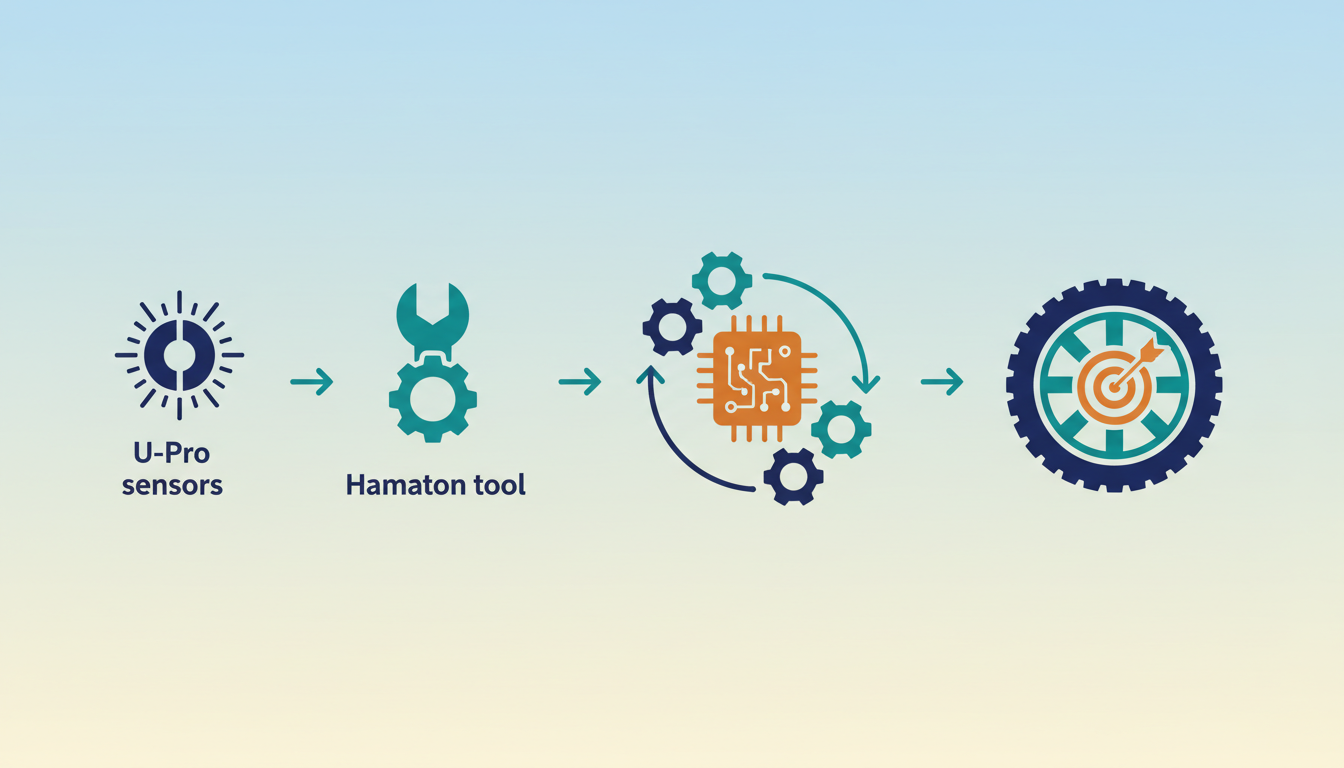
Technicians initiate vehicle coverage access by tapping a smartphone against the sensor valve stem to trigger an instantaneous data handshake. This Near Field Communication protocol bypasses traditional radio frequency handshakes, allowing the Hamaton app to read the sensor identity and push specific configuration files directly. The workflow eliminates manual frequency selection because the hardware natively supports both 315 MHz and 433 MHz bands within a single unit. Retail listings confirm this dual-frequency capability removes the need for separate SKUs for different regional.
- Select the target vehicle model within the application interface.
- Hold the mobile device near the valve to activate the link.
- Receive confirmation once the OE protocols match the database entry.
New vehicle definitions deploy instantly to the field, ensuring shops never face obsolescence gaps common with static tool databases. However, this architecture requires active internet connectivity for the initial database sync before offline programming can proceed. Shops relying on isolated network environments must plan for periodic updates to maintain full functionality. The direct tap method reduces human error compared to complex menu navigation on legacy handheld tools.
Application: Executing 10-Second Programming Cycles for Wheel Packages
Meanwhile, technicians complete full sensor programming in 10 seconds by tapping a mobile device against the valve stem.
- Open the application and select the target vehicle model.
- Hold the smartphone near the U-Pro sensor to initiate Near Field Communication.
- Wait for the confirmation tone indicating successful data transfer.
Operators must note that a single SKU solution reduces carrying costs by eliminating separate stock for 315 MHz and 433 MHz bands. The inclusion of dual valve options in one package further simplifies the supply chain for diverse installation requirements. A critical tension exists between maintaining broad inventory depth and achieving rapid turnover; relying on continual programmable updates resolves this by allowing one physical unit to cover nearly any vehicle. Distributors should verify that their ordering systems recognize the universal nature of these units to prevent unnecessary duplication of stock entries.
Strategic Advantages of Hamaton TPMS Solutions Over Competitor Brands
Hamaton U-Pro Hybrid NFC Sensor Architecture and Dual-Frequency Design
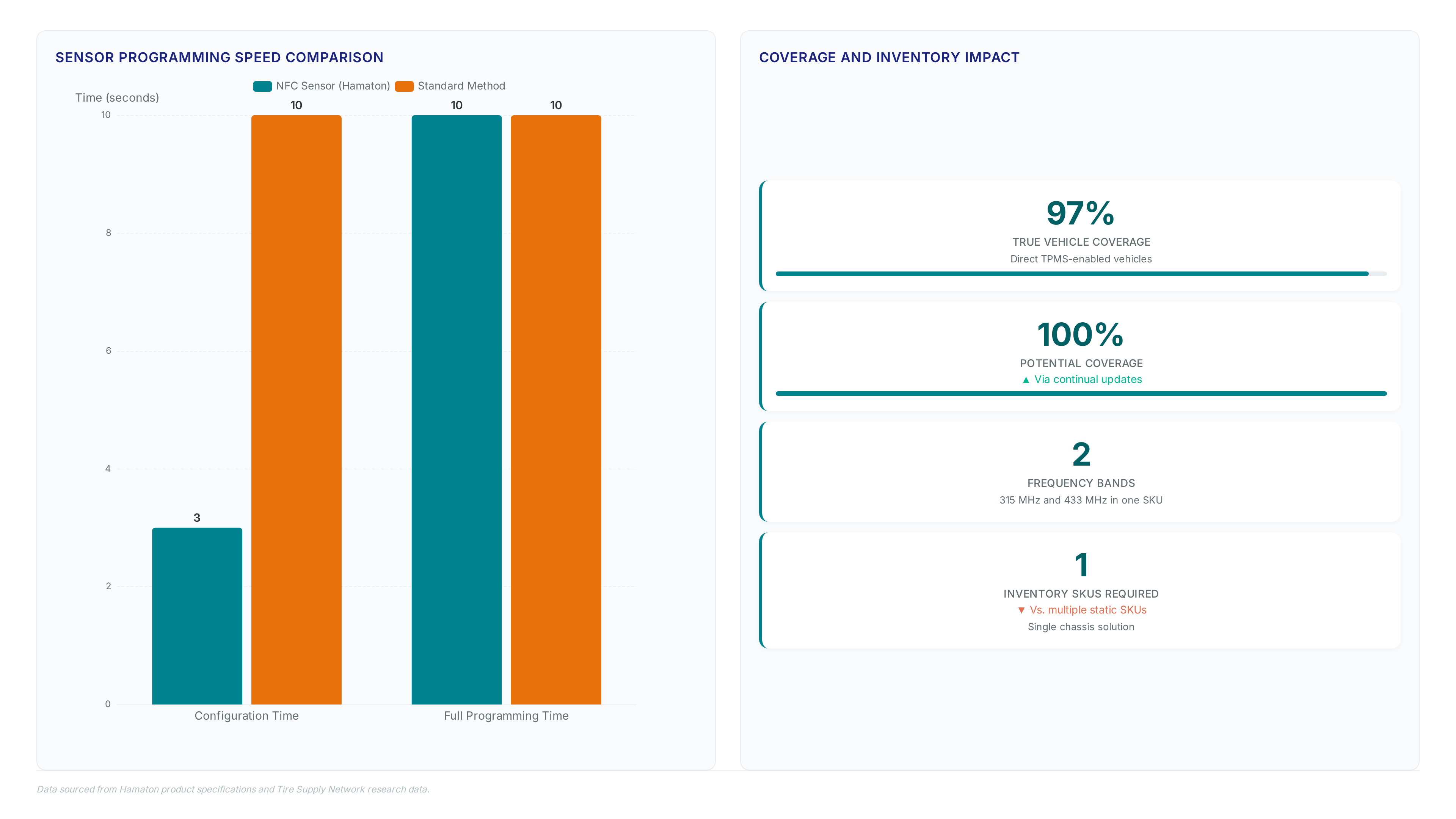
Fragmented frequency requirements disappear when a single chassis natively supports both 315 MHz and 433 MHz bands. This dual-frequency capability removes the logistical burden of stocking separate inventory for different regional standards or manufacturer requirements. Technicians deploy one single SKU solution rather than managing distinct part numbers for every frequency variation.
Continuous app updates provide technicians with access to the latest vehicle definitions as new applications become available. Meyer Distributing combines next-day delivery with digital-ready products to address these logistical needs. Reducing physical storage costs while maintaining near-total market adaptability through software rather than hardware swaps offers a distinct operational edge.
Comparison: Executing 10-Second Programming Cycles for Immediate Vehicle Coverage Updates
Technicians execute full sensor programming in 10 seconds by tapping a mobile device against the valve stem. This NFC-enabled workflow provides immediate access to the latest vehicle definitions through the Hamaton app. As new applications emerge, they deploy instantly, ensuring shop floors have current coverage data.
Balancing inventory management with rapid software updates defines this operational model. Shops choosing this approach reduce physical storage needs while using stable connectivity for data retrieval. The dual-frequency design further simplifies logistics by supporting both 315 MHz and 433 MHz bands without manual switching. Technicians gain an advantage by using a simplified configuration process. The U-Pro Hybrid NFC sensor achieves configuration in 3 seconds and full programming in 10 seconds, offering a fast solution for service workflows. This flexible approach contrasts with fixed SKU models that require warehouses to stock dozens of part numbers for different model years. The single SKU solution reduces storage overhead while maintaining compatibility with evolving OE standards like LOC SYNC and PAL. Conversely, the programmable nature of the U-Pro platform allows technicians to configure devices on-site for immediate installation. This capability helps ensure service bays can address late-model cars with current coverage. Operators seeking thorough coverage can apply programmable sensors available through Meyer Distributing. The shift from hardware-dependent stocking to software-set coverage represents a fundamental change in workshop logistics.
About
Anna Petrova serves as a B2B Auto Parts Market Analyst at KZMALL, where she specializes in evaluating competitive dynamics and sourcing trends within the global independent aftermarket. Her daily work involves rigorous analysis of component distribution, making her uniquely qualified to assess the strategic significance of the new partnership between Meyer Distributing and Hamaton regarding NFC-enabled TPMS sensors. By monitoring how advanced diagnostics and programmable sensors shift supply chain requirements, Anna connects high-level market data to practical procurement strategies for distributors. This article reflects her expertise in identifying how Hamaton's new sensor technology aligns with KZMALL's mission to provide verified, high-tech electronic components through its KTOP brand. Her analysis helps B2B buyers understand the operational value of integrating NFC technology into their inventory, ensuring they remain competitive in a rapidly evolving technical environment.
Conclusion
Adopt NFC-enabled sensors specifically for fleets with high vehicle diversity where stocking multiple frequencies creates excessive inventory drag. Do not attempt this migration if your facility lacks a reliable, secure network for real-time data retrieval, as offline capabilities remain limited compared to dedicated handhelds. The window to lock in these logistics savings is now, before OE manufacturers further restrict access to proprietary cloning protocols.
Start by auditing your current sensor inventory count against your actual service mix this week to identify how many slow-moving SKUs could be replaced by one programmable unit. This concrete step quantifies the storage space and capital you can free up immediately. Focus your initial rollout on high-turnover service lanes where the ten-second programming advantage directly impacts daily throughput.
Frequently Asked Questions
Technicians complete full sensor programming in 10 seconds using a mobile device. This speed allows shops to maintain high throughput during peak service hours while achieving 97% true vehicle coverage immediately.
The sensor delivers 97% true vehicle coverage for direct TPMS-enabled vehicles right now. Continuous updates allow the system to approach 100% coverage across diverse vehicle fleets over time.
No, a single unit supports both 315 MHz and 433 MHz bands simultaneously. This dual-frequency architecture removes the need to stock separate inventory while maintaining near 100% coverage potential.
NFC enables configuration in just 3 seconds by tapping a smartphone against the valve. This eliminates legacy tool updates and ensures technicians always access the latest vehicle applications instantly.
Yes, one universal SKU replaces rigid frequency locks and hundreds of specific part numbers.