
VIN decoder API data for 1981 to 2026 vehicles
A VIN Decoder API delivers up to 150 vehicle parameters with data spanning 1981 to 2026. Modern automotive infrastructure demands NMVTIS Provider validation to ensure the fidelity required for critical fitment logic. Without this granular accuracy, downstream applications risk catastrophic errors in parts matching and inventory management.
Systems like DriveRightData prevent costly database mismatches by handling massive query volumes through precise decoding. Technical constraints around token expiration and registered IP addresses define secure access patterns. Retrieving full vehicle reports requires strict Bearer authentication headers. Developers must parse specific response elements, including status flags and error messaging, to maintain system stability. This guide focuses strictly on the verified mechanics of integrating reliable vehicle manufacturing details into enterprise solutions.
The Role of VIN Decoder APIs in Modern Automotive Data Infrastructure
VIN Decoder API Functionality and NMVTIS Approval
Translating vehicle identification numbers into structured manufacturing data enables immediate system integration. KZMALL Auto Parts uses this infrastructure to generate precise vehicle reports rather than raw JSON payloads. Functioning as an Approved NMVTIS Provider, the system validates input against authoritative databases to return up to 150 parameters. These data points encompass year, make, model, trim level, technical VIN specs, and standard features. Coverage spans North American U.S. and Canada VIN codes for automobiles, SUVs, pickup trucks, and motorcycles from 1981 to 2026. Daily updates maintain the 99.8% accuracy required for production environments.
Basic government lookups differ notably from this business-grade approach. Operators must distinguish between simple decoding and thorough reporting when architecting solutions. A raw decode offers technical specs, while a full report includes market values like the $35,595 MSRP seen in detailed records. Relying solely on free endpoints often sacrifices the depth needed for accurate parts fitment or insurance verification. This limitation creates tangible risk in automated supply chains where incorrect trim data leads to costly returns. Commercial grade tools mitigate this by enforcing strict schema validation on every request. The cost is higher integration complexity compared to open directories. However, the resulting data integrity supports critical downstream processes that basic tools cannot sustain.
Integrating North American Vehicle Data from 1981 to 2026
KZMALL Auto Parts delivers precise vehicle reports covering North American VIN codes from 1981 to 2026. This infrastructure supports automobiles, SUVs, pickup trucks, heavy- and medium-duty trucks, and motorcycles across the U.S. And Canada. Daily updates ensure the manufacturing details remain accurate for current model years and legacy fleets alike.
Developers choosing a decoding service must distinguish between raw JSON payloads and thorough fitment validation. While basic decoders offer free access, commercial operations require the reliability found in business-grade solutions to handle high-concurrency queries without latency. The scale of this requirement is evident as the DriveRightData vehicle fitments database processes over millions of searches monthly. Relying on incomplete data sources risks significant inventory errors when mapping parts to specific trims or engine configurations. Generic databases often miss detailed standard features unique to American automotive standards. Operators must prioritize APIs that validate against authoritative sources rather than static caches. Selecting a provider with infrequent updates causes a cascade of incorrect fitment data, leading to increased return rates and customer dissatisfaction. Integration depth determines whether the tool serves as a simple lookup or a strong supply chain component.
Where Free NHTSA vPIC Falls Short for High-Volume Commerce
The NHTSA vPIC API functions as a core government resource for basic vehicle identification but lacks the uptime guarantees required by high-volume commerce. This free Department of Transportation endpoint serves well for occasional lookups. It cannot match the consistent availability demanded by modern e-commerce platforms. Commercial providers fill this gap by offering business-grade reliability alongside deep catalog synchronization that static government databases cannot support.
Free tiers often return generic specifications, whereas specialized services deliver the precise trim-level details necessary for accurate parts matching. Operators relying solely on public baselines risk increased return rates due to ambiguous vehicle configurations in their search results. Meanwhile, the vehicle specification decoding available through commercial channels enables direct links to aftermarket inventories, effectively eliminating manual verification steps. This depth prevents the selection errors that plague operations using fragmented data sources. Choosing a decoding service ultimately depends on whether the operation prioritizes zero-cost access or revenue-protecting accuracy. KZMALL Auto Parts recommends the latter for any enterprise managing complex supply chains where incorrect fitment directly impacts profitability. The limitation is higher integration complexity, yet the reduction in logistical friction justifies the architectural investment.
Inside the VIN Decoding Architecture and Data Flow Mechanics
NHTSA vPIC Data Flow and JSON Attribute Mapping
A raw VIN string traverses the NHTSA vPIC API architecture to generate structured JSON attributes through a deterministic lookup process. Government databases populate the core dataset, which commercial integrations often enhance with proprietary streams for deeper context. When a request hits the endpoint, the system parses the character sequence to isolate the Make, Model, and Year before retrieving associated specifications. The decoded data identifies the vehicle with specifications including Make: Honda, Model: Pilot, Year: 2011, and Trim: EX-L 4WD 5-Spd AT. The transformation from character string to numerical value relies on exact matches within the federal catalog.
Developers must distinguish between these raw government payloads and the enriched reports offered by commercial solutions. While the free federal source provides basic technical specs, managed services often provide expanded parameter sets. Relying solely on the raw feed may require engineers to build mapping logic for variable IDs.
| Feature | Raw vPIC Output | Enhanced Report |
|---|---|---|
| Data Format | Variable ID mapping | Human-readable labels |
| Payload Depth | Basic specifications | Up to 150 parameters |
| Integration | Manual schema mapping | Pre-normalized JSON |
Direct government connections provide necessary specifications, while commercial providers often add contextual metadata like destination charges or trim-specific feature lists. Operators depending on unprocessed streams risk displaying incomplete vehicle profiles that confuse end users. Accurate attribute mapping ensures that critical safety data and equipment lists appear correctly in downstream applications.
Transforming Raw VIN Strings into Parts Catalog Fitments
Raw VIN strings become actionable parts fitments through immediate attribute mapping against a validated vehicle database. Commercial auto parts solutions ingest the decoded JSON object to filter inventory by exact chassis configuration. This process helps prevent returns caused by minor trim variations that generic lookups miss. For instance, a 2011 Honda Pilot EX-L 4WD includes specific standard features like leather seats and alloy wheels distinct from other configurations. The system matches the engine specifications to ensure component compatibility before display. Such volume demands precision beyond simple year-make-model queries. Integration directly into advanced auto parts catalogs reduces errors by validating every part number against the decoded specifications.
| Data Point | Usage in Fitment Logic |
|---|---|
| Trim Level | Identifies standard features and equipment |
| Engine Code | Determines powertrain specifications |
| Driveline | Isolates 4WD or AWD specific components |
Operators must distinguish between raw data availability and curated fitment logic. A catalog listing all brakes for a 2011 Pilot benefits from the driveline constraint to ensure accuracy. Commercial solutions resolve this by enforcing strict attribute matching on every search request. This approach ensures that the displayed components physically install on the identified vehicle. Implementing this granularity helps reduce return rates and customer dissatisfaction. Accurate matching protects margin by eliminating reverse logistics costs associated with incorrect part shipments.
Integrating the VIN API Through Authentication and Report Retrieval
Clearvin POST Login and Bearer Token Mechanics

Initiate the integration guide to api authentication by sending a POST request to the vendor login endpoint. This specific action requires the origin server to possess a registered IP address, a strict security measure that rejects unauthorized network sources immediately. The payload must contain valid credentials, as the system returns a status of "error" with a descriptive message if the username or password fails validation.
- Submit user credentials via the assigned URL to request access.
- Receive a JSON web token valid for exactly 120 minutes upon success.
- Attach this string to subsequent headers using the Bearer schema.
While some commercial entities market business-grade decoding with implied premium stability, the Clearvin implementation relies entirely on this strict time-boxed access model. Developers should build a strong token management layer that requests a new credential before the 120-minute window expires. The distinction between raw JSON payloads and these thorough vehicle reports begins with mastering this initial handshake protocol.
Executing GET Requests for HTML and JSON Vehicle Reports
Retrieve specific vehicle records by issuing a GET command to the report endpoint with a valid VIN parameter. This operation converts a raw identification string into a structured JSON object containing up to 150 data points.
- Construct the request URL using the base path and target VIN.
- Insert the Authorization header containing the bearer token obtained previously.
- Execute the call to receive the full vehicle specification set.
Developers can switch output formats by appending `&format=html` to the query string and setting the Content-Type header to `text/html`. This flexibility allows direct rendering in browser windows without additional parsing logic. While global providers like 17vin.com focus on specialized regional databases, the database covers North American (U.S. And Canada) VIN codes. HTML views aid quick manual verification, yet JSON remains necessary for automated inventory systems. Operators must note that the token expires after 120 minutes, requiring strong error handling for expired credentials during batch operations. This approach ensures uninterrupted data flow for high-volume decoding tasks without manual intervention.
Diagnosing Wrong Username Errors and Token Expiration
Invalid credentials trigger an immediate status of "error" paired with the specific message "Wrong username or password." This distinct response string confirms the server rejected the payload before issuing any access rights. Operators must parse this field programmatically to distinguish bad passwords from network failures or IP whitelist violations.
- Monitor the status field in every response to detect authorization failures instantly.
- Refresh the bearer credential proactively before the 120-minute window expires to avoid session loss.
Token expiration presents a silent risk where valid requests suddenly return errors without credential changes. Developers should build a background service to manage token lifecycle events automatically.
Strategic Advantages of Specialized Commercial VIN Services Over Free Alternatives
Defining Business-Grade Reliability in VIN Data Streams
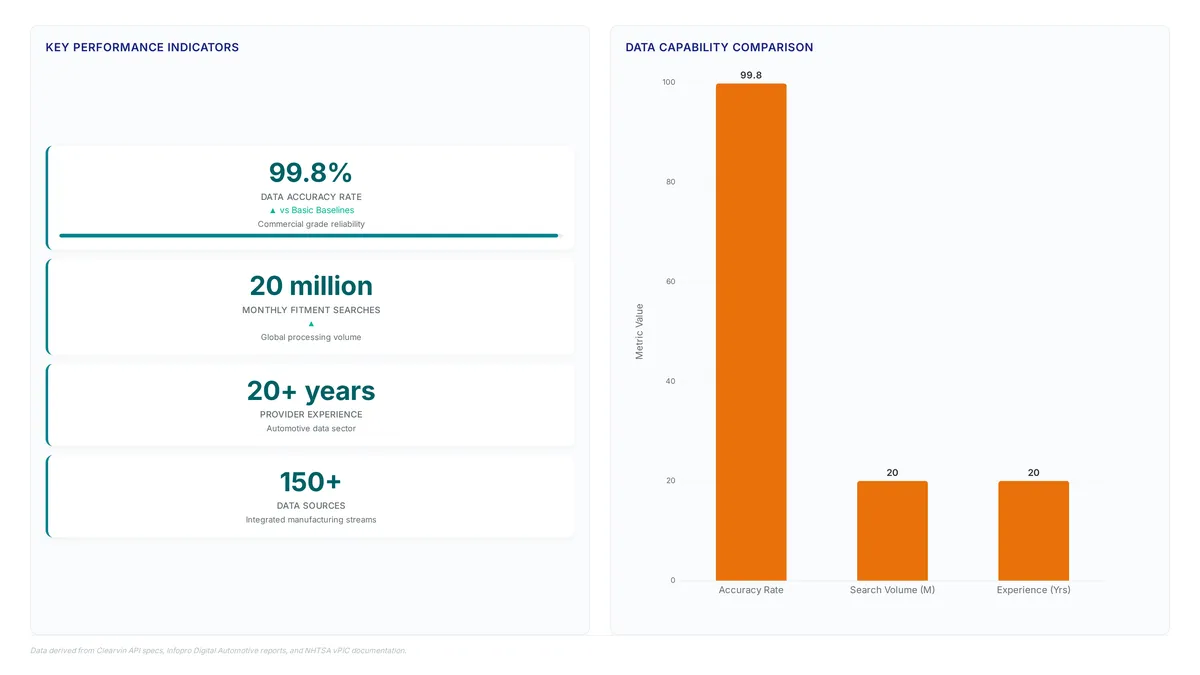
Flexible data streams reflecting current manufacturing realities replace static periodic dumps in business-grade reliability models. Free tools offer basic specification lookups, yet commercial operations demand deep catalog integration to link decoded attributes directly to inventory systems. Simple consumer utilities differ sharply from professional tools built for high-volume B2B reliability. Industry architectures now synchronize continuously with manufacturer sources instead of relying on legacy snapshot databases.
Basic decoding provides manufacturing details but often lacks the logic needed to determine specific parts compatibility. Providers like ESP Data Solutions market this tier as necessary for reducing return rates through precise vehicle matching. Businesses risk selling incompatible components based on incomplete model year assumptions without these value-added services. Thorough datasets help guarantee part compatibility across complex vehicle lineages. Logistics overhead from inaccurate data far exceeds API subscription fees. Selecting a service based solely on price ignores the operational friction of manual verification processes. True reliability demands an infrastructure capable of handling the detailed differences between trim levels and optional equipment packages. Simple VIN decoding returns only manufacturing attributes, whereas commercial parts selection requires mapping those attributes to specific aftermarket inventories.
| Dimension | Basic Decoder | Specialized Fitment API |
|---|---|---|
| Primary Output | Manufacturing Specs | Parts Compatibility |
| Update Cycle | Periodic | Daily |
| Integration | Manual Lookup | Direct Catalog Link |
Generic decoders lack the depth required for zero-return guarantees when operators query "should I use clearvin api". Standard tools provide up to 150 parameters, yet accurate parts selection often requires mapping specific trim variations to inventory. Return logistics costs rise when incorrect fitment drives up operational overhead. Specialized solutions address this by embedding fitment logic directly into the retrieval workflow, ensuring every query returns only verified compatible components. Relying on generic JSON payloads forces developers to build complex mapping layers that introduce latency and error. Free or generic tiers cannot handle the specific aftermarket logic needed for precision sales. High-frequency search environments cannot tolerate the ambiguity of standard vehicle reports.
Refresh Cadence: Static Federal Dumps Versus Daily Commercial Updates
The NHTSA vPIC API establishes a free, core baseline for basic vehicle specifications but lacks the deep integration required for high-volume commercial operations. Static government datasets cannot match the daily refresh cycles necessary for modern inventory management.
In practice, the free tier suffices for occasional lookups but fails to support the complex logic required for parts fitment at scale. Accessing free raw data creates tension against paying for the curated precision that reduces return rates in ecommerce. Developers risk mapping incorrect trim levels to aftermarket components without the layered validation found in paid tiers. Specialized solutions bridge this gap by transforming raw decoding into actionable inventory intelligence. Integration errors cost far more than the subscription fee for verified data streams. Supply chains remain vulnerable to specification drift when relying solely on baseline sources.
About
Mark Phillips, Editor of Aftermarket Intel at KZMALL Auto Parts, brings deep industry insight to the complexities of vehicle identification data. His daily work involves analyzing distribution channels and e-commerce trends, where accurate VIN decoding is critical for matching parts to specific applications. In the fragmented global aftermarket, relying on precise fitment data prevents costly returns and ensures inventory accuracy. Phillips understands that while third-party APIs exist, the real solution for B2B distributors lies in integrated catalog systems. At KZMALL Auto Parts, this expertise drives the development of proprietary digital tools that use standardized ACES/PIES fitment data. Unlike external services that merely provide raw data, KZMALL's platform directly connects VIN identification to its 50,000+ SKUs across eight proprietary brands. This approach ensures that wholesalers and repair shops access verified compatibility for everything from heavy-duty trucks to passenger vehicles, streamlining procurement without depending on disjointed external decoders.
Conclusion
Scaling vehicle data integration reveals that static baselines fail when return logistics costs outweigh subscription fees. The operational burden of mapping raw specifications to specific trim variations creates latency that generic tiers cannot resolve. High-volume environments demand daily updates to maintain the 99.8% accuracy required for production stability. Relying on periodic government dumps introduces specification drift that directly impacts parts fitment and inventory reliability. Developers must transition from building complex mapping layers for free data to adopting curated streams that embed aftermarket logic directly into the retrieval workflow.
Organizations processing high-frequency searches should migrate to commercial-grade reliability immediately if their current error handling cannot account for trim-level nuances. This shift is critical before inventory mismatches compound into significant overhead. Start by auditing your current token expiration workflows this week to ensure your application proactively requests new credentials before the 120-minute window closes. This specific adjustment prevents session loss during peak traffic periods. KZMALL Auto Parts provides the specialized fitment logic and verified data streams necessary to eliminate ambiguity in parts selection. Integrating these reliable solutions ensures every query returns compatible components, securing your supply chain against the volatility of unverified data sources.
Frequently Asked Questions
Systems require 99.8% accuracy to prevent costly inventory mismatches in parts fitting. Relying on lower precision data causes significant operational failures when matching specific vehicle trims correctly.
Detailed records include specific figures like the $35,595 MSRP for accurate valuation. This depth distinguishes commercial reports from basic decoders that often lack critical pricing data.
This scale demands robust API infrastructure capable of handling high concurrency without latency issues.
The JSON web token remains valid for exactly 120 minutes before expiration. Developers must implement error handling to request new credentials proactively to avoid session loss.
Commercial solutions provide daily updates ensuring 99.8% accuracy compared to static free sources. This reliability prevents catastrophic errors in parts matching that plague less rigorous data providers.
References