
Steering belt repair cuts rack costs by half
A worn belt causing steering failure often triggers repair bills exceeding $1,000 for parts alone, according to Aftermarket News data. Throwing away an entire EPS rack because of a single frayed component is bad engineering and worse economics. Component-level repair fixes the actual problem. Plews & Edelmann launched this new category on 11 May 2026 to stop the waste.
Most diagnostics get it wrong. They see a mechanical wear issue and call it a catastrophic rack failure. This error forces technicians into expensive full rack replacements that demand complex reprogramming and realignment. The new Edelmann kits ignore the hype and target the root cause: specific failed elements like drive belts and torque sensors. You replace the broken bit. You skip the module re-flashing. You skip the specialized diagnostic equipment. The system works again.
Let's look at the mechanical realities of belt-driven EPS failure and why these systems default to manual mode. We will detail how drive belt kits and motor couplings restore assist without the downtime of unit swaps. The math is simple: targeted solutions deliver more than 50 per cent cost savings compared to conventional replacement strategies. This shift empowers shops to perform same-day repairs that were previously impossible.
The Role of Component-Level Repair in Modern EPS Architecture
Defining Electric Power Steering Repair and Component Failure Modes
Electric power steering repair targets specific internal failures rather than replacing the entire assembly. In belt-driven architectures, a worn internal belt often causes the system to revert to manual mode. Historically, shops misdiagnosed this as a total rack failure. Traditional OEM approaches mandate full rack replacement, a process where parts alone routinely exceed a significant cost. This replace-only model ignores reality: the torque sensor or motor coupling frequently constitutes the actual point of degradation.
A torque sensor measures driver input force to regulate electric assist; its failure disconnects power assistance while leaving mechanical steering intact.
Restoring steering assist requires replacing the specific worn belt or sensor that causes failure, rather than discarding the entire rack. In belt-driven architectures, a broken internal coupling forces the system into manual mode, removing power assistance entirely. These component-level repairs apply common hand tools and eliminate the need for module re-flashing or complex realignment procedures. The industry shift toward targeted kits allows shops to service millions of domestic and import vehicles without OEM-mandated full replacements.
Success depends on precise diagnosis. Misidentifying a simple belt failure as a total rack issue leads to unnecessary expense. Operators must verify the specific failure mode before ordering parts to avoid purchasing incorrect sensor types. This approach transforms a previously replace-only category into a viable service opportunity for independent facilities. The cost differential highlights how targeted component replacement preserves vehicle uptime while significantly reducing consumer repair bills.
Cost Analysis: Component Repair Savings Versus Full Rack Replacement
Component-level EPS repair targets specific internal failures like worn belts rather than replacing the entire rack assembly. Technicians can restore full steering assist using common hand tools without incurring reprogramming or realignment fees. Replacement motor couplings address scenarios where full rack costs can exceed $1,700, offering a targeted financial alternative for domestic and import vehicles.
Full replacement generates higher parts revenue, sure. But component repair increases shop throughput by eliminating module re-flashes and complex alignments. Independent repairers face declining consumer spend, yet 57% of consumers globally now prefer aftermarket parts over original equipment to manage costs. This shift favors repair kits that lower the final invoice without sacrificing system reliability.
The limitation remains technician training; shops must learn to diagnose specific sensor or belt failures instead of defaulting to whole-unit swaps. Adopting this model requires updating service menus to explicitly offer repair as a distinct line item from replacement.
Mechanics of Belt-Driven EPS Failure and Restoration
Internal Belt Wear and Torque Sensor Degradation Mechanics
A frayed rubber belt inside the rack disconnects motor torque from the gear, forcing a revert to manual steering. The diagnostic depth required to distinguish this wear from electronic board faults separates profitable shops from those performing blind mechanical swaps. Technicians who identify the frayed component can restore function without specialized calibration tools.
Torque sensor degradation presents a subtler challenge where signal noise causes inconsistent assist rather than total loss. Failure here disrupts the feedback loop between driver input and motor response, creating unpredictable steering weight. Plews & Edelmann address this by offering targeted sensor replacements that restore reliability without discarding the housing. Shops capable of electronic component diagnosis gain a distinct advantage in the evolving aftermarket system.
| Failure Mode | Symptom Profile | Root Cause |
|---|---|---|
| Belt Wear | Sudden manual mode | Rubber separation |
| Sensor Decay | Erratic assist levels | Signal noise |
Choose between broad replacement and precise restoration. Full rack exchange guarantees a known baseline, but it ignores the engineering reality that the core housing often remains intact. Component repair preserves the original steering geometry and avoids complex realignment procedures. This approach reduces waste and lowers the barrier for independent technicians to service modern electric systems effectively.
Restoring Function with Coupling Replacements and Drive Belt Kits
Replacing a fractured motor coupling restores the physical link between the electric assist motor and the steering gear, directly resolving loss-of-assist faults. Inside belt-driven racks, a broken rubber belt forces the system into manual mode, creating heavy steering that mimics total electronic failure. Technicians can address this specific mechanical break using Edelmann drive belt kits which include the belt, housing gasket, and necessary seals. These kits allow shops to fix the root cause without module re-flashing or specialized diagnostic equipment.
- Remove the EPS motor assembly from the steering rack.
- Extract the worn belt or degraded coupling from the drive train.
- Install the new components using common hand tools.
- Validate the repair.
Technicians validate same-day steering system repair success by cross-referencing kit contents against rack-specific installation instructions before disassembly. This procedural step ensures all required components, such as the drive belt and housing gasket, match the specific vehicle architecture to prevent mid-repair delays.
| Validation Step | Component Check | Outcome |
|---|---|---|
| Pre-Scan | Verify belt and seal count | Confirms kit completeness |
| Instruction Match | Compare diagrams to rack | Prevents incorrect assembly |
| Post-Install | Test assist return | Verifies manual mode resolution |
- Inspect the included video installation instructions for rack-specific torque specs.
- Confirm the presence of inner and outer boot clamps alongside the new belt.
- Execute the repair using common hand tools without module re-flashing.
Speed matters, but precision matters more. Rushing the initial component count often forces a teardown redo if a single seal is missing. Shops that strictly follow the provided checklists avoid the downtime previously inherent to replacement-only strategies. The inclusion of all-new manufactured parts rather than remanufactured units further reduces the risk of immediate secondary failure within the restored assembly. Technicians can now fix manual steering mode in EPS applications by addressing the root mechanical break directly. This targeted approach restores full power assist while bypassing the logistical hurdles of sourcing entire rack assemblies. The result is a predictable, contained service event that maximizes bay throughput.
Economic Advantages of Edelmann Kits Versus Full Rack Replacement
Defining the Component-Level Repair Economics for EPS Systems
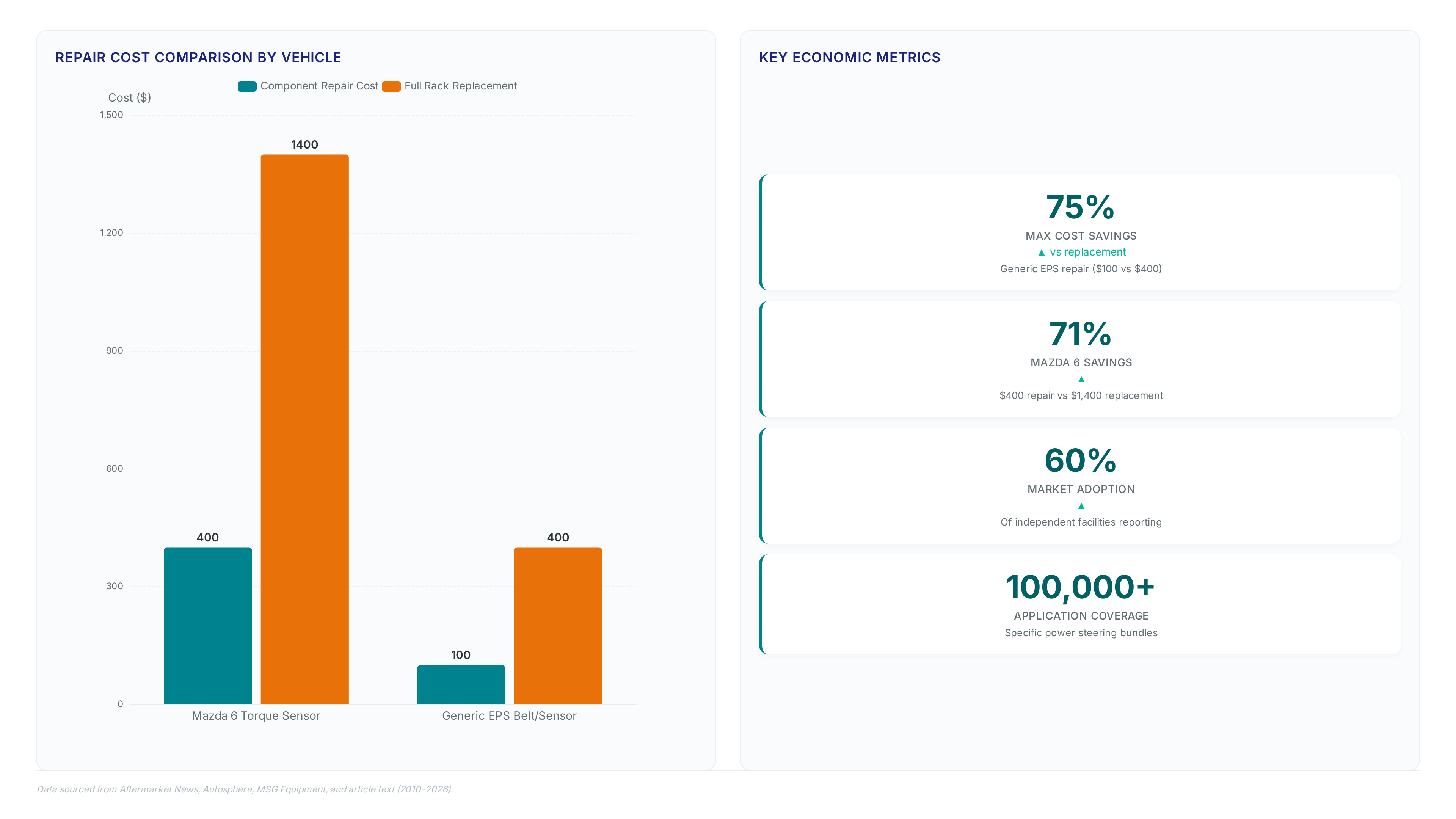
Discarding functional racks because a single belt frays or a sensor degrades wastes both parts and labor hours. Dan Billie noted the industry mistakenly treated these specific component faults as total rack failures. Shifting to component-level repair economics allows shops to target the broken element rather than the entire unit. Purpose-built solutions finally enable technicians to service this previously replace-only category effectively.
High-margin full swaps often tempt shops, yet lower-cost repairs increase service volume through affordable fixes. These kits eliminate the need for module re-flashing, realignment, or specialized diagnostic equipment. Common hand tools suffice for same-day repairs that restore full power steering assist.
Real-World Cost Savings in Mazda and Hyundai EPS Repairs
Specific component failures in Mazda and Hyundai vehicles demonstrate immediate financial advantages when technicians choose repair over full rack replacement. This significant reduction illustrates how isolating the mechanical fault preserves budget while restoring function. This approach yields significant savings compared to traditional replace protocols.
Shops avoiding component-level diagnostics leave significant profit on the table while charging customers more for unnecessary hardware. Accurate failure identification matters more than blanket part swapping. Technicians must distinguish between electronic board faults and simple mechanical breaks to avoid misdiagnosis. Using purpose-built kits eliminates the need for module re-flashing or specialized alignment tools. Independent facilities gain a profitable service opportunity from a category once limited to replacement-only repairs.
Profitability Analysis: Torque Sensor Repair Versus Full Unit Installation
Repair shops maximize net income by prioritizing component fixes over low-margin full rack swaps. A targeted torque sensor service generates a higher proportion of revenue from skilled technician time rather than parts markup. Over 100,000 application-specific bundles are designed to address these failures directly.
Diagnostic skills often reserved for dealership networks remain necessary for this model. Over 60% of independent repair facilities report difficulties performing routine repairs due to OEM barriers, impacting access to EPS diagnostic data and tools. The industry shift toward component-level servicing empowers independents to capture this value. Technicians gain the ability to service systems previously deemed unfixable without full unit installation.
Executing Same-Day EPS Repairs Using Common Hand Tools
Defining the Scope of Hand-Tool EPS Component Repairs
Internal belt fractures and sensor drift define the boundary for valid hand-tool repairs instead of total assembly discard. This distinction separates units suitable for component-level remediation from those requiring full replacement. Technicians identify failure modes such as a broken coupling or worn belt, which traditionally necessitated complete rack replacement.
- Inspect the rack to identify specific failure points like worn belts or torque sensors before selecting a repair path.
- Confirm the specific failure is a worn belt or torque sensor, common issues that cause steering to revert to manual mode.
- Execute the fix using common tools without needing module re-flashing or specialized alignment racks.
Distinguish repairable mechanical fatigue from electronic failure within the control unit. Shops adopting this scope avoid unnecessary inventory costs while restoring steering assist same-day. Technicians apply these set boundaries to maximize bay efficiency and customer value. The focused approach prevents over-repair of functional assemblies while capturing labor value on precise interventions.
Executing Same-Day Repairs on Mazda and Hyundai EPS Systems
Technicians restore steering assist on Mazda 6 and Hyundai Elantra models by isolating failed internal components rather than swapping entire assemblies. This targeted approach bypasses the reprogramming and realignment steps that traditionally inflate labor hours. The process begins with removing the EPS motor to access the drive belt or torque sensor using standard hand tools.
- Install the new Edelmann EPS drive belt or coupling using the provided rack-specific instructions.
- Reassemble the unit and verify assist function without requiring module re-flashing.
This procedure eliminates the need for proprietary service tools often required to write new assist maps. Shops avoid the capital expenditure of specialized diagnostic equipment while maintaining full system reliability. Mechanical failures rather than electronic faults form the basis for this method. Component kits address root causes like broken belts, yet technicians must verify the root cause before proceeding to confirm the unit is repairable. This distinction prevents wasted labor on non-repairable units. Application-specific bundles turn a replace-only scenario into a profitable service event. Operators gain immediate inventory flexibility and reduced downtime for customers.
Validation Checklist for Module-Free EPS Restoration
Technicians validate successful module-free restoration by confirming full assist returns without writing new assist maps or performing wheel alignment. This process isolates mechanical wear from electronic faults, ensuring the repair remains a same-day service.
- Verify the torque sensor installation restores consistent steering assist and system reliability.
- Inspect the installed EPS drive belt for proper tension and absence of slippage marks on pulleys.
- Confirm system status.
The new product line includes specific components and tools designed to address EPS failures without requiring module re-flashing, realignment, or specialized diagnostic equipment.
| Check Point | Pass Criteria | Fail Action |
|---|---|---|
| Sensor Signal | Consistent steering assist | Replace sensor |
| Belt Tension | No slip under load | Re-tension kit |
| DTC Status | None active | Diagnose circuit |
These purpose-built solutions allow technicians to service a category that was previously replace-only, preserving the original vehicle configuration without erasing data. Using these targeted kits helps maintain factory steering feel while achieving significant cost savings.
About
Dmitry Volkov serves as a Senior Automotive Technical Writer at KZMALL Auto Parts, where he specializes in translating complex engineering specifications into actionable technical analysis. His daily work involves rigorously evaluating component standards and manufacturing processes, making him uniquely qualified to assess the viability of electric power steering (EPS) repair solutions. By directly engaging with fitment data and OE cross-references for KZMALL's extensive catalog, Volkov understands the critical need for cost-effective alternatives to full rack replacements. This article reflects his deep familiarity with how independent repair shops require precise, tool-friendly solutions to address modern EPS failures without specialized diagnostic equipment. His analysis connects KZMALL's commitment to standardized, certified parts with the practical demands of the global aftermarket, ensuring that technical recommendations align with real-world service center capabilities and economic constraints.
Conclusion
Scaling this repair model reveals that the primary bottleneck shifts from parts availability to technician discipline in root cause analysis. While full unit swaps generate higher immediate revenue per ticket, they alienate the expanding majority of cost-conscious vehicle owners who seek practical alternatives. The operational cost of ignoring component-level repair is the permanent loss of customers who cannot justify excessive bills for mechanical wear items. Shops must transition from a parts-swapping mentality to a diagnostic service model to capture this demand effectively.
Adopt component-based restoration immediately for any electric power steering system exhibiting mechanical noise or intermittent assist, provided electronic diagnostics confirm the control module remains functional. This approach is specifically recommended for independent repair facilities aiming to retain customers facing rising vehicle maintenance costs. Do not attempt this on units with confirmed internal electronic failures or water damage, as these conditions still necessitate full replacement.
Start this week by identifying three recent electric power steering system replacements in your shop history where the failure mode was likely mechanical, such as belt wear or sensor issues, and contact those customers to offer a retroactive inspection for potential component repair. This proactive outreach demonstrates confidence in the new method while recovering lost trust from clients burdened by previous high-cost repairs.
Frequently Asked Questions
A worn or broken internal belt frequently causes the system to lose power assist entirely. This specific mechanical wear often triggers repair bills exceeding $1,000 for parts alone if misdiagnosed as a total rack failure.
Fixing the sensor directly reduces total repair costs to approximately $400 for many vehicles. This targeted approach avoids the roughly $1,400 expense associated with purchasing and installing a brand new steering rack assembly.
Complex replacements can surpass $1,700 when technicians treat a simple belt issue as a full rack problem. This high cost includes expensive parts that often exceed $1,000 before any labor or programming fees are added.
These kits restore full steering assist using common hand tools without needing module re-flashing.
This strategy transforms a previously replace-only category into a viable service opportunity using standard repair tools.