
Independent Shops Beat Dealers on Routine Work
Ninety-six percent of drivers limit service to three or fewer providers, cementing loyalty before evaluating skill. You need to distinguish between routine maintenance tasks and complex safety system failures requiring specialized calibration. We dissect the specific capabilities of dealerships versus chains like AAA Car Care Plus to help you execute a targeted search for certified mechanics who offer genuine value.
The February 25, 2026, Consumer Reports survey reveals that independent mechanics and select chains provide higher satisfaction rates and greater price flexibility than franchise dealers. While dealerships boast factory training and proprietary diagnostic tools for software updates, their labor rates remain inflated for standard services. An honest mechanic will advise when specialized equipment is truly necessary versus when a generalist suffices.
Your strategy must account for the distinction between planned fluid changes and unexpected infotainment glitches. We analyze where each provider excels, from warranty-covered recalls to post-collision sensor recalibration. Understanding these operational differences helps you avoid overpaying for services that do not require manufacturer-specific intervention. The goal is to align your vehicle's needs with a facility capable of delivering quality without the premium markup.
Defining Routine Maintenance and Critical Safety Systems
Routine Maintenance vs Critical Safety Systems Set
Routine maintenance encompasses periodic items listed in an owner's manual, such as oil changes and filter replacements. These scheduled services keep a vehicle in top operating condition throughout its long life. Repairs, conversely, address unexpected problems like oil leaks or frozen infotainment screens. Distinguishing these categories helps owners select the right facility for their specific service needs.
Critical safety systems rely on sensors located behind windshield glass or in bumpers. These components require special equipment for recalibration so automatic emergency braking functions correctly. Modern vehicles possess complex systems that require specialized training and tools, creating a technical barrier for generalists. A failure in these areas often demands immediate attention rather than scheduled downtime.
| Feature | Routine Maintenance | Critical Safety Systems |
|---|---|---|
| Timing | Periodic and planned | Immediate or urgent |
| Scope | Fluids, filters, tires | Sensors, recalibration |
| Provider | Independent or chain shop | Dealership or specialist |
Automakers often perform TSB repairs free of charge, but this work must be done at a dealership. Ignoring this requirement can void coverage for defects under the original factory warranty. The rise of connected cars requires new communication protocols between shops and vehicles, making data access vital for future fixes.
ASE certification validates technician competency through rigorous testing rather than generic shop accreditation. This credential confirms mechanics possess the specific knowledge required to diagnose complex vehicle systems accurately. Owners should verify these qualifications before authorizing repairs on modern electronic architectures.
Diagnosing frozen screens or brake anomalies requires access to manufacturer Technical Service Bulletins. These documents provide necessary fixes for known glitches that standard diagnostic tools often miss. Independent facilities frequently struggle with these repairs due to restricted data flows. Recent industry analysis indicates 84% of independent shops view vehicle data access as their top business issue.
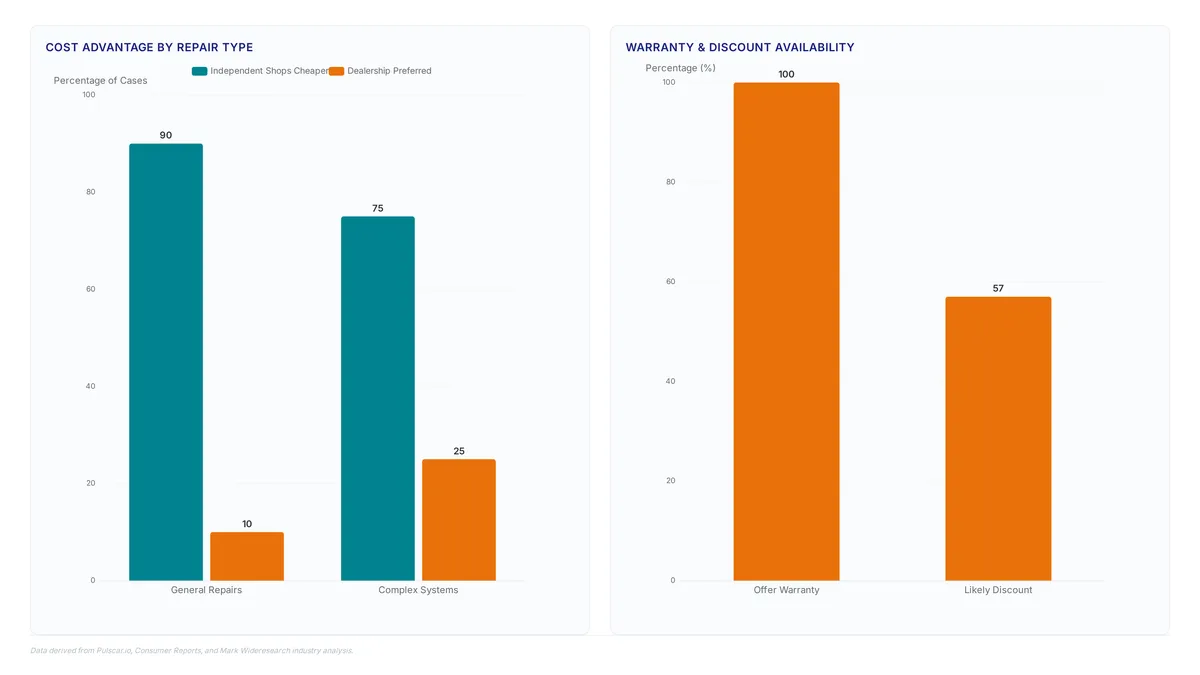
Choosing between facility types dictates total ownership cost and service satisfaction for non-warranty work. Consumers spend significantly more on average at dealerships compared to independent repair shops for similar services. Independent repair shops perform 75% of all aftermarket auto repairs, while dealerships account for only 25% of the business. This market dominance reflects a structural advantage in pricing flexibility that franchise locations rarely match.
| Feature | Dealership Service Dept | Independent Repair Shop |
|---|---|---|
| Labor Rate | High fixed rates | Negotiable pricing |
| Price Satisfaction | Lowest scores | Highest scores |
| Discount Likelihood | Rare | Common |
| Best Use Case | Warranty defects | Routine maintenance |
Survey data covering nearly 11,000 participants reveals independent mechanics receive the highest scores for satisfaction with price. Chains like AAA Car Care Plus also outperform dealers in this metric. Facilities operating outside manufacturer franchises demonstrate a greater willingness to negotiate final invoices directly with vehicle owners.
Paying premium dealership rates for routine items like brake pad replacement creates unnecessary financial drag. Dealerships remain necessary for warranty defects and specific software updates. Their rigid pricing models fail to reward loyalty outside those narrow constraints. KZMALL Auto Parts supplies premium filters and brake components that independent technicians install at competitive labor rates. This combination maximizes vehicle longevity without the overhead of franchise branding. Owners facing brake performance problems should seek independent certification for standard replacements to capture these savings. Strategic selection based on repair complexity rather than brand loyalty optimizes long-term expenditure.
Comparing Dealership, Independent, and Chain Repair Capabilities
Dealership Labor Rates vs Independent Shop Expertise Definitions
Premium labor rates define dealership service departments, where factory-trained technicians apply exclusive proprietary diagnostic tools. This structural advantage guarantees that complex warranty work and safety sensor recalibrations adhere to strict manufacturer specifications using genuine parts. Consumers pay notably more at these facilities for similar non-warranty services compared to independent garages. The cost differential mirrors the overhead required to maintain brand-specific certification levels rather than indicating superior outcomes for routine tasks.
Independent repair shops typically feature lower labor rates and employ experienced technicians who previously worked within dealer networks. These facilities lack direct access to proprietary manufacturer software yet excel in diagnosing drivetrain issues and replacing suspension components without the brand premium. Data indicates a disparity in digital adoption, with independent shops using online booking at lower rates than dealerships. This gap suggests independents often prioritize hands-on mechanical expertise over digital convenience features. Operators face an operational constraint when balancing specialized tool access against significant cost savings for out-of-warranty vehicles.
When to Use Dealerships for Safety Sensor Recalibration and Software Updates
Mandatory dealership specialization occurs when crash repairs alter automatic emergency braking or adaptive cruise control systems. Safety sensors embedded behind windshield glass or within bumpers demand proprietary calibration equipment that independent facilities rarely possess. The vehicle computer cannot accurately map its position relative to surrounding objects without this specific hardware, rendering advanced driver aids ineffective.
Manufacturers explicitly designate dealerships as the sole authorized providers for warranty-covered service campaigns and recall repairs. This restriction ensures software glitches in infotainment units or powertrain controllers receive updates directly from the source. Consumers report being more likely to secure a discount at independent mechanics, yet the risk of voiding a factory warranty outweighs potential savings for these specific technical interventions.
| Capability | Dealership | Independent Shop | Chain Repair |
|---|---|---|---|
| Proprietary Software Access | Yes | No | Limited |
| Warranty Work Authorization | Full | None | Varies |
| Labor Rate Level | High | Low | Medium |
| Specialized Tool Availability | Complete | Partial | Partial |
Safety sensor recalibrations are often needed in conjunction with crash repair so the car's computer correctly identifies the vehicle's position relative to other cars and objects. Choosing a lower-priced provider for these specific tasks often results in repeated visits and unresolved fault codes. Certified equipment access takes priority over labor rate savings when safety systems are involved.
EV Technician Training Gaps and Battery Electric Vehicle Satisfaction Risks
Mass market and premium Battery Electric Vehicle owners report satisfaction scores 51 and 57 points lower respectively than their Internal Combustion Engine counterparts, a deficit driven by specialized training gaps. This significant gap exists because advanced technical training requirements remain far more prevalent at dealerships than in the independent aftermarket.
The structural barrier prevents many independent facilities from safely servicing high-voltage systems, forcing owners toward expensive dealership visits despite clear price disadvantages. Independent shops typically excel in price satisfaction for traditional repairs, yet the specialized training shortage creates a bottleneck for EV adoption support. Owners facing complex battery diagnostics often find no viable alternative to dealer networks, negating the cost savings usually associated with independent garages. Improper handling of high-voltage components poses severe safety hazards that general practice shops cannot mitigate. This creates a distinct tension between desired cost savings and the absolute necessity for certified expertise.
Executing a Strategic Search for Certified Mechanics
Defining BBB Accreditation and ASE Certification Standards
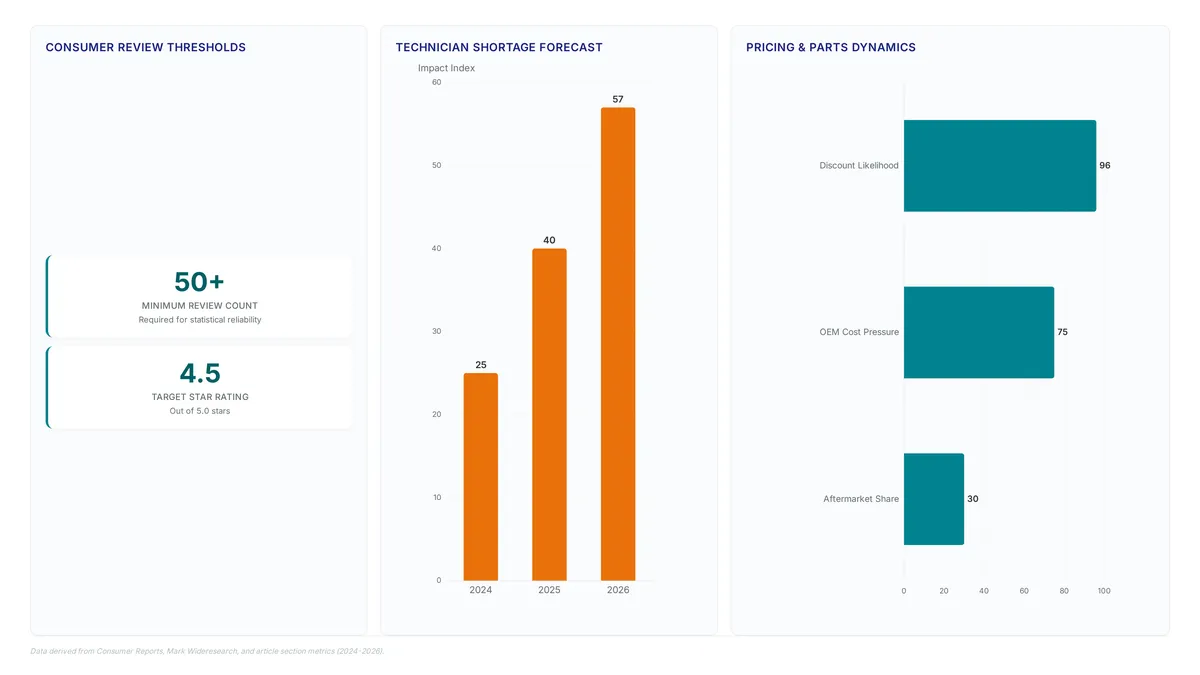
BBB Accredited status signifies a business has met specific trust standards, distinct from a mere listing that lacks complaint vetting. Operators should visit bbb.org to inspect unresolved complaints under Auto Services, filtering results to display only accredited entities. This step isolates shops committed to resolving disputes, a critical filter given that independent mechanics often provide more negotiable pricing than dealerships. Consumers report being more likely to get a discount at independent shops, yet accreditation ensures these savings do not come at the cost of accountability.
ASE certification validates technician competency through rigorous testing across specific repair domains. A competent diagnostician holds Master Technician status, indicating broad expertise rather than a single narrow skill set. Without this verification, owners risk misdiagnosis that inflates long-term maintenance costs.
- Navigate to the BBB website and search the target shop name.
- Filter the view to show only "BBB Accredited" businesses.
- Review the complaint history for patterns in unresolved auto service issues.
- Confirm the shop displays current ASE Master Technician certificates onsite.
| Credential Type | Validation Focus | Verification Method |
|---|---|---|
| BBB Accredited | Business ethics & complaint resolution | Online database filter |
| ASE Master | Technical repair proficiency | Onsite certificate display |
Relying solely on online star ratings ignores the structural difference between popularity and verified ethical conduct. A shop may have hundreds of reviews yet lack the accreditation required to guarantee dispute mediation.
Executing Online Vetting Using RepairPal and Angi Reviews
Start digital vetting by demanding high review volume on RepairPal and Angi to filter out unreliable shops. Facilities boasting hundreds or thousands of stellar reviews represent statistically safer bets for vehicle owners seeking consistency. Specialized garages focusing on your specific brand are more likely to possess the latest training and equipment required to troubleshoot complex issues quickly.
- Search aggregator platforms using your vehicle make as the primary filter criterion.
- Cross-reference findings between RepairPal and Angi to identify consistent rating patterns.
- Prioritize shops explicitly mentioning brand-specific diagnostic tools in their service descriptions.
Shops increasingly apply these aggregator platforms for parts ordering, a technical shift that directly impacts supply chain speed and cost efficiency for the consumer.
| Feature | RepairPal | Angi |
|---|---|---|
| Primary Focus | Certified Shops | General Services |
| Key Metric | Fair Price Estimate | Member Reviews |
| Best For | Brand Specialization | Volume Verification |
A critical tension exists between finding low-cost labor and securing specialized diagnostic capabilities, as price-focused shops often lack deep brand expertise. KZMALL Auto Parts recommends prioritizing certified technicians over marginal cost savings to avoid misdiagnosis penalties later. Operators must recognize that while independent mechanics may offer negotiable rates, only those with verified volume and specialization can match dealership-level diagnostic accuracy without the premium overhead.
This structured approach ensures owners select partners capable of handling both routine maintenance and unexpected system failures effectively.
Validation Checklist for Warranty Compliance and TSB Access
Lessees may be contractually required to use dealerships, creating an immediate compliance boundary for non-franchise facilities. Start by demanding written proof that the shop accesses manufacturer Technical Service Bulletins directly.
- Verify the facility holds current ASE certification specific to your vehicle brand.
- Confirm in writing that using their services will not void existing lease terms.
- Request a copy of the TSB reference number before authorizing any complex repair work.
Data access limitations prevent some independents from performing efficient diagnostics, giving dealers a technical advantage. Owners must weigh the convenience of local repair against the risk of incomplete data integration. KZMALL Auto Parts provides the genuine OEM components necessary to meet strict factory specifications regardless of where the labor is performed. Selecting a shop requires balancing cost savings against the certainty of manufacturer-aligned repair procedures.
Establishing Long-Term Value Through Effective Mechanic Relationships
Defining Effective Communication Protocols with Mechanics
Documenting exact symptoms and their timing before speaking to a technician prevents the liability trap created when owners suggest a diagnosis. Suggesting a cause can bind a customer to pay for repairs even if the root issue remains unresolved. Technicians require unfiltered data to isolate faults accurately without the bias of a customer's hypothesis. Operators should request a road test whenever an issue manifests only under motion or load. This step is vital as connected vehicle systems increasingly demand real-time data access to validate intermittent failures. Independent facilities perform a significant portion of all aftermarket repairs, offering a broad alternative to franchise dealers for most service needs.
Asking for evidence by demanding to see removed components like rusted exhaust sections or depleted brake pads confirms the work was necessary. Some facilities claim insurance policies prohibit customer access to the work area, yet requesting to view old parts is a standard method for ensuring transparent billing. Verified part sourcing solutions support independent shops in maintaining this transparency. Establishing this protocol early filters out dishonest providers before substantial capital expenditure occurs.
Applying Warranty Rights to Shop Selection Decisions
Federal statutes permit vehicle owners to seek routine maintenance at any facility without voiding factory coverage, though lessees often face stricter contractual mandates. Defect repairs under an original warranty typically require a dealership to avoid personal payment, while non-warranty work allows for strategic flexibility. Independent repair shops execute a majority of repairs at lower costs than franchised dealers for vehicles aged three to ten years.
Owners must distinguish between covered manufacturer defects and wear items to maximize value. Telematics data access restrictions can prevent non-dealer technicians from diagnosing specific electronic glitches efficiently. This technical barrier creates a scenario where an independent shop might correctly identify a mechanical fault but lack the proprietary software to reset the associated warning light. Consequently, owners should verify a shop's digital capability for their specific vehicle before authorizing work to avoid potential compatibility issues. Auto parts providers supply the genuine OEM replacements needed for wear-and-tear items, ensuring compatibility regardless of where the installation occurs. By reserving dealership visits for complex, covered failures and using independent providers for standard maintenance, operators preserve warranty rights while minimizing out-of-pocket expenditure. This segmented approach prevents the common error of paying premium labor rates for simple tasks that carry no warranty risk.
Checklist for Validating Mechanic Honesty and Pricing
Requesting physical inspection of worn components like brake pads serves as the primary verification step for repair necessity. Customers should demand to see removed parts before authorizing replacements to confirm actual wear versus theoretical service intervals. This practice filters unnecessary upsells common in high-pressure sales environments. Evaluating a facility requires assessing multiple performance metrics beyond simple labor rates. Shop ratings often hinge on honesty and the quality of work rather than speed alone. Data indicates that a majority of consumers now prefer independent aftermarket options to manage rising repair costs effectively. Recent surveys asked consumers to rate shops based on 12 attributes, including honesty, price, quality of work, time to complete repairs, and level of communication.
Independent mechanics frequently offer greater latitude on pricing compared to franchised dealerships. Shoppers should inquire about discounts specifically, as data shows a higher likelihood of price reductions at independent shops and specific chains. Auto parts experts recommend securing written estimates that itemize every guarantee or warranty included. Operators must recognize that transparency regarding replaced parts is a key indicator of a reputable business model. Establishing trust requires transparent evidence, not verbal assurances of failure. Building a relationship with a single provider allows technicians to learn the specific maintenance schedule and potential problems developing in a specific vehicle. Such familiarity minimizes the inconvenience and expense of surprise repairs over the long-term.
About
Anna Petrova, a B2B Auto Parts Market Analyst at KZMALL Auto Parts, uses deep industry data to guide independent repair shops through complex sourcing decisions. Her daily work involves analyzing market sizing and competitive dynamics across the global automotive aftermarket, directly informing the insights presented in this buying guide. By tracking demand trends for components and distribution patterns, Anna understands the critical need for reliable, certified parts that allow independent mechanics to compete effectively with dealerships and chains. At KZMALL Auto Parts, a leading global wholesale platform, she helps translate these market realities into actionable strategies for business owners. Her expertise ensures that shop owners can identify high-quality suppliers offering thorough catalogs and standardized fitment data. This analytical background enables Anna to provide factual, data-driven guidance on selecting parts providers that support profitability and operational efficiency in the independent repair sector.
Conclusion
Scaling a repair business reveals that transparency becomes the primary bottleneck when customer volume increases. While independent providers already handle the majority of aftermarket work, maintaining that market share requires moving beyond basic price competition to demonstrable proof of value. The operational cost of failing to document worn parts or explain warranty implications is lost customer trust, which no amount of discounting can recover. Shops must institutionalize the habit of showing removed components and itemizing estimates to survive long-term.
Operators should implement a strict policy requiring visual verification of all replaced parts before finalizing any invoice. This specific workflow change transforms abstract trust into tangible evidence, directly addressing the consumer demand for honesty identified in recent surveys. By making this verification standard procedure rather than an optional courtesy, shops differentiate themselves from dealerships that often rely on brand reputation alone.
Start this week by creating a mandatory "parts review" step in your service checkout process where technicians physically show customers the worn components before discussing payment. This single action validates the necessity of the repair and solidifies the relationship, ensuring your shop remains the preferred choice for cost-conscious vehicle owners seeking reliable service.
Frequently Asked Questions
Dealerships often charge significantly higher rates for similar services compared to independent facilities. While specific percentages vary by region, understanding this cost difference helps drivers save money on routine maintenance tasks.
Independent shops perform the vast majority of all aftermarket auto repairs today. With 84% of shops citing data access as a top issue, choosing one with proper tools ensures quality work.
You must visit a dealership for warranty work or safety sensor recalibration needs. These specialized tasks require proprietary diagnostic equipment that general independent facilities typically lack for complex system repairs.
Many technicians struggle due to restricted access to manufacturer technical service bulletins. Since 84% of shops view data access as their primary business issue, verifying this capability is essential.
Diagnostic fees vary widely depending on the shop and vehicle complexity. Customers should expect to pay around $75 for an initial assessment before authorizing any major repairs or parts replacement work.
References