
Parts price shifts: Why inflation drives demand
"Inflation is hitting the customers," says Michael Chung of the Auto Care Association, driving a sharp pivot toward private-label parts.
Legacy brand loyalty in the automotive aftermarket is collapsing under persistent cost pressures. Households stretched thin by fuel, insurance, and financing costs are no longer deferring maintenance; they are demanding cost-effective solutions. Shoppers explicitly reject premium components when cheaper alternatives offer similar reliability.
This financial strain forces a hard reset on repair shop inventory strategies. Technicians now cite finding affordable parts as a top concern, driven by daily living costs that compel consumers to switch products based on price incentives rather than habit. Suppliers must balance price competitiveness with performance standards to survive. The gap between premium branding and practical necessity widens, favoring those who deliver consistent quality without the high markup.
Inflation and Financial Strain Drive Consumer Spending Shifts
Defining the Composition Crisis in Auto Maintenance
Tariff exposure and affordability pressures are altering the specific mix of vehicles and parts rather than total volume, creating a composition crisis. Rising costs for fuel, insurance, and financing strain household budgets, forcing consumers to redefine value in vehicle maintenance. Michael Chung stated that persistent cost pressures are driving shoppers to seek lower-cost alternatives instead of premium options. Demand for cheaper auto parts stems directly from this financial squeeze, with cost efficiency becoming the primary driver for a significant share of consumers delaying maintenance. Brand loyalty erodes as buyers prioritize price over familiarity. A global shift shows 57% of consumers now prefer buying replacement parts from the independent aftermarket over OE parts due to the affordability crisis.
This is market transformation, not simple contraction. Suppliers must balance price competitiveness with performance reliability to retain trust. Manufacturers failing to offer comparable quality at lower price points risk losing customers permanently to private-label competitors. Only adaptable strategies survive this ongoing belt-tightening period.
Tracking Demand Shifts via the Auto Care Association Demand Index
The Auto Care Association Demand Index benchmarks market performance using unit-level, point-of-sale transaction data to reveal real-time spending shifts. This TrendLens platform architecture expanded in February 2026 to include granular data for Switches, Relays, and Connectors across 15 distinct product lines. Distributors track how inflation redirects car repair spending toward necessary hard parts rather than discretionary upgrades by weaving a keyword into daily operations. The mechanism relies on aggregated retail and commercial distribution data to flag volume anomalies before they impact inventory planning.
Consolidating diverse POS systems introduces lag, meaning immediate spot-checks remain necessary for flash sales. Operators must interpret these signals carefully. A spike in relay sales might indicate a specific manufacturing defect wave rather than broad economic distress. Relying solely on brand loyalty metrics fails when 90% of DIY purchases are influenced by digital research seeking value.
Financial strain forces a reevaluation of vehicle maintenance priorities, pushing consumers toward private-label equivalents that offer comparable reliability. This structural change means the composition crisis predicted for 2026 will manifest as a permanent shift in part selection rather than a temporary dip in total sales volume.
Market Volatility Risks from Reduced Consumer Confidence
Reduced consumer confidence creates market volatility by forcing deferred maintenance that threatens the industry valuation. Rising expenses for fuel and insurance directly suppress discretionary spending, causing shoppers to delay non-necessary repairs. Financial strain accelerates demand for cheaper alternatives, yet tariff disruptions are projected to cut 5-6% of aftermarket revenue, compounding affordability issues for end consumers. The tension between seeking lower prices and facing shrinking supply margins creates a fragile economic environment for distributors. Consumers successfully lower short-term costs, but the aggregate effect of delayed care increases the likelihood of catastrophic component failure later.
Industry projections indicate the market will grow to hundreds of billions of dollars by 2027, driven largely by consumers opting for these cost-saving maintenance options rather than premium services. This growth relies on the assumption that deferred maintenance does not permanently remove vehicles from the repairable fleet. Economic pressure could force total abandonment of older vehicles. Projected expansion may fail to materialize despite high demand for budget components if fleets shrink permanently.
Private Label Parts Challenge Premium Brand Dominance
Defining Private Label Parts as Comparable Quality Alternatives
Private label automotive parts are branded components offering a lower price point while addressing the needs of cost-conscious consumers. Inflation is hitting customers, driving demand for these alternatives as households face tighter budgets. Industry data indicates a expanding move toward affordable products. This preference reflects an increase driven specifically by rising repair costs across the sector. Distributors now face the task of managing inventory complexity while satisfying this shift away from legacy brand loyalty. Technicians report increased requests for cost-effective solutions that maintain vehicle reliability. Supply chains must adapt quickly to changing consumer thresholds for switching costs. Network operators should prioritize partners who can balance price competitiveness with quality. Ignoring this structural shift risks losing market share to competitors who stock these necessary, budget-friendly inventories. Future profitability depends on balancing margin preservation with the urgent need for accessible repair solutions.
Applying Price-First Decision Frameworks in Repair Scenarios
Technicians are responding to increased requests for cost-effective solutions, effectively bypassing legacy brand preferences to meet consumer needs. This price-focused approach emerges because inflation is hitting customers, creating immediate pressure to lower repair bills while maintaining vehicle operability. Michael Chung noted that brand loyalty is decreasing as shoppers become willing to try new options if the price is right. Private label is on an upward growth trend because these alternatives offer comparable quality at a lower price point. Supply chain consistency presents a constraint; economic uncertainty continues to influence consumer behavior and market stability. Repair shops must evolve stocking strategies to include multiple tiers of parts to capture cost-conscious market segments. Diversifying inventory protects against sudden supply disruptions. Shops that fail to adapt may lose customers to competitors offering flexible pricing tiers.
Private Label vs Brand Name Parts: The Quality Parity Shift
Manufacturers are increasingly producing private label components that provide comparable quality at a lower price point, narrowing the historical perception gap. This technical parity drives a structural shift where consumers prioritize unit cost over legacy brand heritage. Traditional dominance fades as value and performance take precedence in purchasing decisions. Reliance on independent aftermarket supply chains introduces volatility when large manufacturers face financial distress. The First Brands Group Chapter 11 filing highlights risks within the supply chain that can alter availability despite high demand. That is helping the customer secure immediate repairs while forcing distributors to diversify sourcing strategies. Sourcing teams must monitor manufacturer financial health closely. Alternative suppliers provide a buffer during market contractions.
Repair Shops Capture Value Through Strategic Parts Sourcing
Defining Value-Driven Parts Sourcing for Repair Shops
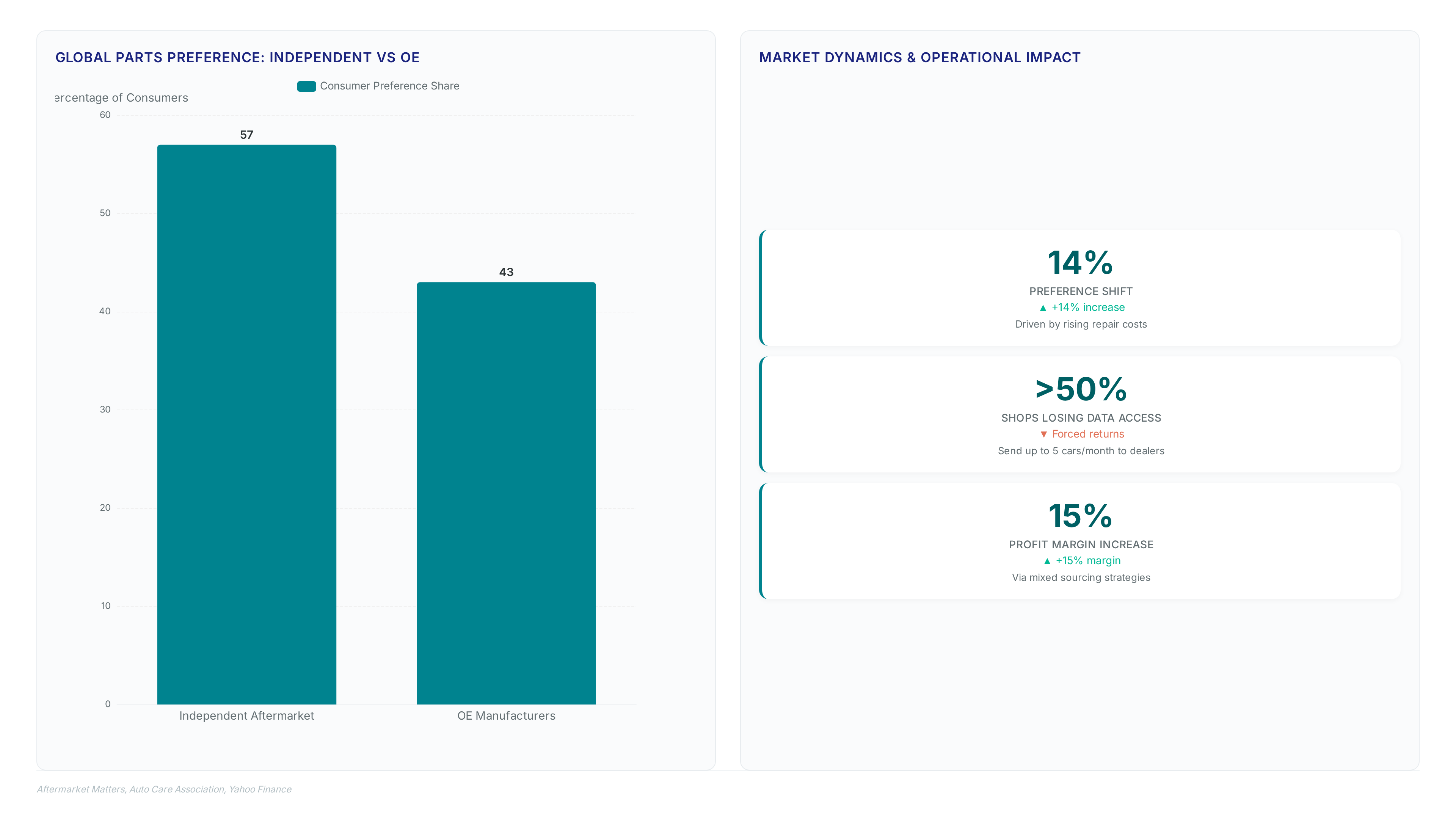
Industry surveys identify finding affordable components as a primary operational concern for repair facilities facing tighter consumer budgets. This approach addresses the reality that inflation pressures are forcing customers to seek simpler, improved quality options at consistent or lower price points, especially as consumers feel the squeeze on everyday things and look for more value. The mechanism involves evaluating private-label offerings that provide comparable performance while reducing the final invoice amount. This strategic pivot helps the customer maintain vehicle operability during economic uncertainty within a U.S.
Implementing Private Label Strategies to Counter Declining Brand Loyalty
Technicians address the erosion of brand loyalty by offering value-tier alternatives that maintain performance standards without premium pricing. This approach directly responds to surveys where finding affordable parts ranks as a top operational concern for independent shops.
| Strategy Element | Traditional Sourcing | Value-Driven Sourcing |
|---|---|---|
| Primary Goal | Brand consistency | Cost containment |
| Customer Pitch | OEM heritage | Verified reliability |
| Margin Profile | Fixed percentage | Flexible tiering |
Ignoring this shift risks losing service volume to competitors who improved align with current economic realities. Customers seeking value will migrate to providers offering verified low-cost solutions.
Validation Checklist for Balancing Price Competitiveness and Performance
This process addresses the reality that high part costs drive shoppers toward independent options rather than original equipment.
- Assess supplier logistics stability, as energy volatility keeps distribution costs high and impacts availability. 4.
| Verification Step | Risk if Skipped |
|---|---|
| Quality Check | Premature failure |
| Supplier Review | Liability exposure |
| Logistics Audit | Stock delays |
| Customer Consent | Dispute resolution |
Executing the Transition to Value-Oriented Aftermarket Models
Implementation: Defining the Value-Driven Inventory Mix for Repair Shops
Defining a value-driven inventory mix requires distinguishing between cheap discounting and strategic cost containment that preserves repair integrity. This friction creates a specific operational tension: shops must source lower-cost alternatives without triggering the distrust associated with failed cheap components. The solution lies in verifying that private-label offerings meet exacting performance standards before they reach the bay.
- Source value-tier alternatives that match original equipment specifications for fit and function. 3.
A critical limitation exists where data barriers prevent independent verification of part longevity, forcing reliance on supplier claims rather than field telemetry. Over 60% of independent repair facilities report difficulties performing routine repairs due to OEM barriers, often forcing them to refer business back to dealers. This flexible shows the need to capture the expanding demand for affordable maintenance while navigating supply constraints.
Sourcing Affordable Parts Without Compromising Technician Trust
Securing lower cost auto parts requires a verification protocol that validates performance before reducing the shelf price. Technicians cannot risk installation failures on components that lack rigorous testing data. Finding affordable parts has become a top concern for technicians based on industry surveys. This structural friction highlights why blind sourcing for cheapness fails; the real cost lies in comebacks and lost trust.
The limitation of this approach is the initial time investment required to gather sufficient failure data before full rollout. However, ignoring this step risks associating the shop's reputation with substandard components. A balanced inventory mix supports cost-effective vehicle maintenance by offering verified alternatives without compromising safety.
Communication Scripts for Explaining Value Options to Customers
Service advisors must frame value-driven alternatives as strategic responses to rising household expenses rather than cheap substitutes. When customers hesitate, scripts should highlight that comparable quality parts now satisfy the majority of shoppers seeking relief from inflation without sacrificing vehicle safety. As Michael Chung, senior director of market intelligence at the Auto Care Association, noted, "Inflation is hitting the customers. They're asking for lower cost parts; the quality is comparable."
| Discussion Point | Customer Concern | Advisor Response |
|---|---|---|
| Price Sensitivity | High repair bills | "We offer tiered options fitting your budget." |
| Brand Loyalty | Trust in OEM | "Independent parts match strict tolerances." |
| Longevity | Fear of failure | "Warranty coverage remains identical here." |
- Present the private-label offering alongside the premium choice visually. 3.
Operators often overlook that explaining the *source* of savings increases acceptance more than price alone. A significant portion of consumers now prefer independent aftermarket solutions due to rising costs, yet they require reassurance regarding durability. As brand loyalty decreases, customers are increasingly open to trying new options if the price is right. Advisors should focus on articulating these market shifts clearly, noting that private label is on an upward growth trend specifically because it helps the customer manage tighter budgets. This approach converts hesitation into trust during the estimate review. Consumers are looking for simpler, improved quality, perhaps at a consistent or lower price.
About
Mark Phillips serves as the Editor of Aftermarket Intel at KZMALL, where he uses extensive experience tracking global distribution channels and e-commerce trends. His daily work analyzing competitive moves among substantial distributors uniquely positions him to explain how consumer financial pressures are reshaping demand for private-label parts. As households prioritize affordability, Phillips observes a direct correlation between rising living costs and the aftermarket's shift toward value-driven purchasing decisions. At KZMALL, a global B2B platform offering over 50,000 SKUs across eight proprietary brands, this trend is central to their strategy of providing high-quality, certified alternatives to expensive OEM components. Phillips connects these macroeconomic realities to KZMALL's mission of simplifying procurement for independent repair shops through a single-source supplier model. By focusing on standardized fitment data and international quality certifications, he illustrates how the industry is adapting to deliver the cost-effective solutions that today's budget-conscious consumers require without compromising vehicle safety or performance.
Conclusion
Scaling private-label adoption breaks when inventory selection relies on outdated brand loyalty metrics rather than real-time digital influence. The ongoing operational cost of ignoring this shift is a direct loss of market share to competitors who align with the consumer's new priority: efficiency over familiarity. As tariff disruptions threaten to erase more than half of potential aftermarket revenue, shops cannot afford to let deferred maintenance drive customers away. The industry must pivot from viewing these components as mere cheap substitutes to treating them as necessary tools for customer retention in an inflationary environment.
Repair facilities should immediately integrate a tiered presentation strategy for all estimates involving parts replacement. This approach works best when advisors explicitly link the choice to the customer's desire for budget management without compromising safety warranties. Do not wait for the next quarter's financial report to show declining ticket averages; start by training service advisors to present the private-label option visually alongside premium choices during every estimate review this week. This specific action capitalizes on the current market momentum where over half of consumers actively seek replacement parts based on value rather than brand name alone. By normalizing this conversation now, shops secure their position in a market that is rapidly expanding due to economic pressure. The goal is to make the private-label discussion a standard part of the service workflow, ensuring that every customer interaction addresses the reality of rising household expenses directly.
Frequently Asked Questions
Inflation forces buyers to seek lower-cost alternatives with comparable quality. This financial strain means 57% of consumers now prefer independent aftermarket parts over original equipment to manage rising household expenses effectively.
Cost efficiency drives a portion of consumers to delay necessary vehicle maintenance. This behavior creates a composition crisis where shops must stock affordable private-label options to capture value from cautious spenders.
Digital research influences 90% of DIY purchases, causing buyers to ignore brand loyalty. Shops must ensure their inventory reflects online value searches or risk losing customers to competitors with better digital visibility.
Tariff disruptions could cut 6% of aftermarket revenue, compounding affordability issues for end users. Suppliers must balance price competitiveness with performance reliability to survive this fragile economic environment without losing trust.
Traditional loyalty metrics fail as shoppers prioritize price over familiarity. With 57% of consumers preferring independent options, suppliers must offer consistent quality at lower price points to retain customers permanently.