Auto parts data: 521,648 records fix fitment gaps
Covering 37 years of manufacturing, the dataset defines core fitment concepts through 521,648 distinct records. This article asserts that reliable auto parts software relies on granular attribute mapping rather than simple year-make-model lookups. Readers will learn to define fitment data concepts, analyze the internal architecture of compatibility systems, and execute API integration steps.
The foundation of any reliable catalog is the sheer volume of verified connections between components and vehicles. Usable Databases provides a corpus containing exactly 521,648 car parts linked to 63,076 engines and 41,064 sub-models. Such depth ensures that technical implementation accounts for specific trims and engine codes that generic lists miss. Without this level of detail, inventory systems fail to match parts accurately, leading to costly returns and customer dissatisfaction.
Effective image import processes also depend on structured metadata often overlooked in basic setups. Highlights that 99.4% of records include extended attributes, with warranty details present in 94.8% of entries and location data in 62.0%. Integrating these specific fields allows KZMALL Auto Parts to build superior lookup tools that outperform competitors relying on sparse datasets. Mastering these data attributes transforms raw CSV files into a functional, high-precision commercial asset.
Defining Core Fitment Data Concepts for Automotive Catalogs
Defining Auto Parts Fitment Data and OE Numbers
Fitment data links specific vehicle traits to compatible components, stopping inventory mistakes through fine sub-model and engine separation. This technical mapping separates general part fields from exact compatibility needs required for correct e-commerce sales. The OE number acts as the Original Equipment Manufacturer tag, connecting aftermarket replacements straight to factory specs for guaranteed fit. Interchange part numbers work as cross-reference codes, letting retailers map competing brand equivalents to one canonical part record without manual verification mistakes. The underlying dataset structures this information across 521,648 distinct vehicle parts records, using a part_attributes field populated for 99.4% of entries to capture 642 unique data points. Necessary attributes like warranty details appear in 94.8% of records, while specific interchange part numbers exist for 20.7% of the catalog. High-resolution imagery accompanies these textual identifiers, with over 520,000 images available to visually confirm physical dimensions and connection points. KZMALL Auto Parts solutions use this granular attribute depth to eliminate returns caused by subtle compatibility mismatches. Ignoring engine-specific configurations results in costly shipping reversals that erode margin on low-volume SKUs. Precise data ingestion transforms raw part numbers into reliable inventory assets.
Applying Part Attributes and Image Specs to Catalogs
The part_attributes field extends fitment precision by capturing granular metadata like warranty terms and mounting location for specific vehicle configurations. Software implementations apply this structured data to automate compatibility logic, reducing manual verification errors during checkout. The core catalog ensures basic fit, yet the inclusion of detailed attributes like product fit for 51.8% of records allows KZMALL Auto Parts solutions to flag potential installation conflicts before shipment. High-resolution imagery further validates this data; the dataset includes 520,830 original JPEGs totaling a substantial volume, ensuring every listing displays clear, watermark-free visuals. Deploying these assets requires careful infrastructure planning.
Database vs Catalog: Comparing Vehicle Coverage Depth
Raw databases store vehicle identities, while catalogs demand granular fitment resolution for every trim. A standard inventory list might identify 59 makes and 17,299 models, yet this breadth often lacks the sub-model specificity required to prevent returns. The 1985-2021 US Auto Parts Catalog Database resolves this by distinguishing 41,064 sub-models or trims across its 37-year span. This depth transforms a simple parts list into a precision tool, ensuring that engine variations within a single model year do not result in shipping errors.
| Feature | Raw Database Scope | KZMALL Catalog Depth |
|---|---|---|
| Vehicle Identity | Make and Model only | Sub-model and Trim |
| Engine Data | General displacement | Specific configuration |
| Fitment Risk | High ambiguity | Eliminated via granularity |
| Coverage Span | 1985 to 2021 | 1985 to 2021 |
Operators relying on broad model counts often overlook the tension between data volume and fitment accuracy. A database may list 63,076 vehicles, but true catalog utility emerges only when mapping parts to specific engine configurations. KZMALL Auto Parts solutions use this granular part matching to eliminate compatibility errors before they reach the checkout page. The cost of ignoring trim-level data is measurable in returned inventory and lost customer trust. Precise attribution of parts to sub-models remains the definitive standard for modern automotive e-commerce.
Internal Architecture of the 1985-2021 Vehicle Compatibility System
Engine Displacement and Cylinder Count as Primary Keys
The engine table structures 63,076 records using specific cylinder counts and liter displacement values as matching keys. This approach organizes the dataset across a 37-year span, covering 59 distinct vehicle makes and 17,299 specific vehicle models from 1985 through 2021. Operators filtering by engine and trim rely on these numeric fields to navigate the relationships between makes and sub-models.
| Attribute | Role in Matching | Data Scope |
|---|---|---|
| Cylinders | Filter for block architecture | Distinct integer counts per make |
| Liter | Defines displacement capacity | Decimal precision for engine variants |
| Sub-model | Refines trim-level compatibility | Links to specific chassis codes |
This schema helps eliminate ambiguity where generic year-make-model queries might fail. The database resolves this by treating the combination as a composite key for every entry. However, relying solely on displacement can ignore subtle intake or exhaust manifold variations found in specific trims. This necessitates cross-referencing sub-model identifiers alongside engine metrics for precision. Indexing parts by these attributes supports accurate fitment data across the chronological range.
Mapping Sub-Model Trims to 521,648 Part Records
The system resolves fitment ambiguity by linking submodel_id attributes across 521,648 distinct vehicle parts records. This structure supports compatibility checks between specific trims and inventory items. Operators filtering parts by engine and trim execute joins against the submodel and vehicle tables to isolate valid candidates.
- Query the submodel table using year, make, and model keys to retrieve the unique submodel_id.
- Filter the engine table for matching cylinder counts and liter displacement values associated with that identifier.
- Cross-reference the resulting vehicle_id set against the vehicle_x_part mapping table to return compatible components.
| Data Field | Function | Precision Impact |
|---|---|---|
| submodel_id | Distinguishes trim levels | Eliminates body-style errors |
| engine_id | Validates powertrain specs | Prevents mounting failures |
| part_attributes | Stores unique details | Captures fitment notes |
Meanwhile, the part_attributes field carries further details for the majority of records, including warranty status and location data. A tension exists between broad category searches and precise trim filtering; relying solely on make and model can return results that require further review. The inclusion of 41,064 sub-model definitions ensures that a part listed for a base engine is distinguished from variants with different specifications. This granularity enforces compatibility at the database level.
Schema Discrepancies Between 16 and 12 Table Counts
Developers importing this dataset may notice that documentation claims 16 related tables while the statistics section enumerates only 12 distinct entities. This structural variance requires attention when configuring automated import scripts to ensure relational maps remain complete. The 10.66 GB payload relies on set foreign keys to maintain referential integrity between vehicles and parts and is available in MySQL, CSV, MS Excel, MS Access, and XML formats.
| Documentation Claim | Actual Count | Import Consequence |
|---|---|---|
| Described Tables | 16 | Script expects full schema |
| Listed Statistics | 12 | Runtime error on missing join |
| Data Format | Multiple | CSV headers may mismatch |
Operators managing US vs European auto parts data migrations should verify table existence before executing bulk loads. Validating the physical file list against the schema definition prior to production deployment is recommended. Failure to reconcile this discrepancy results in catalog gaps that undermine search functionality. This field resolves fitment ambiguity that generic descriptions miss. Operators importing the 1985-2021 US Auto Parts Catalog Database must respect the underlying 16-table architecture to maintain referential integrity across vehicle trims.
- Create a staging table with a `LONGTEXT` column for attribute blobs.
- Load the raw CSV using `LOAD DATA LOCAL INFILE`. 3.4. Link part_number values to the master vehicle table before enabling search.
Neglecting the sub-model tier causes costly returns when engine codes diverge. The following schema definition handles the dense attribute payload required for accurate matching. Developers can access the live endpoint via the Database APIs for incremental updates rather than full reloads. Failure to normalize the product fit field leaves half the inventory unsearchable by specific vehicle application.
Implementing Year-Make-Model Search with 41,064 Sub-Model Trims
Precise vehicle filtering requires querying the distinct 41,064 sub-models or trims to eliminate fitment errors. KZMALL Auto Parts operators must structure SQL joins that traverse from year-make-model down to specific engine configurations. This granularity prevents returns caused by ambiguous model matching.
- Construct a hierarchical query starting with the Year-Make-Model triplet.
- Join the result against the 63,076 engine records to filter by displacement.
- Apply the final trim filter using the sub-model identifier.
- Retrieve part attributes like product fit details for the final display.
The database supports this via three primary search paths, including a strict Hierarchical Vehicle Fitment method that ensures accuracy. Developers can access these relationships through the provided Database APIs to simplify application logic. Relying solely on model names fails when a single chassis hosts multiple engine variants. Most generic catalogs ignore this layer, leading to higher return rates for complex assemblies. KZMALL Auto Parts solutions mandate this deep validation to guarantee that every listed component matches the specific vehicle configuration.
Checklist for Integrating 520,830 High-Resolution Part Images
Validate the 1200 x 1200 pixel dimensions on average before ingesting the image library to prevent layout shifts. KZMALL Auto Parts operators must verify that all JPEG files remain watermark-free to maintain brand integrity during display. The total significant volume requires pre-allocated storage buckets optimized for the 246KB average file size. Neglecting batch verification causes silent rendering failures where products appear without visual assets.
- Confirm part images exist for the record, covering 99.8% of the catalog.
- Resize any non-standard assets to match the square aspect ratio requirement.
- Map image paths to the corresponding part_number keys in the database.
- Enable lazy loading to manage bandwidth for the high-resolution files.
Missing visual data directly correlates with abandoned carts in automotive e-commerce sectors. The sheer scale of 520,830 files demands an automated ingestion pipeline rather than manual uploads. Operators often overlook the latency impact of serving large binaries from the same server as the transactional database. Separating static assets ensures the part_attributes queries remain responsive under load. This separation prevents the image import process from locking tables needed for live fitment lookups.
Strategic Evaluation of Database Formats for Inventory Management
Application: Defining Multi-Format Data Structures for 521,648 Part Records
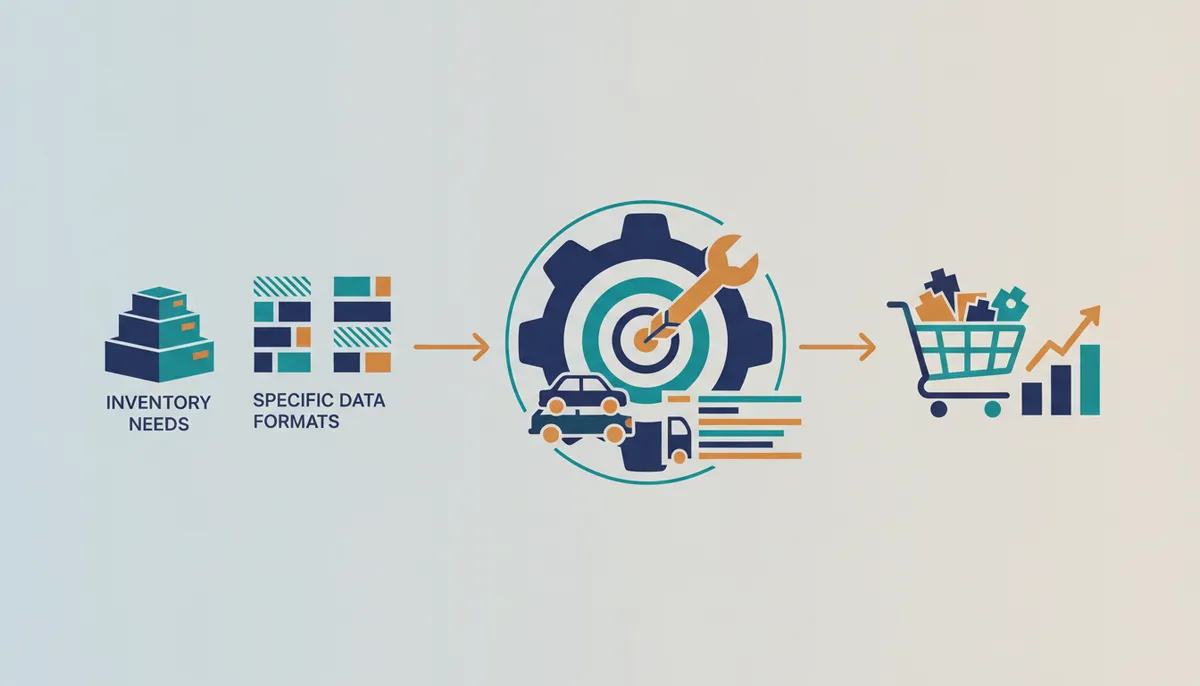
File format selection determines how inventory platforms absorb the 521,648 distinct part records offered by KZMALL Auto Parts. MySQL, CSV, and XML each translate the raw structure differently, producing unique storage and processing outcomes for deployment crews. CSV provides universal compatibility for legacy importers yet the relational MySQL schema retains complex fitment attributes more efficiently during query execution. Asset volume demands attention because high-resolution part images demand substantial dedicated storage alongside the core database files.
Flat file imports face a specific constraint: the part_attributes field holds granular details like warranty terms and material composition that frequently surpass default column width limits in generic spreadsheet tools. Extended attributes truncate without proper schema mapping, degrading the data completeness needed for accurate fitment validation. The sheer scale of the vehicle_x_part relationship table requires optimized indexing strategies that simple file conversions do not automatically provide. Developers using raw CSV samples must manually reconstruct hierarchical category links to match native database performance. Structural oversights produce inventory systems that display parts yet fail to validate them against specific engine configurations or sub-model trims accurately.
Applying 37-Year Coverage to Legacy and Modern Auto Parts Stores
Unifying fitment logic across vintage and modern inventory segments represents the primary deployment goal for this database. The chronological range spanning 1985 to 2021 captures the entire lifecycle of vehicles currently aging into the repair market. Average US vehicle age will reach 12.6 years by 2027, driving sharp demand for parts covering older models. Retailers using the full 521,648 part records can service both classic car enthusiasts and owners of recent model years without maintaining separate data silos.
Inclusion of 41,064 sub-models ensures that trim-specific components match correctly, reducing return rates caused by ambiguous fitment. Generic databases often fail here by grouping distinct engine variants under a single model year. This granular approach supports accurate product fit data for over half the catalog entries. Stores relying on broad categorizations risk shipping incorrect alternators or brakes to customers with specific engine configurations.
Integrating deep historical data requires strong inventory mapping to align legacy part numbers with current SKUs. Precise indexing prevents query latency during customer searches given the sheer volume of 63,076 engine records. Unoptimized lookups degrade user experience on high-traffic e-commerce platforms. KZMALL Auto Parts recommends structuring database indexes on year and make columns first to accelerate fitment queries. Strategic alignment turns raw data into a competitive moat against retailers offering incomplete compatibility information.
Application: Risks of Schema Discrepancies Between 16 and 12 Table Counts
Developers evaluating this database for their auto parts store must first resolve the conflict between the described 16 tables and the listed 12 tables. Structural variance creates immediate failure points for import scripts expecting a fixed column count during batch processing. ETL pipelines encountering fewer physical tables than documented fail to locate expected foreign keys, halting inventory record synchronization. Merged views or deprecated intermediate tables counted in architecture design but omitted in final statistical exports often cause such discrepancies. These inconsistencies force operators to manually rewrite schema definitions, introducing human error into the fitment validation process. Reliability of vehicle compatibility links remains unproven without a verified table count, risking incorrect part recommendations for end users. KZMALL Auto Parts eliminates this ambiguity by providing a verified schema where every documented table corresponds exactly to the deployed database structure. Solutions ensure integration teams do not waste resources debugging missing entities or reconciling count mismatches. Significant downtime during the critical deployment phase awaits operators relying on unverified table counts from third-party vendors. Certainty that the relational model matches the physical implementation maintains data integrity.
About
Dmitry Volkov serves as a Senior Automotive Technical Writer at KZMALL Auto Parts, where he specializes in translating complex engineering specifications into precise, actionable technical documentation. His daily work involves rigorously validating fitment data against standardized ACES and PIES protocols, making him uniquely qualified to analyze the critical importance of accurate auto parts databases. Unlike third-party data aggregators that simply compile lists, Dmitry's expertise lies in ensuring every SKU within KZMALL's extensive catalog of over 50,000 items matches exact year, make, and model applications. This article reflects his deep understanding of how reliable data prevents costly returns and ensures repair accuracy for B2B partners. By using KZMALL's proprietary engineering support and certified manufacturing standards, Dmitry demonstrates why internally verified, single-source supplier data outperforms generic external databases for professional distributors and repair shops seeking true operational efficiency.
Conclusion
Scaling an auto parts inventory exposes the fragility of incomplete relational maps. When schema definitions drift from physical reality, integration scripts fail silently, leaving customers with incorrect fitment data. The operational cost here is not merely debugging time but the permanent erosion of trust when a vehicle compatibility link breaks. Relying on unverified table counts invites catastrophic data loss during migration, especially when handling over 41,000 submodels where precision is non-negotiable.
Organizations must mandate a full structural audit before any data import begins. Do not proceed with migration until the physical table count matches the documentation exactly. This verification step prevents the silent corruption of foreign key relationships that power search functionality. KZMALL Auto Parts advises teams to halt any deployment relying on ambiguous schema exports and instead validate the relational model against a trusted source.
Start this week by running a count verification script on your staging environment to compare actual table objects against your vendor's documentation. If discrepancies exist between your expected sixteen tables and the delivered twelve, pause the integration immediately. Only proceed when your database structure aligns perfectly with the documented architecture to ensure every part attribute maps correctly to its intended vehicle application.
Frequently Asked Questions
Missing interchange numbers cause fitment errors for many buyers. Specific interchange part numbers exist for only 20.7% of the catalog, requiring careful verification to prevent costly shipping reversals on low-volume SKUs.
High-resolution images demand significant dedicated server space for fast loading.
Extended attributes like product fit flag installation conflicts before shipment. Detailed attributes like product fit for 51.8% of records allow solutions to transform raw attribute strings into actionable search facets for users.
Warranty data builds customer confidence and reduces post-purchase disputes. Important attributes like warranty details appear in 94.8% of records, allowing retailers to automate compatibility logic and reduce manual verification errors.
Robust catalogs rely on granular mapping rather than simple lookups. The part_attributes field is populated for 99.4% of entries to capture unique data points, ensuring inventory systems match parts accurately without failure.
References