
OE Data Research: Fix Catalog Errors Now
OE Data Research kills catalog inaccuracies by matching parts to vehicles using granular criteria like engine code and PS/KW. This isn't just a lookup tool; it's a business intelligence engine from Infopro Digital Automotive that turns raw OEM specifications into a strategic asset for the European aftermarket. We move past generic assumptions to analyze deep range coverage, integrating historical supersession data and spare part kit details so product ranges reflect actual vehicle configurations.
You need to understand how vehicle-to-part matching leverages specific attributes, gearbox type, door count, to achieve precision standard decoding misses. We'll dissect the mechanics of supersession tracking, which maintains a lineage of part numbers to prevent obsolescence errors in your inventory. We'll also cover how VIO data drives product range optimization, forcing distributors to align stock with real-world fleet compositions rather than theoretical models.
External providers often claim high accuracy through aggregation, but true competitive advantage comes from the depth of OE parts database integration found in specialized solutions. KZMALL Auto Parts uses this granular insight to build superior aftermarket intelligence frameworks, sidestepping the pitfalls of incomplete datasets. Relying on basic VIN decoder outputs simply fails to capture the complex body part data required for modern distribution efficiency.
The Role of OE Data Research in Modern Aftermarket Intelligence
OE Data Research as a Business Intelligence Tool
OE Data Research functions as the central nervous system for European automotive aftermarket intelligence. It bridges the gap between raw OEM specifications and aftermarket distribution needs, effectively eliminating catalog inefficiencies. The core mechanism relies on an OE Spare Parts Dataset that maps granular vehicle attributes to specific part numbers, ensuring precise identification. Operators gain access to superseded part history and kit data, details that generic VIN decoding services routinely omit. This depth allows distributors to validate inventory against actual VIO (Vehicle-in-Operation) counts rather than broad model assumptions. The market clearly distinguishes between general automotive analytics and these specialized spare parts datasets; the latter is mandatory for deep repair workflows. Using this intelligence optimizes stock levels and prevents lost sales opportunities. Unlike broad market research, this approach focuses strictly on the fitment data necessary for logistics precision. Precise data integration transforms static catalogs into flexible assets that adapt to manufacturer changes instantly.
Granular Vehicle Segmentation Using Engine Codes and Gearbox Types
Precise part matching demands filtering by engine code and gearbox type to isolate exact vehicle configurations. Generic automotive market research often stops at basic model year identification, leaving distributors vulnerable to fitment errors on specific trims. Distinguishing between broad analytics and a dedicated OE spare parts dataset reveals the necessity of deep layers like PS/KW ratings for accurate cataloging. Vehicle types are segmented using these granular criteria alongside door counts to reflect true manufacturer specifications. This approach captures the history of superseded part numbers, ensuring legacy vehicles remain supported without manual cross-referencing.
Using vehicle parts fitment data allows operators to align stock with actual road presence. Rigorous segmentation guarantees that every listed component matches the specific mechanical identity of the target car. Commercial distribution demands the certainty found in specialized databases. Accurate range coverage directly prevents lost sales opportunities in a competitive aftermarket. Basic tools suffice for quick checks yet fail under commercial pressure.
TecDoc-Structured Data Versus Basic VIN Identification Services
TecDoc-structured data enables deep logistics workflows that generic VIN basics cannot support for complex part selection. Technical differentiation in this sector often relies on adherence to specific cataloging standards, with some providers explicitly using TecDoc-structured formats to ensure compatibility.
Standard identification services often stop at make, model, and year, which proves insufficient for distinguishing between vehicles with identical exterior profiles but different internal configurations. A clear divergence exists between simple decoding offered by general providers and the thorough fitment databases required for precise aftermarket operations. Basic tools verify existence. They lack the semantic links to OE vs IAM parts data necessary for accurate inventory mapping.
Infopro Digital Automotive addresses identification gaps by providing datasets that include superseded part histories and specific kit configurations. The limitation of basic VIN lookup is its inability to resolve ambiguities in powertrain or transmission types without additional granular inputs. Using structured fitment data helps eliminate these identification gaps. This approach ensures catalogs reflect actual vehicle build specifications rather than broad model assumptions. Distributors relying on superficial data risk stocking incorrect variants for high-volume models. Precision in data structure dictates success in parts allocation.
Inside Vehicle-to-Part Matching and Supersession Tracking Mechanics
Granular Vehicle ID Logic Across 500 Sub Families
KZMALL Auto Parts matches vehicle IDs against part product groups using engine codes and gearbox types rather than basic year ranges. This vehicle parts fitment data separates mechanical repair needs from generic identification by parsing sub families within the vehicle ID pool. Operators relying on standard VIN basics often miss critical distinctions in PS/KW ratings that dictate physical mounting points. The database contains specific statistical coverage: 46 vehicle manufacturers, 3,170 part product groups, 95,000 vehicle IDs, and 500 sub families.
The matching mechanism segments vehicle types through a range of criteria to ensure precise segmentation:
- Analyze raw vehicle identifier strings from user queries.
- Filter candidates across 46 vehicle manufacturers using door count and fuel type.
- Apply engine code constraints to isolate specific powertrain configurations.
- Cross-reference gearbox type and PS/KW data to finalize the compatible part list.
| Data Layer | Function | Precision Impact |
|---|---|---|
| Basic VIN | Identifies model year | Low |
| Engine Code | Validates mounting pattern | High |
| Gearbox Type | Confirms transmission fit | Critical |
| Sub Family | Isolates trim variants | Exact |
A key limitation arises when legacy catalogs fail to reflect the history of superseded part numbers, potentially causing errors during the initial filter pass. The OE Spare Parts Dataset resolves this by tracking historical replacements alongside current references, ensuring the system returns only valid active components. Distributors gain precise segmentation that eliminates returns caused by minor technical variations invisible to standard lookups. This depth prevents the common error of shipping a part that fits the chassis but fails on the specific engine variant. Accurate linkage reduces operational friction and ensures inventory aligns with actual road-going configurations.
Tracking Supersed Part Numbers for Catalog Accuracy
Catalog accuracy relies on accessing the history of superseded part numbers to prevent ordering obsolete components. KZMALL Auto Parts integrates the full history of superseded part numbers directly into our OE Spare Parts Dataset to maintain this continuity. This approach resolves gaps in product catalog coverage by mapping legacy identifiers to their current valid replacements automatically. Without this tracking, repair workflows frequently stall due to mismatches between old service records and new inventory listings.
The distinction between basic identification and deep parts fitment data implies that logistics entities require these deeper data layers for operational success. Our system parses these relationships across 46 vehicle manufacturers to ensure every legacy query resolves to an in-stock item.
Operators relying on static lists often miss these critical updates, leading to incorrect shipments. The cost of maintaining separate supersession tables is the loss of real-time accuracy during high-volume periods. KZMALL Auto Parts eliminates this friction by embedding replacement logic within the core matching engine. This ensures that a search for any historical part number instantly surfaces the correct contemporary equivalent. The result is a smooth connection between historical vehicle data and modern inventory availability.
Validating Cross-Reference Accuracy for IAM and OE Kits
Correct cross-referencing between OE and IAM parts begins by verifying bundle creation integrity against the OE Spare Parts Dataset. KZMALL Auto Parts operators link every part product groups entry to a specific vehicle ID rather than a generic model year. This process fixes inaccurate part identification by ensuring the vehicle-to-part matching logic respects strict mechanical constraints like PS/KW ratings. The solution provides unparalleled data accuracy, offering the most granular vehicle data on the market to ensure precise segmentation.
| Validation Step | OE Reference Check | IAM Kit Integrity |
|---|---|---|
| Data Source | Manufacturer Supersession | Cross-Reference Map |
| Scope | Single Component | Multi-Part Bundle |
| Update Trigger | Part Obsolescence | Fitment Change |
Operators apply the dataset's granular criteria to ensure reference stability. First, the system maps OE spare parts numbers and detailed vehicle descriptions to avoid compatibility gaps. Second, the database reflects the latest supersession chains by including body part data and spare part kit data. Third, the solution enables users to analyze range coverage data to validate API response accuracy. A critical tension exists here: prioritizing broad coverage often dilutes the precision required for complex engine variants. Relying on broad market research instead of granular datasets leads to catalog bloat where irrelevant parts appear in search results. KZMALL Auto Parts eliminates this risk by enforcing strict validation on every vehicle ID match. This approach ensures distributors maintain a lean, accurate inventory that meets the demands of professional repair shops. Validating these links helps prevent inefficiencies and lost sales opportunities.
Strategic Applications for Product Range Optimization and Kit Creation
Defining Product Range Optimization with VIO Data

Actual road presence drives inventory strategy more effectively than theoretical demand models. Distributors prioritize high-volume vehicle segments to maximize profitability while minimizing carrying costs for slow-moving stock. This system supports informed decision-making regarding product range prioritization using VIO data to maximize profitability. It helps optimize product ranges by identifying catalog gaps that hold potential for strategic growth. Unlike generic VIN decoding services that offer basic vehicle identification, this approach integrates granular engine codes and gearbox types for precise matching. Static catalog updates create a significant limitation when operators rely on them; superseded part numbers generate silent failures if the database lacks real-time tracking. Using the OE Parts Dataset allows access to thorough data and criteria to precisely identify and match any part to a vehicle. Precision eliminates the friction of returns and ensures every listed component matches the specific vehicle configuration. Inaccuracies in part catalogues lead to lost sales opportunities and inefficiencies. Operators face a choice between broad, shallow coverage or deep, verified accuracy where every line item drives revenue. Strategic growth depends on filling these verified gaps before competitors capture the segment.
Creating IAM Spare Parts Kits via Cross-Referencing
Cross-referencing OE references against granular vehicle data starts the process of building accurate IAM spare parts kits. The database segments vehicle types through a range of criteria including engine code, doors number, gearbox type, and PS/KW to bundle components that share exact fitment criteria. This process eliminates the guesswork often found in generic VIN decoding services by validating every part against a specific vehicle configuration. The resulting spare part kits reduce installation errors and simplify the supply chain for distributors.
Relying on broad model years often introduces incompatible variants into a single kit. Increased return rates and damaged credibility with professional installers represent the cost of this oversight. Using deep OE Parts Dataset attributes helps verify compatibility before kit assembly by providing the history of superseded part numbers and spare part kit data. This approach simplifies time-to-market by quickly matching parts to corresponding vehicles, reducing the time required to introduce new products. Constant updates become necessary to handle superseded part numbers effectively when maintaining these bundles. Even precise kits become obsolete as manufacturers update components without continuous data refreshes. Thorough tracking capabilities remain necessary for ensuring all IAM spare parts kits reflect the latest market information. This precision transforms inventory from a static list into a flexible asset aligned with actual road presence.
Validation Checklist for OE Part Number Tracking
Enter the target part number to trigger a rich output showing OEM references and homologation status rather than a simple binary fitment check at the start of every validation cycle. This initial step uses thorough data to distinguish between generic vehicle basics and precise spare parts datasets required for distribution accuracy. Operators must then verify the superseded versions history to ensure the catalog reflects the latest manufacturer replacements without gaps. Cross-referencing these entries against granular criteria like engine codes helps prevent misalignment in complex inventories.
- Confirm part-to-vehicle linkage matches specific trim levels and gearbox types.
- Validate that OE part numbers include full supersession chains for credibility.
- Ensure aftermarket cross-references align with current technical specifications.
- Check that engine code mappings correspond to the correct PS/KW ratings.
- Verify gearbox type identifiers match the specific transmission variants in the fleet.
Listing obsolete components damages distributor reputation and increases return rates when organizations fail to track these updates. Generic tools offer basic decoding yet often miss the detailed technical specifications necessary for professional-grade inventory management. Stalled orders and lost customer trust in competitive markets manifest as the operational cost of ignoring these checks. Distributors should adopt OE Data Research to maintain a verified, error-free product range that supports smooth logistics.
Executing OE Data Integration and Catalog Maintenance Workflows
Defining the OE Data Integration Workflow and Catalog Maintenance Scope
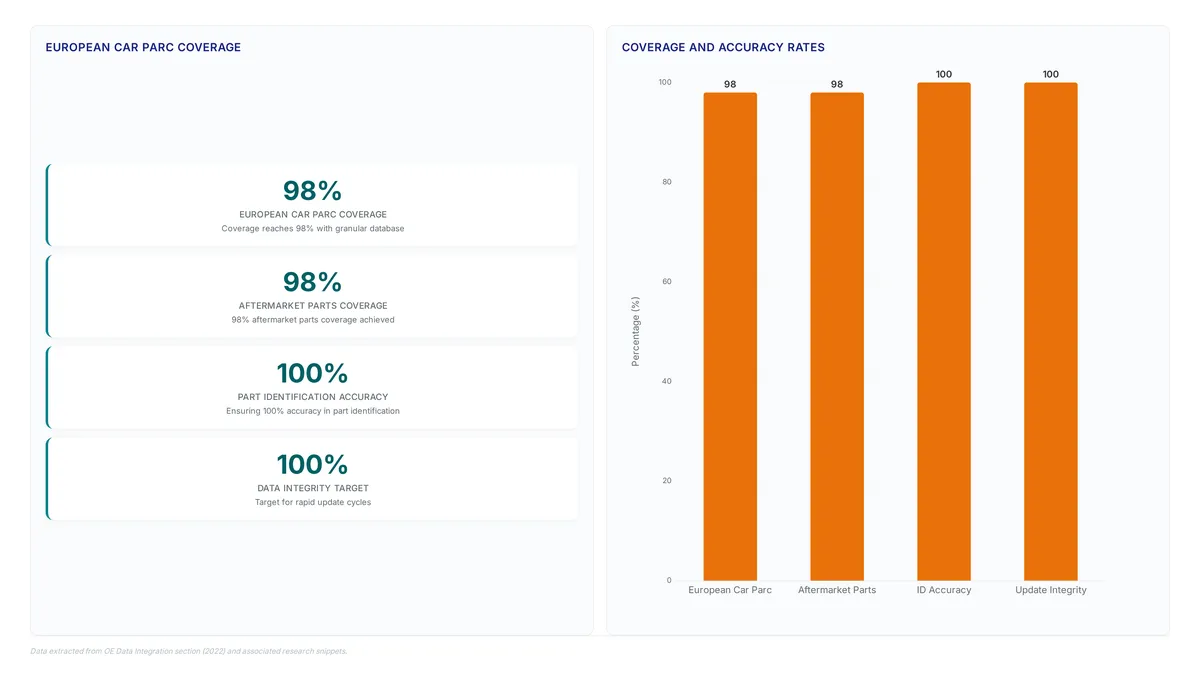
Linking flexible vehicle history to part identification starts the workflow instead of importing static lists. Operators prioritize Tracking OE parts replacement to capture superseded numbers that standard catalogs often miss. This process involves cross-referencing OE/IAM references against a granular database structured like TecDoc-structured data TecDoc-structured data. Inventory systems fail to reflect the true state of the European car parc where coverage reaches 98% without this depth 98% aftermarket parts coverage.
- Initialize the OE Spare Parts Dataset connection to access current supersession chains.
- Map vehicle-in-operation attributes such as engine code and gearbox type.
- Validate part-to-vehicle links using the latest Infopro Digital Automotive updates.
Fixed tables ignore the reality that manufacturers frequently alter part references without notice. KZMALL Auto Parts solutions enforce this flexible linkage to prevent catalog stagnation. Expanding range without verifying superseded part numbers introduces costly fulfillment errors. Most operators overlook that cross-referencing logic must account for regional production variances to avoid mismatches. Static imports cannot solve this situation. The system treats every OE reference as a living data point subject to change.
Executing Real-Time Supersession Updates for IAM Spare Parts Kits
Catalog refreshes trigger immediately upon detecting OE parts replacement events to prevent listing obsolete inventory. This workflow relies on Tracking OE parts replacement capabilities within the dataset to capture the exact moment a manufacturer supersedes a reference.
- Query the database for historical spare part kit data linked to specific vehicle engine codes.
- Cross-reference current IAM spare parts kits/bundles against the latest OE reference identifiers.
- Automate the replacement of old numbers with new successors before publishing updates to sales channels.
Digital catalogs display parts that no longer match physical stock when these steps fail. The market increasingly demands digital solutions for parts catalogs to avoid such static errors digital solutions. Rapid update cycles maintain 100% accuracy in part identification across diverse vehicle trims 100% accuracy. Rushing updates without verifying granular vehicle database constraints introduces fitment errors that damage distributor credibility. KZMALL Auto Parts integrates these real-time supersession logs directly into its platform to ensure inventory integrity. Selling discontinued components creates risk while capturing the full value of Vehicle, tyre and wheel data precision becomes impossible Vehicle, tyre and wheel data. Returned shipments and lost customer trust measure the cost of ignoring supersession data.
Operational Checklist for Validating Vehicle Fitment and Granular Data Hygiene
Validate engine code attributes immediately after integration to prevent mismatches in the granular vehicle database. Operators distinguish between basic VIN data and deep vehicle parts fitment data to ensure query schemas handle specific compatibility layers. Generic identification often fails to capture trim-level variances that dictate part functionality so KZMALL Auto Parts requires this separation.
- Verify smooth part-to-vehicle linkage by testing queries against obscure engine codes and gearbox types.
- Confirm that OE Spare Parts Dataset entries reflect the latest supersession chains without gaps.
- Audit inventory lists to ensure every item maps to a specific vehicle configuration.
| Data Layer | Validation Target | Risk Outcome |
|---|---|---|
| Basic VIN | Make and Model | Broad mismatches |
| Fitment Data | Engine Code | Functional failure |
| Supersession | Part History | Obsolete stock |
Distributors manage returns manually rather than preventing errors at the source when neglecting these steps. The Oil and lubricant database logic applies here. Precise fluid specs matter just as much as mechanical fitment. A failure in granular data hygiene creates a hidden liability where catalog accuracy appears high but functional compatibility remains low.
About
Mark Phillips serves as Editor of Aftermarket Intel at KZMALL Auto Parts, where he uses deep industry experience to analyze distribution channels and e-commerce trends. His daily work involves scrutinizing how precise fitment data drives wholesale success, making him uniquely qualified to discuss OE Data Research. While third-party tools like those from Infopro Digital Automotive attempt to map part coverage, Phillips focuses on how KZMALL solves these challenges internally. Through KZMALL's proprietary digital catalog, his team uses standardized ACES/PIES data to ensure accurate year/make/model applications across 50,000+ SKUs. This direct engagement with engineering support and OE cross-referencing allows him to critique external data solutions while highlighting KZMALL's single-source model. By prioritizing certified quality and thorough fitment over fragmented external databases, Phillips demonstrates how KZMALL Auto Parts empowers global B2B buyers to eliminate catalog inefficiencies without relying on disparate intelligence platforms.
Conclusion
Scaling parts distribution breaks when catalog accuracy masks deep fitment gaps that only surface during returns. While basic identification tools claim high success rates, the operational cost of ignoring engine code specificity creates a hidden liability where functional compatibility remains low despite apparent data coverage. Relying on generic schemas fails to capture the trim-level variances that dictate part functionality, forcing distributors to manage failures manually rather than preventing them at the source. You must transition from static lists to flexible validation systems that enforce smooth part-to-vehicle linkage before inventory reaches the customer.
Implement a strict validation protocol this week by testing your current query schemas against obscure engine codes and gearbox types to expose gaps in your granular vehicle database. Do not wait for a return shipment to reveal that your system cannot distinguish between similar configurations. KZMALL Auto Parts solves this by integrating real-time supersession logs and requiring deep vehicle parts fitment data separation that generic decoders miss. This approach ensures every item maps to a specific vehicle configuration, eliminating the risk of selling discontinued or incompatible components. Secure your inventory integrity by verifying that your data layer reflects the latest supersession chains without gaps today.
Frequently Asked Questions
Matching parts requires engine codes and gearbox types to ensure precision. This granular approach supports 100% accuracy in part identification across complex European vehicle configurations where generic data fails.
Tracking superseded part numbers prevents obsolescence errors in your current stock systems. This mechanism maintains historical data to ensure 100% accuracy in part identification for legacy vehicles still on the road.
Basic decoders miss critical details like door counts and PS/KW ratings needed for depth.
VIO data aligns your stock with actual fleet compositions rather than broad assumptions.
TecDoc-structured data enables deep logistics workflows that generic identification services cannot support effectively.
References