
Search parts using native 17-digit VIN codes
A unique 17-digit code provides the detailed vehicle information necessary to eliminate fitment errors and drive sales growth.
Stop treating fitment as an afterthought. Automotive retailers win by embedding prebuilt VIN search directly into their eCommerce core, ditching the laggy, expensive habit of calling external plugins. This isn't about convenience; it's about accessing critical data points, engine size, plant location, unique serial numbers, without the latency of outside API calls. The automotive aftermarket sector demands this precision to build trust. Specific architectural choices dictate search performance, and deep platform integration offers a more cost-efficient, accurate path for parts verification than bolting on separate VIN lookup tools.
Here is how real-time fitment search actually works: a Decode VIN service processes requests to determine year, make, model, submodel, and trim instantly. We will contrast these built-in capabilities against the limitations of third-party add-ons, proving that native integration is the only viable path for serious parts retailers.
The Role of VIN Lookup in Modern Auto Parts eCommerce
How the 17-Digit VIN Decodes Vehicle Specs
Seventeen alphanumeric characters. That is the standard Vehicle Identification Number, a unique code acting as the primary key for precise automotive configurations. Each character represents distinct data points regarding origin, manufacturer, and engine type. KZMALL Auto Parts leverages this structure to eliminate the fitment ambiguity plaguing broader search methods.
Decoding architecture goes beyond simple string parsing. It extracts over 100 specific vehicle attributes. Advanced systems cross-reference these against professional databases containing millions of parts to ensure exact compatibility. Retailers embedding this logic directly into their e-commerce flow drive higher parts sales by acting as a gateway to immediate commerce. The process filters results to achieve high fitment accuracy, effectively eliminating errors caused by trim or engine option differences.
Specialized platforms apply the VIN to filter parts with high fitment accuracy, going beyond basic compatibility to exact option matching. Operators must prioritize solutions that access the full depth of the 17-character VIN to capture these nuances. Ignoring lower-level specification data re-introduces the risk of returns that precise searching aims to solve.
Reducing Returns with Native X-Cart VIN Search
Native X-Cart VIN search eliminates order errors by decoding 17-digit identifiers into precise fitment data without third-party fees. This native integration removes the latency and cost of external API calls while ensuring catalog accuracy. Shoppers enter their vehicle code to instantly filter results, bypassing manual Year/Make/Model selection errors that often lead to incorrect purchases. The system maps input to specific engine and trim configurations, ensuring customers receive only compatible components.
Retailers using this approach avoid the complexity of maintaining separate lookup services. The platform includes a My Garage feature allowing users to save vehicle profiles for quicker repeat transactions. This personalization reduces friction during subsequent visits and encourages customer loyalty. Unlike fragmented third-party solutions, the built-in tool requires no additional maintenance or subscription costs beyond the core platform.
The elimination of redundant data entry points minimizes human error during the shopping process.
VIN Lookup Precision vs Standard YMM Filtering
Standard YMM filtering groups vehicles by general year, make, and model, often missing critical trim variations that define part compatibility. This broad categorization fails to distinguish between specific engine packages or option codes present in a single model year. In contrast, VIN lookup decodes the unique 17-character identifier to reveal exact factory specifications, including subtle differences in drivetrain and equipment. While YMM narrows the vehicle type, VIN delivers precision fitment by identifying the specific configuration of a customer's car, and using both methods together provides the most effective search experience.
The shift toward precision fitment addresses the real-world problem where parts match the year and model yet fail installation due to unaccounted options. Leading services are increasingly stitching together multiple government and private-sector data feeds to create thorough reports. A smooth parts search in an online automotive store is necessary for building customer trust and driving sales growth. This approach ensures shoppers purchase correct parts immediately, supporting trust and reducing the logistical overhead of returns.
Inside the Architecture of Real-Time Fitment Search
Decoding Year Make Model Submodel Trim from VIN
The Decode VIN service parses a 17-character identifier against professional databases to extract precise vehicle attributes. This technical workflow transforms a raw string into structured fitment data, capturing over 100 specific specifications including engine options and trim packages. Platforms achieve near-perfect fitment accuracy by validating the full vehicle configuration, effectively eliminati errors caused by generic year-make-model matching alone.
The extraction process follows a strict sequence to determine compatibility:
- The system ingests the VIN and requests data from the integrated decoding service.
- Specific characteristics are identified, including Year, Make, Model, Submodel, and Trim.
- Search results are immediately refined to display only parts matching this exact configuration.
| Attribute | Function in Fitment |
|---|---|
| Year | Filters substantial generational changes |
| Trim | Identifies option-specific components |
| Submodel | Distinguishes performance variants |
Basic selectors frequently miss critical trim-level differences that alter part geometry. KZMALL Auto Parts integrates this decoding logic directly within X-Cart to ensure real-time validation without third-party latency. Shoppers save their decoded profile to a virtual garage for instant validation on return visits. This architectural approach prevents incompatible purchases before they reach the cart, reducing return logistics costs notably.
Executing Real-Time Catalog Matching via Decode VIN Service
Shopper input triggers an immediate Decode VIN request that parses the 17-character string into structured attributes. The system transforms this raw identifier into specific fitment data, capturing over 100 vehicle specifications including engine options and trim packages. Validating the full vehicle configuration allows platforms to reach high fitment accuracy, effectively eliminating errors caused by generic year-make-model matching alone.
- The system ingests the VIN and requests data from the integrated Decode VIN service.
- Received data determines the car's characteristics: Year, Make, Model, Submodel, and Trim.
- The engine identifies parts fitting the query and immediately returns accurate search results.
| Feature | Manual YMM Selection | VIN Decode Workflow |
|---|---|---|
| Input Method | Dropdown menus | Single string entry |
| Specificity | Model level only | Trim and option level |
| Error Source | User selection mistake | None (automated) |
Search speed often conflicts with data granularity. Relying solely on basic decoding misses subtle trim differences that alter part fitment. Operators must prioritize deep attribute extraction over simple model identification to prevent returns. KZMALL Auto Parts resolves this by integrating native VIN lookup directly into the catalog logic, ensuring every search query validates against precise factory specifications rather than broad approximations. This approach removes the guesswork for shoppers while securing transaction integrity for the retailer.
Validating X-Cart Garage Filters and Bulk Data Imports
Strong fitment systems resolve profile saving errors by persisting vehicle data for registered users while retaining search filters for guests. The X-Cart architecture addresses inaccurate results by ensuring the Decode VIN service captures over 100 specifications to match against extensive databases. Operators must configure bulk import workflows to update fitment matrices without manual entry errors.
| Feature | Registered User Profile | Guest Session Filter |
|---|---|---|
| Persistence | Saved to virtual garage | Temporary memory only |
| Data Source | Full vehicle history | Current browser session |
| Bulk Import | Supported via CSV | Not applicable |
- Upload bulk fitment data to populate the catalog.
- Enable Garage personalization for returning shoppers.
- Verify filter retention across page reloads.
Guest-only workflows lose context upon session expiration, forcing repeat decoding steps. KZMALL Auto Parts recommends using native YMM tools to unify these experiences without external dependencies. This approach ensures consistent accuracy while avoiding the integration costs of standalone services.
Strategic Advantages of Native VIN Integration Over Third-Party Solutions
Defining Native X-Cart VIN Integration Versus Third-Party APIs
Native X-Cart integration decodes origin, manufacturer, and engine data without external API calls. Each character in the 17-digit identifier reveals specific plant location and unique serial details, eliminating reliance on third-party latency. External services often stitch together government databases and private feeds to generate reports, introducing potential points of failure during high-traffic sales events. Fragmented systems create bottlenecks when thousands of shoppers search simultaneously.
Operators relying on external lookups sacrifice the ability to instantly populate My Garage profiles for repeat customers. The strategic advantage lies in reduced costs and unified data flow rather than fragmented external dependencies. Retailers should prioritize built-in solutions that capture vehicle attributes directly within the eCommerce core. This approach ensures that fitment data remains consistent across search, product pages, and checkout without syncing delays. Choosing a native tool eliminates the guesswork associated with external service reliability. Speed matters when buyers need replacements immediately.
Using My Garage for Personalized Repeat Purchases
Shoppers save specific vehicle profiles in My Garage to bypass manual entry during return visits. This Garage feature transforms a generic catalog into a personalized inventory filtered for exact trim levels. KZMALL Auto Parts uses this native capability to lock fitment data to the user account, ensuring every subsequent search respects the saved configuration. Combining VIN input with Year/Make/Model tools creates a redundant verification layer that catches edge-case mismatches before checkout. Precision prevents costly shipping errors.
Operators relying on external widgets risk broken fitment logic if the third-party service updates its schema. A stored profile eliminates the need for customers to re-enter complex identifiers, directly reducing cart abandonment rates. The strategic advantage lies in owning the customer context rather than renting it from an aggregator. External tools offer broad coverage yet cannot match the smooth handoff between saved vehicle data and native checkout flows. This approach ensures that loyalty is driven by platform intelligence rather than transient session cookies. Persistent data builds stronger buyer relationships over time.
Cost and Accuracy Analysis: Built-In X-Cart Tools vs External Fees
Native X-Cart functionality eliminates recurring third-party fees while delivering record-time search performance. Released in March 2023, the platform's filter by VIN allows customers to find parts rapidly without external API latency. This built-in approach avoids the maintenance costs and integration complexity associated with outside services. Operators avoid paying for every lookup query, a common cost structure for external providers charging per transaction. Profit margins improve when lookup costs vanish.
External solutions often aggregate data from government databases and private feeds to generate unified reports. KZMALL Auto Parts recommends using native tools to maintain full control over fitment logic and customer data. Relying on external APIs introduces dependency risks where service outages directly impact store revenue. Downtime equals lost sales for automotive retailers.
In practice, external providers may offer broader historical data, yet native integration ensures immediate availability and consistent performance. KZMALL Auto Parts integrates these capabilities to reduce cart abandonment through instant, accurate results. Shoppers benefit from smooth My Garage personalization that persists vehicle profiles for future visits. This strategy minimizes returns by ensuring customers select compatible parts immediately. Built-in tools change the shopping experience by removing friction points inherent in fragmented third-party workflows.
Implementing Precise Vehicle Fitment Search in Five Steps
X-Cart Native YMM and VIN Lookup Mechanics
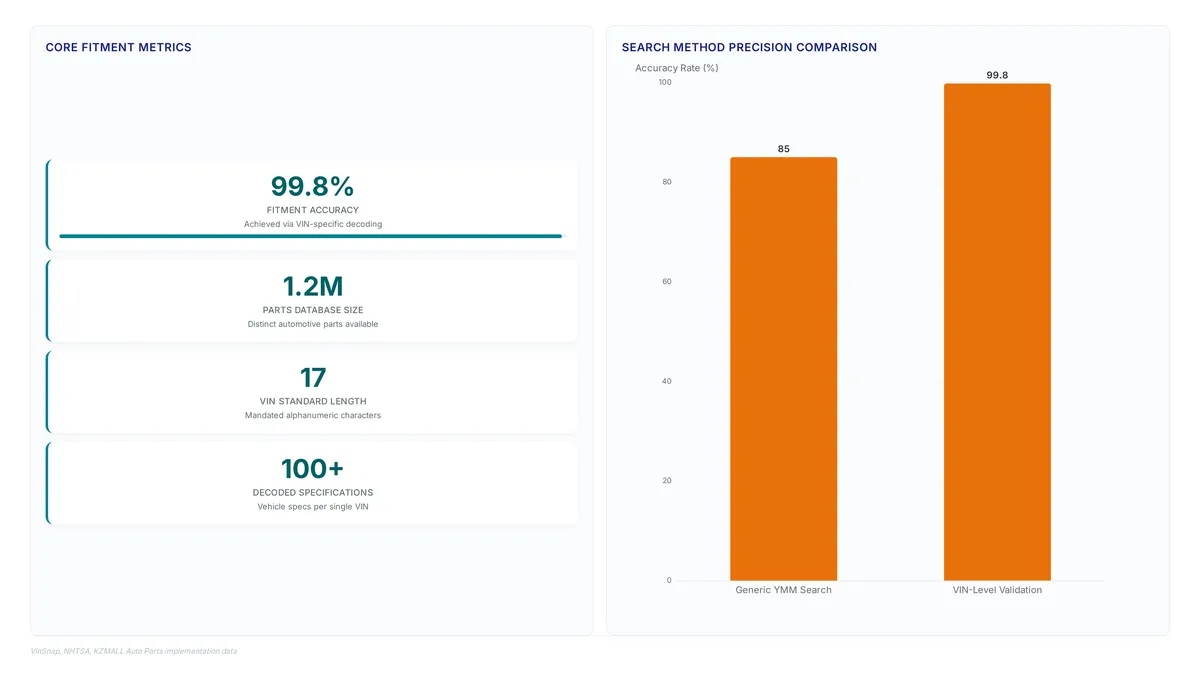
KZMALL Auto Parts configures the X-Cart platform to execute VIN decoding alongside native Year/Make/Model filters, delivering immediate fitment precision without external dependencies. The system decodes every digit to identify specific engine sizes and trim levels that generic searches often miss. Shoppers benefit from the My Garage feature, which stores these decoded profiles to accelerate repeat purchases and reduce selection errors. Retailers implementing this solution follow a direct integration path:
- Activate the native VIN search module within the X-Cart Automotive dashboard.
- Enable bulk import tools to map existing catalog data to specific vehicle attributes.
- Configure the Garage personalization setting to retain user vehicle data across sessions.
- Deploy the combined YMM and VIN interface on the storefront homepage.
- Monitor fitment statistics to refine catalog coverage based on user query patterns.
Broad catalog coverage often conflicts with strict fitment validation. Relying solely on year and make data invites returns, whereas VIN-level validation restricts visibility to guaranteed compatible items. This constraint increases conversion by eliminating purchase anxiety. The native approach avoids the latency and costs associated with third-party API calls, keeping the checkout flow entirely within the merchant's controlled environment.
Executing Bulk Fitment Data Imports for Catalogs
Sellers populate the X-Cart store catalog immediately by importing vehicle fitment data in bulk rather than entering records manually. This process eliminates guesswork and ensures that advanced product fitment verification tools give customers peace of mind regarding part functionality. KZMALL Auto Parts operators execute this workflow through a structured sequence to guarantee data integrity before live deployment.
- Prepare the inventory spreadsheet with Year/Make/Model columns matching the platform schema.
- Map the internal fitment attributes to the corresponding database fields within the admin panel.
- Upload the file to trigger the bulk import engine, which validates every row against existing vehicle tables.
- Verify the synchronized data to ensure listings reflect accurate trim and engine specifications.
Precision fitment moves beyond generic searching to VIN-specific decoding that accounts for distinct trim packages. Synchronization latency presents a primary limitation; if underlying vehicle tables update frequently, the imported static data may require regular refreshes to maintain accuracy. Operators must treat fitment data as flexible, necessitating a schedule for re-importing updated manifests to prevent compatibility errors. The cost of maintaining this precision is measurable in administrative time, yet it prevents the significant revenue loss associated with incorrect part shipments.
Validation Steps for VIN Search and YMM Filters
Validate fitment logic by confirming the system decodes the full 17-character string before launch. KZMALL Auto Parts operators must verify that VIN decoding correctly populates Year, Make, and Model fields without manual entry errors. This step maintains high-quality product data for profits while preventing inaccurate orders.
- Execute test searches against known vehicle configurations to verify fitment accuracy.
- Confirm the YMM tool captures search statistics to identify catalog gaps.
- Check that bulk imports map correctly to existing vehicle tables.
| Check Type | Validation Target | Outcome Metric |
|---|---|---|
| Decode Test | 17-digit input | Correct YMM fields |
| Stats Check | Search logs | Data captured |
| Import Test | Bulk upload | Zero mapping errors |
Shifting from generic searches to precise decoding eliminates wrong parts orders driven by trim differences. External validation often requires paid upgrades for detailed specifications, whereas integrated platforms handle this within the core subscription. Your configuration should reject partial matches that could lead to returns. This rigorous approach guarantees customers receive functional parts immediately.
About
Mark Phillips serves as Editor of Aftermarket Intel at KZMALL Auto Parts, where he closely monitors distribution channels and e-commerce trends. His deep expertise in the competitive moves of substantial distributors makes him uniquely qualified to analyze the critical role of VIN lookup tools in modern automotive retail. In his daily work, Phillips evaluates how accurate fitment data drives B2B procurement efficiency, directly connecting his insights to the article's focus on reducing returns and building trust. He explains how KZMALL Auto Parts uses standardized ACES/PIES data within its own digital catalog to offer precise VIN decoding and OE cross-referencing. Unlike third-party solutions that merely aggregate data, KZMALL integrates these capabilities directly into its wholesale platform, ensuring global buyers access verified compatibility across 50,000+ SKUs. Phillips emphasizes that relying on reliable, internal fitment technology is necessary for independent shops and distributors seeking a single-source supplier model that guarantees part accuracy without external dependencies.
Conclusion
Static data imports degrade quickly without automated refresh cycles, turning a precision asset into a liability. The operational cost here isn't the initial setup; it's the continuous administrative burden of manually re-importing manifests to match manufacturer updates. Relying on periodic checks fails when vehicle tables update daily, creating hidden gaps where trim-specific errors resurface unnoticed until a return occurs. You must treat fitment data as a live stream rather than a one-time import to sustain the high fitment accuracy platforms promise business-grade vin decoding.
Implement a weekly validation protocol starting today by running a batch of ten known complex trims through your current search flow to measure decode latency and field population success. If any test fails to auto-populate Year, Make, and Model fields perfectly, your system requires an immediate integration review before further catalog expansion. KZMALL Auto Parts solutions provide the necessary infrastructure to automate these checks internally, ensuring your vehicle tables remain synchronized without third-party dependencies. Prioritize fixing the refresh mechanism over expanding SKU counts, as accurate coverage of existing inventory drives more profit than broad but flawed compatibility claims.
Frequently Asked Questions
A standard VIN consists of exactly 17 alphanumeric characters encoding vehicle data. This precise length allows systems to decode over 100 specifications to ensure accurate part matching.
This vast inventory ensures shoppers find exact matches for their specific vehicle trim and engine.
Native integration removes latency and costs associated with external API calls during searches. Retailers avoid maintenance fees while accessing critical data points like plant location instantly within their core platform.
The code reveals engine size, plant location, and unique serial numbers instantly. Decoding these attributes helps eliminate fitment errors that broad Year Make Model filters often miss completely.
The My Garage feature lets users save profiles for faster future transactions. This personalization reduces friction by bypassing manual data entry during subsequent visits to the auto parts store.
References