
Magique 2026 update kills tab shuffling for shops
Version 2026.003 kills the browser tab shuffle. By embedding NAPA ProLink directly into the AB Magique interface, VL Communications forces parts ordering and repair management into a single view. This isn't just a UI tweak; it's a structural rejection of the disjointed workflows that have slowed down estimating for decades.
The update targets the fragmentation inherent in modern shop floors. Instead of jumping between supplier portals, technicians now access Carquest WebLink, Uni-Select, and NAPA ProLink from a consolidated hub. Datainsightsmarket reports confirm this shift mirrors the broader industry migration toward cloud-based solutions, yet AB Magique takes a different path by deepening local integration rather than moving everything to the web.
The result is tangible efficiency. Technicians stop toggling applications during high-pressure estimates. Unlike single-page competitors, the system relies on a Multiple Document Interface architecture, keeping repair orders and supplier inventories visible simultaneously. Released in May 2026, this integration proves established vendors can close the loop between shop management and supply chain logistics without forcing a total platform rip-and-replace.
The Role of AB Magique in Modernizing Automotive Shop Management
AB Magique Definition: VL Communications Shop Management Platform
VL Communications launched AB Magique in 2007 after 12,000 hours of dedicated development. This desktop-hybrid system leverages over 35 years of industry tenure to unify repair workflows. While cloud-first rivals often trap users in single-page applications that restrict multitasking, this software employs a Multiple Document Interface (MDI) to handle complex tasks without browser fragmentation. Competitors like Mitchell 1 frequently charge extra for Digital Vehicle Inspection capabilities; this platform bundles them. There is a learning curve. Mastering the MDI environment demands more initial training than simpler, linear interfaces, but the payoff is a unified operational view that tabbed browsers cannot match.
NAPA ProLink Integration in Version 2026.003 for Parts Ordering
Version 2026.003 hardwires the NAPA ProLink catalog into the AB Magique interface. Repair shops demanded unified workflows, not disjointed browser tabs, driving this architectural pivot. Previously, operators navigated separate systems to verify pricing or availability, introducing latency into the estimating phase. Now, technicians search inventory and submit orders within the same Multiple Document Interface window used for repair orders. Cloud-native competitors like Shop-Ware excel at digital vehicle inspection but often require third-party connectors for deep distributor access.
AB Magique targets small businesses by rejecting legacy per-device fees. Competitors like Mitchell 1 historically charge for every terminal, inflating costs for expanding shops. AB Magique bundles features like Digital Vehicle Inspection without bolt-on fees, directly addressing market criticism regarding expensive add-ons. Small operators avoid the hidden costs that erode margins in traditional contracts. Financial friction often stalls technology adoption in smaller garages. The Multiple Charter Interface lets users manage windows simultaneously rather than buying extra screens or licenses. This design choice reduces the total cost of ownership notably over a three-year horizon. Interface familiarity must be weighed against long-term expenditure. Legacy systems demand higher capital outlay for similar functional depth. Staff accustomed to older, fragmented workflows may show initial resistance. The affordable positioning ensures cash flow remains dedicated to parts and labor rather than software overhead. VL Communications prioritizes this balance to retain independent shops. Thorough accounting and parts ordering coexist without tiered pricing penalties.
Inside the Direct Parts Ordering Mechanics Within Version 2026.003
Multiple Framework Interface Architecture in Version 2026.003
Software fragmentation ends as version 2026.003 embeds NAPA ProLink. AB Magique employs a Multiple Instrument Interface (MDI) architecture resembling Microsoft Word or Excel, letting users manage multiple windows without exiting the application environment. This specific integration with NAPA ProLink joins a broader suite of direct catalog links, separating the platform from single-page app competitors.
| Interface Type | Window Management | Context Switching |
|---|---|---|
| MDI Architecture | Simultaneous Panels | Eliminated |
| Single Page App | Tab-Based Only | Frequent |
Child-window containment within a parent shell allows operators to view repair orders and parts catalogs side-by-side. Most cloud-native rivals force technicians to toggle between browser tabs, a friction point introducing data entry errors. The MDI approach demands higher local system resources than lightweight web alternatives. This architectural choice prioritizes operator throughput over minimal hardware footprints. Shops gain the ability to cross-reference pricing across Carquest WebLink. Legacy hardware may struggle with multiple active rendering engines. Interface richness conflicts with limited workstation specifications. The result is a unified workspace where parts sourcing occurs without abandoning the primary repair ticket.
Executing Direct Parts Search and Order Placement Workflows
Technicians now submit parts searches and orders directly inside the AB Magique window, removing browser context switches. A repair order opens, the embedded catalog invokes, and queries run by part number or description without leaving the MDI environment. Live pricing and availability from NAPA PROLink drive the process.
- Select the active repair order in the Multiple Blueprint Interface.
- Click the integrated parts tab to launch the distributor catalog.
- Enter the search term; the query syncs with external inventory databases.
- Confirm line items to auto-populate the estimate with current costs.
Industry demand for real-time data synchronization drives this workflow, mirroring recent Monaco Group integrations. The MDI architecture maintains state across multiple open documents unlike disjointed browser tabs, preventing data loss during complex estimates. External catalog uptime dictates performance since local network latency can delay price refreshes, a constraint absent in static local databases. Operators gain speed but inherit the distributor's API response times as a hard limit on workflow velocity.
Maxime Gagnon noted this evolution provides a smoother experience, yet shops must train staff to trust the embedded NAPA ProLink results over legacy habits. Failure to adopt the single-platform approach leaves the pricing model advantages unrealized as manual entry errors persist. Fewer clicks equal quicker estimate generation provided the network connection remains stable.
Validating NAPA ProLink Connectivity and Performance Fixes
Search latency disappears as version 2026. Autoserviceworld. The release includes several additional fixes and performance improvements targeting query response times within the unified window. Operators must verify connectivity against the integrated catalog suite, which uniquely combines access to Carquest WebLink and Uni-Select Nexpart-WHI alongside NAPA.
| Validation Step | Expected Behavior | Failure Indicator |
|---|---|---|
| Catalog Launch | Window opens inside MDI frame | New browser tab spawns |
| Search Query | Results return under 2 seconds | Spinner hangs indefinitely |
| Order Sync | Line items populate repair order | Data fails to transfer |
- Initiate a parts search from an active repair order to test internal routing.
- Confirm live pricing updates match external distributor portals.
- Verify order submission completes without switching application contexts.
Community feedback scored the software at 4.50 as of September 2025, indicating high user reliance on stable parts sourcing. A failure in the search function now blocks the entire estimating workflow rather than just delaying a single step. Shops relying on this direct catalog.
Operational Efficiency Gains From Embedded NAPA ProLink Workflows
Embedded NAPA ProLink Workflow Mechanics in AB Magique 2026.003
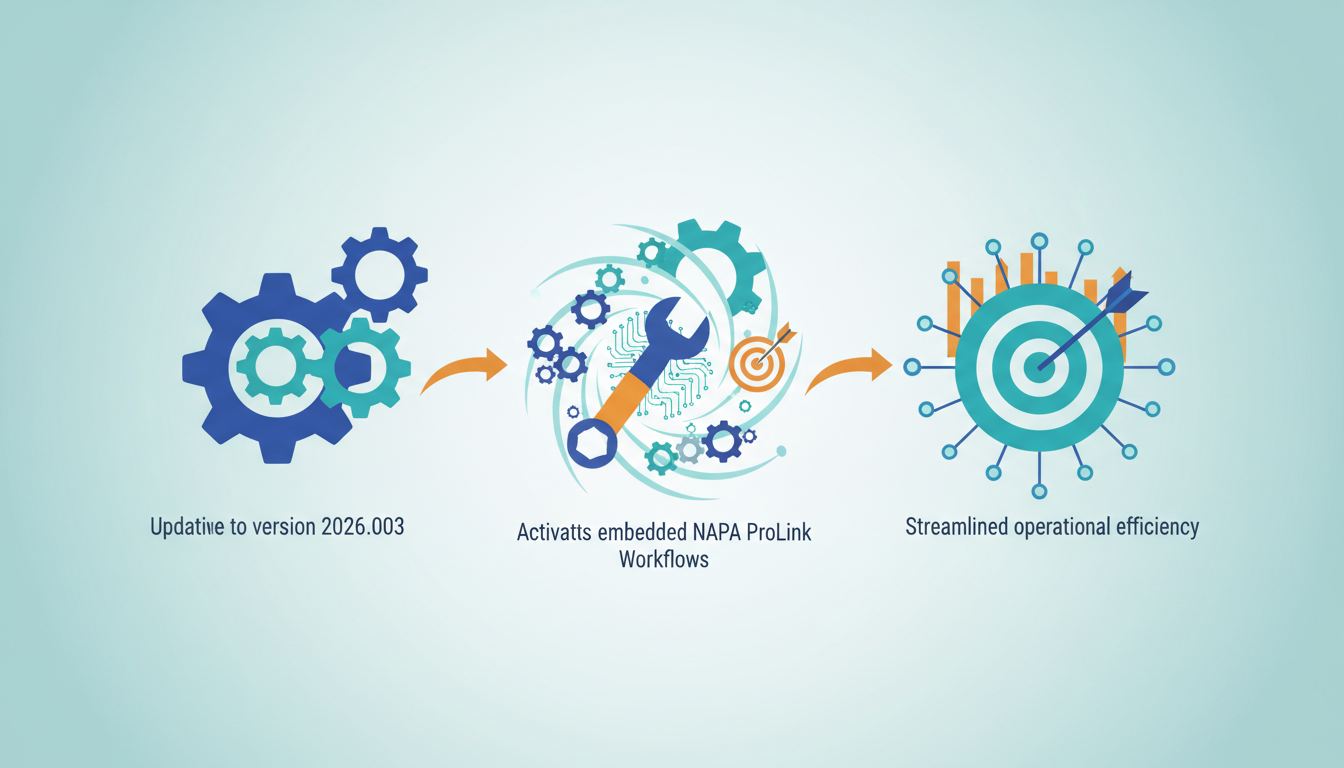
Version 2026.003 executes parts queries through the Multiple Charter Interface by embedding NAPA PROLink. This architecture maintains active repair order context while technicians search catalogs, eliminating the window-switching friction common in legacy shop management systems. The update uses direct integration protocols to sync real-time pricing and availability data within the primary estimating window. Operators updating to version 2026.003 gain access to a unified catalog suite that includes Carquest WebLink. The workflow requires no separate login sequences once the software authenticates the shop credentials with the distributor network.
- Navigate to the active repair order within the MDI environment.
- Select the integrated parts tab to launch the distributor query interface.
- Input part numbers or descriptions to retrieve live inventory status.
- Confirm line items to append costs directly to the customer estimate.
The technical limitation lies in the dependency on distributor API uptime; an outage at the supplier level renders the embedded pane empty despite local software stability. Shops must maintain fallback procedures for manual phone orders when the Vast Auto NetValue Products and Brands recommends verifying firewall rules allow outbound connections to distributor domains before deploying the update across multiple terminals.
Application: Executing Direct Parts Search and Order Placement Workflows
Version 2026.003 executes parts queries inside the Multiple Framework Interface, removing external browser tabs entirely. Technicians select an active repair order and invoke the embedded catalog to search by part number or description. The system retrieves live pricing and availability from NAPA PROLink within the same pane used for labor entries. This architecture prevents context loss during high-volume estimating sessions.
- Open the target repair order in the MDI environment.
2.3. Enter search terms; the query syncs with external inventory databases..
The workflow supports a broader suite of direct catalog links, granting simultaneous access to Carquest WebLink. Real-time data synchronization ensures purchase orders reflect current market pricing without manual re-entry. However, reliance on embedded frames requires stable internet connectivity to avoid rendering delays during peak lookup windows. Shops upgrading from legacy systems must verify firewall rules allow these specific embedded connections to function. The operational result is a unified workflow where parts selection and order placement occur without leaving the AB Magique window. Products and Brands recommends this configuration for shops seeking to minimize system switching.
Application: Validating NAPA ProLink Connectivity and Performance Fixes
Version 2026.003 resolves search latency by embedding NAPA PROLink. The release includes several additional fixes targeting query response times within the unified window. Failure to validate these connections risks silent data desynchronization during high-volume estimating.
Technicians should confirm the MDI architecture retains context when switching between labor and parts tabs. This specific integration protocol ensures real-time inventory checks without leaving the primary estimating screen. Shops relying on legacy redirects will note the absence of session drops during complex multi-part lookups. Validating these performance fixes confirms the software correctly uses the new direct link infrastructure rather than fallback web pointers.
Strategic Advantages of AB Magique Against Competing Repair Platforms
Defining AB Magique's Market Position Against AutoFluent and Tekmetric
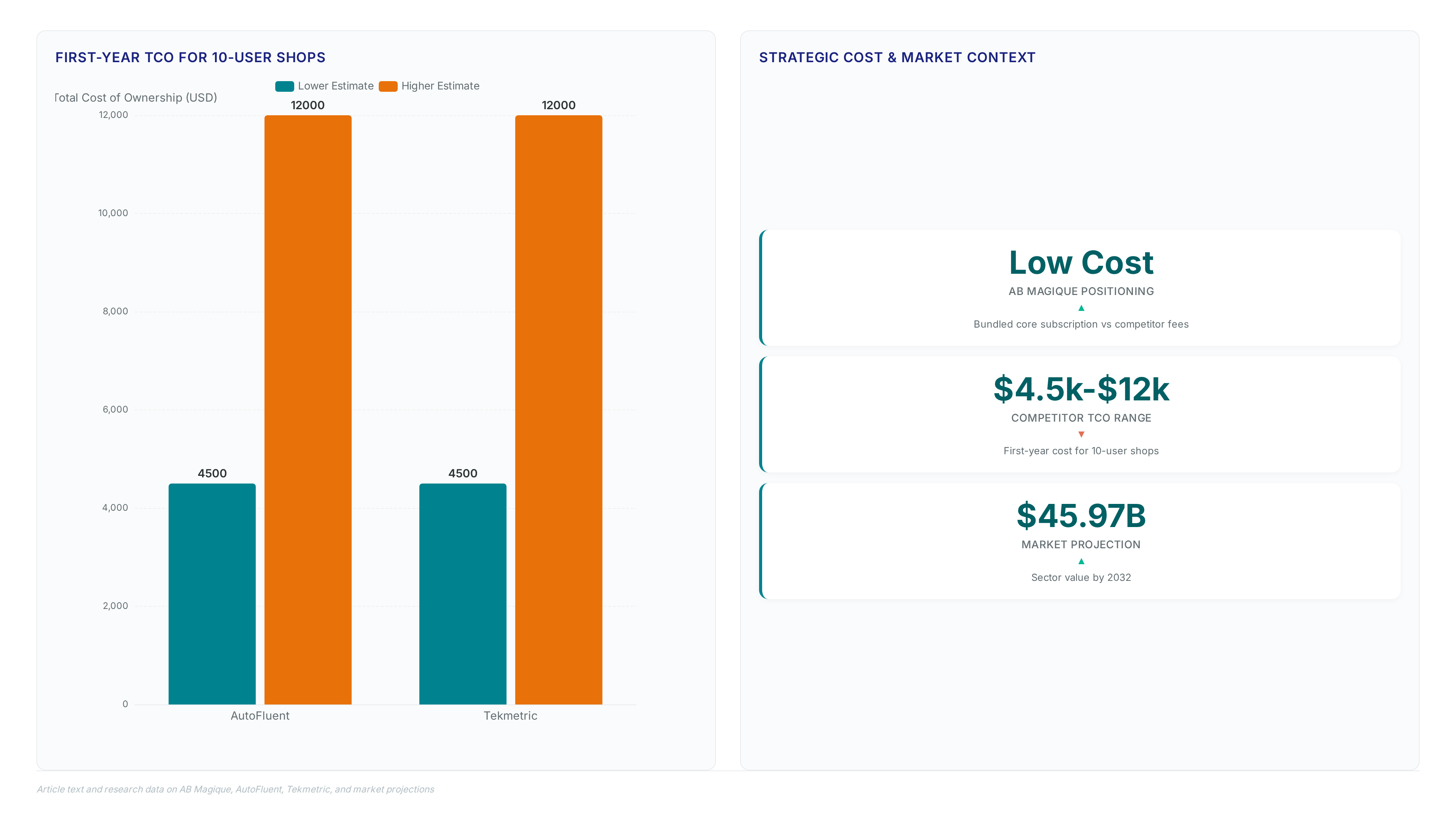
AB Magique secures market position by maintaining low implementation costs while AutoFluent and Tekmetric charge $4,500 to $12,000 for first-year Total Cost of Ownership in 10-user shops. This pricing disparity defines the Cost Efficiency advantage for small businesses operating under strict budget constraints. Competitors often layer fees for necessary modules, whereas the Canadian developer bundles core functionality into a single subscription model.
| Feature Dimension | AB Magique Approach | Competitor Standard (AutoFluent / Tekmetric) |
|---|---|---|
| Architecture | Hybrid local-cloud MDI | Pure SaaS Cloud |
| Parts Integration | Native NAPA ProLink pane | External browser redirect |
| Pricing Model | Flat low-cost subscription | Tiered per-user scaling |
The platform uses a Multiple Instrument Interface to keep technicians within one window, contrasting sharply with the fragmented tab management required by Shop-Ware profiles. While pure cloud models offer remote access, they frequently suffer latency during catalog searches that native panes avoid. The trade-off is local infrastructure maintenance, which some IT teams may find burdensome compared to zero-touch cloud deployments.
Market projections indicate the sector will reach USD 45.97 billion by 2032, driving intense competition for Feature Parity. AB Magique addresses this by embedding distributor connections directly, unlike rivals that treat supply chain links as premium add-ons. Operators must weigh the TCO savings against the requirement for on-premise hardware maintenance. The strategic choice depends on whether a shop prioritizes immediate cash flow preservation or prefers shifting all capital expenditure to operational expenses. Long-term viability favors the integrated model where parts ordering friction directly impacts bay throughput.
Applying Feature Parity: VIN Scanning and Tax Remittance Without Add-On Fees
AB Magique version 2026.003 embeds VIN scanning and tax remittance directly into the core subscription, eliminating the add-on fees competitors typically impose. While rival platforms often charge extra for mobile-first features or Digital Vehicle Inspection capabilities, this Canadian developer bundles customer tracking modules as standard. The operational benefit is immediate cost avoidance for shops that would otherwise pay thousands annually for basic compliance tools. However, the Multiple Blueprint Interface architecture required to support these simultaneous windows demands higher local RAM than pure browser-based SaaS alternatives. This trade-off favors shops prioritizing multitasking depth over minimal hardware specs.
| Feature Module | AB Magique Inclusion | Typical Competitor Model |
|---|---|---|
| VIN Decoding | Native Core Module | Paid Add-on |
| Tax Remittance | Automated Core Function | Manual or Extra Cost |
| Customer History | Integrated Database | Separate CRM License |
Operators gain feature parity without expanding their vendor list, yet they must manage local updates to maintain compatibility with external catalog APIs. The strategic advantage lies in predictable budgeting; shops avoid the surprise invoices common with modular SaaS pricing. Adoption requires verifying that existing workstations meet the memory requirements for the MDI environment.
Comparing NAPA Partnership Integration Versus Standalone Competitor Platforms
Direct NAPA PROLink integration defines the platform's edge. This architectural choice reduces workflow fragmentation by keeping parts searches within the active repair order window. Shops using disjointed systems face higher operational friction compared to those using unified interfaces.
| Feature Dimension | AB Magique (VL Communications) | Standalone Platforms (e.g. Shop-Ware) |
|---|---|---|
| Parts Sourcing | Native NAPA PROLink pane | Third-party connector or browser tab |
| Window Management | Multiple Charter Interface | Single-view web browser |
| Catalog Depth | Direct links to Carquest, Uni-Select | Limited native distributor list |
Standalone solutions often require technicians to toggle between applications, increasing the risk of data entry errors during high-volume periods. However, the Multiple Framework Interface demands local resource allocation that pure cloud-native architectures avoid entirely. This trade-off favors shops prioritizing multi-tasking speed over zero-footprint deployment models. The strategic divergence creates a clear separation between thorough desktop-hybrid tools and lightweight cloud alternatives. Operators must weigh the efficiency of embedded catalogs against the infrastructure requirements of the host system.
About
Priya Raman serves as the Aftermarket Category and Supply-Chain Strategist at KZMALL Auto Parts, where she oversees the intersection of parts data, sourcing efficiency, and digital distribution. With fifteen years of experience managing complex B2B catalogs and ACES/PIES fitment standards, she is uniquely qualified to analyze the strategic value of the AB Magique platform's new NAPA ProLink integration. Her daily work involves optimizing how wholesalers access over 50,000 SKUs across diverse vehicle categories, making her deeply familiar with the friction caused by switching between disparate systems. This article reflects her direct engagement with the operational challenges that AB Magique addresses by unifying parts search and ordering within a single interface. By connecting KZMALL's commitment to standardized data with AB Magique's evolved workflow capabilities, Raman provides a factual perspective on how this 2026 update simplifies the "business of parts" for independent distributors seeking to convert technical knowledge into tangible margin.
Conclusion
The desktop-hybrid model breaks at scale when hardware refresh cycles lag behind software memory demands, creating a hidden operational tax that pure cloud platforms avoid. While the unified interface eliminates context switching, the local resource burden shifts the maintenance responsibility entirely to the shop owner. This architecture favors established facilities with dedicated IT oversight over rapidly expanding franchises needing zero-touch deployment. The pricing disparity against competitors like Tekmetric is only an advantage if the local infrastructure can sustain the MDI environment without frequent crashes or latency.
Adopt this platform only if your shop floor operates on a strict three-year hardware replacement schedule and requires deep, native integration with NAPA PROLink above all else. Shops relying on aging workstations or those needing immediate remote scalability should reject this architecture in favor of browser-based alternatives. The window for using this specific cost-to-feature ratio closes as web-based competitors mature their native catalog integrations.
Start by auditing the RAM and processor age of your ten oldest service bays this week to determine if they meet the strict memory thresholds required for stable multi-window operation.
Frequently Asked Questions
AB Magique is easily affordable while competitors charge significantly more. Tekmetric's Total Cost of Ownership ranges from $4,500 to $11,000 for the first year in a 10-user shop environment.
Live pricing search query results now return in under 2 seconds. Previously, users faced indefinite spinner hangs or stale cache errors that disrupted the critical estimating workflow process.
No, the platform bundles digital vehicle inspection tools directly without extra fees. Competitors like Mitchell 1 frequently charge additional amounts for these specific capabilities within their management systems.
VL Communications invested 12,000 hours of dedicated development before launching. This extensive groundwork created a desktop-hybrid system leveraging over 35 years of industry tenure for shops.
The AB Link add-on costs only a few dollars more per month. This small increase provides a transactional website beyond the base software subscription for small and mid-sized businesses.