
IATF 16949 Rules: Why Tier1 Suppliers Can't Skip
Over 1,800 technical standards from SAE dictate exactly which components survive in global supply chains. The automotive parts sector functions as a rigid hierarchy where IATF 16949 certification acts as the sole gateway for suppliers targeting OEMs and tier-1 manufacturers. Without this specific credential, entities remain confined to the lower-margin aftermarket, regardless of their production capacity or general quality controls.
This analysis tracks how tier-1 and tier-2 suppliers navigate these mandatory requirements to avoid being locked out of the USD 1.12 trillion market projected for 2033. We dissect the mechanics of data interoperability through ACES and PIES standards, which ensure digital catalogs communicate effectively across borders. Strategic roadmaps follow for achieving compliance without burning capital on unnecessary audits. While general quality policies satisfy basic import rules, only those adhering to strict traceability and continuous improvement protocols see elevated inquiry rates. This examination strips away the ambiguity surrounding J1939 communication protocols and cybersecurity guidelines like J3061, focusing instead on the hard requirements that define market access.
The Role of IATF 16949 and SAE Standards in Global Supply Chains
IATF 16949 Mandates for Tier-1 and Tier-2 OEM Suppliers
Customer complaints regarding component failure often stem from skipped validation steps. IATF 16949 defines the mandatory quality management system for Tier-1 and Tier-2 suppliers, distinguishing itself from general frameworks by enforcing strict product safety and full traceability protocols. Unlike ISO 9001, which offers a broad baseline, this standard mandates automotive-specific requirements that govern every production stage rather than relying on final inspection. The mechanism requires suppliers to integrate standardized audits across the global supply chain, ensuring Tier-1 suppliers and their sub-vendors meet unified OEM expectations without redundant assessments.
| Feature | General Quality (ISO 9001) | Automotive Mandate (IATF 16949) |
|---|---|---|
| Scope | Broad industry application | Specific to automotive production |
| Focus | Customer focus, process approach | Product safety, traceability, APQP |
| Requirement | Baseline for all suppliers | Mandatory for OEM programs |
Without this unified framework, global supply chains would face challenges aligning with conflicting OEM demands. KZMALL Auto Parts insists on verified certification to guarantee every component matches the vehicle's original engineering specifications.
Deploying ISO 26262 and ISO/SAE 21434 for Connected Vehicle Risks
Modern vehicle architectures require distinct protocols for functional safety and cyber threats. ISO 26262 governs functional safety for electrical systems, ensuring hardware behaves predictably during random failures. Conversely, ISO/SAE 21434 addresses cybersecurity risks in connected vehicles, focusing on malicious actor intrusion rather than component wear. A brake controller can be mechanically sound yet digitally compromised. P&C Global notes that manufacturers now seek cybersecurity certification to mitigate liability from smart car breaches, a domain separate from general quality control. While IATF 16949 mandates process consistency, it does not validate code against hacking attempts. The cost of ignoring this separation is severe, as safety mechanisms cannot stop a hijacked software update.
IATF 16949 vs ISO 9001: Automotive Specifics vs Baseline Quality.
IATF 16949 mandates automotive-specific process controls that general ISO 9001 baselines omit.
The core distinction lies in supply chain integration depth. While ISO 9001 establishes a core quality policy and customer focus applicable to any sector, IATF 16949 enforces rigorous product safety and traceability protocols unique to vehicle manufacturing. This specialized framework aligns OEMs and suppliers through standardized audits, ensuring consistent expectations across global operations. Suppliers targeting Tier-1 status must adopt this stricter regime to satisfy mandatory OEM requirements for continuous improvement.
Financial implications for small-to-medium enterprises vary significantly between the two paths. Initial certification for the automotive-specific standard typically ranges from USD 5,000 to 15,000, whereas the general baseline costs between USD 3,000 and 8,000. These estimates exclude annual audit fees required to maintain standing. Export-focused firms often question if they should pursue ISO 14001 for sustainability instead; however, environmental management does not replace the functional safety mandates required for mechanical components.
A critical tension exists between cost efficiency and market access. Choosing the general baseline saves capital upfront but limits access to OEM contracts requiring automotive validation. The limitation is clear: IATF 16949 is mandatory for suppliers targeting OEM customers or tier-1 manufacturers, whereas ISO 9001 serves as a general framework.
Data Interoperability Mechanics Through ACES and PIES Standards
ACES Fitment Data vs PIES Product Attributes Structure
ACES manages vehicle configuration fitment, while PIES defines product attribute details. This structural separation prevents catalog errors where a part lists correct dimensions but fits the wrong engine. The Vehicle Configuration Database (VCdb) supports over 60,000 vehicle configurations, acting as the relational key for fitment accuracy. Manufacturers map Year/Make/Model/Engine data through ACES to ensure a buyer selects a component compatible with their specific chassis. PIES handles the descriptive metadata, including technical specifications and pricing required for digital data exchange.
| Feature | ACES Standard | PIES Standard |
|---|---|---|
| Primary Function | Vehicle Fitment Mapping | Product Attribute Definition |
| Data Scope | Year, Make, Model, Engine | Dimensions, Weight, Pricing |
| Dependency | Relies on VCdb codes | Relies on Part Terminology |
| Business Risk | Returns due to incompatibility | Liability from missing specs |
Traceability in automotive manufacturing depends on this dual-schema approach to link physical inventory with digital records. Global fitment standards like ACES/PIES maximize sales and avoid costs associated with fitment errors, indicating a direct correlation between data standardization and revenue recovery. Accurate data structures help ensure the part matches the engineered application, reducing the likelihood of returns.
Fixing Fitment Errors in Dorman and GM Parts Catalogs
Reviews confirm fitment success yet flag leaking lines, indicating a gap between physical manufacturing and catalog claims. Proper ACES mapping resolves this by linking specific engine codes to verified vehicle configurations, preventing mismatched inventory from reaching the bay. The cost of ignoring this data interoperability is measurable, as distributors relying on non-standardized formats face higher return rates and customer dissatisfaction.
Conversely, high-volume success stories like the GM Genuine Parts vapor canister vent valve solenoid demonstrate the value of precision. This component maintains a 4.7-star rating across 2,124 reviews, with 83% being five-star ratings, proving that accurate fitment data accuracy drives buyer confidence.
| Component Issue | Root Cause | ACES/PIES Fix |
|---|---|---|
| Coolant Line Leak | Machining tolerance drift | Map tolerance specs in PIES attributes |
| Wrong Engine Fit | Missing sub-model qualifier | Apply VCdb engine type flags |
| High Return Rate | Generic year-range listing | Restrict to verified configuration pairs |
Operators must recognize that digital marketplace integration relies on validating parts against the Vehicle Configuration Database. A part listed for a broad year range without engine specificity invites failure. Suppliers are advised to verify every Year/Make/Model/Engine combination against the latest VCdb release before publishing.
Financial Risks of Skipping Pre-Shipment Data Verification
Saving USD 200-300 on pre-shipment inspection often triggers thousands in return costs and warranty claims. A sourcing professional with 12 years of experience warned that trusting samples without verification is a costly mistake. The root cause frequently involves fitment data accuracy gaps where physical parts mismatch digital catalogs. Without rigorous traceability in automotive manufacturing, suppliers cannot isolate batch failures or prove compliance during liability disputes. Market feedback indicates Trakmotive axles failed within one year, whereas OEM axles lasted 115,000 miles, highlighting the disparity between cheap aftermarket goods and engineered specifications.
Distributors relying on non-standardized data face higher return rates compared to those adopting global standards. Implementing ACES/PIES formats reduces interpretation errors across the supply chain. The limitation is clear: initial data validation requires upfront investment that low-margin exporters often skip. This false economy leaves buyers exposed to massive financial liability when components fail functional safety tests. Sourcing professionals advise buying the part the vehicle was engineered for, not the one that looks close.
| Risk Factor | Consequence | Mitigation Strategy |
|---|---|---|
| Skipped Inspection | Thousands in returns | Enforce third-party protocols |
| Poor Traceability | Unrecoverable liability | Mandate batch control systems |
| Data Errors | Customer dissatisfaction | Adopt ACES/PIES standards |
The constraint is temporary cash flow versus long-term brand viability in a regulated market.
Strategic Implementation of Certification and Compliance Roadmaps
Phased Roadmap for IATF 16949 and ISO 9001 Certification
Establish the quality management system foundation first by pursuing ISO 9001 certification during months one through six. This initial phase requires a budget allocation between USD 5,000 and USD 15,000 to document processes effectively. Suppliers must recognize that ISO 9001 provides the necessary architecture before attempting automotive-specific validation.
- Execute gap analysis against current production workflows.
- Implement corrective action protocols for non-conformances.
- Train internal auditors on general quality principles.
Transition to IATF 16949 pursuit in phase two, spanning months six to eighteen. Budget requirements increase significantly here, ranging from USD 15,000 to over USD 50,000 depending on facility complexity. This stage demands strict adherence to product safety and traceability mandates that general standards omit. Operators often underestimate the documentation load required for continuous improvement cycles.
The final expansion phase uses these credentials to access higher-value contracts. Total investment typically yields return on investment within 18 to 24 months for disciplined exporters. A common failure mode involves skipping the core ISO 9001 step, causing costly delays during the stricter IATF 16949 assessment.
Executing ACES/PIES Data Standards and CAPA Systems
Begin with the VCdb database, covering over 60,000 vehicle configurations, to anchor your fitment data before writing a single line of code.
- Map part attributes to ACES 5.0 schemas, noting the new support for non-diagram digital assets within the App Segment.
- Integrate PIES 8.0 fields for Extended Producer Responsibility packaging to satisfy emerging regulatory compliance mandates.
- Establish a Corrective and Preventive Action loop where every fitment error triggers a root-cause analysis and raw material traceability review.
Neglecting pre-shipment inspection to save USD 200-300 risks costly returns that erode the margin gained from maximizing sales through accurate cataloging. Functional safety implementation for electronic components demands adherence to ISO 26262 rather than general quality metrics alone. The operational tension lies between rapid data deployment and the rigorous validation required to prevent liability in ADAS-equipped vehicles.
Supplier Configuration Checklist: OEM vs Aftermarket Requirements.
Buy the certification path your target customer mandates, not the one that looks close on a brochure.
- Validate Target Tier: Select IATF 16949 for Tier-1 OEM contracts requiring zero-defect traceability, or choose ISO 9001 for general aftermarket distribution where cost sensitivity dominates buying decisions.
- Audit Data Readiness: Confirm ACES/PIES capability to handle the 60,000+ vehicle configurations in the VCdb, as fitment errors trigger immediate rejection by North American distributors regardless of physical part quality.
- Initialize CAPA Loop: Document a Corrective and Preventive Action system where every non-conformance forces a root-cause analysis before production resumes, satisfying the continuous improvement mandate inherent to automotive quality gates.
| Configuration | Investment Level | Target Buyer | Strategic Constraint |
|---|---|---|---|
| IATF 16949 | High | Tier-1 OEMs | Mandatory for safety-critical supply chains |
| ISO 9001 | Medium | Repair Shops | Insufficient for direct OEM engagement |
| Basic Export | Low | Price Markets | Excludes regulated regions entirely |
Com/understanding-role-of-certifications-standards-aftermarket-parts/) process locks suppliers into low-margin segments where price is the only differentiator.
Risk Mitigation Strategies for Audit Failures and Supply Chain Disruptions
Cummins Global Packaging Standard and Audit Failure Definitions
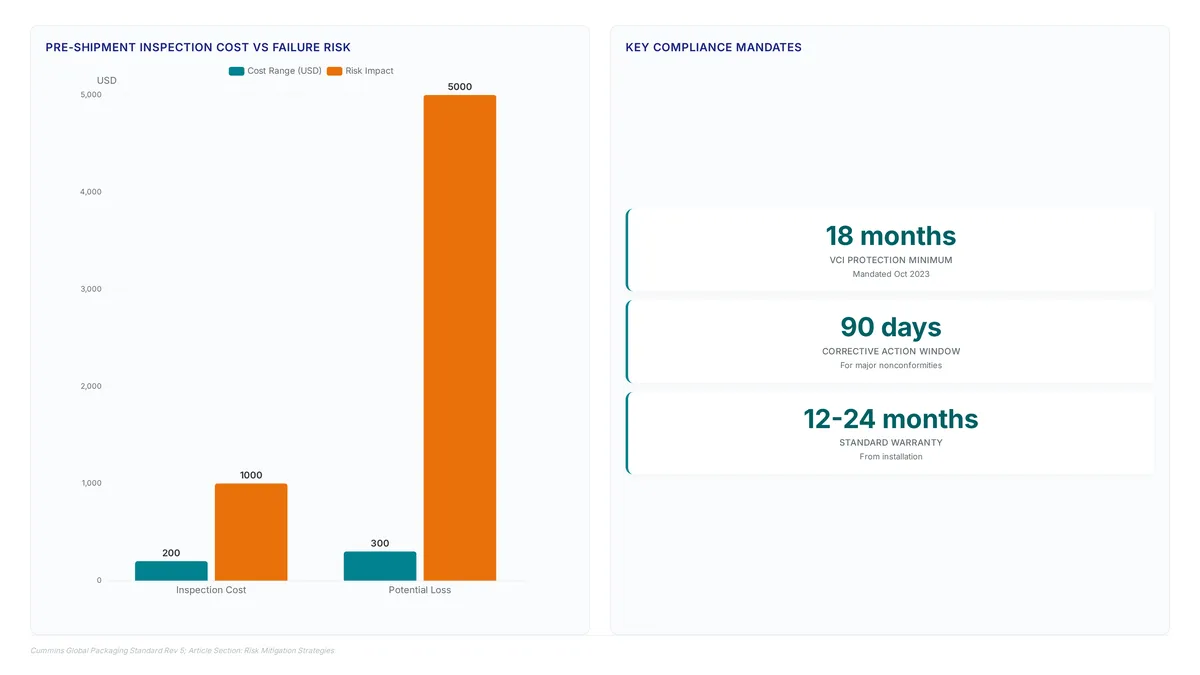
Audit failure occurs when shipments lack PDMS approval or valid IATF 16949 documentation under Cummins' Global Packaging Standard Revision 5. Released in October 2023, this mandate specifies an 18-month minimum for VCI corrosion protection and strict ISPM 15 compliance for all wood materials. Missing 2D Data Matrix barcodes or failed ASTM D4169 testing validation triggers immediate shipment rejection. Non-compliance risks supplier disqualification rather than simple rework fees. The hidden costs of these failures extend beyond logistics delays to include consequential warranty liabilities often excluded from initial price quotes.
- Labor charges for sorting non-compliant inventory at the receiving dock.
- Administrative overhead for processing corrective action requests.
- Logistics fees for expedited return or destruction of rejected goods.
- Long-term reputational damage affecting future bid eligibility.
Supply chain efficiency gains from rigorous certifications function as cost-mitigation strategies against such functional failures. Operators treating packaging as secondary to part quality overlook that physical protection directly dictates field reliability. A single moisture breach during transit invalidates the internal quality controls built during manufacturing. Skipping pre-shipment inspection to save minor upfront costs invites thousands in downstream returns. Buyers must verify that the physical packaging matches the technical data sheet before authorizing load release.
Pre-Shipment Inspection ROI: Avoiding Thousands in Returns
Skipping a pre-shipment inspection to save USD 200-300 can cost suppliers thousands in returns and reputational damage. Market feedback from sourcing professionals with over a decade of experience confirms that trusting samples without verification is a critical error. This financial risk escalates when aftermarket buyers demand cost-effective solutions while expecting OEM-level durability.
Real-world data illustrates the stakes clearly. Trakmotive axles have been reported to fail within one year, whereas original equipment often exceeds 100,000 miles. Similarly, Dorman turbocharger kits sometimes suffer from coolant line leaks due to machining tolerance issues. These defects trigger warranty claims that include labor, logistics, and administrative fees.
Hidden costs of avoiding third-party inspections include:
- Sorting non-compliant inventory at the recipient facility.
- Air freight charges for emergency replacement shipments.
- Permanent supplier disqualification from tier-1 vendor lists.
- Legal liabilities associated with safety-critical component failures.
Functional safety breaches carry immense financial liability that far exceeds the price of a basic audit. Suppliers must verify that parts meet strict dimensional and material specifications before leaving the factory floor. At KZMALL Auto Parts, we advise clients that early detection via independent inspection is the only viable hedge against total shipment rejection. The return on investment becomes obvious when comparing a fixed inspection fee against the variable but potentially ruinous cost of a recall. Quality verification ultimately trumps minor price savings in high-stakes automotive supply chains.
Warranty Cost Structures and NTF Process Pitfalls
Standard warranty periods span 12 to 24 months from installation, yet the financial exposure extends far beyond simple part replacement. CLEPA guidelines define warranty cost structures that accumulate labor, logistics, consequential damages, and administrative overhead rapidly.
| Cost Component | Direct Impact | Hidden Consequence |
|---|---|---|
| Labor | Technician diagnostic time | Overtime premiums for rush claims |
| Logistics | Reverse shipping fees | Hazardous material surcharges |
| Administrative | Claim processing labor | Disputed liability delays |
| Consequential | Downstream damage | Loss of future bidding rights |
The No Trouble Found (NTF) process addresses returned parts with no detected defects, creating a specific administrative bottleneck. Suppliers often absorb full logistics costs for these units while expending resources to validate functionality. This flexible creates a tension where rigorous supply chain integration intended to prevent quality escapes ironically increases the volume of low-value administrative disputes. The limitation here is procedural; without shared diagnostic data protocols between OEMs and Tier-2 providers, the NTF resolution cycle remains stagnant.
- Validate failure modes against OEM diagnostic trees before authorizing return shipping.
- Audit historical NTF rates to identify systemic misdiagnosis patterns in the field.
- Negotiate administrative fee caps for verified NTF returns in supplier agreements.
KZMALL Auto Parts advises that ignoring these accumulation points erodes the margin gains achieved through efficient manufacturing. The real cost lies in the operational drag of resolving disputes rather than the physical defect rate itself.
About
Ray Donnelly, Master Automotive Technician and Aftermarket Parts Authority at KZMALL Auto Parts, brings over two decades of hands-on experience to the complex environment of automotive industry standards. Having transitioned from running an independent repair shop to leading technical content at KZMALL, Ray understands that compliance is not merely bureaucratic; it is the critical difference between a reliable repair and a costly comeback. His daily work involves interpreting IATF 16949 requirements to ensure KZMALL's 50,000+ SKUs meet rigorous global quality benchmarks for tier-1 and aftermarket distribution. This article uses his deep expertise in fitment accuracy and OE cross-referencing to explain why adhering to strict manufacturing protocols is necessary for exporters and distributors alike. By connecting real-world diagnostic challenges with high-level supply chain compliance, Ray illustrates how standardized quality systems protect both vehicle safety and business reputation in a rapidly expanding global market.
Conclusion
Scaling automotive parts distribution reveals that procedural friction often outweighs physical defect costs. When warranty windows extend to 24 months, the cumulative burden of No Trouble Found disputes drains liquidity quicker than isolated manufacturing errors. The core failure point is not the part itself but the lack of shared diagnostic data between OEMs and Tier-2 providers, which turns every return into a costly liability debate rather than a technical resolution. This operational drag silently erodes the return on investment promised by disciplined exporting strategies.
Exporters must mandate shared diagnostic protocols before authorizing any reverse logistics movement. This requirement should be embedded in supplier agreements immediately, with a target to reduce administrative dispute volume by half within the next two warranty cycles. Relying solely on standard 18-month corrosion mandates or basic functional testing is insufficient when consequential damages and labor premiums accumulate unchecked. The financial exposure lies in the time spent arguing over non-defects, not just the price of replacement units.
Start by auditing your historical NTF rates this week to identify specific misdiagnosis patterns that trigger unnecessary shipping fees. Cross-reference these findings against current OEM diagnostic trees to pinpoint where field technicians lack clarity. By addressing these data gaps now, you protect your margins from the hidden administrative overhead that defines modern automotive parts supply chains.
Frequently Asked Questions
Certified suppliers can access the projected 1.12 trillion market by meeting strict OEM requirements. This massive value pool requires IATF 16949 certification to ensure product safety and traceability across global supply chains effectively.
The industry is expanding at a 4.2% CAGR, creating steady demand for compliant components. Suppliers must adopt rigorous standards like IATF 16949 to capture share in this growing market without facing exclusion.
An 83% five-star rating proves that verified components significantly reduce failure risks for buyers. This high satisfaction rate demonstrates why sourcing professionals insist on strict certification before purchasing critical vehicle systems.
While specific splits vary, the aftermarket remains a primary growth driver for repair solutions. Suppliers often target this segment first, though OEM access requires stricter mandates than general quality frameworks provide.
Many entities fail because they lack mandatory traceability protocols required for OEM programs. Without these specific controls, suppliers cannot prove product safety or continuous improvement needed for tier-1 status.
References