
IATF 16949 Risk: Stopping Defects Before Start
Certifications like IATF 16949:2016 are not optional badges; they are the price of entry for suppliers serving global OEMs and Tier-1 manufacturers. This standard replaced ISO/TS 16949 to enforce stricter process control and risk management protocols across high-volume production programs. We must examine the operational mechanics of defect prevention through structured tools like PFMEA and control plans, which shift quality assurance from final inspection to embedded production stages. Finally, the discussion covers necessary regulatory compliance frameworks necessary for CE Marking and hazardous substance control in international markets.
THACO INDUSTRIES emphasizes that these certifications serve as objective measures for assessing supplier capability and manufacturing credibility. As noted in industry analysis, the transition to IATF 16949:2016 reflects elevated expectations for supply chain integration and end-to-end traceability from incoming materials to final delivery. Manufacturers must now demonstrate continuous improvement driven by data monitoring rather than relying on ad-hoc corrections.
The stakes are clear for any entity seeking product interchange validation or direct contracts with substantial brands. Failure to adopt these quality management systems excludes firms from the standardized audits and clear quality expectations demanded by global buyers. This is not merely about paperwork but about surviving a supply chain that tolerates zero ambiguity in safety-critical assemblies.
The Strategic Role of IATF 16949 and ISO 9001 in Global Supply Chains
IATF 16949:2016 Definition Replacing ISO/TS 16949
IATF 16949:2016 serves as the definitive quality management standard specifically developed for the automotive industry, formally replacing the legacy ISO/TS 16949 framework to address modern supply chain complexities. This transition marks a strategic shift where quality must be built into every production stage rather than relying on final inspection outcomes. While ISO 9001:2015 provides the core management system structure, the automotive-specific extension introduces rigorous expectations for process control, risk management, and end-to-end traceability that general standards lack.
The standard functions as a unified framework aligning OEMs, Tier-1, and Tier-2 suppliers through standardized audits and clearer quality expectations across global operations. Key focus areas include defect prevention via structured risk analysis tools like PFMEA and continuous improvement driven by data monitoring. Suppliers must distinguish between general quality compliance and automotive readiness to meet specific product safety and consistency protocols required by the industry.
| Feature | ISO 9001:2015 | IATF 16949:2016 |
|---|---|---|
| Scope | General Industry | Automotive Specific |
| Risk Approach | Basic Identification | PFMEA & Control Plans |
| Inspection | Final Output Focus | Built-in Process Control |
Consequently, certification acts as a mandatory sourcing requirement for high-volume programs, effectively gating market access for component manufacturers.
ISO 9001:2015 as Foundation for Automotive Defect Prevention
ISO 9001:2015 establishes the mandatory management architecture for documented workflows and batch consistency.
This standard defines the core system upon which automotive-specific extensions are structured. It enables standardized workflows across departments, ensuring that operating procedures and change controls reduce process variability before specialized automotive rules apply. Without this structural base, higher-level defect prevention tools lack the necessary data integrity to function effectively.
The pressure to adapt intensifies as electric vehicles are expected to represent a significant share of total vehicle sales by 2030, increasing pressure on manufacturers to meet specific safety and quality demands. Rapid scaling for such market shifts often tempts manufacturers to bypass core documentation in favor of speed. However, skipping the quality management foundation creates untraceable variances that final inspections cannot catch. ISO 9001:2015 serves as the structural quality management foundation for IATF 16949:2016, defining the core management system on which automotive-specific requirements are built. This makes the initial investment in ISO 9001:2015 a critical step for any supplier seeking to establish the operational stability required for OEM eligibility.
OEM Sourcing Requirements for IATF 16949 Process Consistency
Global automotive OEMs mandate IATF 16949 certification as a non-negotiable prerequisite for supplier eligibility in high-volume programs. This standard functions as a unified quality framework that aligns OEMs, Tier-1, and Tier-2 suppliers through standardized audits and clearer expectations across global supply chains. Buyers apply these credentials as objective benchmarks to validate process discipline and compliance readiness before awarding contracts. Widespread adoption among serious manufacturers is evidenced by the issuance of more than 800 certificates in the automobile sector since 1997.
| Requirement Aspect | ISO 9001:2015 Baseline | IATF 16949 Extension |
|---|---|---|
| Risk Analysis | General risk identification | Mandatory PFMEA and control plans |
| Quality Focus | Process consistency | Defect prevention and traceability |
| Supply Chain | Internal workflow control | Full tiered supplier integration |
Operators pursuing OEM contracts must recognize that ISO 9001:2015 provides only the structural foundation, whereas the automotive extension enforces strict end-to-end traceability and data-driven improvement. While ISO 9001:2015 remains highly relevant for aftermarket suppliers and non-safety-critical parts, those targeting primary assembly lines require the specific automotive protocol to meet mandatory sourcing requirements. Consequently, certification acts as a functional gatekeeper determining access to long-term production programs. Industry leaders outline these critical certifications as necessary for validating manufacturing credibility and participation in international automotive supply chains.
Operational Mechanics of Quality Systems and Risk-Based Process Control
APQP and PFMEA Roles in IATF 16949 Risk Analysis
Advanced Product Quality Planning structures the timeline for defect prevention before tooling begins. This methodology forces engineering teams to validate process consistency across high-volume production programs rather than reacting to failures after launch. The mechanism relies on phased gate reviews where PFMEA and control plans drive design changes early through structured risk analysis. IATF 16949:2016 is the core quality management standard developed specifically for the automotive industry, replacing ISO/TS 16949.
Operators often mistake these documents for static compliance artifacts, yet their true value lies in flexible updates whenever process variables shift. Rigorous upfront analysis delays initial prototypes but prevents costly line stoppages later. The industry is shifting from final inspection-based quality control to a model where quality is built into every production stage. This approach mandates that risk management occurs at the design phase, not the assembly line.
Consequently, the certification serves as a mandatory sourcing requirement by global automotive OEMs and Tier-1 suppliers, especially for long-term and high-volume programs. The cost of skipping structured risk analysis manifests as unpredictable yield losses that erode margins quicker than planning overhead. Certification bodies verify this integration by tracing corrective actions back to original PFMEA entries during audits.
Implementing Control Plans for End-to-End Material Traceability
Effective control plans mandate continuous verification steps rather than relying on single-point final inspections to guarantee material traceability. This mechanism embeds quality checks directly into the production flow, requiring operators to validate component integrity at multiple distinct phases before assembly. Electronic component qualification now enforces rigorous protocols involving four optical inspections at the wafer level and assembly stage to uncover defects before parts integrate into vehicle systems. Key focus areas include process consistency across high-volume production programs, end-to-end traceability from incoming materials to final delivery, and defect prevention.
The implementation requires a structured sequence:
- Define critical control characteristics for each manufacturing step.
- Establish measurement frequencies and sample sizes based on risk.
- Document reaction plans for out-of-spec conditions.
- Assign clear ownership for data recording and review.
- Integrate feedback loops from downstream assembly sites.
However, maintaining such granular process control increases overhead costs for low-volume production runs where manual verification slows throughput. The limitation is measurable in reduced line speed and higher capital expenditure for automated optical equipment. Consequently, network operators must balance the depth of inspection against production velocity targets. Without this balance, the drive for zero defects can paradoxically introduce supply bottlenecks that alter just-in-time delivery schedules.
Validating Supply Chain Integration Against OEM Sourcing Requirements
Suppliers achieve eligibility by aligning internal audits with the unified framework that connects OEMs and Tier-1 partners. It serves as a unified quality framework aligning OEMs, Tier-1, and Tier-2 suppliers. This modern approach mandates standardized audits across OEMs and Tier-1/Tier-2 suppliers to ensure process control and risk management at every production stage. The mechanism shifts validation upstream, requiring defect prevention tools like PFMEA to drive corrections before production starts.
Operators must verify their systems against specific automotive expectations for risk management and supply chain integration. This framework replaces older models by embedding quality into every step of manufacturing.
The constraint of this integration is the loss of flexibility for ad-hoc process changes without full re-validation. The certification is commonly treated as a mandatory sourcing requirement by global automotive OEMs and Tier-1 suppliers. Global buyers treat these credentials as objective benchmarks for compliance readiness.
Regulatory Compliance Frameworks for CE Marking and Hazardous Substance Control
CE Marking Scope for Structural and Safety Automotive Parts
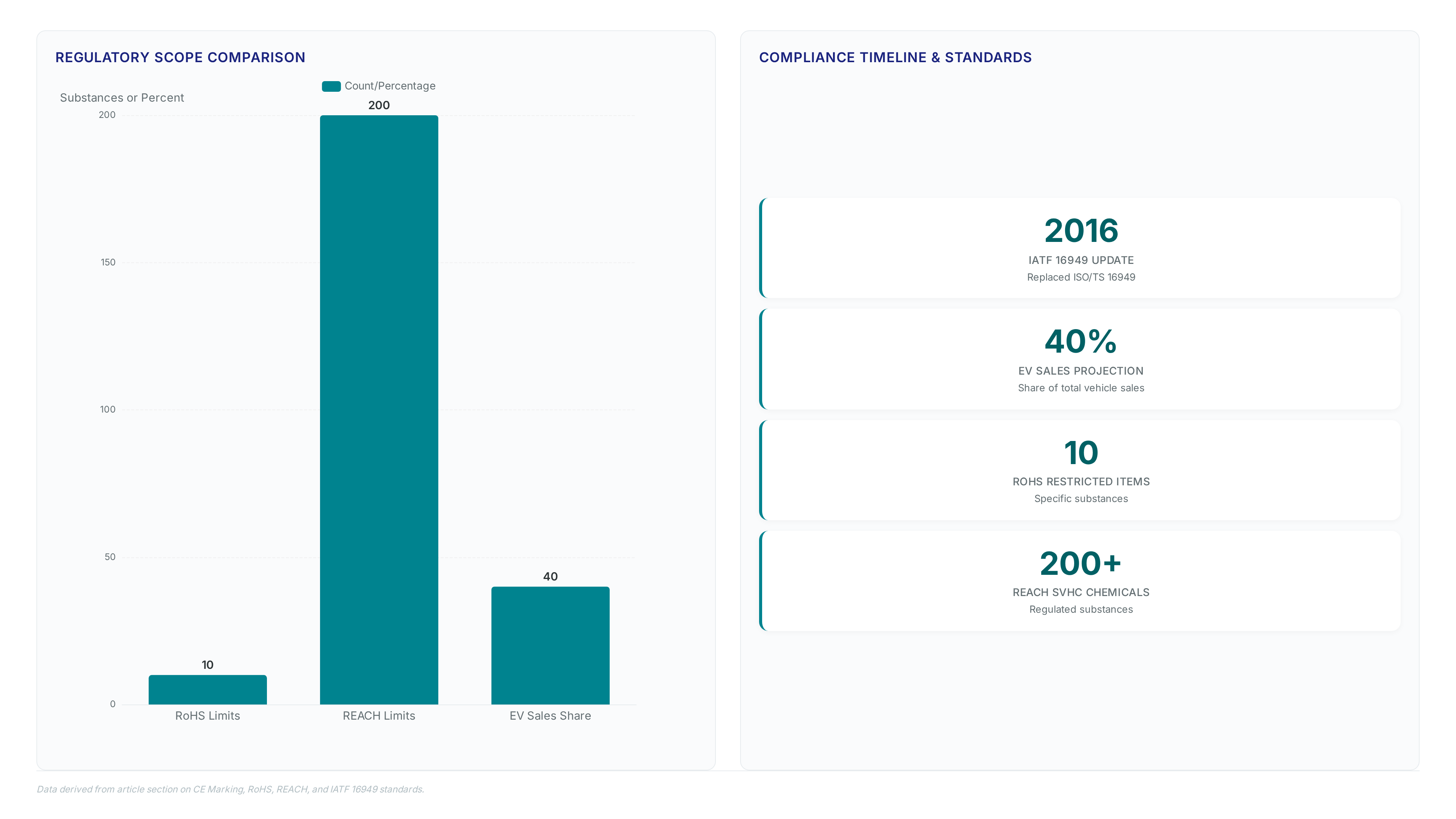
CE Marking functions strictly as a market-entry requirement confirming alignment with EU safety directives rather than serving as a standalone quality indicator. Its regulatory scope encompasses specific structural, safety-related, and load-bearing assemblies governed by set European mandates. Suppliers targeting the European market must distinguish this declaration from general management certifications, as it validates product-level conformity for cross-border access.
| Feature | CE Marking | RoHS / REACH |
|---|---|---|
| Primary Focus | Safety and health directives | Chemical substance control |
| Application | Structural and load-bearing parts | Coatings, electronics, materials |
| Mechanism | Conformity assessment | Registration and restriction |
RoHS and REACH regulations govern hazardous substance limits across the supply chain while CE Marking addresses mechanical and physical safety. RoHS restricts specific materials in electrical components. REACH mandates full chemical registration and risk assessment for production inputs. Chemical compliance is distinct from mechanical integrity. Surface coatings and material compositions follow separate regulatory protocols. Successful deployment requires treating chemical data as a critical path item alongside mechanical testing results.
Implementing REACH Substance Registration for Electrical Systems
Compliance requires manufacturers to compile material declarations for substances in electrical modules and interior components. REACH regulates chemical safety across the supply chain by mandating substance registration, risk assessment, and full material traceability to ensure controlled use of chemicals throughout production. Operators must map these chemical inputs against functional safety requirements, as hazardous substance limits often interact with performance additives needed for high-voltage stability.
| Dimension | Electrical Systems | Interior Components |
|---|---|---|
| Primary Risk | Flame retardants in plastics | Plasticizer migration in upholstery |
| Traceability Depth | Sub-component level | Raw material batch level |
| Registration Trigger | Presence above threshold limits | Direct consumer exposure potential |
The implementation timeline relies on supply chain transparency and internal testing capacity. Upstream chemical providers may withhold proprietary formulation data until the registration requests are filed, frequently causing delays. This creates a bottleneck where risk assessment cannot proceed without verified input from raw material vendors. The cost of non-compliance exceeds registration fees. Customs authorities may reject entire shipments lacking valid substance dossiers. Manufacturers must integrate material traceability into their quality management systems before submitting registration files to avoid duplicative audits.
RoHS vs REACH: Hazard Limits for Electronics Versus Chemical Traceability
RoHS restricts specific hazardous materials in electrical components, whereas REACH mandates broad chemical registration across all manufacturing stages. Operators often confuse these distinct regimes, yet the operational impact differs notably between component-level bans and supply-chain-wide transparency.
Compliance is particularly critical for electrical systems, interior components, coatings, and surface finishes supplied to the European market. RoHS focuses on preventing hazardous substances like lead or mercury from entering waste streams. REACH requires operators to assess risks for every chemical input regardless of the final product type. A supplier might meet electronic restrictions but fail broader chemical disclosure obligations for interior trim.
The cost of non-compliance extends beyond rejected shipments; it involves losing eligibility for future programs as OEMs integrate chemical data into their sourcing algorithms. A notable limitation is that REACH data collection often stalls at sub-tier material producers who lack digital reporting infrastructure. Suppliers must verify that their upstream partners can provide updated substance declarations rather than assuming historical data remains valid.
| Risk Factor | Electronics Focus | Chemical Focus |
|---|---|---|
| Failure Mode | Single part rejection | Batch contamination |
| Detection | Incoming inspection | Supply chain audit |
| Remediation | Component swap | Formula reformulation |
Meeting functional safety requirements sometimes conflicts with chemical restrictions if flame retardants or adhesives require specific hazardous additives. Manufacturers must balance performance needs against regulatory limits by validating alternative compounds early in the design phase. Failure to align RoHS limits with REACH registration status creates a gap where compliant parts become unavailable due to unregistered inputs.
Practical Implementation Strategies for Certification and Non-Compliance Remediation
Defining Quality Standards in Automotive Electronics

Process control deviations often trigger non-compliance issues more frequently than simple threshold breaches in automotive manufacturing. Electrical components and surface treatments face specific failure risks that differ from general mechanical parts. Wiring harnesses and control modules exhibit distinct defect patterns when production discipline lapses. General quality management systems lack the specific constraints required for automotive applications. Built-in quality at every stage replaces reliance on final inspection protocols. CE Marking functions as a market-entry permit rather than a quality guarantee. Internal standards must exceed basic regulatory floors to satisfy OEM sourcing contracts.
- Conduct the conformity assessment procedures to verify process consistency across high-volume production programs.
- Compile complete technical documentation proving end-to-end traceability from incoming materials to final delivery.
- Implement testing protocols that include structured risk assessment (PFMEA) and control plans to prevent defects.
| Violation Type | Affected Area | Consequence |
|---|---|---|
| Process Inconsistency | Circuit boards | Unstable output |
| Control Failure | Connectors | Quality variability |
| Missing Docs | All electronics | Audit non-conformance |
Self-declaration without verified technical documentation fails to meet OEM sourcing requirements. The validation remains mandatory for all suppliers. Supply chain depth creates hidden tensions during audits. IATF 16949:2016 serves as a unified quality framework aligning OEMs, Tier-1, and Tier-2 suppliers. Standardized audits become possible through this shared structure. Costly recalls far exceed the price of initial certification when upstream validation is weak.
Workflow to Correct Documentation Errors
Structured re-validation of technical files must occur before any re-submission for conformity assessment. Suppliers audit the technical file first. This step verifies that documented operating procedures match actual change controls. Inconsistencies in these documents alter production workflows immediately.
- Cross-reference part specifications against original type-examination certificates to confirm scope validity.
- Validate end-to-end traceability records from raw material intake to final assembly logs.
- Ensure production testing records demonstrate ongoing compliance through data monitoring and corrective actions.
Random inspection mechanisms mandate regular checks to verify continued adherence to standards. Static documentation fails under active surveillance conditions. Missing traceability links prevent the demonstration of conformity even if the product physically meets safety standards. Operators often overlook this critical gap.
| Step | Action Item | Verification Output |
|---|---|---|
| 1 | Audit Technical File | Updated procedure list |
| 2 | Verify Traceability | Material flow map |
| 3 | Review Test Records | Signed compliance log |
| 4 | Re-assess Risk | Updated PFMEA |
Production disruptions and potential loss of supplier status with substantial OEMs result from delayed corrections. Implementing this validation loop immediately upon detecting any discrepancy in marking documentation maintains baseline quality performance.
Remediating Failures in Wiring Systems and Coatings
Immediate material substitution in wiring systems maintains compliance with stringent quality and safety standards. Operators replace non-conforming solders and coatings with certified alternatives. This action satisfies IATF 16949:2016 requirements for defect prevention. Regulatory frameworks such as RoHS commonly apply to wiring systems, electronic modules, and treated metal parts. Strict chemical compliance becomes necessary for these components.
- Isolate affected batches using digital traceability logs from incoming inspection to final assembly.
- Validate substitute materials against functional safety protocols to ensure performance stability under high-voltage stress.
- Update technical documentation to reflect new homogeneous material declarations for each component.
Labor costs represent only one portion of remediation expenses. Insurance companies often prefer or require certified parts for repairs. Non-certified stock may face limited recovery value in this market flexible. Suppliers serving global markets face heightened scrutiny where certification validity depends on underlying chemical and process compliance. Rapid substitution conflicts with long-term supply stability. Niche alternative chemicals may lack the volume consistency of standard substances. THACO INDUSTRIES mitigates this risk by maintaining pre-approved vendor lists for treated metal parts across its global network. Full material traceability during remediation allows operators to prove conformity during subsequent OEM audits. Updated substance registration data makes parts sellable in regulated zones. Without it, physically corrected parts remain unsellable.
About
Dmitry Volkov serves as a Senior Automotive Technical Writer at KZMALL Auto Parts, where he specializes in translating complex engineering specifications into actionable industry insights. His daily work involves rigorous analysis of manufacturing standards and component data across KZMALL's extensive catalog of over 50,000 SKUs. This direct engagement with technical documentation makes him uniquely qualified to dissect the critical role of certifications like IATF 16949:2016 in automotive parts manufacture. At KZMALL, ensuring that proprietary brands meet strict international quality benchmarks is a routine operational priority, not just a theoretical concept. Volkov uses this practical experience to explain how validated quality governance systems directly impact supplier credibility and OEM readiness. By connecting abstract regulatory requirements to real-world production workflows, he provides readers with a clear understanding of why these certifications are necessary for success in the global automotive aftermarket supply chain.
Conclusion
Scaling electric vehicle production to meet the projected significant market share by 2030 exposes a critical fragility in supply chains that rely on reactive material substitution. The operational cost of remediating wiring systems and coatings extends far beyond immediate labor; it creates a hidden liability where non-certified stock holds negligible recovery value against insurance mandates. As ISO 26262 functional safety requirements tighten, the window for correcting chemical non-compliance without losing OEM status narrows significantly. Manufacturers must treat material traceability not as a documentation task but as a primary revenue enabler, because physically corrected parts remain unsellable without updated substance registration data.
Organizations should mandate a full review of their pre-approved vendor lists for treated metal parts within the next quarter to ensure volume consistency for niche alternatives. Relying on ad-hoc sourcing for compliant solders or coatings invites production halts that digital logs alone cannot prevent. Start by cross-referencing your current inventory against OEM interchange numbers to identify any gaps in homogeneous material declarations before the next audit cycle begins. This proactive verification secures access to regulated markets and ensures that remediation efforts actually result in sellable products rather than stranded assets.
Frequently Asked Questions
Missing this certification blocks access to major OEM contracts immediately. Firms cannot validate the process discipline required for modern vehicle platforms without these specific credentials.
The 2016 update enforces stricter process control and risk management protocols. It replaced the previous standard to reflect higher expectations on process control and risk management.
Quality must be built into every production stage rather than relying on final inspection outcomes. This shift ensures defect prevention through structured tools like PFMEA and control plans.
ISO 9001 establishes the mandatory management architecture for documented workflows. It serves as the structural quality management foundation for IATF 16949:2016 and broader industrial production.
Electric vehicles are expected to represent nearly a portion of total vehicle sales by 2030. This surge increases pressure on manufacturers to meet specific safety and quality certifications.
References