
Fitment standards prevent costly marketplace returns
With fitment errors driving the highest bounce rates in the sector, precision infrastructure is the only viable path forward. Unlike general retail, this sector demands that scalability be engineered from day one to handle the catastrophic costs of incompatibility.
Readers will learn how vehicle-level data layers, including trim variations and brake caliper sizing, form the non-negotiable backbone of any credible marketplace. We dissect the complexities of component-level compatibility, where bolt patterns and offset tolerances determine structural safety rather than mere aesthetics. The discussion extends to configuration-level logic, analyzing how front-to-rear axle differentiation and suspension clearance prevent costly logistical failures.
The urgency for such discipline is highlighted by recent market shifts, specifically the late 2025 partnerships between TecAlliance and entities like Alzura and Mercado Livre. As noted in MarqStats reports, these consolidations signal a definitive move away from fragmented data ecosystems toward unified, high-fidelity standards. Without this level of structured data integration, operators face compounding returns and eroded trust that no amount of marketing can.
Fitment Data as the Core Driver of Vehicle Compatibility
ACES and PIES Standards Define Fitment Data Scope
Over 60,000 vehicle combinations fall under the jurisdiction of the Aftermarket Catalog Exchange Standard), which manages fitment data scope far beyond simple year-make-model attributes. This standard governs specific technical layers including trim levels, engine types, and brake system variations that generic e-commerce platforms often miss. Without these specific XML structures, VIN decoding tools cannot accurately filter catalogs to show only compatible parts, leaving user error as the primary failure mode. The Product Information Exchange Standard complements this by organizing product attributes like dimensions and weight, creating a complete technical baseline for automotive transactions. Industry data indicates fitment errors account for 34% of substantial restraints in the automotive aftermarket, making precision non-negotiable for operational stability.
General retail systems lack the architecture to process these complex relationships without expensive customization. Incorrect purchases trigger return cycles that strand inventory and alter cash flow. Operators must prioritize proprietary data models that continuously refine compatibility logic based on support interactions. This approach transforms fitment accuracy from a static catalog feature into a flexible structural advantage that reduces operational strain at scale.
Validating Wheel Offset and Bolt Pattern Compatibility
Bolt pattern (PCD) mismatch prevents physical mounting, while incorrect offset values cause immediate structural failure against suspension components. Wheel fitment validation demands precise measurement of five distinct parameters to guarantee safety.
Staggered fitment configurations introduce complexity by requiring different offsets for front and rear axles to maintain proper track width and handling balance. Positive offset pushes the wheel inward toward the chassis, risking caliper clearance. Negative offset pushes it outward, risking fender contact during compression. Maintaining internal compliance for these attributes requires significant technical understanding, as small mapping mistakes create substantial compatibility issues leading to financial loss. Generic platforms often lack native support for these specific XML formats
Specialized providers ensure adherence to strict marketplace requirements that generic listing tools miss without heavy customization. Expanding SKU count without rigorous attribute validation directly increases return volumes for oversized freight items. This financial leakage stems from incompatible parts reaching customers, triggering expensive reverse logistics and inventory stranding. Reliance on manual mapping rather than automated validation systems drives this inefficiency. Leading platforms implementing AI-based part identification tools 360researchreports.com/market-reports/e-commerce-automotive-after-market-213679) achieve a 27% improvement in accuracy, directly countering these error rates. Legacy workflows struggle to manage the complexity of modern vehicle configurations without such automation.
The operational penalty extends beyond shipping costs; it erodes customer trust necessary for marketplace liquidity. Platforms using advanced VIN decoding report a 40% reduction in return rates by enforcing strict compatibility gates at checkout. This data-driven approach prevents incorrect purchases before transaction completion. Significant upfront investment in proprietary data models contrasts with generic catalog management costs. Operators must weigh the cost of infrastructure against the compounding expense of returns. Investing in proprietary fitment logic transforms a cost center into a defensive moat against competitors relying on static data.
Architecting Real-Time Inventory and Pricing Automation
System-Driven Architecture vs Manual Process Dependencies
Manual data entry methods create immediate scaling failures due to inherent latency and high error rates compared to automated systems. Shifting to system-driven architecture replaces reactive workflow dependencies with proactive, rule-based logic. Static pricing models fail during demand spikes, whereas flexible strategies adopted by 48% of market players adjust instantly to inventory fluctuations. This transition requires moving beyond basic CSV uploads, which lack real-time synchronization, toward deep integration via APIs that synchronize catalog updates with inventory status.
| Feature | Manual Workflow | System-Driven |
|---|---|---|
| Update Latency | Hours to days | Milliseconds |
| Error Source | Human transcription | Logic definition |
| Scalability | Linear cost increase | Exponential efficiency |
| Data Sync | Batch processing | Real-time stream |
Enterprises exceeding $10 million in revenue must adopt headless architectures to support custom fitment logic and prevent data conflicts. Legacy systems relying on manual mapping cannot sustain the velocity required for modern automotive commerce. A critical tension exists between deployment speed and long-term stability; rapid manual setup creates technical debt that cripples operations during seasonal peaks. 41% of leading platforms now apply AI-based part identification to automate fitment, leaving manual competitors vulnerable to accuracy gaps. Without this shift, growth increases chaos rather than revenue.
Translating Technical Specs into Plain Language Product Pages
Plain language product pages require structured diagrams that map bolt patterns and offsets directly to vehicle trims to prevent manual interpretation errors.
- Ingest raw technical attributes including PCD and center bore dimensions.
- Cross-reference these values against ACES
- Render visual overlays showing caliper clearance for the specific sub-model.
- Display plain-language warnings if the selected wheel conflicts with brake systems.
Generic platforms often lack native support for the complex XML schemas required to process these technical specifications accurately. Without this structural translation, buyers face ambiguity regarding physical fitment, leading to hesitation or incorrect purchases. The limitation is that simplifying data for humans can obscure necessary engineering tolerances if the underlying logic remains opaque. Operators must balance readability with the precision required for safety-critical components.
| Data Layer | Technical Input | Customer View |
|---|---|---|
| Geometry | Offset, Width, PCD | "Fits stock brakes" |
| Load | Load Index, Rating | "Supports 3,000 lbs" |
| Clearance | Caliper, Fender | "No rubbing guaranteed" |
Inventory overselling occurs when synchronization latency disconnects the APIs from the live catalog state. This disconnect forces systems to sell stock that no longer exists physically. The consequence is a breakdown in operational trust that exceeds the cost of the returned freight. Real-time dashboards must flag these sync failures before order confirmation to maintain integrity.
Operational Volume Risks in Launch-Speed Backend Structures
Backends optimized for launch speed collapse under operational volume because they lack real-time inventory synchronization logic. This architectural debt manifests as overselling when distributed stock levels change quicker than database polling intervals. Market restraints from inventory mismatch account for 29% of friction, a direct result of process-dependent operations failing to track localized availability. Scalable marketplaces avoid this by deploying proprietary tech stacks that aggregate localized inventory across thousands of locations rather than relying on static caches. Static pricing models exacerbate data conflicts during demand spikes, creating revenue leakage through margin erosion or missed sales opportunities. Transitioning to system-driven architecture requires API integration to enforce rule-based pricing and prevent race conditions during concurrent user sessions.
| Constraint | Launch-Speed Backend | System-Driven Architecture |
|---|---|---|
| Data Source | Local Cache | Distributed Real-Time Aggregation |
| Update Latency | Minutes to Hours | Sub-Second |
| Conflict Resolution | Manual Override | Automated Rule Engine |
| Scalability Limit | Single Region | Multi-Location Logical Pool |
Early platforms sacrifice the latter for the former, assuming manual reconciliation will suffice until volume makes that impossible. By then, data conflicts have already corrupted customer trust metrics. Infrastructure must anticipate peak load synchronization requirements before the first transaction occurs.
Operationalizing Risk Reduction and Fraud Prevention
Integrating Fraud Protocols into Payment Workflows

Wheels and performance components attract high-value fraud, requiring direct integration of intelligent transaction monitoring into payment gates. Proven defense layers address verification with velocity checks to flag suspicious patterns before order fulfillment begins. This approach counters the reality that workflow embedding creates high switching costs, making initial security posture critical for long-term operational continuity. Risk scoring systems must evaluate transaction velocity against omnichannel fulfillment 360researchreports. Fraudsters often exploit gaps between online discovery and physical pickup windows. Platforms ignoring this vector face elevated chargeback rates on heavy items. The trade-off is friction; strict velocity checks can delay legitimate bulk orders from professional shops. However, the cost of manual review exceeds automated rejection for standard transactions. Operators must tune thresholds to avoid blocking recurring B2B buyers while catching isolated fraudulent attempts. Failure to balance these variables results in lost revenue or increased exposure.
| Protocol | Function |
|---|---|
| Address Verification | Validates billing location |
| Velocity Checks | Limits transaction frequency |
| Risk Scoring | Ranks threat probability |
Automated protocols protect margin by stopping bad actors before inventory leaves the warehouse.
Using KPI Dashboards to Detect Operational Stress
Real-time dashboards tracking return rates and cancellation metrics expose fitment failures before customers report compatibility errors. Wrong-part returns erode profit margins simultaneously with customer retention, transforming fitment accuracy into a direct acquisition cost issue rather than a simple logistical nuisance. Operators observing a 28% restraint rate from returns must distinguish between supplier fulfillment lag and catalog data corruption.
| Metric | Stress Signal | Root Cause |
|---|---|---|
| Return Rate | >a minor spike | Fitment logic gap |
| Cancellation | Rising trend | Inventory sync delay |
| Fulfillment | <high accuracy | Supplier data latency |
High return volumes often stem from incomplete vehicle mapping where trim-level variations invalidate standard part claims. Research identifies fitment precision as the primary factor influencing bounce rates among automotive shoppers, meaning dashboard alerts on exit behavior predict future return spikes. A dashboard showing rising cancellations alongside stable inventory levels indicates a pricing or data latency disconnect rather than stockouts. The cost of reactive management is stranded inventory and disrupted cash flow during refund cycles. Automated alertsd by thresholds in supplier fulfillment accuracy allow teams to pause listings before bad data propagates across sales channels. Visibility into these operational layers prevents minor data drift from compounding into systemic trust failures.
Checklist for Coordinating Data and Logistics Scalability
True scalability requires disciplined coordination across data, infrastructure, logistics, and supplier networks to prevent fragile expansion. Operators must validate that product attributes including dimensions and UPC codes align strictly with logistics constraints before publication. Automated validation logic must verify each vehicle application against industry rules to clean inconsistent source data.
- Cross-reference localized inventory
- Implement intelligent transaction monitoring to flag high-value fraud patterns in wheel and tire categories.
- Deploy dashboards tracking return rates as early warning signals for fitment logic gaps.
- Shift from process-dependent operations to system-driven architecture to handle distributed inventory logic.
Fitment errors remain the leading cause of market restraints, yet many platforms prioritize speed over data validation. This oversight forces manual intervention later, increasing labor costs and stranding inventory. A marketplace selling across three channels sees 38% higher total sales volume, but only if compliance with Amazon, eBay, and Walmart standards holds. Growth without operational visibility creates instability where minor sync delays cascade into customer-facing failures. Sustainable scale demands systems designed to detect problems before they compound into visible outages.
Strategic Implementation of a Scalable Marketplace System
Defining System-Driven Architecture for Auto Parts Scale
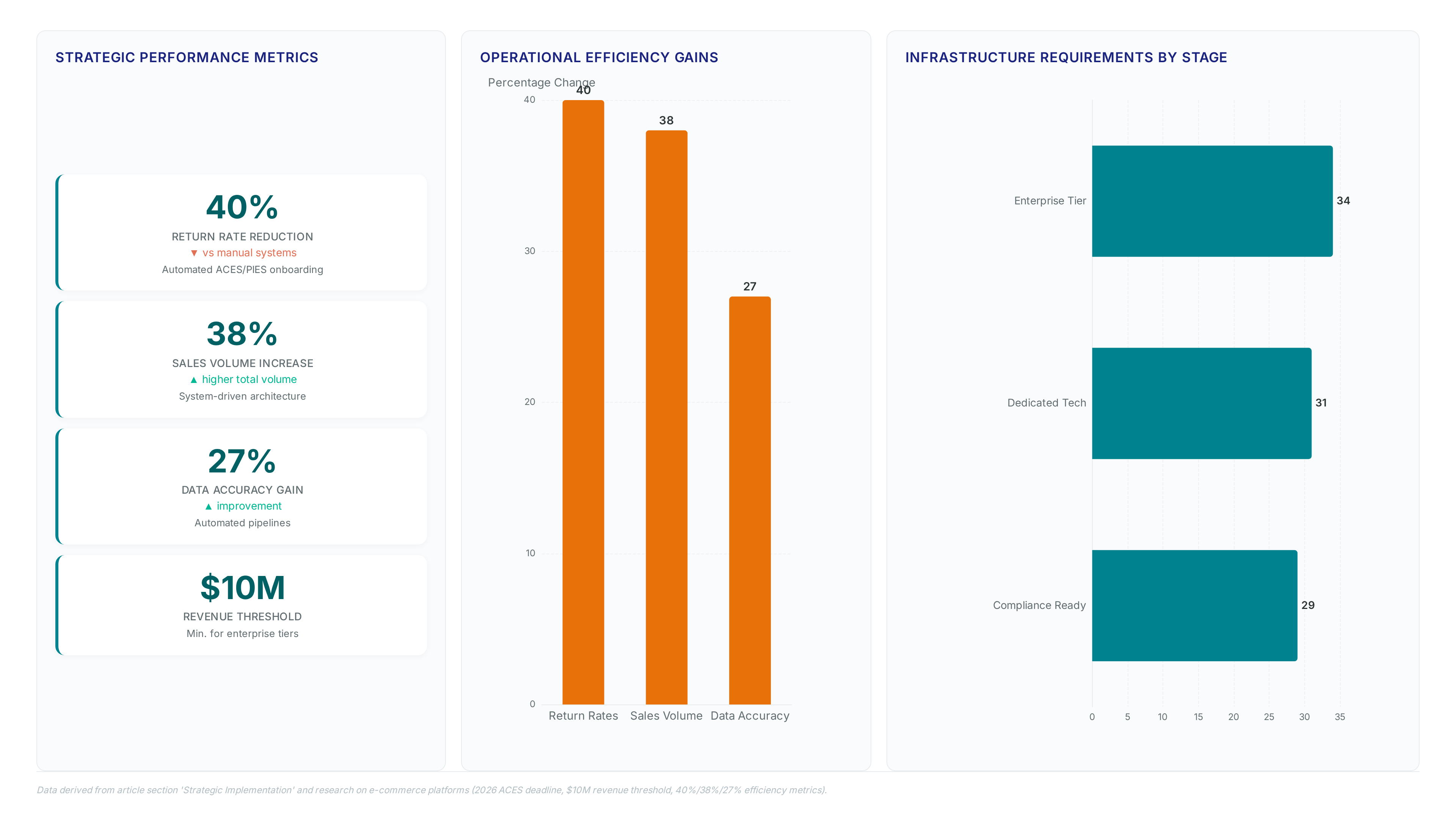
Early-stage platforms often break under growth because they prioritize launch speed over long-term complexity. Manual data entry methods introduce hidden labor costs that erode margins as volume increases. Operators must shift from process-dependent operations to system-driven architecture where APIs enforce real-time synchronization between inventory and catalog layers. This transition eliminates the data conflicts that plague fragmented ecosystems. 1.2. Replace basic CSV uploads with automated pipelines that prevent human error during bulk updates (synchronization. 3. Align data schemas with upcoming ACES 5.0 standards before the April 2026 deadline to maintain marketplace compliance. Market consolidation accelerates as substantial players like TecAlliance partner with platforms such as Mercado Livre, signaling a move away from fragmented data ecosystems (consolidation). The cost of delaying this shift is measurable: systems built for average traffic fail during seasonal spikes, causing immediate revenue loss. True scalability requires designing infrastructure that anticipates failure rather than reacting to.
Applying Real-Time Visibility to Coordinate Supplier Networks
Real-time inventory aggregation across thousands of locations distinguishes scalable stacks from fragile storefronts that cannot handle distributed logic. Proprietary tech stacks enable this by syncing localized stock levels instantly, preventing the overselling common in manual systems. Operators must deploy real-time tech.
- Replace basic CSV uploads with APIs that enforce immediate synchronization between supplier warehouses and the central catalog layer. 2.3. Implement structured monitoring dashboards to detect latency issues before customers encounter stock discrepancies during peak seasonal spikes.
The limitation of this approach is the dependency on supplier data maturity; not all partners maintain the digital infrastructure required for instant updates.
About
Anna Petrova serves as a B2B Auto Parts Market Analyst at KZMALL, where she specializes in market sizing and competitive dynamics within the global automotive aftermarket. Her daily work analyzing cross-border trade flows and demand trends directly informs the article's thesis on the critical need for precision infrastructure in auto parts e-commerce. Unlike general retail, this sector demands rigorous technical accuracy, a challenge Petrova addresses by using KZMALL's extensive data on 50,000+ SKUs and standardized ACES/PIES fitment protocols. Her expertise allows her to explain why scalable marketplaces must prioritize structured data over emotional marketing to reduce bounce rates caused by fitment errors. By connecting high-level market analysis with the operational realities of KZMALL's single-source supplier model, Petrova provides actionable insights on building the disciplined logistics and operational control necessary for success in this complex, high-stakes industry.
Conclusion
Scale breaks when human verification speeds cannot match transaction velocity, turning marginal data errors into catastrophic inventory mismatches. The operational cost of maintaining process-dependent operations explodes once return rates climb due to fitment inaccuracies, directly eroding the very margins that growth promises. Marketplaces exceeding $10 million in revenue must transition to headless architectures immediately, as monolithic backends simply cannot sustain the real-time synchronization required for modern automotive commerce. Waiting for legacy systems to adapt is a futile strategy; the infrastructure must dictate supplier compliance, not the reverse.
Operators should mandate a shift to rule-based pricing engines and standardized data formats within the next two quarters to prevent compounding reconciliation errors. This timeline is critical because seasonal demand spikes will expose any remaining manual bottlenecks, leading to unavoidable overselling. Do not attempt to patch existing workflows with temporary fixes. Start by auditing your current fitment data pipeline against OEM standards this week to identify where batch processing creates latency. Replace any static spreadsheet dependencies with automated validation rules before the next substantial inventory upload. This specific technical enforcement ensures that expansion drives profitability rather than administrative chaos.
These errors create cascading issues across logistics and support, proving that fitment accuracy is an acquisition cost issue as much as an operations one.
Frequently Asked Questions
Fitment errors account for thirty-four percent of major restraints in the automotive aftermarket sector. This significant figure highlights why precision infrastructure is non-negotiable for operators seeking to avoid compounding returns and eroded customer trust at scale.
Leading platforms utilizing AI-based part identification tools achieve a twenty-seven percent improvement in accuracy. This directly counters error rates caused by manual mapping, reducing the financial leakage associated with incompatible parts reaching customers.
Generic platforms often lack native support for complex XML formats required for specific attributes. Consequently, they miss critical validation for bolt patterns and offsets, leading to higher error rates compared to specialized providers ensuring strict marketplace requirements.
Systems must validate bolt patterns, center bore sizes, and offset tolerances to ensure safety. Without checking these five distinct parameters, mismatches prevent physical mounting or cause immediate structural failure against suspension components during vehicle operation.
Incorrect purchases trigger return cycles that strand inventory and disrupt cash flow significantly. These errors create cascading issues across logistics and support, proving that fitment accuracy is an acquisition cost issue as much as an operations one.