
Automotive Aftermarket Shifts: 2028 Supply Chain
The U.S. Market hits a critical inflection point by 2028. Aging fleets and complex logistics are rewriting the rules. We are looking at a fundamental shift in retail models, the rigid mechanics of OEM parts distribution, and the desperate scramble for inventory efficiency as part counts explode.
The scale is staggering. The Automotive Aftermarket Industry Association defines a sector covering everything from lubricants to heavy-duty replacements. Polk data showed the average light vehicle age hit 11.4 years back in 2013. Current Auto Care Association projections show no relief; growth continues through the end of the decade. This longevity forces supply chains to support an ever-widening array of components for vehicles that refuse to die.
Operational complexity spikes as retailers merge DIY sales with professional service models. Fortna notes that giants like O'Reilly Auto Parts and Advance Auto Parts are aggressively chasing wholesale opportunities. Serving these distinct channels means navigating a maze of stockkeeping units created by gas-electric hybrids and niche commercial applications. Success demands precise coordination between distribution nodes. You need rapid response capabilities to keep repair bays moving, or you lose the customer to the next supplier.
The Role of the Automotive Aftermarket in Modern Vehicle Maintenance
Defining the $307.7 Billion Automotive Aftermarket System
Light-, medium-, and heavy-duty vehicles need replacement parts, accessories, lubricants, tires, and repair tools long after the original sale. This defines the automotive aftermarket. Raw material providers feed manufacturers who build components for a supply chain ending with vehicle owners. Sales hit $307.7 billion in 2012.
Projections indicate the total U.S. Market value will reach hundreds of billions of dollars by 2028 as fleets age further. Retailers face a sharp divide: stock high-turn DIY items or low-turn professional application parts. Merging these previously distinct sales models drives top-line growth for companies targeting the wholesale professional installer market. Serving professional installers demands carrying over 125,000 SKUs compared to 60,000 for consumer-focused stores. Fast movers require immediate availability. Slow-moving parts strain warehouse capacity. Mechanics needing a specific part will call a retailer only so many times before finding a new supplier if stock is missing. Profitability in this capital-intensive sector depends on aligning SKU proliferation with localized demand patterns rather than hoarding stagnant inventory.
Retailers Targeting the Professional Installer Market Growth
Substantial retailers now combine DIY retail fronts with wholesale distribution hubs. Mechanics need immediate parts availability to keep cars turning over in repair bays. This strategic pivot is non-negotiable. Current growth relies on securing the wholesale segment even as the total U.S. Automotive aftermarket climbs toward future highs.
O'Reilly Automotive operates a network of 6,483 stores as of June 30, 2025, using this density to serve both consumer and commercial clients. The company holds a market capitalization of approximately billions in 2025. Traditional chains maintain a physical hub model necessary for rapid replenishment, a distinct advantage over pure-play e-commerce entrants. Top-line expansion drives retailers to get a piece of the wholesale professional installer market.
Inventory complexity creates the friction. Serving professionals requires stocking over 125,000 SKUs, far exceeding casual consumer needs. Slow-moving hard parts must still reach bays quickly despite the logistical strain on supply chain logistics. Some retailers ship from distribution centers or source directly from the manufacturer to fill demand for the slowest-moving parts. Big-box retailers must function as logistics providers instead of mere shelf-stockers to survive this market shift.
DIY vs Dealership Supply Chains in an Aging Vehicle Fleet
Vehicle age dictates a split between consumer self-service and dealer-exclusive OEM distribution networks. An aging light vehicle fleet creates persistent demand for replacement components across both channels. DIY supply chains prioritize broad retail accessibility so consumers can purchase parts for immediate installation. Dealership networks rely on proprietary regional distribution centers to deliver branded parts overnight to service bays. Structural divergence shapes inventory strategy and fulfillment speed for these distinct customer bases.
Retailers increasingly target the professional installer market to capture wholesale volume alongside retail sales. O'Reilly supports its 6,483 stores with over 10 distribution centers to ensure rapid replenishment for these commercial clients. Steady repair volumes continue regardless of new vehicle sales fluctuations because the fleet keeps aging. Strict order cutoffs limit the dealer model; missing the window delays receipt until the following night. Dealers and OEMs aim to take waste out of the replenishment chain to get parts to customers quicker.
Inside Hub-and-Spoke Networks and OEM Parts Distribution
OEM Parts Flow from RDCs to Dealerships via Cages
OEM-branded aftermarket parts travel a rigid path from regional distribution centers (RDCs) to parts distribution centers (PDCs) before reaching dealerships through a strictly timed nocturnal logistics rhythm. This flow relies on regional distribution centers owned by OEMs that consolidate inventory and supply downstream parts distribution centers. Transportation providers dispatch route drivers to collect units sorted in specialized conveyances known as cages, organized specifically by destination dealer. These drivers often possess direct access credentials to enable dealership facilities, ensuring parts are staged inside before service bays open. Dealers must submit orders by a set cutoff window to qualify for this next-day replenishment cycle.
Pushing deadlines later satisfies dealers but compresses the sorting window for PDC staff. This risks errors in cage composition that delay entire routes. The system tolerates little deviation.
Midnight Delivery Windows and Dealer Cutoff Times
Third-party logistics providers execute overnight delivery windows so dealerships receive inventory before opening hours. This application relies on strict cutoff times where dealers must submit orders to qualify for next-day arrival. 3PL drivers apply direct access credentials to enter facilities and stage cages sorted by dealer while the business remains closed.
| Feature | Standard Freight | Midnight Delivery |
|---|---|---|
| Arrival Window | Business Hours | Overnight |
| Access Method | Dock Staff Required | Keys / Codes |
| Inventory State | Palletized Bulk | Dealer-Sorted Cages |
| Objective | Cost Efficiency | Immediate Availability |
This model supports the professional installer market where mechanics cannot wait for morning shipments. O'Reilly Auto Parts operates more than 10 distribution centers to maintain similar rapid replenishment capabilities across its network. The operational tension lies between extending the order cutoff time for dealer flexibility and preserving enough transit time for reliable night delivery. If the window shrinks too far, route drivers miss the midnight delivery slot, leaving service bays empty at opening. Conversely, early cutoffs force dealers to hold excess stock, contradicting OEM goals to minimize inventory waste. Missing a single night window means a lost repair order to a competitor with immediate part availability. Successful networks balance these constraints by optimizing route drivers and strictly enforcing submission deadlines.
Tire Storage Challenges and Warehouse Space Requirements
Tire logistics demand dedicated square footage because rubber compounds emit odors that contaminate adjacent inventory. Approximately 60 percent of the tire market relies on independent dealerships, requiring massive standalone facilities rather than shared shelving. It is not uncommon for a single manufacturer to operate multiple 500,000- to one-million-square-foot warehouses strategically placed to serve regional demand. Unlike small boxed components, tires require vertical racking systems stacked four or five units high, consuming significant cubic volume.
| Storage Attribute | General Auto Parts | Tire Inventory |
|---|---|---|
| Container Type | Shelving / Bins | Movable Racks |
| Stacking Limit | Variable Height | 4 to 5 Units |
| Environmental Risk | Low | Odor Contamination |
| Facility Type | Mixed Use | Standalone Only |
Operators face a spatial tension between holding sufficient seasonal inventory and maintaining efficient pick paths. If workers misplace a specific tire size within a sprawling warehouse, travel time to retrieve the unit erodes fulfillment speed. This inefficiency compounds when product placement ignores the high velocity of common sizes versus slow-moving specialty rims. The industry value chain depends on this separation to prevent cross-contamination and ensure rapid retrieval. Digital transformation efforts now target these physical constraints by using predictive models to optimize rack positioning before a tire ever arrives on the dock. Failure to isolate these operations results in degraded air quality and slower service levels.
Strategies for Managing SKU Proliferation and Inventory Efficiency
SKU Proliferation Drivers in Hybrid and Commercial Auto Parts
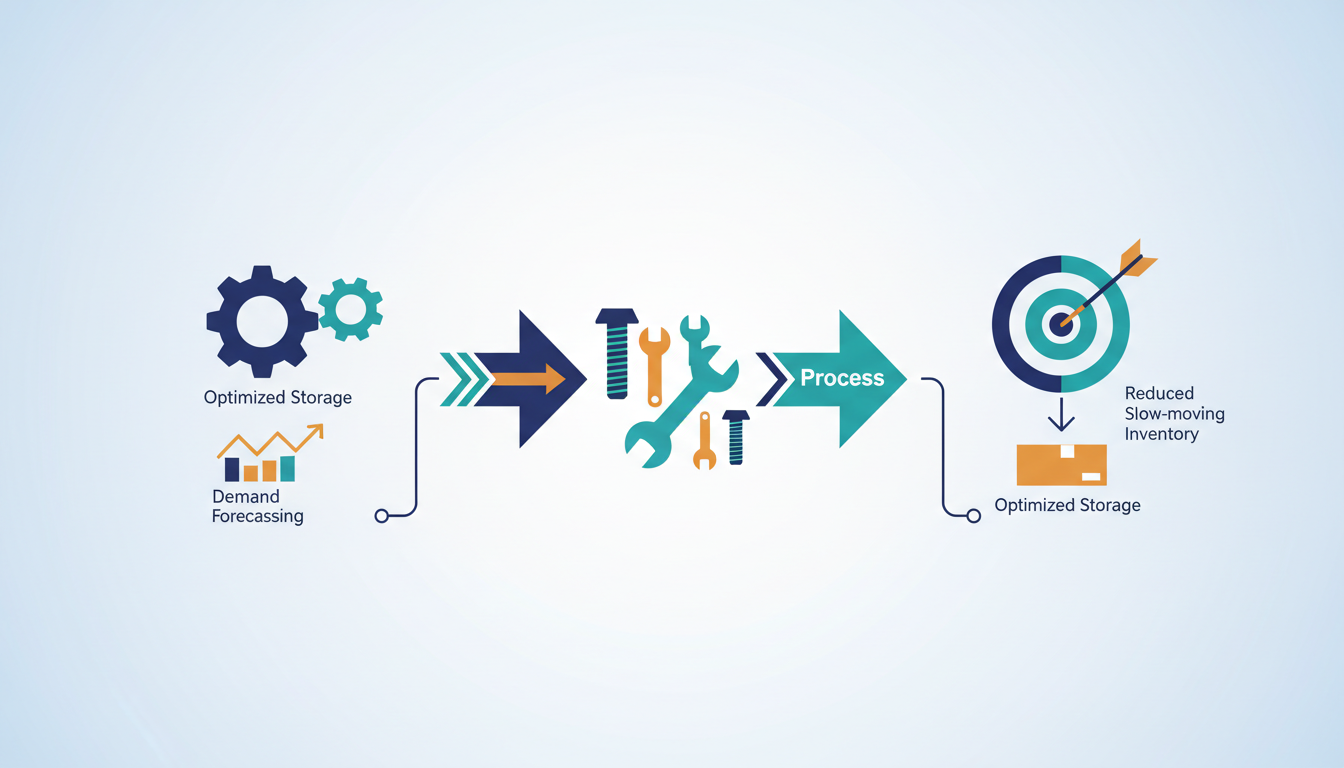
Hybrid powertrains and expanding vehicle model counts drive the exponential growth of distinct stockkeeping units required for accurate catalog coverage. This proliferation forces a strategic divergence. A retailer serving primarily DIY consumers manages an inventory range of 60,000 to 90,000 SKUs. A distributor supporting the professional commercial market must stock more than 125,000 unique items. The gap exists because professional installers demand immediate access to application-specific hard parts that DIY shoppers rarely purchase. Operators managing high SKU counts face a tangible risk: mechanics who cannot source parts locally will quickly shift loyalty to competitors with improved fill rates.
Category Management vs Knockoff Parts Sourcing Strategies
Should you stock OE, premium aftermarket, or both? Domestic suppliers differentiate through category management, a value-added service absent from knockoff parts suppliers in China or Vietnam. This approach demands deep collaboration and trust, ensuring the retailer knows the supplier possesses the right data and decision-making processes. Sourcing inexpensive copies from Asia often leaves retailers exposed to SKU proliferation without analytical support. Modern retailers counter inventory bloat by deploying AI-driven predictive inventory management. These systems analyze demand patterns to reduce carrying costs while preventing stockouts. Cheap unit costs become expensive when fill rates drop and mechanics switch vendors. A strategy relying solely on low-cost imports ignores the operational reality that professional installers require immediate part availability. Stock the parts the rolling fleet actually needs, priced at the tier the buyer values.
Trucks rolling into low-density corridors frequently depart with only a fraction of their capacity utilized. Suppliers facing margin compression now seek non-competing partners to occupy this dead space. Historical resistance from substantial automakers regarding mixed cargo is crumbling under market pressure. Unconsolidated loads in sparse markets drive up the cost per unit, eating directly into margins on slow-turning application hard parts.
- Identify regional partners delivering to overlapping distribution centers or retail clusters across town.
- Align cutoff times to ensure consolidated loads meet the strict next-day delivery windows demanded by dealers.
- Coordinate with logistics providers to manage the physical consolidation and reduce administrative friction between brands.
Operators must balance the trust required for data transparency against the undeniable economics of a full truckload.
| Strategy | Load Utilization | Cost Implication |
|---|---|---|
| Single Shipper | Low utilization | High cost per unit |
| Consolidated | High utilization | Shared freight expense |
Safelite Group's Steel Pallet Standardization Strategy
Routing inbound shipments through area-based distribution centers grants precise command over logistics flows. Safelite Group demonstrated this power by swapping three distinct wooden pallet designs from the 1970s for a single 30-inch deep steel pallet. This unified container secures up to 35 windshields without demanding new racking infrastructure, directly countering the SKU proliferation plaguing the wider automotive supply chain.
- Identify regional partners delivering to overlapping distribution centers to share truck space effectively.
- Align cutoff times to ensure consolidated loads meet strict next-day delivery windows demanded by dealers.
- Simplify handling processes to manage shared logistics facilities and divide fixed costs.
Eliminating dunnage and reducing storage complexity beats the legacy method of strapping together separate bases, sides, and ends. Standardizing inbound packaging boosts outbound density for commodities like glass. The constraint is rigid adherence to one pallet depth, which restricts flexibility for non-glass items while maximizing cube usage. Logistics leaders serving professional installers should prioritize contained units that slash dock handling time. Mechanics receive parts quicker, stopping them from dialing competitors when local stock runs dry. Network designers must recognize that standardization yields efficiency only when the vehicle mix justifies the specialized equipment needed to move it.
Identifying Non-Competitor Shipping Overlaps
Route density often justifies sharing trailer space with firms that do not compete directly. Many operators miss that a company across town services identical retail clusters, creating instant consolidation opportunities. Big automakers previously refused to place cargo on trucks carrying another OEM's products, yet soaring logistics costs force a reevaluation.
- Map delivery endpoints against competitors serving professional installers to find geographic overlaps.
- Verify partner cargo does not include direct OEM competitors to maintain brand exclusivity agreements.
- Align night delivery windows to satisfy the strict cutoff times required for next-day dealer availability.
Maintaining exclusive carrier contracts conflicts with the need to fill empty volume in low-density markets. Sharing space cuts per-unit freight costs but introduces coordination risks if one shipper misses the loading window.
| Criterion | Traditional Solo-Ship | Collaborative Overlap |
|---|---|---|
| Cargo Mix | Single OEM Only | Non-Competing Brands |
| Utilization | Partial Truckload | Full Truckload |
| Risk Profile | Low Coordination | High Dependency |
This method allows suppliers to fill distribution centers efficiently while preserving the distinct supply chains different vehicle manufacturers require.
About
Priya Raman serves as the Aftermarket Category and Supply-Chain Strategist at KZMALL Auto Parts, where she orchestrates the complex logistics of global parts distribution. With fifteen years of experience spanning parts cataloging, sourcing, and B2B distribution, Raman possesses the specific expertise required to dissect the automotive aftermarket supply chain. Her daily work involves managing over 50,000 SKUs across eight proprietary brands, ensuring accurate ACES/PIES fitment data, and optimizing inventory turns for independent repair shops worldwide. This hands-on role allows her to directly address the industry's critical challenges, from maintaining quality certifications like IATF 16949 to streamlining procurement for diverse vehicle types. At KZMALL, a leading multi-brand wholesale platform, she applies deep knowledge of coverage economics and digital B2B channels to solve real-world supply chain inefficiencies. Her insights bridge the gap between raw market data and actionable margin strategies for distributors and retailers navigating a fragmented global environment.
Conclusion
Scaling the automotive aftermarket supply chain reveals that rigid adherence to single-brand logistics creates unsustainable unit economics. While traditional models isolate inventory to protect brand exclusivity, the significant cost penalty for single shipping erodes margins that consolidated freight eliminates. Operators relying solely on dedicated fleets face rising operational friction when vehicle mix density fails to justify specialized equipment. The path forward requires shifting from protective silos to strategic cargo collaboration with non-competing entities. This transition should occur within the next two quarters to capture shared freight expenses before peak seasonal demand strains capacity.
Companies must immediately map delivery endpoints against non-competing firms serving identical retail clusters. This specific action uncovers geographic synergies without exposing OEM-branded inventory to direct rivals. Success depends on aligning night delivery windows to meet strict next-day dealer cutoffs while verifying partner cargo excludes competing manufacturers. By prioritizing contained units that reduce dock handling time, suppliers can accelerate parts availability for mechanics and prevent lost sales. The industry must recognize that standardization yields efficiency only when the vehicle mix supports the infrastructure. Embracing collaborative overlaps transforms fixed logistics costs into variable advantages, ensuring networks remain resilient as the U.S. Market value expands.
Frequently Asked Questions
Aging vehicle fleets create sustained demand for replacement parts and services. This structural shift pushes the total market value toward billions by 2028, forcing supply chains to adapt logistics for older vehicles.
Serving mechanics requires stocking significantly more parts than consumer-only models. A business serving the commercial market might carry over 125,000 SKUs, creating complex logistics challenges compared to the 60,000 items typical for DIY stores.
Retailers pursue wholesale markets to grow their top lines amid changing consumer habits. This strategic pivot helps them capture value as the industry evolves from its $307.7 billion sales baseline recorded in 2012.
Top players like O'Reilly Automotive demonstrate the sector's significant capital intensity. The company holds a market capitalization of approximately billions, reflecting the high stakes involved in managing dense store networks and complex parts distribution.
These networks use super-hub stores to stock rare parts for rapid local delivery. This structure ensures mechanics get needed components quickly, preventing lost business when specific items are not immediately available on local shelves.