
Auto parts search: Stop duplicate content traps
The $200 billion digitally influenced market demands you prove part fitment to rank. Forget generic content strategies; automotive SEO is strictly a catalog-data problem. Retailers must translate chaotic inventory into machine-readable precision. Buyers here do not browse; they hunt with surgical accuracy using specific manufacturer part numbers or vehicle configurations. Vague product pages fail to capture this high-intent traffic.
Clean ACES and PIES standards form the bedrock of search visibility by organizing inventory into structured relationships. This guide details how to architect crawlable YMM fitment pages that allow search engines to validate compatibility instantly. We also cover deploying JSON-LD schema to resolve the duplicate content traps plaguing sites with massive SKU counts.
The BizIQ Organic Strategy Team emphasizes that managing hundreds of thousands of SKUs does not require an enterprise budget, only technical discipline. By focusing on flexible metadata scaling and protecting crawl budget from faceted navigation bloat, smaller retailers can compete effectively. Success depends on ensuring your database speaks the language of search crawlers rather than relying on marketing fluff.
The Critical Role of ACES and PIES Standards in Auto Parts Visibility
ACES and PIES Data Standards Set
Two data standards administered by the Auto Care Association form the backbone of the automotive aftermarket. ACES (Aftermarket Catalogue Exchange Standard) governs vehicle fitment data, mapping year, make, model, sub model, engine type, and transmission details to specific parts. PIES (Product Information Exchange Standard) handles product data, covering part numbers, brand identifiers, dimensions, weight, pricing tiers, and image references. These frameworks define the vehicle fitment data required for accurate search indexing.
Raw product feeds ingested directly from a distributor look identical across hundreds of rival retail sites, so they share the same description and specs. The definition of MPN and GTIN within PIES enables precise part identification beyond generic descriptions. Most retailers ingest unprocessed distributor feeds that appear identical across hundreds of rival sites. This uniformity prevents search crawlers from distinguishing one catalog from another. Maintaining raw data integrity while generating unique on-page signals creates operational friction. KZMALL Auto Parts must convert these static records into flexible metadata structures. Separating fitment logic from product descriptions prevents lost visibility for high-intent queries. Precision in data translation determines ranking success more than content volume.
Translating Raw Distributor Feeds for Search Crawlers
Unprocessed database feeds from warehouse distributors rarely translate into the on-page HTML elements that search crawlers read. Because raw product feeds ingested directly from a distributor look identical across hundreds of rival retail sites, search engines lack a mechanism to reward one copy of that content over another. Most retailers ingest these raw streams directly, leaving search engines with no way to distinguish one store from another.
Auto parts buyers search with acute precision using specific year, make, model, or manufacturer part number rather than browsing general categories. This behavior demands that catalog-first SEO strategies convert static database rows into unique on-page elements like title tags and specification tables. A site remains invisible despite holding valid inventory data without this translation layer.
The stakes for visibility are high, as a significant share of automotive buyers click on one of the first three search results when using local keywords to find services or vehicles. Successful campaigns often manage catalogs containing over 50,000 SKUs, requiring specialized technical frameworks to avoid duplicate content issues. Automating metadata for scale can inadvertently standardize phrasing if templates lack vehicle-specific variables. Operators must balance the efficiency of programmatic generation with the need for distinct fitment signals on every page. Skipping this step results in total obscurity in a market where precision determines revenue.
Duplicate Content Risks in Unprocessed Catalog Feeds
Identical raw distributor feeds create indistinguishable page signatures that prevent search engines from rewarding specific retail sites. Most retailers ingest these unprocessed database streams, leaving crawlers with no mechanism to prioritize one copy over another across hundreds of rivals. This duplication forces a reliance on crawl budget efficiency, where effective sitemap management keeps indexes under 50,000 URLs to guarantee proper indexation.
High-intent queries for specific vehicle fitments yield no visibility without unique translation of ACES and PIES standards into distinct HTML elements. The market context increases this risk as the US auto sales forecast reaches 15.9 million units in 2026, directly increasing the volume of parts requiring accurate digital representation. Search engines require unique value demonstrations, such as explicit fitment proof, to rank pages effectively. Operators must change static data rows into flexible, crawlable specifications to capture traffic. Technical debt from unprocessed feeds compounds as catalog size grows, making late-stage remediation notably more complex than initial structured implementation.
Architecting Crawlable YMM Fitment Pages and Flexible Metadata
Static HTML Rendering vs JavaScript YMM Selectors
Most auto parts sites rely on JavaScript-driven YMM selector widgets that search crawlers cannot execute, leaving fitment data invisible to indexing engines. This architectural choice forces a binary decision between interactive user experience and search engine visibility. The "Index All" methodology advocates generating static category pages for every vehicle combination to capture long-tail queries like specific model years. Dedicated pages for combinations such as "2018 Honda Civic Parts" consistently outperform purely flexible filtered results in search rankings because they provide unique, crawlable content targets.
| Feature | JavaScript Widget | Static HTML Page |
|---|---|---|
| Crawler Access | Blocked | Fully Indexed |
| URL Structure | Flexible Parameters | Clean Hierarchy |
| Long-Tail Capture | Low | High |
| Implementation Cost | Low | High Initial Effort |
Creating these static assets requires mapping popular vehicle combinations to distinct URLs rather than relying on session-based filters. Technical guidelines specify that sitemaps must exclude non-static URLs to prevent crawl budget waste on infinite filter loops. A hybrid approach often yields the best results by blocking low-value parameters while hand-curating landing pages for high-volume models. This strategy prevents index bloat while securing traffic for high-intent searches. The trade-off is the storage and maintenance overhead required to manage thousands of fixed URLs instead of a single flexible template. Operators must balance the depth of their crawlable YMM fitment pages against the risk of diluting domain authority across too many thin content pages. Static category pages remain the foundation of this architecture.
Programmatic Metadata Templates for Auto Parts
Manual metadata entry for 100,000+ SKUs creates an unsustainable operational bottleneck that halts scalability. Effective auto parts SEO resolves this by deploying Automated Title Tags using the rigid structure `{Brand} {Part Name} for {Year} {Make} {Model} | Part #{MPN}`. This format directly targets high-intent queries while embedding unique identifiers to prevent duplicate content flags across similar vehicle applications.
Flexible generation extends beyond titles to include Flexible Meta Descriptions formatted as `{Brand} {Part Name} (Part #{MPN}) for {Year} {Make} {Model}. In stock, fast shipping, and guaranteed fitment.` These templates ensure every permutation of vehicle data receives distinct, crawlable text rather than generic boilerplate. A study by Hedges & Company demonstrated that optimizing low-CTR keywords with precise meta titles and snippets drove a 30% increase in organic traffic and a 20% boost in CTR within 30 days.
| Element | Static Manual Entry | Programmatic Template |
|---|---|---|
| Scalability | Fails at >1,000 SKUs | Unlimited |
| Accuracy | High human error risk | Database-driven precision |
| Indexation | Sparse coverage | Full catalog coverage |
H1 Tag Optimization completes the triad by setting the primary header to `{Brand} {Part Name} - Part #{MPN}`, establishing immediate relevance for both users and crawlers. However, rigid templating risks generating thin content if the underlying product database lacks granular attributes like engine type or sub-model. Operators must validate that source data contains sufficient variance to justify unique page creation before enabling full automation. The cost of skipping this validation is index bloat, where search engines devalue pages lacking distinct informational signals. Successful implementation requires balancing broad coverage with data quality thresholds.
Preventing Index Bloat in Faceted Navigation
Five filter dimensions applied to 50,000 parts mathematically generate millions of unique URL strings that waste crawl budget. This explosion occurs because every checkbox combination creates a new path, forcing operators to choose between blocking access or drowning the index. Effective crawl budget protection requires implementing strict indexing rules that disallow parameterized URLs while preserving static category paths. The operational cost involves significant custom development on platforms like Shopify, Magento, and BigCommerce to distinguish high-value fitment pages from low-value filter permutations.
| Strategy | Crawl Impact | Implementation Cost |
|---|---|---|
| Block All Parameters | Safe | Low |
| Allow Specific Paths | Targeted | High |
| Index Everything | Catastrophic | None |
Failure to segregate these paths means search engines spend cycles on infinite loops rather than product pages. Technical teams must deploy rel="canonical" tags pointing filter URLs back to their parent static categories to consolidate ranking signals. This approach ensures that static category pages for popular vehicle combinations receive full indexing priority. The limitation here is rigid; over-blocking valid fitment pages sacrifices long-tail traffic, yet under-blocking guarantees index bloat. Proper faceted navigation controls change a chaotic database into a structured asset that crawlers can traverse efficiently. Operators who ignore this mathematical reality see their critical fitment data buried under generated noise.
Deploying JSON-LD Schema and Resolving Duplicate Content Traps
Defining Core JSON-LD Properties for Auto Parts
Specific year, make, model, or exact part numbers drive over 70% of automotive searches, forcing retailers to adopt precise structured data practices. The Product Schema acts as the primary container, demanding properties such as name, image, brand, and offers on every single product page. Nested inside this framework, the Offer Schema pushes live pricing and stock availability directly to Google Merchant Center to maintain inventory accuracy. Search engines fail to distinguish discontinued items from available stock without this nested configuration, which degrades the user experience notably.
Retailers must also integrate Vehicle Compatibility Schema so search engines can match products to complex fitment queries across 30 years of vehicle history. This data complexity dwarfs standard e-commerce catalogs because compatibility data spans decades of manufacturing changes. Including the Manufacturer Part Number (MPN) as a key identifier helps search engines understand exactly which part is being sold.
| Property Type | Function | Requirement Level |
|---|---|---|
| Product Schema | Defines core entity identity | Mandatory |
| Offer Schema | Communicates price/stock | Mandatory |
| Vehicle Compatibility | Maps fitment relationships | Critical for Auto |
| AggregateRating | Displays review stars | Recommended |
Data completeness often conflicts with page load performance since embedding exhaustive compatibility lists in JSON-LD bloats page size if not filtered carefully. Inventory remains invisible to ready-to-buy shoppers when ACES and PIES standards are not translated into crawlable HTML structures.
Rewriting Distributor Descriptions to Break Duplicate Traps
Identical product pages appear across hundreds of retailers because distributor feeds lack the unique signals crawlers need to distinguish one store from another. Search engines arbitrarily select a single version to rank when faced with this systemic duplication. Successful auto parts SEO campaigns often manage catalogs containing over 50,000 SKUs, making manual page optimization impossible without a structured workflow. The core mechanism involves augmenting generic descriptions with specific installation context, common failure symptoms, and required tool lists.
- Identify high-velocity parts causing traffic stagnation.
- Add vehicle-specific fitment edge cases to the description body.
- Include OEM and rival cross-reference part numbers to capture replacement searches.
- Document torque specifications and fluid types for the specific vehicle application.
- List common misdiagnosis scenarios to capture troubleshooting queries.
Differentiation creates tension between maintaining data consistency and generating unique content. Aggressive modification of descriptions risks breaking the PIES attribute mapping that governs product identity. Accurate inventory remains invisible in search results without unique text. Operators must apply strict `rel="canonical"` tags for product variants like left-side versus right-side components to consolidate ranking signals. This technical step ensures that search engines attribute authority to a single parent URL rather than diluting it across similar pages. Duplicate content traps are not solved by volume but by adding specialized technical value to high-priority items. Translating static database fields into human-readable troubleshooting advice creates the necessary semantic distance from competitors using the same feed.
Validating MPN, GTIN, and Rating Schema Implementation
High-intent queries are captured by displaying the Manufacturer Part Number and Global Trade Item Number in a searchable HTML table. Backend databases must map these identifiers directly to the `mpn` and `gtin12` fields within JSON-LD structured data. Direct mapping prevents search engines from misinterpreting variant SKUs as duplicate content. KZMALL Auto Parts advises verifying that these fields populate visibly in the page source code rather than existing solely in hidden scripts. This benefit vanishes if the underlying product identity remains ambiguous to crawlers. Effective technical frameworks are required to manage these relationships across large catalogs without manual errors. Data completeness conflicts with page load speed since including excessive nested properties can bloat the DOM. Operators should prioritize the `mpn` and `gtin12` accuracy over secondary attributes when bandwidth is constrained. Rankings are suppressed when the visible table does not align with the structured data, creating a trust signal mismatch.
Executing Scale Metadata Optimization and Technical Maintenance
Implementation: Defining Programmatic Metadata Structures for Auto Parts
Manually writing title tags for 100,000+ SKUs creates a staffing crisis waiting to happen for any expanding auto parts retailer. Effective scaling requires deploying programmatic metadata generation that pulls directly from structured ACES and PIES database fields. This approach replaces error-prone manual entry with rigid syntax rules designed for high-intent vehicle fitment searches.
- Automated Title Tags: Construct strings using `{Brand} {Part Name} for {Year} {Make} {Model} | Part #{MPN}` to target precise search queries effectively.
- Flexible Meta Descriptions: Append inventory status and shipping guarantees to part specifics, maximizing click-through rates across vast catalogs.
- H1 Tag Optimization: Set the primary header as `{Brand} {Part Name} - Part #{MPN}` to establish instant relevance for users and crawlers.
Optimizing low-CTR keywords with structured snippets can significantly increase organic traffic and revenue when implemented correctly. However, rigid template application across diverse inventories risks generating duplicate content if vehicle specificity is absent from the source data. Without this guardrail, scale becomes a liability rather than an asset. Operators must ensure their internal linking architecture connects these flexible pages to distribute ranking power effectively.
Applying Core Web Vitals Benchmarks to Mobile Fitment Selectors
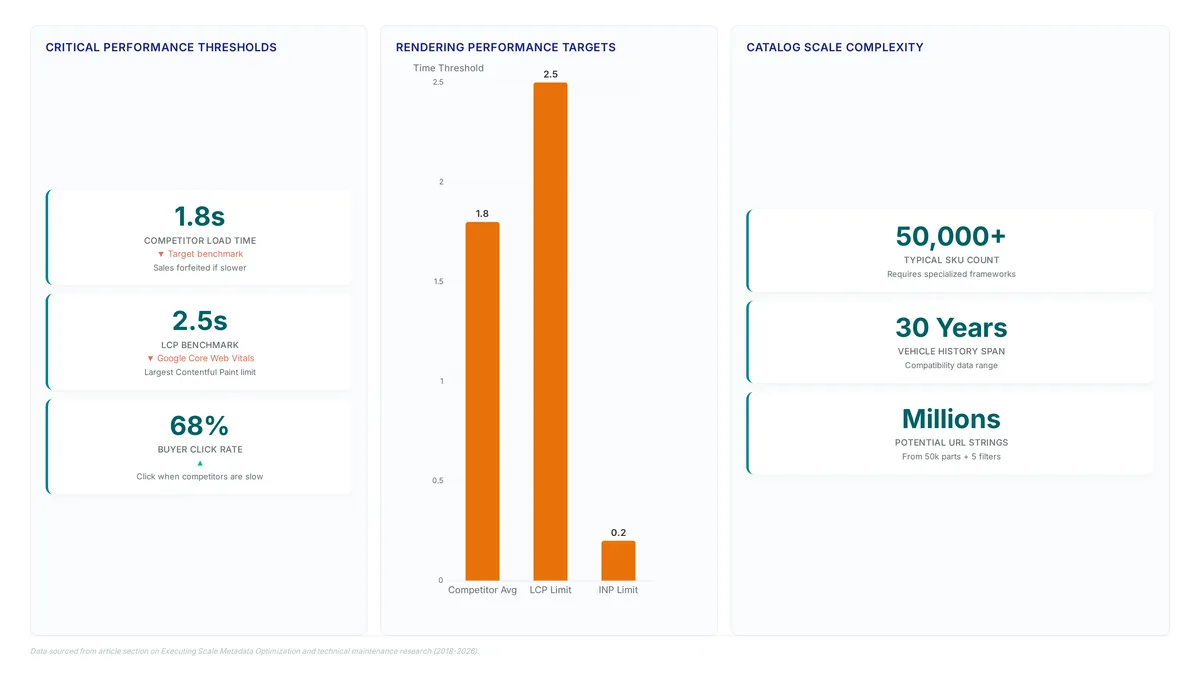
Mobile page loads taking four seconds forfeit sales when competitors load in 1.8 seconds. Prioritizing rendering performance is critical for mechanics verifying part numbers beside lifted vehicles. Recommended Google Core Web Vitals benchmarks include a Largest Contentful Paint (LCP) under 2.5 seconds and an Interaction to Next Paint (INP) under 200 milliseconds. While specific targets vary by device, minimizing latency is necessary to display fitment charts instantly.
- Minimize input latency during vehicle selection to ensure responsive interactions on mobile devices.
- Reduce reliance on heavy client-side JavaScript blocks for year, make, and model dropdowns where possible to improve render times.
- Preventing crawl budget waste requires enforcing strict indexing rules on faceted navigation parameters.
Faceted navigation can mathematically produce millions of unique URL strings from a catalogue of 50,000 parts with five active filter dimensions. Operators must implement the following validation sequence to protect site health.
- Implement indexing controls to prevent search engines from wasting crawl budget on infinite flexible parameter combinations.
- Apply canonical tags pointing to the static base category for all filtered variation pages.
- Generate static category pages for popular vehicle combinations since flexible results often fail to rank effectively or get indexed properly.
- Maintain sitemap indexes under 50,000 URLs to ensure search engines crawl and index content efficiently.
- Verify that only pages returning a 200 status code remain within the sitemap file.
| Method | Scope | Risk Level |
|---|---|---|
| Robots.txt | Crawling | High if misconfigured |
| Canonical Tag | Indexing | Moderate |
| Noindex Meta | Indexing | Low |
Internal linking architecture must connect related products and categories to distribute ranking power across complex catalogs. The trade-off is that over-blocking parameters can accidentally hide valid inventory from search results. Sites must balance aggression with coverage to avoid losing long-tail traffic.
About
Dmitry Volkov serves as a Senior Automotive Technical Writer at KZMALL Auto Parts, where he daily translates complex engineering specifications into clear, actionable data for global distributors. This role uniquely qualifies him to address SEO for auto parts, a discipline he defines as a catalog-data problem rather than simple content creation. At KZMALL, managing over 50,000 SKUs across eight proprietary brands requires rigorous adherence to ACES/PIES fitment standards, mirroring the article's focus on precision year-make-model indexing. His daily work involves converting technical manufacturing details into accurate digital assets, directly aligning with the blueprint's emphasis on entity-based schema and flexible metadata scaling. By bridging the gap between raw engineering data and searchable e-commerce formats, Dmitry ensures that KZMALL's B2B platform remains discoverable for buyers searching by specific part numbers. His expertise proves that in the automotive aftermarket, technical accuracy is the ultimate driver of search visibility and revenue growth.
Conclusion
Scaling automotive SEO breaks when inventory complexity outpaces crawl efficiency, turning valuable long-tail queries into dead ends. The operational cost of ignoring this is the silent erosion of high-intent traffic to competitors with quicker render times and cleaner indexation. While generic content has value, the industry is decisively shifting toward a "Catalog-First" blueprint where the inventory database itself functions as the primary organic engine. This requires treating fitment data not merely as a display feature but as the core structural element of your site architecture. You must prioritize edge computation to handle complex joins without sacrificing mobile UX, ensuring that specific part queries load instantly regardless of catalog size.
Implement strict faceted navigation controls immediately to prevent crawl budget waste on infinite parameter combinations. Your first action this week is to audit your current sitemap and enforce canonical tags on all filtered variation pages, ensuring only static base categories and high-value vehicle combinations remain indexable. This specific configuration protects your site health while preserving visibility for the longtail searches that drive actual sales. By aligning your technical infrastructure with these catalog-centric realities, you secure a sustainable advantage in a market where precision directly dictates revenue capture.
Frequently Asked Questions
Raw feeds create duplicate content that hides your site from buyers. Since a portion of users click the top three results, failing to customize data means losing most potential traffic immediately.
Your database must handle compatibility spanning 30 years of vehicle history. This complexity requires structured ACES data, as 70% of searches use longtail queries needing precise year, make, and model details.
Slow rendering causes you to forfeit sales when competitors load faster. You must keep Largest Contentful Paint under 2.5 seconds, or you risk losing the a portion of buyers who click top results.
Keep sitemap indexes under 50,000 URLs to ensure search engines properly crawl your catalog. Exceeding this limit wastes crawl budget on duplicate pages instead of indexing your unique fitment data.
Precise metadata drives a 30% increase in organic traffic within 30 days. This approach also delivers a 20% boost in click-through rates by matching specific manufacturer part numbers accurately.
References