
Aftermarket supply chains: Fixing the 11.4-year vehicle gap
The average vehicle on U.S. Roads is now a record 11.4 years old. This single statistic drives massive repair demand. It forces the automotive aftermarket to manage inventory complexity reaching millions of SKUs while balancing diverse technologies. Surviving this volume requires shifting from basic stocking to strategic supply chain best practices that prioritize efficiency over sheer breadth.
Readers will learn how the AutoCare Association defines the modern system, encompassing everything from replacement parts to specialized tools for light- and heavy-duty vehicles. The discussion moves beyond simple definitions to address navigating an inventory environment that has expanded exponentially since the sector generated $307 billion in revenue in 2012.
Finally, the piece explores strategic implementations needed to control costs in a market employing over 6 million people. You will see how new thinking impacts inventory complexity and why standard procurement models fail when facing such vast product diversity. By examining these core areas, the analysis provides a roadmap for handling the profound impact of technology on today's supply chains without getting lost in the noise of millions of part numbers.
Defining the Automotive Aftermarket System and Replacement Parts
AutoCare Association Definition of Aftermarket Products and Services
The AutoCare Association defines the aftermarket as all products and services purchased for light-, medium-, and heavy-duty vehicles after the original sale. This sector definition explicitly includes replacement parts, accessories, lubricants, appearance products, tires, and collision repair parts alongside the tools and equipment necessary to make repairs. Such a broad categorization matters because the average age of light vehicles in the United States reached 12.6 years as of January 2024, indicating significant upkeep needs for the nation's aging fleet. Operators must manage SKU inventory reaching into the millions to service this diverse demographic effectively. The challenge intensifies as vehicles aged six to 14 years require more frequent maintenance, creating a revenue "sweet spot" that demands precise stock alignment. Regional variations further complicate logistics; for instance, Mexico's vehicle fleet reached a record 35.1 million units in 2024 with an average age of 16.2 years. Category Examples : : Consumables Lubr.
Aggregating high-turnover consumables with slow-moving collision components forces distributors to adopt dual-track supply chain strategies. Managing these distinct flow rates within the single "aftermarket" label is necessary to control carrying costs and maintain service levels for critical repair items.
Aging Vehicle Fleet Impact on Aftermarket Demand and SKU Complexity
A sustained maintenance window opens for repair networks due to the 12.6-year average age of U.S. Light vehicles. Distributors now stock part numbers for models spanning two decades of manufacturing. As the bulk of the fleet enters the six-to-14-year window, the frequency of component failure rises sharply for light-duty vehicles. Maintenance costs typically escalate beyond economic viability after 7-8 years or 150,000 miles. The inventory burden expands because modern cars contain diverse electronic modules alongside mechanical wear items. A single modern car comprises approximately 30,000 parts. Operators must manage SKU complexity that reaches into the millions to cover these varying technologies. A distinct tension exists between holding deep stock for older trucks and maintaining liquidity for newer imports. Medium-duty fleets often share chassis components. Heavy equipment requires specialized sourcing that strains standard warehousing models. Losing a customer over a missing obscure part hurts, yet overstocking ties up capital in slow-moving goods. Regional variations further complicate this balance, as Mexico's fleet averages 16.2 years, demanding even older part sets than domestic markets. Tariff disruptions are projected to cut 5-6% of aftermarket revenue, which may impact parts availability. Local warehouses hold unique reserves based on regional vehicle survival rates.
US vs EU Vehicle Age Statistics and Fleet Maintenance Trends
Comparing North American and European vehicle ages reveals global fleet maintenance demand patterns. The U.S. Light vehicle sector projects 5.2% growth in 2026 as older units require service. Across the Atlantic, the average age of cars is 12.3 years, while vans average 12.5 years, trucks average 13.9 years, and buses average 12.5 years. Heavier EU trucks exceed car ages by over a year, creating distinct parts profiles for commercial fleets versus passenger vehicles. Trucks represent the oldest asset class in the EU. This suggests a heavier reliance on maintenance for commercial transport sectors compared to passenger vehicles. EU truck longevity, averaging 13.9 years, indicates an older commercial fleet profile compared to passenger cars. U.S. Fleet uniformity simplifies forecasting compared to the varied EU commercial mix. Global distributors must account for different stages of market maturity and parts demand profiles across regions. Regional variance dictates localized stocking strategies rather than a unified global.
Operational Mechanics of SKU Proliferation and Inventory Complexity
SKU Proliferation Drivers in Aging Vehicle Fleets
A Stock Keeping Unit functions as a unique alphanumeric identifier for every distinct part variation needed during repair. High interest rates convince buyers to delay new vehicle acquisitions, pushing them toward maintaining older assets instead. Modern cars contain approximately 30,000 parts, and their expanding technological sophistication multiplies the number of required codes. By January 2024, the average age of light vehicles in the United States hit 12.6 years, shifting inventory pressure toward legacy support systems. Distributors face a choice between stocking deep reserves for rare, aging models or prioritizing turnover for high-volume contemporary components. Ignoring this parts diversity leads to inflated carrying costs or lost revenue from unfilled orders. Flexible forecasting models help by weighting vehicle age against failure rates to optimize these massive catalogs.
Economic Thresholds Dictating Repair Versus Replacement Cycles
Maintenance expenses often climb past the point of economic viability once specific mileage benchmarks are reached. Studies identify the optimal replacement window for light-duty fleet vehicles at 78 years or 150,000 miles, generating predictable demand spikes for older components. Heavy-duty Class 8 trucks follow a separate path, with an optimal threshold extending to 1012 years or 500,000+ miles before operators typically retire assets.
| Vehicle Class | Optimal Age | Mileage Threshold |
|---|---|---|
| Light-Duty | 78 years | 150,000 miles |
| Medium-Duty | 810 years | 200,000 miles |
| Heavy-Duty | 1012 years | 500,000+ miles |
Elevated prices for new vehicles compel consumers to keep assets well beyond these windows, deferring capital expenditure in favor of rising repair bills. This behavior forces distributors to stock inventory for vehicles that technically exceed their cost-effective service life. Operators struggle to maintain supply chain efficiency for rare parts while avoiding obsolescence risk on slow-moving SKUs. Strategic inventory management must address this extended tail of aging assets to prevent stockouts on critical repair items. Financial pressure mounts as high new vehicle prices and rising interest rates push operators to extend asset lifecycles well past standard depreciation curves.
| Financial Driver | Operational Consequence |
|---|---|
| Import Tariffs | Reduced supplier margins and higher unit costs |
| Interest Rates | Deferred fleet renewal and extended repair cycles |
| Inventory Age | Increased SKU complexity for obsolete models |
Capital constraints prevent new acquisitions, locking funds into maintaining aging units that need increasingly rare parts. The inventory burden grows because distributors must stock deep lines for vehicles manufacturers no longer support. A limitation emerges here; volume stays stable due to deferred purchases, yet profit margin compression from tariffs creates significant financial headwinds for suppliers. Demand for repairs remains high even as the economic viability of supplying those specific parts diminishes. Operators balance holding costs against obsolescence risk as the aftermarket supply chain navigates these concurrent fiscal challenges.
Strategic Implementation of Supply Chain Best Practices
Defining Innovation-Driven Best Practices for Aftermarket Supply Chains
Technology and new thinking are having a profound impact on aftermarket supply chains. This approach helps businesses manage a SKU inventory that reaches into the millions due to the volume of older vehicles and increasingly diverse technologies in new models.
- Manage inventory that accounts for millions of unique part variations required by diverse vehicle technologies.
- Implement inventory management strategies to handle the complexity of parts for light-, medium-, and heavy-duty vehicles.
- Address supply chain challenges created by the combination of aging fleets and new vehicle technology diversity.
The following configuration logic illustrates how to tag parts for priority restocking based on vehicle cohort maturity:
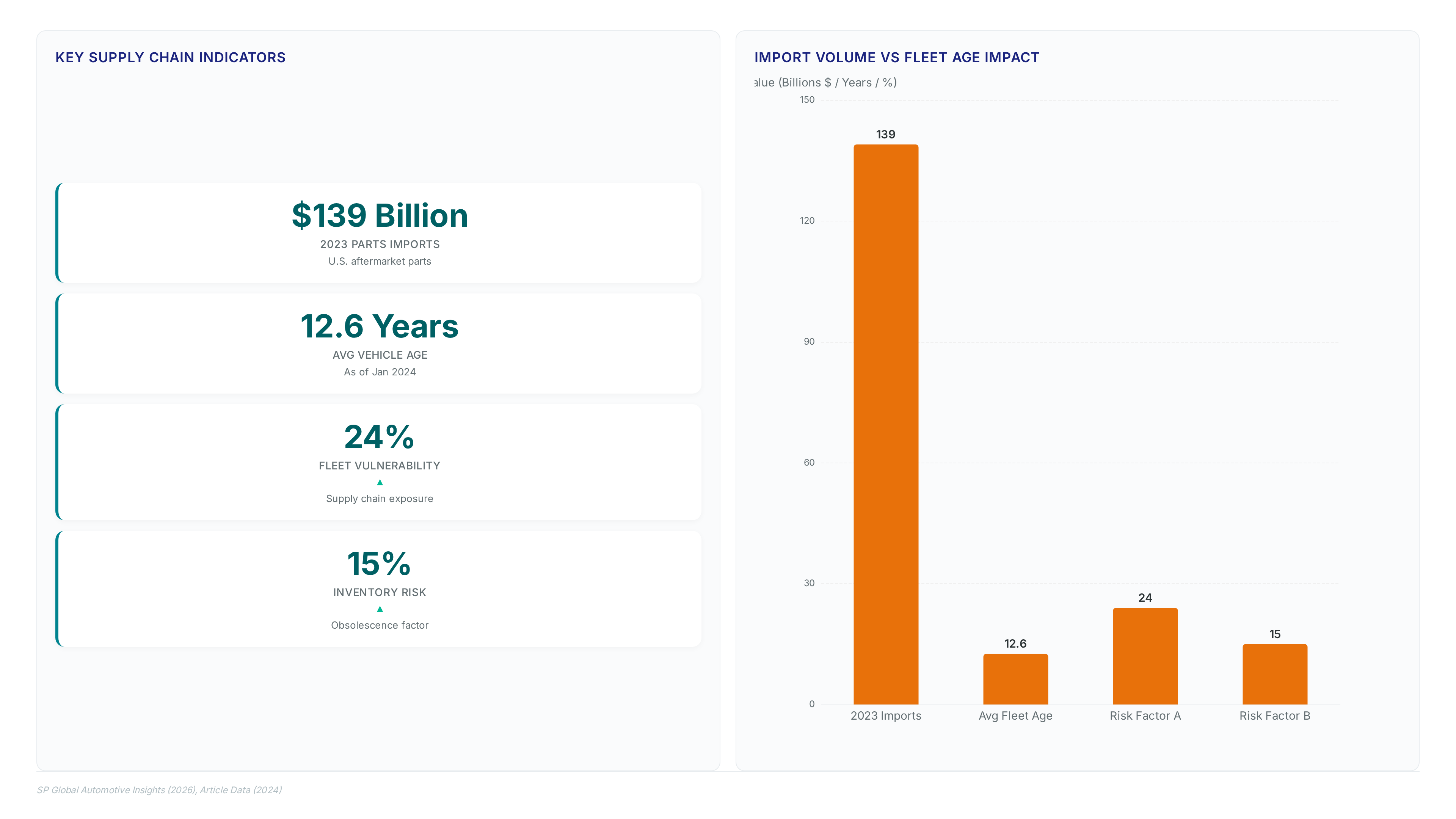
Merely stocking parts is insufficient when global supply chains face volatility. In 2023, the U.S. Imported $139 billion in aftermarket parts, indicating a heavy reliance on global networks vulnerable to disruption. A tension exists between maintaining deep inventory for rare repairs and minimizing capital tied up in slow-moving stock. The cost of this balance is measurable: over-stocking leads to obsolescence, while under-stocking loses customers to competitors with improved availability. Strategic innovation rather than simple volume expansion offers a path to cost control. Industry guidance highlights new thinking designed to help aftermarket businesses achieve greater efficiency and control over supply chain costs.
Aligning Inventory Strategies with 12.6-Year Vehicle Lifecycles
Stocking models must shift depth toward legacy components because the average age of light vehicles in the United States reached 12.6 years as of January 2024. This reality forces distributors to prioritize availability for an aging fleet where maintenance needs are significant. High interest rates and limited new inventory drive consumers to retain older assets longer, effectively deferring purchase costs in favor of ongoing maintenance expenditures. Operators should execute these steps to align stock with fleet age:
- Prioritize inventory for vehicles exceeding the optimal replacement age of 78 years or 150,000 miles, where maintenance costs typically escalate. 2.3. Focus on parts availability for vehicles approaching the 150,000-mile threshold where maintenance costs typically escalate beyond economic viability for light-duty fleets.
A critical tension exists between minimizing carrying costs and preventing lost sales; holding deep inventory for rare, old models ties up capital but secures customer loyalty when competitors cannot source parts. Recommendations suggest adopting best practices that treat age-specific inventory as a strategic necessity rather than dead stock. The cost of this approach is measurable capital commitment, yet the implication is clear: businesses ignoring the 12.6-year average will lose relevance as the fleet continues aging.
Mitigating Revenue Loss from Tariff Disruptions and Deferred Purchases
Import cost volatility directly erodes margins when distributors fail to adjust pricing models for incoming tariff shocks. In 2023, the U.S. This financial strain compounds as high vehicle prices force consumers to delay purchases, extending the life of older units beyond standard cycles. A typical modern car comprises approximately 30,000 parts, meaning extended lifespans exponentially increase the probability of complex, low-volume failures straining inventory budgets. Operators must implement flexible restocking protocols to balance these competing pressures. 1.2. Adjust inventory strategies to account for consumers retaining older vehicles longer due to high new vehicle prices and rising interest rates. 3. Prepare for increased demand complexity as the shift from traditional mechanical failures to issues involving telematics and electronic systems accelerates.
Industry analysis suggests immediate attention to supplier exposure and fleet aging trends to mitigate this specific revenue leakage.
Optimizing Inventory Control for Maximum Business Efficiency
Application: Defining Innovation-Driven Inventory Control in Aftermarket Supply Chains

Inventory control in this sector manages SKU complexity across light, medium, and heavy vehicle segments rather than simple consumer goods. The industry generated more than $307 billion in revenue during 2012, a figure that shows the massive scale of parts distribution required for an aging fleet. Sales within the industry are broken down based on parts for light, medium, and heavy vehicles, creating distinct stocking challenges for each class. General retail models fail here because a single heavy-duty truck requires vastly different replacement cycles compared to a light-duty sedan. Innovation-driven control means deploying digital catalogs that index millions of unique part variations for obsolete models while maintaining inventory management tools that prioritize high-turnover SKUs. However, the average age of light vehicles in the United States has risen to 12.6 years, marking a consistent upward trend that increases maintenance needs. Operators must align procurement with extended lifecycles as high new vehicle prices and rising interest rates drive consumers to retain older assets longer. This approach transforms static lists into flexible response systems capable of handling complex repair demands. Effective strategies require balancing these opposing forces as the industry shifts from traditional mechanical failures to issues involving telematics and electronic systems.
Applying Best Practices to Manage Light, Medium, and Heavy Vehicle Parts
Distributors serving this sector support an industry that employed more than 6 million people, creating immense pressure to optimize supply chain costs without sacrificing part availability. Conversely, heavy-duty operations demand deep reserves of specific drivetrain components that face longer usage cycles but catastrophic downtime risks if missing. Technology and new thinking are having a profound impact on how these diverse inventories are managed across the board. Purolator International highlights that applying best practices drives the efficiency needed to handle such complex SKU volumes. Operators face a tension between minimizing carrying costs for slow-moving heavy truck parts and the severe revenue loss incurred when those specific units are out of stock.
| Vehicle Class | Primary Inventory Focus | Risk Profile |
|---|---|---|
| Light Duty | High-turn filters, brakes | Obsolescence |
| Medium Duty | Suspension, cooling | Seasonal spikes |
| Heavy Duty | Drivetrain, electronics | Downtime cost |
The analytical reality is that optimal replacement thresholds vary notably, with light-duty vehicles typically reaching economic limits at 78 years, while heavy-duty Class 8 trucks extend to 1012 years or 500,000+ miles. Businesses must deploy separate reorder points for each class rather than applying a single turnover metric to account for these divergent lifecycles. This segmented approach prevents capital from being tied up in inappropriate stock levels for each vehicle type.
Checklist for Validating Supply Chain Efficiency Against 2012 Revenue Benchmarks
Validate current stock turnover rates against historical growth baselines to identify stagnation in inventory velocity. Operators must determine if their supply chain costs align with the sector's past performance, noting that sales previously represented a 3.5 percent increase over the prior year. Modern validation requires more than matching old percentages; it demands assessing durability against global volatility, particularly as tariff disruptions are projected to impact aftermarket revenue.
| Metric Category | 2012 Baseline Context | 2026 Validation Requirement |
|---|---|---|
| Revenue Growth | Moderate annual increase | Durability to tariff shocks |
| SKU Complexity | Standard parts mix | Millions of aging vehicle variants |
| Cost Drivers | Labor and materials | Global logistics and tariffs |
Technology and new thinking are having a profound impact on how businesses achieve this alignment. Distributors should consult the white paper from Purolator International regarding best practices to drive aftermarket supply chain efficiency. Ignoring these digital tools risks leaving margin on the table as import dependencies create new vulnerabilities.S. Operators must dynamically adjust safety stock levels to account for the increasing technological complexity and electronic system failures prevalent in the aging fleet.
About
Mark Phillips serves as Editor of Aftermarket Intel at KZMALL, where he daily analyzes the complex dynamics of global parts distribution. His deep expertise in tracking e-commerce trends and distributor strategies makes him uniquely qualified to address the challenges of the automotive aftermarket supply chain. As the industry grapples with an aging vehicle fleet and millions of required SKUs, Phillips uses his frontline experience monitoring competitive moves to explain how fragmented markets can optimize inventory. At KZMALL, a leading B2B platform offering over 50,000 SKUs, his work directly connects high-level supply chain theory with practical solutions like standardized ACES/PIES fitment data. By bridging the gap between massive catalog breadth and accurate application, Phillips illustrates how modern wholesalers can simplify procurement for independent repair shops. His insights reflect KZMALL's commitment to solving real-world logistics hurdles through single-source supplier models and rigorous data standards, ensuring the global aftermarket remains resilient amidst expanding complexity.
Conclusion
The operational breaking point arrives when distributors apply uniform inventory logic to a fleet where Mexico's 16.2-year average age demands obsolete part sets while the U.S. Market saturates with mid-life repairs. Maintaining broad stock across this divergence creates unsustainable carrying costs, especially as tariff disruptions threaten to erase more than half of potential revenue. Operators must immediately segment their reorder points by vehicle class rather than relying on aggregate turnover metrics that ignore the specific failure curves of aging electronics versus mechanical consumables.
Distributors should enforce a strict policy of flexible safety stock adjustment within the next quarter, specifically isolating components for vehicles exceeding the seven-year economic threshold. This approach prevents capital from stagnating in low-velocity SKUs while securing availability for high-frequency maintenance needs. The automotive supply chain now requires this granular visibility to survive global logistics volatility. Start this week by auditing your current inventory mix against the specific age distribution of your local fleet, flagging any parts allocated for vehicles beyond 150,000 miles for immediate liquidation or reallocation.
Frequently Asked Questions
Older vehicles require more frequent maintenance, forcing deeper stock levels. With the U.S. fleet averaging 12.6 years, operators must manage millions of SKUs to cover diverse repair needs effectively.
Tariff disruptions threaten to cut aftermarket revenue by 6%. This potential loss requires distributors to diversify sourcing and optimize inventory turnover to maintain liquidity during supply chain volatility.
The industry generates over $307 billion in annual revenue while employing 6 million people. This scale demands robust supply chain practices to handle the complexity of millions of unique part numbers.
Mexico's fleet averages 16.2 years, demanding older part sets than domestic markets. Distributors must tailor inventory to regional vehicle survival rates to avoid stockouts on critical legacy components.
The light vehicle sector projects 5.2% growth in 2026 driven by aging units. Businesses must align procurement with this uptick to capture revenue from increasing maintenance frequency.
References