VIN decoder API stops manual entry mistakes now
A single API call retrieves over 49 specific vehicle details, eliminating the high error rates of manual data entry. Automation through a VIN Decoder API is no longer optional for fleets and insurers aiming to survive the data demands of 2026. These tools validate information and clean databases of human errors. Commercial providers like vindecoder.eu cite accuracy rates up to 99.8% by using continuously updated sources. This stands in contrast to government-backed resources like the NHTSA vPIC API, which serves as a primary data source for entities such as FaxVIN.
The measurable ROI appears clearly in fleet management and insurance. Precise decoding of attributes like Average CO2 Emission or Engine Type directly impacts cost calculations. Operators who understand the architecture of these systems stop guessing at specifications. They enforce strict data integrity across their entire vehicle inventory.
The Critical Role of VIN Decoder APIs in Modern Vehicle Data Automation
VIN Decoder API Definition and Encoded Data Scope
A VIN Decoder API converts raw identification strings into structured vehicle specifications through automated parsing. The software dissects the 17-character code to expose Make, Model, Engine details, and Plant location as encoded by the manufacturer. Reliable business solutions depend on continuously updated sources to maintain accuracy. The decoding process extracts fixed data points like Model year and Serial number, yet distinct limitations exist. Manufacturers do not encode color, crash history, or maintenance intervals within the VIN structure itself. These details require separate data purchases or direct manufacturer access. KZMALL Auto Parts integrates this precise decoding to match inventory with the rolling fleet's actual needs. Automating this input eliminates manual entry errors that damage database integrity. Without enriched catalogs, a decoded VIN yields only a fraction of necessary attributes for supply chain precision.
Automating Vehicle Data Validation with Vincario API
Vincario transforms raw identification strings into actionable vehicle specifications by enriching standard decode outputs with approximately 50 additional details. Manufacturers encode basic attributes like Model year and Plant location but omit critical operational data such as Fuel Type or Emission Standard from the VIN string itself, requiring enrichment from vehicle catalogs. KZMALL Auto Parts uses this depth to validate fleet records against precise engineering constraints rather than generic model names. The service retrieves full vehicle specifications to automate data processes, effectively cleaning databases of misspellings and human-based errors.
VIN Decoder vs Vehicle History Report Data Distinctions
A VIN Decoder API extracts static manufacturing specifications but cannot reveal flexible ownership events or accident records. Decoders reliably parse Model year and Engine details, yet they fundamentally lack access to crash history and recall status because manufacturers do not encode these variables. This distinction forces aftermarket strategists to separate fitment validation from risk assessment when sourcing parts. The NHTSA vPIC API serves as the primary government-backed data source for vehicle specifications, utilized by commercial entities for decoding operations. Relying solely on decoding for risk analysis creates blind spots in inventory planning. Free lookup tools often provide limited build sheets for specific brands, yet these remain insufficient for thorough fleet auditing. Business-grade APIs deliver the structured vehicle specifications necessary for automated catalog matching without the noise of unverified ownership claims. Accurate vehicle identification boosts sales and avoids costs associated with incorrect part selection. Operators must distinguish between the static "birth certificate" a decoder provides and the living "medical record" found in history reports to optimize stock turns.
Inside the Architecture of Machine Learning-Driven VIN Decoding Systems
Machine Learning Validation Layers in VIN Decoding
These validation layers function by pairing standard vehicle details with enriched commercial datasets to identify statistical anomalies in engine codes or plant locations. This dual-source architecture allows systems to flag inconsistent attributes, such as a mismatched transmission type for a specific trim level, before returning a result. The technical backbone of modern VIN decoding relies on a layered infrastructure where the NHTSA vPIC API serves as the core government source for vehicle specifications.
| Data Source Type | Coverage Scope | Error Correction Capability |
|---|---|---|
| Government Registry | Standardized mandatory fields | Returns manufacturer input |
| Paired Catalogs | Global makes and brands | High; resolves trim and option conflicts |
| ML-Enriched Layer | Aftermarket fitment details | Critical; adds missing specifications |
The process enriches basic identifiers with additional details, including precise wheelbase measurements and emission standards. Some providers claim high data accuracy rates for vehicle specification decoding by using continuously updated sources. Results are verified by statistical models to ensure data integrity while maintaining API responses in milliseconds. The limitation remains that non-encoded features like color or crash history require direct manufacturer access. Solutions use these enriched datasets to ensure inventory matches the actual rolling fleet.
Resolving Edge Cases with Global Brand Hierarchies
Complex brand hierarchies require strong infrastructure to correctly interpret sub-brand identifiers like AMG within a parent make. For instance, a raw input for a VIN correctly yields a specific high-performance model with the correct engine only when the system recognizes the sub-brand distinction. Using multi-catalog pairing helps fix incorrect VIN decoding that plagues single-source systems. The limitation of relying solely on government databases is the absence of granular trim details required for precise aftermarket selection.
| Decoding Approach | Brand Coverage | Trim Accuracy |
|---|---|---|
| Single Source | Limited | Low |
| Layered Hierarchy | Global Brands | High |
While free tools exist for basic checks, professional platforms demonstrate the necessity of integrated aftermarket data for commercial viability. The cost of error involves returned inventory and delayed service bays. Advanced solutions ensure catalogs reflect the rolling fleet actually on the road by using these advanced hierarchies.
Vincario vs NHTSA vPIC: Proprietary Enrichment Strategies
Raw NHTSA vPIC outputs provide core specifications but often lack the granular trim data required for precise aftermarket cataloging. Commercial enrichment strategies layer proprietary algorithms over this government baseline to resolve ambiguities in high-performance sub-brands. While the federal database offers a standardized schema, it frequently returns generic model names that omit critical engine variants or chassis codes. Vincario uses a proprietary VIN Decoder algorithm based on machine learning, trained on national vehicle databases. This dual-source architecture ensures that a query for a specific high-performance model correctly identifies the engine rather than a base model alternative.
| Feature | NHTSA vPIC Native Output | Enriched Logic |
|---|---|---|
| Data Source | Government Manufacturer Submissions | Multi-Catalog Aggregation |
| Brand Depth | Standard Make/Model | Global Manufacturers |
| Trim Resolution | Often Generic | Specific Engine/Ch codes |
| Error Handling | Static Validation | Machine Learning Correction |
Automated enrichment eliminates these bottlenecks by delivering verified attributes instantly. The limitation of government-only data becomes apparent when managing diverse fleets containing niche marques, where standard fields may remain empty. A strong supply chain requires the specificity that only layered commercial validation provides. By integrating these deeper checks, businesses ensure their inventory aligns with the actual rolling fleet rather than a generic approximation. This approach minimizes dead stock and maximizes fill rates for complex applications.
Measurable ROI from Automated Vehicle Data Entry in Fleet and Insurance Operations
Should you automate vehicle data entry now? Consider automation when manual VIN transcription creates bottlenecks in your Fleet Management or Car Insurance & Leasing Services workflows. Automated Vehicle Data Entry automates data submissions and reduces human errors by pre-filling application forms, effectively eliminating misspellings and specification errors common in manual processing. This approach transforms raw identification numbers into verified business intelligence, ensuring that telematics solutions and inventory systems reflect the actual vehicle on the road rather than a data-entry approximation.
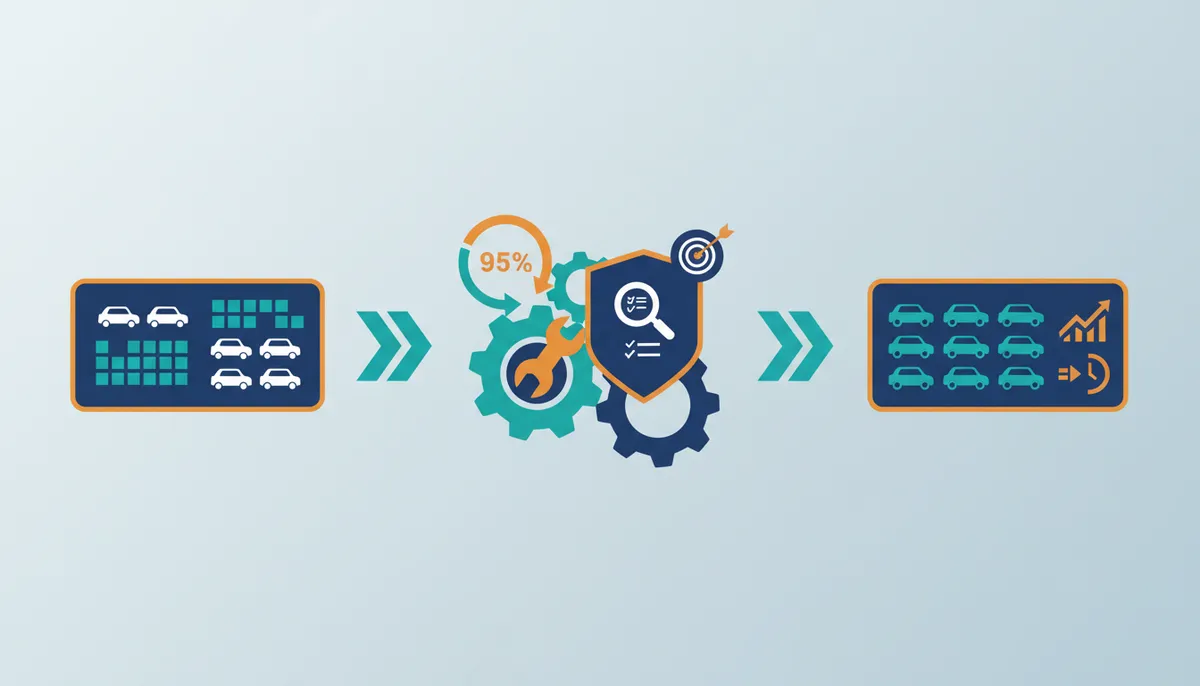
The distinction lies in validation rigor. Consumer-grade tools often rely on static lookups, whereas business-grade implementations apply statistical models to verify results against global databases. High-stakes sectors demand high accuracy rates claimed by specialized providers to prevent costly underwriting or parts mismatches. KZMALL Auto Parts uses these same validation principles to ensure our aftermarket catalog aligns precisely with the rolling fleet's needs.
| Feature | Manual Entry | Automated API |
|---|---|---|
| Error Rate | High (Typos) | near-zero |
| Speed | Minutes per VIN | Milliseconds |
| Data Depth | Basic Make/Model | 50+ Specifications |
Relying on free, manufacturer-specific lookup tools limits operational scope to single brands, whereas thorough automation supports diverse fleets globally. The hidden cost of delayed automation is not merely labor hours but the compounding risk of incorrect spare part identification downstream. Organizations often transition to automation to reduce human-based errors and speed up vehicle onboarding.
Fleet CO2 Tracking and Insurance Cost Calculation Use Cases
Fleet operators can deploy decoding services to capture CO2 emission metrics and electric vehicle ratios necessary for regulatory compliance. Manual entry risks misidentifying engine codes, which can skew carbon reports and insurance premiums due to incorrect transmission or fuel type data. KZMALL Auto Parts integrates this decoded intelligence directly into your workflow, ensuring every vehicle in the Fleet Management portfolio is categorized by its actual environmental impact rather than a generic model average.
Insurers similarly rely on exact engine details and model year specifications to calculate risk exposure accurately. Errors in manual uploads can lead to incorrect vehicle classification. By automating this lookup, organizations eliminate the variance between the physical asset and its digital twin.
However, relying on free consumer tools introduces latency and lacks the statistical model verification required for audit-ready financial reporting. The cost of inaccurate data extends beyond immediate billing; it corrupts long-term asset valuation models. KZMALL Auto Parts provides the verified infrastructure necessary to change raw identification numbers into actionable business intelligence without the noise of unverified sources. This approach secures the integrity of both sustainability reports and insurance ledgers simultaneously.
Validation Checklist for API Uptime and Global Vehicle Coverage
Should you use a VIN API for fleet management? Yes, when manual entry risks misidentifying specialized assets like ATV Quads or heavy Tractors in your rolling inventory. KZMALL Auto Parts recommends validating providers against a strict 99.9% service uptime guarantee to prevent costly operational stalls during peak intake windows. While free tools exist for common passenger cars, they often lack the depth required for diverse commercial fleets containing Vans, Buses, and Trailers. A critical limitation emerges if the provider cannot decode non-standard vehicle types, forcing staff to revert to error-prone manual inputs for equipment like Motorbikes or specialized machinery. Relying on fragmented government sources like the NHTSA vPIC API alone may leave gaps in global coverage outside North America. True automation requires a unified source that handles all asset classes without switching contexts. Operators benefit from response times in milliseconds to maintain workflow velocity. The cost of downtime or incorrect part selection far outweighs the investment in a strong, validated data stream.
Implementing a Global VIN Lookup Service in Five Minutes Using REST and PHP
Vincario REST JSON API Architecture and Control Sum Logic
Secure integration starts with the prefix `api.vincario.com and a valid SHA1 control sum. This REST JSON API structure stops manual entry errors by standardizing how databases query vehicle specs. Developers must concatenate the VIN, action ID, API key, and secret key before hashing.
- Define the API prefix string variable in your PHP environment.
- Generate a ten-character control sum using the `sha1` algorithm on the concatenated credentials.
- Execute the request via `file_get_contents` to retrieve the decoded vehicle data object.
The system returns over 49 vehicle details, enriching basic decoding for aftermarket fitment needs. A Github repository holds samples beyond PHP. Deployment takes under 5 minutes, speeding up fitment verification tools. High-volume teams should contact customer service for a custom package. This workflow eliminates stocking wrong SKUs due to transcription slips.
PHP Implementation Steps Using file_get_contents and GitHub Examples
Code logic concatenates credentials before hashing them for the control sum.
- Initialize the API prefix variable with the versioned endpoint string.
- Generate a ten-character hash using `sha1` on the combined VIN and secrets.
- Retrieve the response payload via `file_get_contents` to parse vehicle specs.
This method skips complex HTTP client libraries while keeping access to vehicle data intelligence secure. A Github repository provides templates that accelerate deployment. Business-grade APIs differ from consumer tools through this infrastructure reliability. Operators must prioritize secure patterns over quick fixes to maintain integrity during high-volume decoding.
Account Provisioning Checklist: Trial Keys, Industry Selection, and Volume Tiers
Pick the correct industry vertical and volume tier so the trial request matches backend routing logic. This setup guarantees your API key reaches specific data subsets needed for accurate parts matching in Fleet Management, Automotive Aftermarket, and Car Insurance.
- Submit first name, last name, email, and password to generate a secure verification code.
- Choose an industry classification like Automotive Aftermarket or Fleet Management to filter the data streams.
- Define your estimated lookup volume, noting that custom packages are available for expected higher volumes.
Support spans diverse verticals, from identifying CO2 emissions in fleets to simplifying vehicle onboarding for rentals. The table below lists required provisioning fields against optional strategic inputs.
| Field Category | Mandatory Data Points | Strategic Impact |
|---|---|---|
| Identity | First name, Last name, Email | Routes support tickets correctly |
| Security | Password, Verification code | Enables REST JSON API access |
| Context | Industry, Business description | Aligns with specific segment use cases |
| Scale | Estimated volume, Target region | Determines need for custom packages |
Selecting an industry tag like Automotive Aftermarket grants access to spare part identification data, while Fleet Management focuses on CO2 metrics and electric vehicle ratios. Users prepay for VIN Decode API lookups based on selected volume, with tiers ranging from 0 - 500 to 100001 +. Email delivers a verification code upon sign-up. Customer service builds custom packages for expected higher volumes. Accurate provisioning prevents bottlenecks when scaling to production workloads involving complex vehicle histories.
About
Priya Raman, Aftermarket Category & Supply-Chain Strategist at KZMALL Auto Parts, brings over 15 years of expertise in parts cataloging and B2B distribution to the discussion on VIN Decoder APIs. Her daily work revolves around maintaining standardized ACES/PIES fitment data, ensuring that KZMALL's 50,000+ SKUs match precise vehicle applications. This deep immersion in data governance makes her uniquely qualified to analyze how decoding technology impacts inventory accuracy and supply-chain efficiency. At KZMALL, Priya oversees the integration of digital tools that support their single-source supplier model, where accurate VIN-based lookup is critical for matching hard parts, lubricants, and electrical components to specific year/make/model configurations. She understands that for independent repair shops and distributors, reliable vehicle identification a convenience but a fundamental requirement for reducing returns and optimizing stock. Her insights connect technical API capabilities directly to the economic realities of wholesale auto parts procurement.
Conclusion
Scaling VIN decoding operations reveals that initial connectivity is trivial, but maintaining data integrity under load is where most architectures fracture. While basic lookups are becoming commoditized by zero-cost alternatives, the operational risk of relying on unverified sources grows exponentially with volume. A single misidentified trim level can cascade into costly inventory errors or compliance failures, making the 99.8% accuracy of validated providers a critical operational requirement rather than a luxury feature. Organizations must transition from viewing these tools as simple lookup utilities to treating them as core infrastructure components that demand strict provisioning and industry-specific routing.
Deploy a hybrid validation strategy immediately: route non-critical developmental traffic through free tiers to conserve budget, but mandate verified, high-uptime endpoints for all production fitment and insurance workflows. This approach balances cost efficiency with the need for reliable parts matching. Start this week by auditing your current error logs for fitment mismatches and cross-referencing them against your provider's industry classification settings to ensure your account tier aligns with your actual data needs. Only by securing the foundation of your vehicle data stream can you safely automate complex downstream processes without inviting systemic failure.
Frequently Asked Questions
Professional APIs deliver high precision by leveraging continuously updated sources for reliable data. Users can achieve up to 99.8% accuracy to ensure their fleet records match actual vehicle specifications perfectly.
High availability prevents costly downtime during peak vehicle onboarding or insurance processing periods. Providers often maintain a strict 99.9% service uptime guarantee to ensure your operations never stop unexpectedly.
No, decoders extract static manufacturing specs but cannot reveal dynamic crash history or ownership events. You must purchase separate data because manufacturers do not encode accident records within the VIN structure itself.
The VIN structure omits critical details like color, crash history, and maintenance intervals completely. Operators must access enriched catalogs or manufacturer databases to retrieve these missing variables for full inventory validation.
Developers can deploy a fully functional REST JSON API integration in under five minutes. This rapid setup allows teams to immediately start automating data entry and cleaning database errors efficiently.
References