
Unified inventory stops auto parts stockouts today
Cybersecurity gets the budget, but unified inventory and agentic commerce keep auto parts businesses alive. The modern order management product must evolve from a simple transactional ledger into an intelligent orchestration layer connecting real-time fitment data with automated fulfillment networks. Without this architectural shift, distributors cannot support the complex multi-ship-to carts or flexible pricing models required by today's B2B buyers.
Agentic commerce add-ons diagnose jobs and auto-generate catalog content, replacing static databases with responsive AI agents that interpret part numbers semantically.
Specific implementation strategies for automated fleet replenishment use subscription models to lock in maintenance plans. Dropship integration expands long-tail inventory without fragmenting the checkout experience. Finally, reverse logistics automation reduces mis-fits and improves analytics through standardized core handling procedures.
The Role of Unified Inventory and Agentic Commerce in Auto Parts
Defining Agentic Commerce and Unified Inventory Promising
Stop treating your platform as a static repository. Agentic Commerce deploys AI agents to diagnose vehicle jobs, assist complex orders, and auto-generate catalog content instantly, making the system an active participant in the supply chain. The Agentic Commerce Add-On leverages these agents for order assistance and content generation.
Parallel to this intelligence sits Inventory Promising Capability. This function calculates precise delivery dates by respecting network constraints and routing rules. Unlike siloed systems that guess based on local stock, this function views the entire network. It enables distributors to track inventory across multiple locations in real-time for efficient fulfillment. The system aggregates supply and localized inventory to meet time-sensitive demands inherent in the auto parts economy.
| Feature | Siloed Approach | Unified Agentic Approach |
|---|---|---|
| Diagnosis | Manual lookup by part number | AI agent assists orders |
| Stock View | Warehouse specific only | Real-time multi-location view |
| Promise Date | Estimated shipping window | Calculated via routing rules |
Data latency is the primary friction point. Agents require access to unified stock levels to function effectively. If the Inventory Visibility Capability lags, the agent's diagnosis becomes a liability rather than an asset. Successful deployment demands that catalog structures and discounting logic align with physical movement. Without this synchronization, the promise of instant commerce collapses into delayed shipments and customer frustration. The true value emerges only when the diagnostic agent and the logistics engine share a single source of truth.
Applying Real-Time Inventory Visibility and AI Search to Auto Parts
Unified inventory management consolidates dispersed stock into a single real-time view across DCs and vendor networks. Adopting this architecture resolves the fragmentation that plagues multi-location distributors today. Mechanics require immediate certainty on part availability rather than estimated restock dates. The Inventory Visibility Capability enables this by synchronizing data from branches and external suppliers instantly.
Semantic intelligence addresses the second failure point: incorrect part selection due to vague queries. The AI Search Add-On interprets raw part numbers and applies fitment logic to filter incompatible results. Complex B2B transactions often involve multiple ship-to locations that confuse standard checkout flows. The Cart & Checkout Capability supports these multi-drop shipments with custom fields for each destination. The Reverse Logistics Add-On features automated returns and core handling to improve analytics and reduce mis-fits.
Expanding long-tail inventory while maintaining fulfillment speed presents a distinct constraint. Dropping slow-moving SKUs improves turns but risks losing customers needing rare components. The Dropship Add-On addresses this by expanding long-tail inventory while controlling the unified cart and checkout experience. This approach balances breadth of catalog with the reliability of local stock.
| Feature | Primary Function | Operational Impact |
|---|---|---|
| Inventory Visibility | Real-time DC synchronization | Provides unified network view |
| AI Search | Semantic part matching | Uses fitment and compatibility |
| Multi-ship Cart | Complex B2B routing | Supports custom fields |
Infrastructure advancing toward instant commerce relies on this localized aggregation to meet time-sensitive demands. Sellers implementing these systems provide custom product catalogs that adapt to specific buyer contracts. The result is a network that reacts dynamically to road-ready vehicle needs.
How Microservices Architecture Enables Real-Time Fitment and Accurate Delivery
Microservices Mechanics for Catalog and Pricing Structures
The Catalog, Pricing & Promotions Capability isolates complex fitment rules and regional discount logic into independent services that scale separately from order processing. This architectural separation allows the system to manage catalog structures and discounting by account, segment, and region without locking the entire platform during updates. Modern platforms now support VIN-based search and AI-powered fitment to surpass legacy catalog logic that often requires deeper, non-integrated workflows. The knowledge half-life in the field of artificial intelligence has shrunk from years to merely months, demanding an architecture that absorbs new fitment data instantly.
| Legacy Monolith | Microservices Approach |
|---|---|
| Single database lock during price updates | Independent scaling of pricing rules |
| Static fitment tables | Flexible AI search integration |
| Regional pricing requires code deploy | Real-time segment discounts |
Data consistency fights update velocity constantly. Decoupling these services means temporary divergence in price visibility across regions until event streams reconcile. Operators must accept this eventual consistency to achieve the throughput required for real-time B2B transactions. Unlike generalist e-commerce tech, vertical-specific solutions distinguish themselves through deeper automotive catalog logic often requiring specialized integrations for fitment data. The AI Search Add-On interprets part numbers and uses fitment and compatibility to ensure the rolling fleet gets the right tier of parts. Without this granular separation, a pricing error in one region could cascade, forcing a total system rollback rather than a localized fix.
Should you stock OE, premium aftermarket, or both for this application? Here's the math. Complex B2B orders fail when the Cart & Checkout Capability cannot split a single transaction across multiple delivery points with unique contractual fields. Mechanics ordering for a fleet often ship brakes to one garage and filters to another, requiring distinct billing codes per line item. Standard carts merge these into one shipment or reject the custom data entirely, causing manual re-entry errors that delay fulfillment.
Modern platforms resolve this by allowing bulk SKU entry that respects specific shipping constraints for every destination. Distributors can now track inventory across multiple locations in real-time for efficient fulfillment by linking each ship-to address to the nearest available stock node. This architectural shift ensures that delivery date accuracy relies on actual network capacity rather than static estimates. The system validates routing rules against current warehouse loads before confirming the order, preventing impossible promises.
| Feature | Legacy Cart | Unified B2B Cart |
|---|---|---|
| Ship-to Addresses | Single per order | Multiple per line item |
| Custom Fields | None or Global | Per-shipment specific |
| Date Logic | Static lead times | Network-constrained |
| Error Rate | High (manual fix) | Low (automated) |
Data hygiene creates the real bottleneck. If vendor lead times are stale, the calculated dates remain inaccurate despite advanced logic. Operators must ensure upstream inventory feeds update frequently to trust the Inventory Promising Capability output. Without this discipline, the architecture simply automates bad data quicker. The cost of ignoring multi-ship complexity is measurable in lost repeat business from frustrated commercial buyers who cannot automate their procurement.
Implementing Automated Fleet Replenishment and Dropship Integration for B2B
Defining Subscriptions Add-On and Dropship Add-On for B2B Fleets
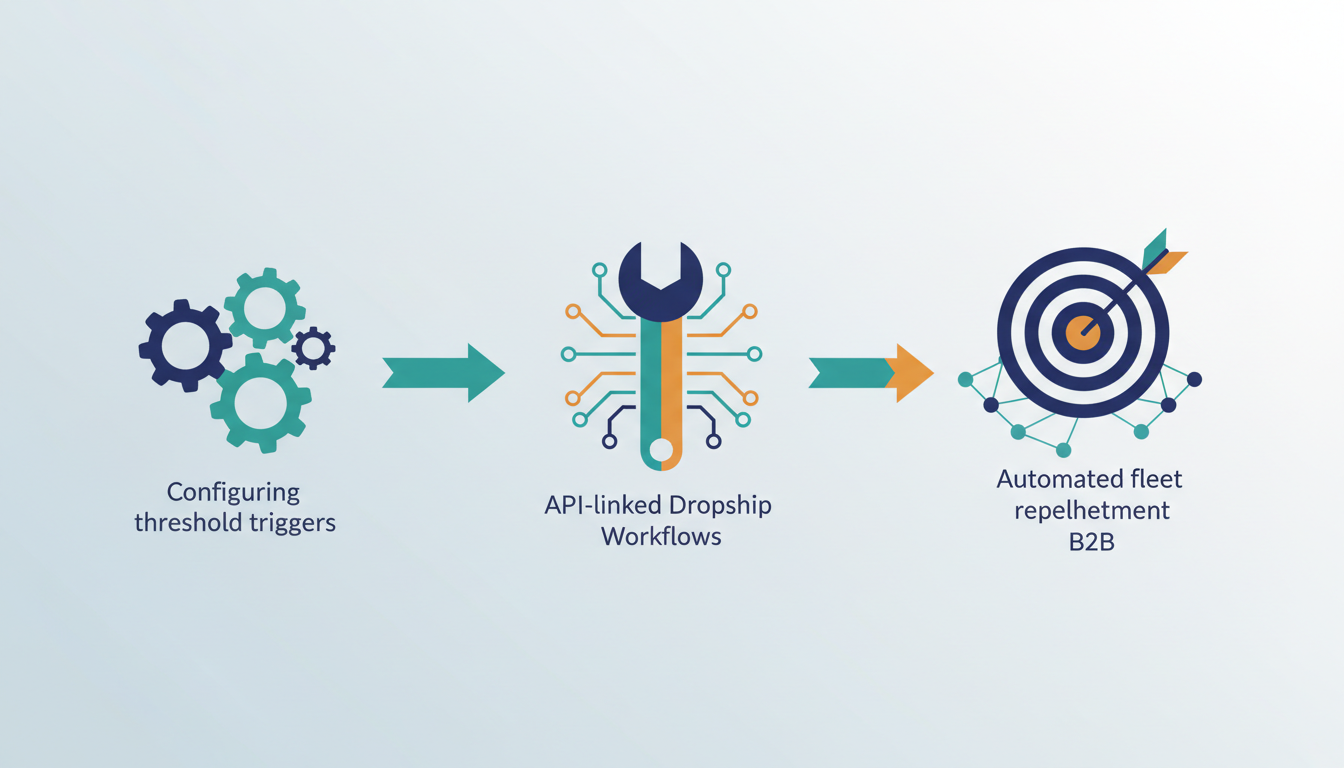
The Subscriptions Add-On removes friction by automating fleet replenishment cycles and embedding membership perks directly into maintenance plans. This strategy shifts the commercial model from transactional spot-buying to predictable, scheduled delivery. Distributors gain stable revenue visibility while buyers eliminate the administrative overhead of generating purchase orders for routine filters or brake pads.
Expanding assortment without inflating warehouse overhead requires a different mechanism for low-velocity SKUs. The Dropship Add-On enables distributors to offer long-tail inventory while retaining control over the unified cart and checkout experience. This architecture allows businesses to scale catalog depth without proportional increases in physical storage costs.
| Feature | Subscriptions Add-On | Dropship Add-On |
|---|---|---|
| Primary Function | Automates recurring orders | Expands available inventory |
| Inventory Impact | Predictable demand planning | Zero holding cost for slow movers |
| Customer Value | Membership perks and consistency | Access to rare or specialty parts |
Balancing tight inventory control with endless aisle breadth creates tension. Specialized integrations often handle automotive-specific catalog logic and fitment data that generalist platforms miss. Combining both add-ons helps distributors balance immediate availability with broad coverage.
Implementing Automated Fleet Replenishment and Dropship Integration
Deciding whether to stock OE, premium aftermarket, or both demands specific math. Complex B2B orders require a Cart & Checkout Capability that splits a single transaction across multiple delivery points with unique contractual fields. Modern platforms resolve this by supporting complex multi-ship-to carts with custom B2B fields. Distributors track inventory across multiple locations in real-time for efficient fulfillment by linking each ship-to address to the nearest available stock via real-time inventory visibility across DCs, branches, and vendor networks. The Subscriptions Add-On automates these recurring flows, turning sporadic purchases into predictable revenue streams. This rapid optimization mirrors broader tech trends where AI startups are scaling from a modest revenue base to a significant revenue level five times quicker than SaaS companies did during their initial growth phases.
Holding every possible SKU locally increases exposure to obsolescence. The Dropship Add-On mitigates this risk by expanding long-tail inventory while controlling unified cart and checkout. This hybrid approach lets sellers offer rare parts without capital exposure.
| Feature | Local Stock | Dropship Integration |
|---|---|---|
| Capital Risk | High | Low |
| Delivery Speed | Immediate | Variable |
| SKU Depth | Limited | Unlimited |
Speed to market often outweighs perfect inventory depth. Reliance on accurate data becomes the constraint; therefore, operators must prioritize inventory promising capabilities that calculate delivery dates respecting network constraints and routing rules rather than relying on static catalog entries.
About
Priya Raman, Aftermarket Category & Supply-Chain Strategist at KZMALL Auto Parts, brings over 15 years of specialized experience in parts cataloging and B2B distribution to the discussion on order management products. Her daily work revolves around optimizing inventory economics and managing complex ACES/PIES fitment data across 50,000+ SKUs, making her uniquely qualified to analyze advanced commerce capabilities. At KZMALL Auto Parts, a global wholesale platform, Priya directly addresses the challenges of unified inventory and mixed shipments that independent repair shops and distributors face. She understands that effective order management is not just about logistics but about translating precise parts knowledge into margin for buyers. By using her expertise in sourcing strategies and digital catalog governance, Priya connects the technical requirements of agentic commerce and reverse logistics to real-world profitability. Her insights bridge the gap between raw data and actionable supply-chain decisions, ensuring that modern order management solutions truly serve the fragmented needs of the global automotive aftermarket.
Conclusion
Scaling an order management product from early traction to enterprise dominance exposes a critical fracture: static inventory logic cannot support the flexible routing required for complex B2B transactions. As AI evolves into the backbone of enterprise architecture by 2027, the operational cost of maintaining rigid, siloed stock records will become prohibitive. Distributors relying on simple availability checks will fail to compete with platforms that dynamically calculate delivery promises based on real-time network constraints. The window to adapt is narrowing, not because the technology is unavailable, but because the margin for error in capital allocation is disappearing.
Organizations must commit to a hybrid fulfillment model integrating dropship capabilities with local stock within the next two quarters to remain viable. This transition requires treating inventory data as a fluid asset rather than a static ledger. Start this week by mapping your top fifty long-tail SKUs to potential dropship vendors to immediately reduce capital risk without sacrificing catalog depth. This specific action isolates the variable of inventory depth while you build the underlying logic for complex multi-ship-to carts. Success depends on executing this pivot before legacy data structures calcify into permanent bottlenecks that slow down checkout flows.
Frequently Asked Questions
Delayed data causes agents to promise unavailable parts, creating customer frustration. Since a portion of businesses prioritize cybersecurity, similar attention to data synchronization prevents operational collapse and ensures accurate delivery promises.
AI agents diagnose vehicle jobs instantly instead of relying on slow manual part number lookups. This shift supports a portion of businesses focusing on technology risks by reducing human error in complex order assistance.
The Dropship Add-On expands long-tail inventory while maintaining a unified cart experience for buyers.
Legacy systems cannot respect network constraints needed for precise delivery dates across distributed vendors.
Siloed views prevent agents from seeing total network supply, leading to incorrect stock promises.