
Tyre capacity jumps as JK Tyre targets 26M units
JK Tyre commits ₹4,980 crore to boost capacity by 24%, targeting 26 million units by 2030.
When your plants run above 90% utilization, you don't have a "good problem." You have a bottleneck that strangles revenue. The European Rubber Journal Report confirms this reality drives JK Tyre's three-phase rollout, scheduled for commissioning between August 2028 and December 2029. While tire makers globally earmark $13 billion in 2024 for similar footprint increases, JK Tyre's specific focus on Truck Bus Radial and Passenger Car Radial segments highlights a calculated bet on commercial logistics recovery rather than speculative consumer growth.
We need to dissect the financial mechanics required to jump from a baseline of 21 million units. How does the company plan to sustain its steady year-on-year revenue climb to hit ₹20,000 crore by fiscal 2027? We will also examine the global competitive environment, contrasting JK Tyre's phased domestic scaling against international rivals scrambling to secure manufacturing capacity amidst tightening supply chains. Operating near maximum efficiency is no longer a badge of honor; it is a critical warning signal demanding immediate capital expenditure.
Strategic Drivers Behind JK Tyre's Record-Breaking Expansion
Defining the ₹4,980 Crore Capacity Expansion Scope
The ₹4,980 crore capital injection targets a precise 24% capacity increase across JK Tyre's Chennai and Vikrant facilities. This specific manufacturing expansion converts record liquidity into physical volume, addressing the constraint of plants operating above 90% utilization. The initiative raises annual output from a baseline of 21 million units to 26 million by 2030.
Execution relies on a three-phase deployment schedule rather than a single switch-over event. Phase I targets commissioning by August 2028, establishing the initial ramp-up curve for Truck Bus Radial lines. Subsequent phases follow in April 2029 and December 2029 to synchronize with demand growth. This staggered approach mitigates the risk of overbuilding before market absorption occurs.
Input cost volatility threatens the viability of scaling production when commodity prices surge against fixed revenue targets. JK Tyre anticipates a 16%-20% escalation in raw material expenses during the first quarter of Fiscal Year 2027. This pressure arrives despite the company posting a modest year-on-year revenue increase to reach record consolidated figures recently. Some commodities are rising 50% or 40% respectively, creating significant input cost volatility for manufacturers. Failure to hedge these specific inputs could erode the intended margin benefits from volume increases.
| Risk Factor | Impact Scope | Mitigation Strategy |
|---|---|---|
| Crude Oil Spikes | High | Price pass-through mechanisms |
| Synthetic Rubber Supply | Medium | Diversified sourcing contracts |
| Freight Logistics | Low | Regionalized distribution hubs |
Operators must recognize that revenue targets become elusive if volume contracts due to aggressive pricing. The planned capacity increase assumes steady demand elasticity that rising prices may erode. Success depends on executing the price hikes without triggering a disproportionate drop in unit sales volume. The expansion executes across three distinct phases to maintain operational continuity while integrating new curing trenches and mixing lines. Previous success at the Banmore facility demonstrated that modular upgrades could boost volume by 31%.
Modern tire plant engineering requires specific bay dimensions, such as 50'-0" bays, to accommodate high-volume commercial vehicle molds and automated guided vehicles. This spatial constraint dictates the physical layout of the Chennai and Vikrant upgrades more than raw capital availability.
| Component | Upgrade Requirement | Operational Impact |
|---|---|---|
| Mixing Lines | High-torque rotor replacement | Increases compound throughput |
| Curing Presses | Additional thermal stations | Expands finished goods capacity |
| Logistics | AGV path widening | Reduces bottleneck transfer times |
The limitation lies in the synchronization of civil works with machinery installation; delaying structural reinforcement halts all downstream equipment calibration. Competitors like Brisa target similar volumes, yet JK Tyre's phased approach mitigates the risk of simultaneous commissioning failures. Raw material supply chains must scale parallel to physical assets, or the new lines will sit idle despite completed construction. The production baseline shifts only when mechanical completion aligns with supply chain readiness. Newindianexpress.
| Phase | Target Date | Primary Facility | Operational Impact |
|---|---|---|---|
| Phase 1 | August 2028 | Chennai | Initial TBR/PCR ramp |
| Phase 2 | April 2029 | Chennai | Mid-cycle volume boost |
| Phase 3 | December 2029 | Vikrant | Final capacity closure |
Staggering these activations allows engineering teams to validate curing trenches and mixing lines sequentially rather than simultaneously. A critical tension exists between this slow rollout and the urgent need to capture market share before competitors stabilize their own supply chains. Delaying full capacity closure until 2030 risks ceding ground to rivals who might complete smaller, quicker expansions elsewhere. However, rushing the commissioning timeline could introduce quality defects that damage brand reputation in the premium radial segment. The chosen path prioritizes technical stability over speed, accepting a longer time-to-market to guarantee that the new manufacturing lines meet strict durability standards upon activation. Engineering teams must replicate the two 50'-0" bays configuration observed in modern greenfield designs to ensure structural compatibility with heavy-duty mixing lines.
The logistical checklist prioritizes modular integration to avoid the operational downtime seen in monolithic upgrades. Operators must sequence utility hookups to match the three-phase commissioning window ending in late 2029.
| Component | Requirement | Constraint |
|---|---|---|
| Bay Structure | 50-foot clear span | Existing foundation load limits |
| Curing Lines | High-density trenching | Thermal output caps |
| Utility Feed | Redundant power grid | Local substation availability |
Over-investing in fixed mixing lines before demand stabilizes creates stranded assets if input costs force production delays. Validating supply chain durability before committing to full equipment deployment is essential. The cost of premature scaling exceeds the penalty of delayed activation when commodity prices fluctuate wildly.
Global Competitive Environment and Market Positioning Analysis
Giti's 60, 70% Price Positioning Against Michelin Premium Tiers
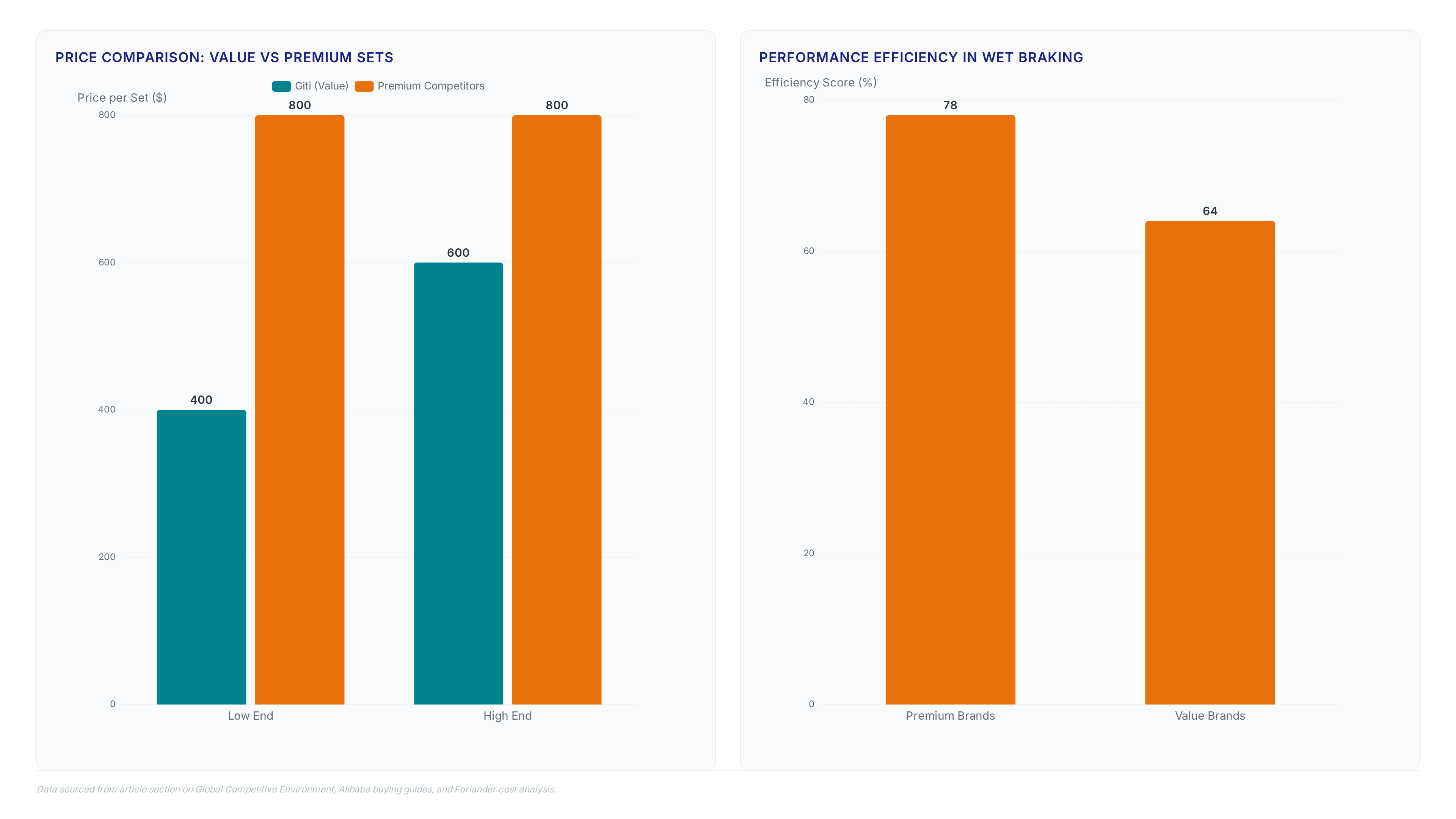
Giti captures market share by pricing tires at 60, 70% of Michelin levels while delivering comparable utility. This strategy positions the Singapore-based manufacturer as the fastest-expanding brand in 2026, directly challenging established players through aggressive value engineering. A complete set of four Giti tires typically costs between $400 and $600, whereas premium competitors often exceed $800 for similar specifications.
JK Tyre faces immediate pressure to justify its own expansion against this compressed pricing structure. While Giti achieves volume through lower entry costs, the trade-off is reduced per-unit margin compared to legacy premium brands. Operators must weigh the benefit of lower acquisition costs against the slight degradation in wet braking performance noted in independent testing. The market flexible now favors manufacturers who can sustain quality at mid-tier price points rather than those relying solely on brand heritage.
Using U.S. Aftermarket Growth and Aging Vehicle Fleets
The U. S. Automotive aftermarket will grow 5.4% in 2026, driven by an aging vehicle fleet with an average age approaching 13 years. This demographic shift creates immediate demand for replacement tires, a sector where JK Tyre must compete against entrenched rivals like Michelin. While Michelin retains its position as the most valuable brand, Giti has emerged as the fastest-expanding competitor by targeting value-conscious consumers with aggressive pricing. The total industry supports over 291,000 manufacturing jobs, indicating a massive scale where even minor market share shifts yield significant volume. Capturing share in the aftermarket requires competitive pricing that mirrors Giti's model, yet JK Tyre's expansion aims to relieve utilization stress from record revenues.
Phase 1 commissioning in August 2028 initiates the three-phase deployment. The mechanism relies on sequential capital injection, where revenue from earlier tranches funds subsequent infrastructure builds. However, compressing three substantial milestones into an 18-month window creates a narrow margin for error in equipment installation. The limitation is that any delay in Phase 2, scheduled for April 2029, cascades directly into the final December 2029 target. Operators must account for this tight coupling when scheduling vendor deliveries.
The implication for network engineers supporting such industrial IoT rollouts is that bandwidth provisioning must scale linearly with each phase rather than waiting for full completion. Aligning monitoring infrastructure with these specific commissioning dates validates throughput gains immediately. Failure to synchronize digital twins with physical commissioning results in blind spots during the most volatile production ramp-up period.
Geopolitical tensions in West Asia drive crude oil prices. Nearly 70 tire manufacturers have issued price hike notices recently, confirming industry-wide margin compression beyond isolated incidents. The mechanism requires converting floating raw material expenses into fixed capacity assets before Q1 FY2027 peaks. Failure to lock long-term contracts now leaves the expansion vulnerable to the same geopolitical tensions.
About
Dmitry Volkov, Senior Automotive Technical Writer at KZMALL Auto Parts, brings critical engineering perspective to the analysis of JK Tyre's massive plant expansion. As KZMALL serves as a global B2B platform distributing over 50,000 SKUs for commercial and passenger vehicles, Volkov understands how upstream production bottlenecks directly impact downstream aftermarket availability. This expertise allows Volkov to connect high-level corporate strategy with the practical realities faced by distributors and repair professionals relying on consistent parts flow.
Conclusion
Scaling capacity without synchronizing supply chain hedging creates a critical vulnerability where expanded output merely amplifies exposure to volatile input costs. The proposed sequential funding model assumes stable commissioning windows, yet compressing three infrastructure phases into 18 months invites catastrophic scheduling conflicts if vendor deliveries slip. Network bandwidth and digital twin validation must scale linearly with each phase; waiting for full completion before upgrading monitoring infrastructure guarantees blind spots during the most volatile ramp-up period. This operational lag directly threatens the ability to capture the projected asset value, as unmonitored throughput gains cannot be verified against revenue targets in real-time.
Executives must mandate that IT infrastructure upgrades precede physical equipment installation by at least six weeks, specifically targeting the August 2028 and April 2029 milestones. Do not rely on floating raw material pricing once production volumes exceed current baselines. The window to secure fixed-cost contracts before the next geopolitical price spike closes rapidly. Start by auditing your current vendor delivery SLAs against the Phase 2 timeline this week to identify single points of failure in the supply chain. Aligning these logistical constraints with your digital monitoring rollout is the only way to ensure the capital injection translates into realized revenue rather than stranded assets.
Frequently Asked Questions
Plants operating above 90% utilization force immediate expansion to avoid market irrelevance. This critical threshold drives the company's decision to inject capital for a precise 24% capacity increase across facilities.
The initiative raises annual output from 21 million units to 26 million by 2030. This massive capital injection converts record liquidity into physical volume to address current capacity constraints effectively.
JK Tyre anticipates a 16% to 20% escalation in raw material expenses during the first quarter of Fiscal Year 2027. This surge is driven primarily by geopolitical instability affecting supply chains in West Asia.
Some commodities are rising 50% or 40% respectively, creating significant input cost volatility for manufacturers. Failure to hedge these specific inputs could erode the intended margin benefits from volume increases.
The company posted an 11% year-on-year revenue increase to reach record consolidated figures recently. However, this growth arrives despite significant pressure from rising commodity prices affecting the entire global industry.