
TireSpec stops the 90% bounce from manual entry
TraXtion goes after the 90% of tire shoppers who bounce because typing tire sizes is a pain. Their new AI-powered TireSpec solution lets consumers snap a photo of their tire sidewall to get an instant quote. No app download. No leaving the retailer's site. The thesis is blunt: let the tire act as the search engine. Manual data entry kills conversion; removing it saves the sale.
The mechanics are straightforward. Computer vision and proprietary algorithms read sidewall markings directly from a smartphone image. Wire Reports confirms this approach removes the need for customers to know their vehicle trim level, VIN, or specific tire size codes. By embedding directly into existing dealer platforms, the system bypasses traditional search menus that confuse buyers.
This no-app widget plugs into inventory software to serve real-time pricing and availability. Below, we break down the AI mechanics that identify tire models instantly and the measurable ROI dealers gain by stopping website abandonment. TraXtion keeps shoppers on the retailer's domain, preventing drift to third-party aggregators.
The Role of TireSpec in Modernizing Digital Tire Retail
TireSpec: An AI-Powered Smartphone Solution for Instant Quotes
Shoppers snap a photo. They get a quote. No typing. TireSpec acts as a smartphone-based imaging tool that translates sidewall images into valid part numbers using optical character recognition. It reads tire specifications directly from customer smartphone cameras, bypassing the need to decipher complex alphanumeric codes or know vehicle trim levels. Legacy search tools demand precise size inputs; this solution uses computer vision to identify make, model, and dimensions automatically. Traditional retailer interfaces force shoppers through multiple form fields, creating friction that spikes website abandonment rates.
Capturing the 90% of Online Tire Shoppers Lost to Manual Entry Friction
Recovering abandoned sales means replacing manual fields with instant sidewall photo analysis via a website tire widget using AI vision. Legacy interfaces demand precise alphanumeric codes that most vehicle owners cannot accurately recall or locate. This friction kills traffic before a quote is ever generated. The solution eliminates these barriers by allowing users to photograph their tire for immediate identification. Recovering even a fraction of that 90% translates to massive revenue recovery.
Snap-and-Quote AI vs Traditional Manual Tire Size Lookup Methods
Snap-and-quote AI converts sidewall photos into quotes, replacing error-prone manual data entry fields. Traditional workflows require customers to locate and transcribe complex alphanumeric codes from tire sidewalls into website forms. This manual verification process creates significant friction, often causing shoppers to abandon the transaction entirely. In contrast, the new approach uses computer vision to read sidewalls instantly, removing the need for users to know vehicle trim levels or specific tire dimensions. Retailers deploying this software-only solution avoid hardware costs while capturing revenue previously lost to digital friction.
Inside the AI and Computer Vision Mechanics of Tire Recognition
Computer Vision and Proprietary OCR in TireSpec Mechanics
The engine driving TireSpec combines advanced artificial intelligence with proprietary optical character recognition to decode tire sidewalls instantly. This computer vision stack analyzes smartphone photographs to extract alphanumeric codes without requiring users to manually decipher complex markings or navigate confusing menus. Unlike static calculators that demand precise user input, the system automates the translation of visual data into actionable purchase recommendations.
The operational sequence is strict:
- A consumer taps a button on a retailer's site to activate the camera interface.
- The algorithm captures the tire image and isolates the sidewall text region.
- Proprietary OCR parses the extracted characters to identify size, type, and specifications.
- The platform matches these parameters against inventory databases to generate immediate pricing.
| Component | Function |
|---|---|
| AI Image Recognition | Identifies tire presence and orientation |
| Proprietary OCR | Decodes sidewall alphanumerics |
| Matching Engine | Maps specs to inventory |
This automation offers a distinct economic advantage. Competitor vehicle fitment services charge approximately $1.99 per vehicle specification decode. This solution handles data verification internally through image analysis. Removing the need for customers to know their specific tire dimensions lets the physical tire serve as the primary search engine for the entire transaction. Costs drop while accuracy rises.
Executing No-App Tire Scanning via Website Widget Integration
Shoppers initiate instant quotes by scanning a QR code or tapping a dedicated button on the retailer's mobile site. This widget integration bypasses app store requirements entirely, allowing the browser to access the camera directly for immediate image capture. The system uses computer vision to parse sidewall data, translating visual patterns into structured inventory queries without manual typing. Retailers see fewer abandoned carts.
- The user clicks the scan trigger embedded in the dealership page.
- The browser captures the tire image and sends it to the cloud engine.
- Proprietary OCR extracts size codes to fetch live pricing.
| Method | User Action | Friction Level |
|---|---|---|
| Manual Entry | Type alphanumeric code | High |
| App Download | Install software | Extreme |
| Widget Scan | Tap and photograph | None |
Eliminating manual entry bridges the gap between complex technical specifications and the average consumer. Frustration decreases when typing is unnecessary.
Image-Based Search Versus Manual Alphanumeric Tire Size Entry
Image-based search eliminates the friction of manual alphanumeric entry by letting the tire become the search engine. The computer vision stack in TireSpec automates this decoding, extracting size and specifications directly from a smartphone photo without requiring users to know their vehicle trim or VIN. Confusion regarding sidewall markings disappears.
| Feature | Manual Entry | Image Search |
|---|---|---|
| Input Method | Alphanumeric Code | Smartphone Photo |
| User Knowledge | High | None (Visual only) |
| App Required | No | No |
| Error Source | Transcription Mistakes | Image Clarity |
The operational flow requires zero hardware installation, embedding directly into existing retailer websites to capture traffic that would otherwise exit. Manual-only interfaces cause the continued loss of customers who cannot accurately transcribe their current tire dimensions. Retention improves when the process matches consumer behavior.
Measurable ROI from Embedding No-App Tire Scanning Widgets
Application: Defining the No-App Tire Scanning Widget Architecture
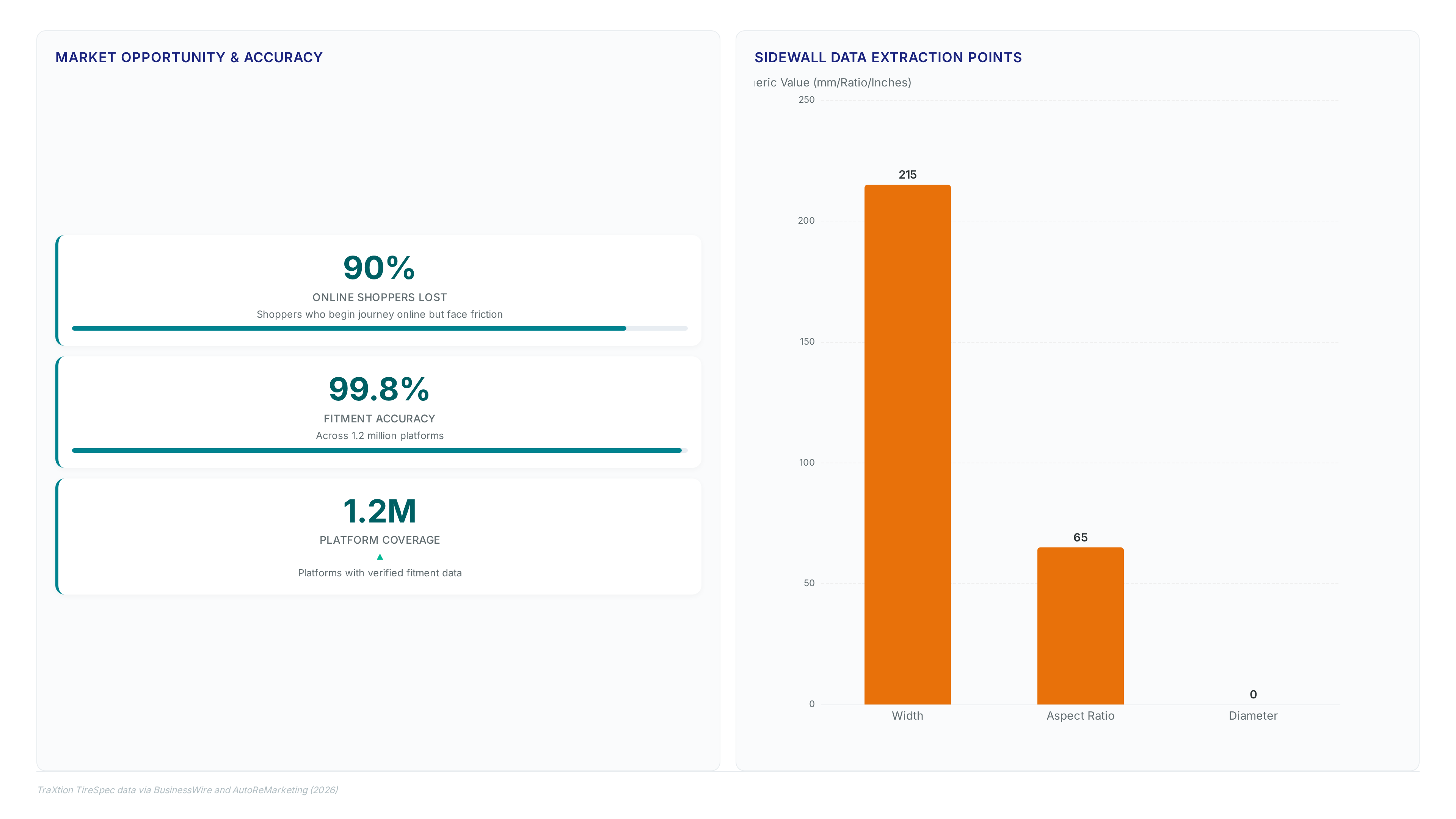
Dealerships eliminate the manual data entry that stalls digital sales funnels by deploying AI tire scanning. The TireSpec architecture functions as a pure software embed, requiring zero additional hardware or consumer app downloads to operate. This website widget uses proprietary optical character recognition to parse sidewall markings directly from smartphone photos, instantly converting visual noise into structured inventory queries. Letting the tire serve as the search engine removes the need for shoppers to decipher complex alphanumeric codes or locate vehicle VINs. The deployment footprint extends beyond mobile handsets, functioning on desktops through QR code scanning to bridge device gaps.
The mechanism relies on computer vision to parse visual data. Shoppers avoid deciphering complex markings or locating vehicle VINs, a barrier that often stalls conversion on standard e-commerce platforms. Traditional tools require users to know their exact trim level. This system extracts necessary specifications automatically from the image. Visual search deployment depends on image clarity. Obscured sidewalls may still require manual verification by sales staff. Network operators and site architects see that reducing input complexity directly correlates to maintaining session continuity. Removing the cognitive load of data entry transforms browse-and-leave behavior into a qualified sales opportunity within seconds. The solution captures intent at the moment of inspection, keeping the inquiry within the dealer's digital system for immediate fulfillment.
Application: Automated Sidewall Recognition Versus Manual Tire Size Entry
Automated sidewall recognition removes the friction of manual alphanumeric entry by letting the tire become the search engine. Legacy tools force shoppers to decipher complex codes and navigate deep menus, a process causing website abandonment before a quote generates. Static calculators demand precise manual input to understand dimensions.
| Feature | Automated Recognition | Manual Entry |
|---|---|---|
| Input Method | Smartphone camera photo | Alphanumeric typing |
| Data Source | Sidewall image analysis | User knowledge/memory |
| Error Risk | Low (AI-verified) | High (transposition typos) |
| User Friction | Minimal (single tap) | Significant (multi-step) |
Removing typing errors prevents lost sales from incorrect fits. Camera clarity remains a constraint. Blurry images may require a retake, whereas manual entry forces a guess. Dealerships gain an advantage by eliminating the cognitive load of decoding markings like aspect ratios or load indices manually. This shift reduces the barrier for customers who cannot identify their current tire specifications. Integrating directly into existing retailer sites keeps the transaction context local rather than redirecting users to third-party aggregators. The result is a simplified path from visual identification to instant pricing that manual methods cannot match in speed or accuracy.
Integrating Real-Time Tire Pricing into Dealership Websites
TireSpec Widget Architecture for Direct Website Embedding
Injecting a lightweight JavaScript snippet into host dealership HTML starts the integration, skipping complex hardware installations entirely. This direct embedding strategy lets the website widget operate as a native module inside existing retail infrastructures. Operators deploy the tool to capture the vast majority of shoppers who start purchases online yet abandon sites because manual search interfaces feel cumbersome. The architecture uses computer vision to parse sidewall images instantly, so consumers never have to manually transcribe alphanumeric tire codes. Legacy forms demand precise vehicle trim knowledge, but this system accepts raw visual data as the primary query input instead. Deployment supports mobile browsers and desktop environments through QR code scanning or direct button interaction. Maintaining session continuity provides the technical advantage; shoppers receive pricing without redirecting to third-party aggregators. Poor illumination during image capture can degrade optical character recognition accuracy, which presents a clear constraint. Site CSS must not conflict with the widget's overlay z-index to prevent rendering errors. This configuration anchors the AI-powered engine directly to the retailer's inventory database. Removing the app download barrier reduces friction points that usually interrupt the conversion funnel. Visual identification transitions smoothly to finalized quote generation within a single browser tab.
Configuring QR Code and Button Access Points
Embedding two distinct access triggers enables real-time tire pricing: a clickable button for mobile users and a flexible QR code for desktop visitors. This dual-path configuration ensures the mobile-first experience functions across all hardware, allowing shoppers to initiate AI recognition without leaving the retailer's domain. Deployment logic routes desktop traffic to a scannable image while presenting a camera-activation button on handheld devices, reflecting a hybrid browsing trend where users start on large screens but prefer smartphone cameras for data input.
- Inject the provided JavaScript snippet into the website header to load the TireSpec widget asynchronously.
- Configure the display mode to render a "Snap Photo" button on mobile viewports and a QR code on desktop widths.
- Verify that the QR code scanning pathway correctly redirects mobile cameras to the secure recognition engine.
Universal access competes with interface clutter; placing both triggers on all devices confuses users, whereas context-aware rendering preserves screen real estate. Static forms cannot match this setup, which uses computer vision to translate sidewall codes instantly and bridges the knowledge gap for average consumers. Desktop-only users without a secondary smartphone cannot complete the scan, so clear on-screen instructions to "use your phone" become necessary. The website widget captures shopper data instantly while maintaining the host site's navigation context.
Validating Real-Time Inventory and Pricing Sync
Confirm distribution platform handshakes to guarantee the website widget displays live stock levels instead of cached catalogs.
- Verify the integration connects to leading tire distribution software for real-time inventory accuracy.
- Test that product availability flags update instantly when warehouse counts change.
- Validate that pricing structures reflect current contract rates without manual intervention.
| Validation Target | Legacy Method | TireSpec Approach |
|---|---|---|
| Data Source | Static CSV upload | Live API stream |
| Update Latency | Daily batch | Instant |
| Error Type | Stale pricing | Flexible sync |
Preventing the sale of unavailable units requires operators to secure the API bridge, a common failure point in high-volume retail. Data freshness acts as a competitive moat; databases like Wheel-Size.com update instantly upon notification of new vehicles, setting a standard for fitment accuracy that static annual catalogs cannot match. Lost trust occurs when a customer selects an item shown as available but is actually backordered. Traditional tools force users through multiple clicks, yet this system competes on time-to-quote rather than just breadth. Distributor update frequency creates the limitation; if their feed lags, the dealership display inherits that delay regardless of widget speed.
About
Mark Phillips serves as Editor of Aftermarket Intel at KZMALL, where he specializes in tracking distribution channels and e-commerce evolution within the global automotive aftermarket. His daily work involves analyzing competitive moves by substantial distributors and evaluating how digital tools reshape parts procurement, making him uniquely qualified to assess TireSpec. This AI-powered solution, which converts smartphone photos into instant tire quotes, directly aligns with Phillips' focus on technology-driven sales strategies for independent retailers. As KZMALL expands its JOYGROUND tire brand and digital catalog capabilities, Phillips uses his deep understanding of B2B wholesale dynamics to contextualize how hardware-free innovations like TireSpec empower repair shops and fleet operators. His expertise bridges the gap between emerging consumer-facing technologies and the practical needs of professional service centers seeking efficient, accurate fitment data. Through this lens, Phillips provides critical insight into how such tools drive revenue while simplifying the complex tire replacement process for both dealers and drivers.
Conclusion
Scaling TireSpec reveals that API latency becomes the primary bottleneck, not image capture speed. While the per-vehicle decode cost remains low at roughly $1.99, the operational burden shifts to maintaining real-time inventory integrity across disparate distributor feeds. Dealerships relying on batch updates will face customer friction when digital availability conflicts with physical stock, eroding the very trust the tool builds. The technology succeeds only when the backend data pipeline matches the frontend speed of the camera scan.
Dealers must prioritize live API integration over static catalog uploads immediately to prevent pricing and stock discrepancies. This shift is necessary for any retailer aiming to convert the majority of shoppers who start their path online but demand immediate confirmation. Do not deploy the widget until your distribution partner confirms flexible sync capabilities, as stale data renders the fitment accuracy irrelevant. The window to differentiate on service speed is narrow, and legacy update cycles will undermine the user experience.
Start this week by requesting a latency test report from your current tire distributor to measure the gap between their warehouse counts and your website display. This single audit identifies whether your infrastructure can support instant validation or if it requires a new data partnership before launch.
Frequently Asked Questions
Retailers lose 90% of potential tire shoppers to manual entry friction. This massive drop-off occurs because customers cannot accurately recall or locate precise alphanumeric codes required by legacy search interfaces.
Shoppers need zero prior knowledge of vehicle trim levels or VINs. The system uses computer vision to read sidewall markings directly, removing the requirement for users to decipher complex codes themselves.
The system provides replacement recommendations and pricing in mere seconds. This speed eliminates the minutes typically spent on manual data entry, significantly reducing cognitive load and preventing website abandonment during the process.
No mobile app or software download is required for operation. Users simply access the widget through their standard web browser on mobile devices or desktops to snap photos and get quotes.
Advanced artificial intelligence and optical character recognition drive the identification process. These technologies allow the widget to automatically identify tire make, model, and size from a single smartphone image without human input.