
Plastic repair center cuts waste with zero-waste model
Thermosets and composites will hit 8% of vehicle composition by 2027 per SensXpert. The industry can no longer ignore the plastic crisis. The Plastic Repair Excellence Center in Dallas proves that live repair operations are the only viable path forward for modern automotive infrastructure. This facility moves beyond theoretical training to validate ISO-backed methodologies against strict OEM specifications, specifically targeting polypropylene (PP) components that dominate exterior damage.
This center functions as a zero-waste environment where damaged parts are strictly segregated by material type for responsible recovery. It contrasts sharply with the wastefulness of traditional replacement models. Unlike previous initiatives that dabbled in smart repair or aluminum, Plasnomic's exclusive focus on plastic creates a specialized framework backed by real-world data. By integrating collision repairers, insurers, and OEMs into a single innovation environment, the Dallas flagship establishes a scalable model for circularity. This is not merely a training ground; it is the physical manifestation of a necessary shift away from fragmented approaches toward a unified, skilled workforce capable of handling the complex material science of tomorrow's vehicles.
The Role of the Plastic Repair Excellence Center in Circular Automotive Infrastructure
Defining the Plastic Repair Excellence Center as a Zero-Waste Hub
The Plastic Repair Excellence Center opens its doors in August as a Dallas-based facility proving circular repair solutions through live operational data. Functioning beyond a standard classroom, this environment serves as a functional research hub where real-world repair activity verifies best practices against strict OEM specifications. Leadership at Plasnomic explicitly excludes smart repair or aluminum work to limit scope strictly to polymer component restoration. Narrow focus addresses the technical complexity inherent in restoring dimensional tolerances and thermal stability within polypropylene systems. Generalist collision facilities often lack the specific tooling required for validated plastic fusion.
| Feature | General Collision Shop | Plastic Repair Excellence Center |
|---|---|---|
| Primary Scope | Mixed materials (steel, aluminum, plastic) | Exclusive plastic component repair |
| Methodology | Fragmented replacement habits | Validated circular repair models |
| Waste Output | High landfill volume | Zero-waste segregation streams |
Specialized training represents a barrier because most existing workforces do not possess these skills. Dimovski the organization does not focus on unrelated repair categories, creating a sharp divide between generalists and specialists. Facilities ignoring this distinction risk retaining high replacement costs while missing material recovery opportunities. The shift demands a complete operational overhaul rather than simple tool addition.
Operationalizing Circular Repair Solutions in Automotive Infrastructure
A zero-waste repair environment physically segregates polypropylene waste streams to eliminate landfill dependency within collision facilities. Plastic components constitute 60% of average claim replacements, creating a massive volume of potential material for recovery rather than disposal. The Dallas facility addresses this by directing all non-repairable parts and repair waste into identified recycling streams instead of general trash. This operational shift targets the multi-billion dollar global automotive plastics market by retaining material value inside the supply chain. Traditional shops often lack the sorting protocols required to handle mixed polymer blends effectively. Plasnomic emphasizes evidence-based standards so recovered materials meet strict performance criteria before re-entry. Transitioning from theoretical circularity to physical execution introduces measurable tension between throughput speed and sorting accuracy. Technicians must pause to categorize materials, which initially slows bay turnover rates compared to immediate binning. Long-term cost avoidance of raw material procurement offsets this operational drag. The center functions as a live case.
| Metric | Traditional Approach | Circular Model |
|---|---|---|
| Waste Destination | Landfill | Material Recovery |
| Component Focus | Replacement | Restoration |
| Data Source | Assumption | Validation |
Strict segregation protocols prevent contaminated batches that recyclers reject entirely. Human error remains the primary limitation; consistent training serves as the only control mechanism without automated sorting. Operators must decide if their current labor model can sustain the required attention to detail.
Strategic Milestones for Building the Future Framework of Plastic Repair
Establishing the Plastic Repair Excellence Center required the March 2025 appointment of Brian Driehorst as CEO to drive standardization. This leadership shift enabled formation of the Global Plastic Repair Alliance, creating a governance body distinct from product vendors. Technical validation followed through benchmarking eleven global providers, ensuring repair materials meet strict OEM specifications for polypropylene flexibility. Selection of Tanner Jacobs as Director of Technical Excellence in May 2026 further solidified the operational hierarchy required for this specialized scope.
| Strategic Phase | Key Action | Outcome |
|---|---|---|
| Leadership | CEO Appointment | Centralized decision authority |
| Governance | Alliance Formation | Unified industry standards |
| Validation | Provider Benchmarking | Verified material compatibility |
The Dallas facility serves as the physical anchor for these abstract governance changes. Limiting scope exclusively to plastic repair prevents dilution of technical resources often seen in general collision centers. Narrow focus creates a dependency on widespread industry adoption to achieve economies of scale. Cost per repaired unit remains prohibitive compared to replacement without broad participation from insurers and OEMs. The circular repair solutions model demands high volume to offset the labor intensity of proper polymer restoration. Success relies on converting theoretical standards into repeatable shop-floor workflows that rival the speed of part swapping.
Operational Mechanics of Live Repair and Material Segregation Systems
Defining the Live Repair and Material Segregation Workflow
Real-world repair activity defines the Dallas Excellence Center, distinguishing it from a standard classroom model. This facility functions as a live repair, research, and innovation environment Operational flow begins when staff identify damaged polypropylene components for potential restoration instead of immediate replacement. Technicians then segregate materials by polymer type and damage severity to feed distinct processing streams. This rigorous sorting enables the zero-waste plastic repair environment to direct non-repairable waste into specific recycling channels while preserving viable parts for refurbishment.
A critical tension exists between repair speed and material purity; rushing the segregation phase contaminates the recycling stream and invalidates the circular economic model. Operators often overlook that improper sorting of polypropylene blends renders the recycled feedstock useless for new OEM-grade parts. The limitation is clear: without rigorous adherence to material segregation, the financial benefits of the repair-first model evaporate through lost material value. Successful deployment requires discarding the convenience of bulk disposal in favor of granular tracking.
Validation Requirements for Repair Integrity and Stakeholder Alignment
Validation begins with ISO-backed laboratory data combined with real-world repair validation to test polypropylene substrates. Operators must execute a strict four-step protocol to ensure repair integrity across diverse stakeholder requirements.
- Isolate damaged components for polymer identification before any thermal application occurs.
- Apply nitrogen welding tools
- Segregate waste streams by chemical composition rather than visual appearance.
- Direct non-repairable remnants into verified circular recovery channels. This technical rigor addresses the historical reliance on assumptions within the sector by prioritizing evidence-based Collaboration between substantial networks like Fix Network and Driven Brands ensures these protocols scale beyond single locations. The cost of this alignment is measurable coordination time, yet the alternative remains fragmented replacement habits that inflate claim costs.
Failure to validate weld materials against original characteristics results in premature structural failure under thermal stress. Stakeholders must accept that rigorous comparative evaluation
Comparative Analysis of Repair-First Strategies Versus Traditional Replacement Models
Defining Repair-First Economics Against Replace-and-Dispose Models
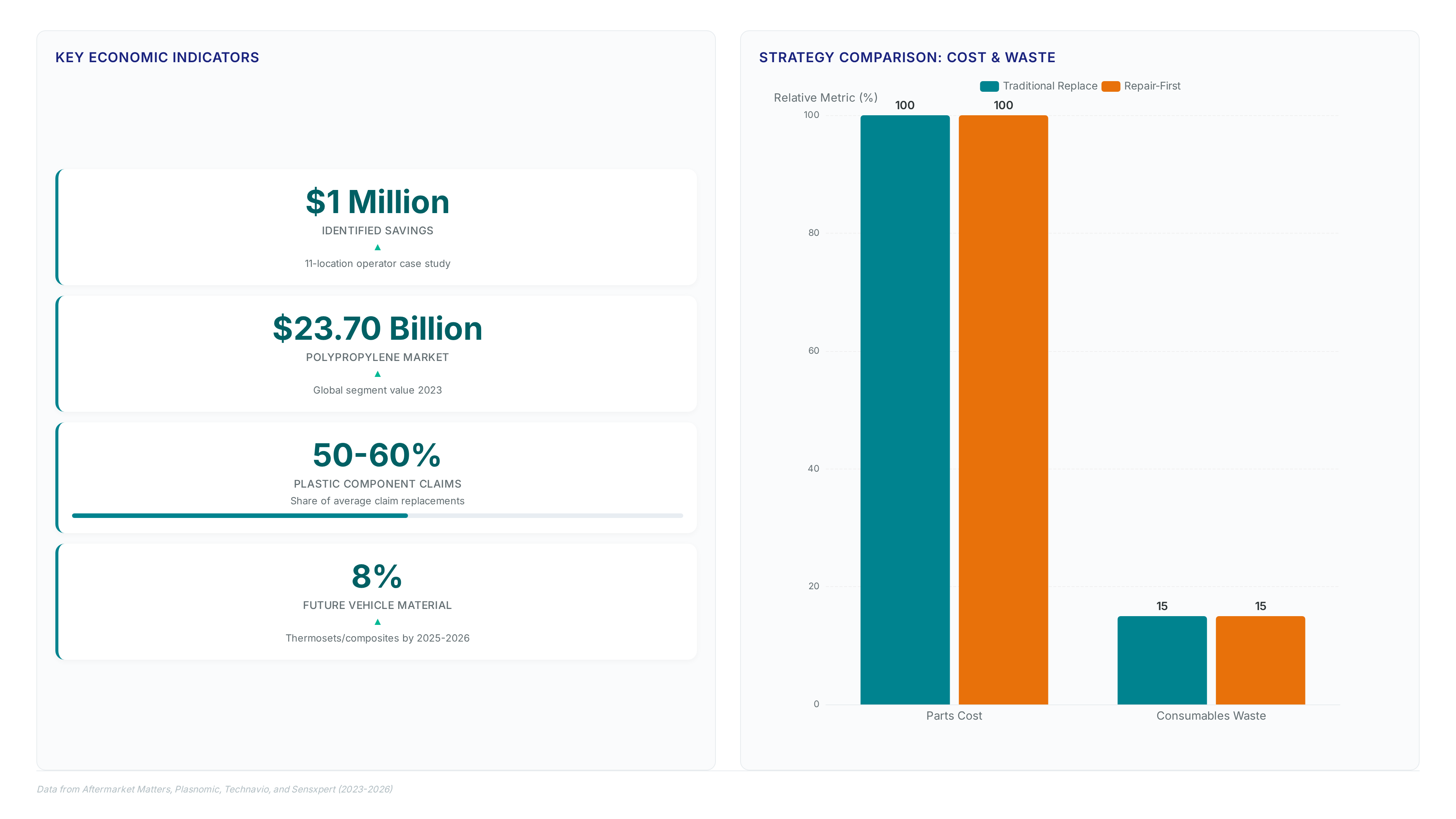
Repair-first strategies replace automatic part swapping with data-driven workflows that validate polypropylene restoration before disposal. Traditional models discard components based on visual heuristics, whereas circular repair models mandate material segregation and technical validation to determine fixability. This shift transforms the Dallas Excellence Center from a classroom into a live economic engine where waste reduction directly impacts claim costs.
| Dimension | Replace-and-Dispose Model | Repair-First Circular Model |
|---|---|---|
| Primary Driver | Speed of throughput | Lifecycle cost reduction |
| Waste Stream | Landfill destination | Material recovery streams |
| Labor Skill | Generalist application | Specialized polymer science |
| Cost Basis | New part procurement | Tooling and labor time |
Operators adopting circular repair solutions face higher initial training overhead but gain margin protection against rising parts inflation. The limitation remains the scarcity of technicians skilled in nitrogen welding and polymer identification. Without this specialized workforce, facilities revert to fragmented replacement habits that inflate total loss ratios. Plasnomic asserts that moving beyond these fragmented approaches requires a unified standard backed by data-driven strategies. The economic tension is clear: speed favors replacement, but profitability increasingly favors the precision of repair. Facility operators must choose between short-term velocity and long-term margin preservation.
ROI Scenarios for Plastic Bumper and Trim Repair Versus Replacement
Direct economic justification for repair-first models emerges from an 11-location operator identifying $1 Million This financial leakage stems from inefficiencies where shops automatically replace plastic components rather than validating fixability. The global polypropylene segment held a value of billions of dollars in 2023, creating a massive inventory liability when minor damage triggers total part write-offs. Operators must weigh the immediate labor cost of repair against the hidden supply chain volatility of replacement parts.
| Metric | Replace-and-Dispose | Repair-First Strategy |
|---|---|---|
| Parts Cost | Full Retail Price | Under a small fraction of Consumables |
| Waste Stream | High Volume Landfill | Near-Zero Recovery |
| Turnaround | Dependent on Shipping | Same-Day Completion |
Adoption requires shifting from visual heuristics to validated technical processes. The shifting trend away from automatic replacement demands that technicians distinguish between structural failures and superficial cosmetic damage. However, the limitation remains the lack of standardized training across the fragmented collision market. Without unified specifications, insurers hesitate to approve labor-intensive repairs over cheap part swaps. The implication for network operators is clear: failing to implement circular repair solutions locks businesses into a cycle of rising material costs and waste disposal fees. Stakeholders like Fix Network and Driven Brands recognize that controlling claim severity now dictates future profitability.
Decision Framework: Validating Repair Viability for Thermosets and Composites
Thermosets and composites will reach 8% of vehicle composition by 2027, forcing technicians to distinguish cross-linked polymers from standard thermoplastics. Traditional replacement logic fails here because material chemistry dictates structural recovery limits rather than visual damage alone.
| Criterion | Thermoplastic (PP/EPDM) | Thermoset / Composite |
|---|---|---|
| Repair Mechanism | Thermal fusion | Chemical bonding or patching |
| Failure Mode | Melt deformation | Delamination or fracture |
| Viability Signal | Heat reactivation possible | Structural integrity compromised |
| Waste Outcome | Fully recyclable stream | Landfill or downcycled filler |
Operators must validate polymer type before applying heat, as attempting to melt a thermoset causes irreversible degradation. The Dallas Excellence Center addresses this gap by testing nitrogen welding tools against diverse substrates to confirm fixability thresholds. A critical tension exists between speed and accuracy; rushing diagnosis on mixed-material assemblies often converts a repairable composite panel into total waste. Insurers like GEICO benefit from reduced claim volatility when shops correctly identify non-repairable thermosets early in the workflow. Without precise identification protocols, the industry risks contaminating recycling streams with incompatible resins. Validating repair viability requires rejecting the assumption that all plastics respond to thermal manipulation.
Implementing Industry-Wide Collaboration for Scalable Plastic Repair Solutions
Defining Specialized Workforce Models for Data-Driven Plastic Repair

Generic technician roles fail when facing the complexity of modern polymer chemistry. Repair-first strategies demand specialized workforce models grounded in material science rather than visual estimation. Plastic components represent the majority of claim replacements, yet legacy approaches often default to replacement due to a lack of specific material identification skills. This gap forces shops to discard fixable parts, inflating costs unnecessarily. A dedicated plastic repair training facility must therefore function as a live research environment where technicians validate repair viability against OEM specifications using empirical data. The evidence-based Operators learn to distinguish between thermoplastic and thermoset structures through direct application.
Thermoset differentiation presents a steep learning curve that standard training rarely covers. Operators cannot apply thermoplastic fusion techniques to cross-linked polymers without risking structural failure. Consequently, the industry must prioritize technical validation over throughput speed during the transition period. Without this specialized focus, the projected growth in composite vehicle materials will outpace the workforce's ability to sustain circular repair economies.
Establishing Multi-Stakeholder Alliances with OEMs and Insurers
Collision centers must align with insurers like GEICO The Global Plastic Repair Alliance structure provides the necessary framework for shops to secure OEM buy-in by aggregating technical data rather than relying on visual heuristics. Individual operators lack the use to shift supply chain behaviors away from automatic part write-offs without this coalition. Real-world migration toward standardized plastic repair is accelerating as substantial entities like Fix Network adopt evidence-driven repair standards to ensure consistency across their operations. This collective approach addresses the economic reality where plastic parts constitute the majority of claim replacements yet offer high recovery potential through skilled labor. Operators joining these alliances gain access to validated workflows that reduce preventable losses identified in multi-location audits.
Coordination overhead required to maintain consensus among competing interests remains a significant hurdle. Shops attempting to mimic this structure independently often fail to secure the volume commitments needed to influence OEM policy changes. Success requires embedding recycling programs directly into the repair workflow, segregating thermosets from thermoplastics before any material recovery occurs. This operational discipline transforms waste streams into auditable assets that insurers can track for compliance reporting. Technicians often miss revenue by failing to distinguish polypropylene from thermosets before disposal. The first step requires training staff to identify resin codes using ISO-backed standards rather than visual guessing.
Operators should implement training standards that mandate physical sorting bins for every polymer type found in modern collision repairs. Facilities must also validate repair viability against OEM specifications to prevent unnecessary part write-offs. Using nitrogen welding tools allows for structural restoration without the carbon footprint of manufacturing new bumpers. Improper heat application ruins the polymer chain, rendering the part unfixable, which highlights the technical skill constraint. Shops must therefore pair equipment acquisition with certified curriculum adoption. Finally, operators should document all recovered kilograms to prove circular economy participation to insurers. This data creates value when negotiating claim settlements based on actual repair costs versus replacement lists. Without verified metrics, the financial argument for zero-waste operations remains theoretical rather than actionable.
About
Dmitry Volkov serves as a Senior Automotive Technical Writer at KZMALL Auto Parts, where he specializes in translating complex engineering standards and manufacturing processes into clear industry analysis. His daily work requires a deep understanding of component integrity and repair methodologies, making him uniquely qualified to evaluate the significance of Plasnomic's new Plastic Repair Excellence Center. As KZMALL distributes over 50,000 SKUs including critical consumables and chemicals, Volkov recognizes that advanced plastic repair is necessary for maintaining the quality expectations of the independent aftermarket. His expertise in ACES/PIES fitment data and technical specifications allows him to articulate how Plasnomic's focus on innovation and sustainability directly impacts parts compatibility and repair outcomes. By connecting rigorous technical documentation with real-world application, Volkov provides readers with a factual perspective on how this Dallas facility sets a new benchmark for automotive plastic restoration and professional training standards.
Conclusion
Scaling plastic recovery fails when shops treat material sorting as a secondary task rather than a primary revenue stream. Relying on visual identification creates a bottleneck where high-value polypropylene gets incinerated alongside non-repairable thermosets, destroying potential profit centers. You must transition from ad-hoc fixes to a standardized material segregation protocol before Q3 to capture this value. Do not simply purchase nitrogen welding tools; instead, install distinct, labeled containment bins for every polymer type currently entering your bay and require staff to log the weight of each category daily. This data transforms waste from an invisible loss into a negotiable asset when discussing claim settlements with adjusters. Facilities that validate repair viability against OEM specs while simultaneously tracking recovered kilograms will secure favorable terms with insurers seeking compliance metrics. Those delaying this dual approach will find their labor rates undercut by competitors who monetize the waste stream. Start by training your lead technician to distinguish resin codes physically today, ensuring your team stops discarding revenue before the next fiscal quarter begins.
Frequently Asked Questions
Plastic parts drive sixty percent of average claim replacements, demanding exclusive attention. Generalist shops miss recovery opportunities, whereas this center targets the massive volume of polypropylene components specifically to eliminate landfill dependency effectively.
The facility segregates all plastic waste by material type for responsible recovery streams. This approach captures value from the sixty percent of claims involving plastic, preventing usable polymers from entering general trash bins at collision facilities.
This operational shift directly targets the one hundred fifteen point two billion dollar global automotive plastics market. By retaining material value inside the supply chain, the center reduces the financial drain of replacing expensive polymer components entirely.
Thermosets and composites will reach eight percent of vehicle composition, increasing repair complexity. This rising percentage necessitates specialized fusion techniques that general collision facilities currently lack, driving the need for dedicated plastic repair excellence centers globally.
Repair strategies avoid the full retail price of new parts while minimizing waste. With plastic representing sixty percent of replacements, shifting to validated repair methods significantly lowers overall claim costs compared to traditional replacement models.