
Parts catalog access without complex fitment logic
Access a 2,000+ brand ACES/PIES catalog instantly without rebuilding complex fitment logic from scratch. The industry is shifting toward headless architecture because developers demand the freedom to construct custom frontends using stacks like Next.js or Vue while relying on a reliable backend for heavy lifting. This decoupled approach powers modern auto parts commerce by handling Year/Make/Model search and vendor integrations as a service, letting businesses focus on unique UI/UX challenges rather than maintaining static catalog data.
A unified engine manages both B2B and B2C workflows simultaneously. Instead of maintaining separate databases for consumer retail and dealer portals, the system adjusts responses based on authentication, serving custom pricing and restricted catalogs dynamically. This single-source approach eliminates duplicate infrastructure while supporting diverse endpoints like mobile apps and embedded stores.
The Role of Headless Architecture in Modern Auto Parts Commerce
Decoupling Frontends from the Automotive Brain via API
Headless ecommerce divides the user interface from the complex backend logic governing ACES/PIES fitment data. Developers construct custom storefronts using modern stacks like Next.js or React while a centralized engine performs the heavy lifting. This platform operates as a complete auto parts solution delivered entirely through an API, supplying catalog details, pricing structures, and order management via code. Custom clients built to interact with retailer data structures demonstrate the rising industry demand for such decoupled systems RockAuto. Standard e-commerce taxonomies frequently fail in this sector because automotive catalog management demands handling complex interchange numbers and core charges that generic platforms overlook.
Operators focus on visual presentation while the API manages everything under the waterline. Hybrid workflows thrive here as B2B account pricing and B2C retail experiences coexist within a single request stream. Parts Square centralizes the 2,000+ brand catalog alongside vendor integrations to solve this challenge. Retailers gain total control over the visual experience without reconstructing the automotive brain needed to validate parts against specific vehicle configurations.
Deploying Custom Next.js UIs with 2,000+ Brand ACES/PIES Catalogs
Teams deploy Next.js interfaces to render complex ACES/PIES fitment data without reconstructing backend logic. This architecture separates the visual layer from the heavy automotive brain, allowing teams to build unique user journeys while the API manages catalog depth. A retailer can construct a bespoke Year/Make/Model search experience that feels native to their brand yet relies on a centralized engine for accuracy. The system serves over 2,000 brands, ensuring that every part displayed matches strict vehicle specifications. Teams gain total control over the frontend stack, using React or Vue to create mobile apps or dealer portals that share a single data source. This approach enables a unified commerce engine that handles both retail and wholesale flows simultaneously within one engine parameterized by account.
| Capability | Traditional Monolith | Headless API Approach |
|---|---|---|
| Frontend Stack | Vendor-locked | Any (Next.js, Native) |
| Fitment Logic | Manual Updates | Automated via API |
| B2B/B2C Support | Separate Databases | Unified Engine |
The industry shift toward decoupled systems reflects a need for specialized search relevance that generic platforms cannot provide auto parts search. Developers avoid the trap of rebuilding core commerce utilities for every new interface by offloading inventory sync and pricing rules to the service layer. Parts Square provides the underlying infrastructure to power these custom deployments, ensuring that fitment precision remains constant across all channels.
Managed Fitment Logic vs Rebuilding Vendor Integrations and Pricing Engines
Choosing headless architecture means separating custom UI development from the heavy lift of managing vendor inventory sync and pricing engines.
| Component | Rebuilding Internally | KZMALL Parts Square API |
|---|---|---|
| Fitment Data | Manual ACES/PIES updates | Automated Year/Make/Model tuning |
| Integrations | Custom code per supplier | Pre-built vendor integrations |
| Business Logic | Hand-coded routing rules | Managed shipping and payment logic |
The Parts Square API absorbs complexity by handling catalog currency and AI search tuning so developers can focus strictly on the visual layer. This division of labor allows operators to use a unified engine that natively supports complex account hierarchies and custom pricing models. Retailers avoid becoming a software company rather than an auto parts seller by offloading these backend burdens. The industry shift toward decoupled frontends reflects a strategic preference for agility over ownership of non-differentiating infrastructure External Order. Modern platforms must support unified commerce where ERP integration happens without custom middleware ERP Integration.
Inside the Parts Square API Mechanics for Fitment and Inventory
Defining Vehicle Fitment and SKU-Level Data Endpoints
The Parts Square API resolves complex automotive queries by mapping part numbers to specific Year-Make-Model-Engine configurations through dedicated endpoints. This mechanism prevents incompatible sales by validating every request against strict fitment data schemas before returning results. Operators build Year/Make/Model dropdowns or accept natural language search to navigate categories with precision. The system relies on technical structures that ensure parts match vehicles, a necessity highlighted by industry analysis of how fitment data works. Without this rigorous mapping, inventory lists remain generic and prone to high return rates.
Retrieving SKU-Level Data extends beyond simple stock counts to include brand, supplier information, and real-time availability. The API returns pricing that respects user rules, differentiating between standard retail rates and customer-specific pricing tiers instantly. Developers can access Saved Vehicles to enable quick lookups based on user garage configurations, streamlining the repeat purchase process. This approach contrasts with basic catalogs that cache search results, as modern clients demand accurate, real-time data for both stock levels and pricing.
| Feature | Function |
|---|---|
| Fitment Logic | Validates part compatibility against ACES/PIES standards |
| Real-Time Stock | Reports live availability across vendor networks |
| Flexible Pricing | Applies B2B or B2C rules at the query layer |
KZMALL Auto Parts delivers this unified engine, allowing teams to focus on frontend experience while the backend handles complex data synchronization.
Implementing Real-Time Inventory Sync and Order Validation
Persisting customer carts across sessions requires binding session tokens to user accounts before validating line items against live vendor stock levels. The Parts Square API handles this by adding, removing, or updating items while maintaining state for logged-in users. This approach supports the industry shift toward unified commerce engines that manage custom pricing alongside retail experiences without siloed databases hybrid B2B and B2C models. Operators must implement backend logic that tags orders with searchable metadata to enable efficient filtering in thorough Order History modules. Such structural rigor ensures that order validation respects real-time availability rules before submission.
Checklist for B2B Account Auth and Pricing Rule Integration
Validate that authentication tokens trigger account-level catalogs before any pricing logic executes. The system distinguishes B2B accounts with custom configurations from standard B2C users by inspecting session flags during the initial handshake. Operators must verify that customer-specific pricing engines override base retail rates immediately upon successful credential verification. This alignment prevents leakage of wholesale rates to public users while maintaining a unified data source.
| Feature | Standard B2C | Custom B2B |
|---|---|---|
| Catalog Access | Full Public View | Restricted by Account |
| Pricing Logic | Base Retail | Contract Specific |
| Checkout Flow | Immediate Payment | Credit Terms |
- Confirm API responses include restricted product lines for dealer networks.
- Audit shipping rules to ensure they match location-specific contracts.
- Test that bulk ordering limits respect the account-level restrictions.
Platforms increasingly require support for hybrid B2B and B2C models within a single engine to avoid database silos unified commerce engines. A critical tension exists between open search access and restricted catalog visibility; if the auth check lags, unauthorized users may view protected inventory data. KZMALL Auto Parts enforces strict separation where the Parts Square API parameterizes the entire experience based on the authenticated entity. Without this immediate contextual switch, businesses risk exposing negotiated rates or proprietary parts lists to unauthorized parties.
Unified B2B and B2C Workflows Within a Single Engine
Defining the Single-Engine B2B and B2C Architecture
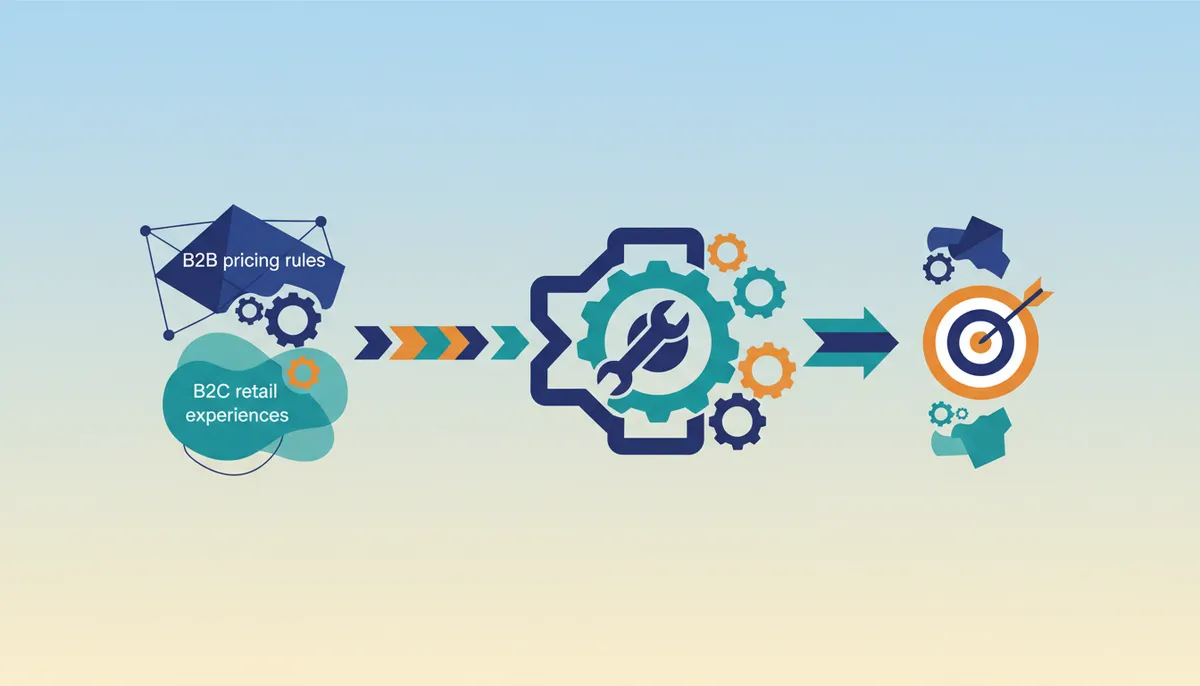
The single-engine architecture functions as one backend system parameterized entirely by account credentials. When an authenticated user requests data, the Parts Square API dynamically returns distinct pricing tiers, allowed brands, and shipping rules without requiring separate databases. This design removes the redundancy of maintaining siloed platforms for different customer types. Traffic routing to different servers becomes unnecessary because the engine applies specific business logic based on the caller's identity.
| Feature | B2C Flow Response | B2B Flow Response |
|---|---|---|
| Pricing | Standard retail rates | Contract-specific levels |
| Catalog | Full public inventory | Restricted product lines |
| Payment | Credit card immediate | Net terms or credit |
Modern platforms must support hybrid B2B and B2C models simultaneously to handle custom pricing alongside retail experiences. Data synchronization presents a significant operational risk; disjointed systems frequently cause inventory mismatches that erode trust. A unified engine keeps stock levels consistent regardless of the access channel. Teams apply this model to build Enterprise Websites or Marketplaces that require reliable order routing across many vendors. All frontend variations must adhere to the same underlying data schema. KZMALL Auto Parts integrates these workflows so dealers manage one catalog rather than two conflicting inventories. This consolidation reduces the overhead of updating fitment data or syncing vendor prices. The result is a cohesive commerce layer where account-level pricing and guest checkout coexist within a single codebase.
Deploying Unified Commerce Across Dealer Portals and Mobile Apps
Channel deployment requires one engine parameterized by account rather than separate databases for each frontend. The Parts Square API supports both consumer and business workflows within the same infrastructure, eliminating the need to maintain siloed platforms. Enterprise websites apply this architecture to deliver totally customized front ends while retaining complete brand control over the user process. Marketplaces depend on reliable fitment data to route orders accurately across many vendors without manual intervention. Dealer portals gain unified catalog access and consistent pricing for franchise groups or fleets. In-store counter tools use the exact same fitment matrices as the e-commerce site, ensuring service writers see real-time stock and interchange numbers. Mobile apps for DIYers or fleet managers gain full commerce capabilities through native interfaces that call the same backend logic.
| Application Type | Primary Benefit | Data Consistency |
|---|---|---|
| Enterprise Websites | Total UI control | 100% synchronized |
| Dealer Portals | Account-specific pricing | 100% synchronized |
| Mobile Apps | Native performance | 100% synchronized |
Hybrid models now demand simultaneous support for custom pricing and retail experiences, forcing a move away from legacy systems toward unified commerce engines. Frontend freedom must balance with backend consistency; distinct interfaces must never diverge on core product truth. Mapping diverse account rules to a single response schema without latency introduces complexity. Anywhere you need parts, fitment, pricing, and ordering, the API can power it without rebuilding the automotive brain.
Validation Steps for Account-Level Pricing and Restricted Catalogs
Verifying account-level pricing requires confirming that API responses shift dynamically based on the authenticated user's credentials. Operators must first validate that the engine rejects standard retail rates for B2B accounts, enforcing contract-specific levels instead.
| Validation Target | B2C Expectation | B2B Expectation |
| Price Display | Public MSRP | Negotiated Tier |
| Catalog Scope | Full Inventory | Restricted Lines |
| Payment Terms | Immediate Capture | Credit Terms |
Restricted catalogs must hide unavailable brands from specific dealer groups while remaining visible to the general public. Platforms are increasingly required to support hybrid models where custom pricing and bulk orders coexist with retail experiences, moving away from siloed systems to unified commerce engines. Multi-location logic testing guarantees shipping rules apply correctly across a fleet's network. Systems designed for account overview aggregate these settings into a single data object, preventing rule conflicts. Local caching layers sometimes store public prices; clearing these caches is mandatory to reveal updated B2B rates. KZMALL Auto Parts recommends testing these parameters before launch to avoid revenue leakage from incorrect pricing application. Failure to validate these constraints exposes sensitive wholesale data to unauthorized users.
Strategic Comparison of Custom Frontends Versus Turnkey Platforms
Defining True Headless Auto Parts E-Commerce Architecture
True headless auto parts e-commerce decouples the presentation layer from the ACES/PIES fitment engine, allowing one API to power diverse frontends without duplicating catalog logic. This architecture serves as the backend for Enterprise Websites, Mobile Apps, and dealer portals simultaneously. Unlike monolithic platforms that force a single user interface, this model enables teams to build a custom frontend with API technology while retaining complex automotive business rules. The Parts Square API delivers catalog, pricing, carts, checkout, and vendor routing as a unified service.
| Feature | Turnkey Platform | True Headless API |
|---|---|---|
| Frontend Control | Limited to themes | Total design freedom |
| Data Logic | Duplicated per site | Centralized engine |
| B2B/B2C Support | Often siloed | Unified workflows |
| Integration Scope | Fixed modules | Extensible system |
General e-commerce solutions frequently struggle with automotive catalog management because they lack native schemas for Year/Make/Model validation. By centralizing these rules, retailers avoid rebuilding the "automotive brain" for every new channel. However, this approach requires teams to possess their own tech stack, such as Next.js, React, Vue, or native app capabilities. This architecture supports a scalable revenue model where usage grows as business and partners expand across multiple connected touchpoints. This concentration of value strengthens the entire system as more traffic flows through the single engine.
Comparison: Deploying Unified Commerce Across Dealer Portals and Mobile Apps
Deploying distinct frontends for Dealer/Group Portals and native apps is optimized by a single backend engine to prevent data fragmentation. The Parts Square API resolves potential inconsistencies by serving as one integration point for both web and mobile environments, ensuring that responses automatically reflect specific price levels, allowed brands, and shipping rules based on the authenticated user. Teams apply this architecture to build Enterprise Websites alongside In-Store Tools, ensuring service writers see identical stock levels as online shoppers. Manufacturers seeking to enable D2C channels while supporting dealers find this dual capability necessary for maintaining brand consistency.
| Dimension | Custom Frontend Deployment | Turnkey Platform Limitation |
|---|---|---|
| Data Consistency | Real-time sync across all apps | Siloed databases per channel |
| Brand Control | Complete UI/UX freedom | Template-dependent design |
| Workflow Support | Unified B2B and B2C logic | Often requires separate systems |
A critical tension exists between speed-to-market and long-term scalability; while turnkey platforms offer rapid setup, they often fail to support hybrid models where custom pricing and bulk orders coexist with retail experiences. Using separate platforms or databases for different channels can lead to disjointed experiences, whereas a unified engine parameterized by account ensures consistency. The Parts Square system unifies these workflows, allowing agencies to deliver solutions with less risk while concentrating value in the catalog and vendor layers. Anywhere you need parts, fitment, pricing, and ordering, the API powers the transaction without forcing a choice between channel fidelity and operational efficiency.
Marketparts Trading Hubs vs Parts Square D2C Control Models
Marketparts functions as an anonymous B2B trading hub connecting over 1,000 sellers to enable liquidity without revealing supplier identities. This model prioritizes wholesale volume and privacy over brand visibility for participants seeking immediate inventory clearance. In stark contrast, Parts Square targets parts manufacturers and brands that require strict catalog control to enable Direct-to-Consumer channels. The strategic divergence lies in asset ownership: trading hubs commoditize the SKU, while the Parts Square approach preserves brand equity and dealer relationships. Operators choosing anonymous hubs apply a shared pool of goods with fixed interfaces, whereas brands using Parts Square solutions retain full authority over pricing logic and customer data. This distinction dictates whether a retailer competes on price alone or builds a differentiated experience. Anonymous hubs focus on market-driven pricing, while the D2C model supports complex, account-specific rules and hierarchies.
| Feature | Anonymous Trading Hubs | Parts Square D2C Model |
|---|---|---|
| Primary Goal | Liquidity and Privacy | Brand Control and D2C Growth |
| Catalog Ownership | Shared/Anonymous | Full Manufacturer Ownership |
| Frontend Flexibility | Fixed Interface | Customizable Headless Architecture |
| Pricing Logic | Market-Driven | Rule-Based and Account-Specific |
Participating in a trading hub often means the transaction layer is obscured, limiting direct customer engagement data availability. Parts Square recommends the controlled D2C model for entities valuing long-term brand health and direct customer relationships. The tension between immediate sales volume and lasting brand value requires careful evaluation of business goals. Manufacturers must decide if they are selling commodities or building a lasting marketplace presence.
About
Mark Phillips, Editor of Aftermarket Intel at KZMALL Auto Parts, uses deep industry insight to analyze the shift toward headless commerce architectures. His daily work tracking global distribution channels and e-commerce evolution positions him to evaluate how the Parts Square API empowers large retailers and software firms. Unlike generic tech platforms, this solution is purpose-built for the complexities of the automotive aftermarket, delivering critical catalog, fitment, and pricing logic via API. Phillips connects these technical capabilities directly to KZMALL Auto Parts' core mission: providing a single-source supply chain with over 50,000 SKUs and standardized ACES/PIES data. By focusing on how developers can apply these APIs to build custom front-ends using stacks like React or Next.js, the article highlights a strategic advantage for businesses needing total UI control without rebuilding backend logic. This approach ensures that B2B buyers and distributors access accurate, certified parts data smoothly, reinforcing KZMALL's role as a leader in digital wholesale infrastructure.
Conclusion
Scaling beyond niche inventory reveals that anonymous trading hubs fracture brand identity, whereas the Parts Square API ensures 100% synchronized dealer portals that maintain strict account-specific rules. The operational cost of relying on shared liquidity pools is the permanent loss of customer data and pricing authority, forcing manufacturers into a race to the bottom. Brands must shift from viewing their digital presence as a mere clearance channel to treating it as a proprietary asset. We recommend that parts manufacturers committed to long-term equity migrate to a headless architecture immediately if they require custom frontend experiences and direct consumer relationships. This transition is necessary for any entity that refuses to let market-driven pricing erode their catalog value. Start this week by auditing your current integration points to identify where customer data ownership is compromised by third-party intermediaries. Only by securing these endpoints can you use the full potential of account-specific pricing logic. The path forward demands rejecting commoditized interfaces in favor of systems that preserve your specific business hierarchies. Implementing a solution that offers total UI control allows you to dictate the customer path rather than adapting to a generic marketplace template.
This division prevents teams from rebuilding core commerce utilities for every new interface or mobile app.
Frequently Asked Questions
The system delivers over 2,000 brands with ACES/PIES fitment data instantly. This allows developers to build custom interfaces without manually reconstructing complex automotive catalog management logic from scratch.
A single unified engine manages both B2B and B2C workflows simultaneously within one system. This eliminates the need for duplicate databases while serving custom pricing dynamically based on user authentication.
Developers can utilize modern stacks like Next.js or Vue to construct entirely custom user interfaces. This approach grants total UI control while relying on the backend for heavy automotive data lifting.
The API manages real-time stock levels and dynamic pricing rules so teams do not have to. This ensures that every part displayed matches strict vehicle specifications across all connected channels.
Operators focus on visual presentation while the API manages everything under the waterline automatically. This division prevents teams from rebuilding core commerce utilities for every new interface or mobile app.
References