
Front counter split: Why shops need two roles
Technicians are quitting. Retention struggles dominate shop floors, making the split of front counter roles the only viable path to stabilizing revenue in 2026. Conflating sales duties with administrative logistics guarantees missed opportunities and erodes the value of high-priced technical labor.
Alysa Beech of Beech Consulting notes a glaring disconnect: owners readily fund technical upskilling but treat front counter training as an unnecessary expense. This is shortsighted. The front desk is the primary driver for "locking cars into bays." The traditional service advisor model fractures under conflicting demands, resulting in wrong parts orders and frustrated clients. Separating the workflow into distinct Customer Experience Advisors and Vehicle Consultants eliminates this chaos. It allows the latter to focus entirely on quoting and sales without the constant interruption of phones and walk-ins.
This structural shift correlates directly to measurable reductions in errors and increases in revenue. Specialization is no longer optional; ADAS calibration needs will hit 100% of repairs sooner than predicted, demanding a precision level a distracted front desk cannot support.
The Critical Distinction Between Customer Experience Advisors and Vehicle Consultants
Defining the Customer Experience Advisor and Vehicle Consultant Split
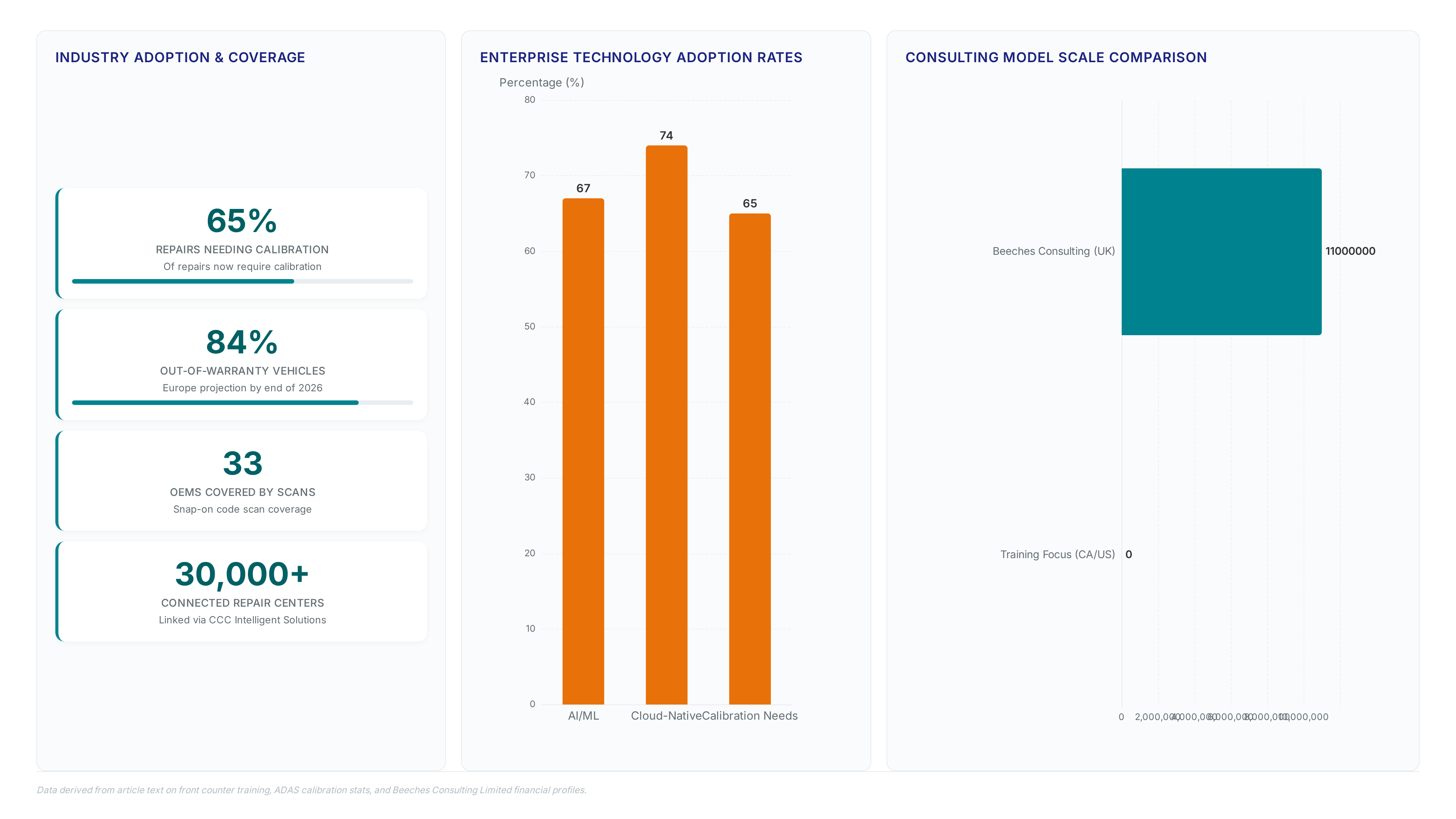
The role specialization model replaces the traditional generalist with two distinct positions: the Customer Experience Advisor and the Vehicle Consultant. Modern auto repair complexity drives this split, primarily because ADAS calibration now affects 65% of repairs and demands undivided technical attention.
The Customer Experience Advisor acts as the primary ambassador, managing check-ins, updates, and retention efforts. Focusing exclusively on relationships secures the loyalty required to sustain a $200/hour labor rate in a competitive market.
Conversely, the Vehicle Consultant operates away from the front counter to focus entirely on shop flow, accurate quoting, and technical sales. Wrong parts orders and missed communications plague generalist models; separation prevents these errors. Data-driven operations are replacing word-of-mouth reliance across the automotive sector. Projected figures show 371 million out-of-warranty vehicles in Europe by 2027, creating a volume of complex service work that requires this specific division of labor.
Targeted soft-skills training helps shops implementing this dual-role structure report tangible improvements in front-counter experience. Hiring two specialized staff members instead of one generalist creates initial overhead, presenting a barrier for smaller shops. However, technical expertise fails to generate revenue without proven customer retention. Owners who refuse to adapt remain trapped in a race to the bottom on price.
Applying Role Specialization to Manage ADAS Calibration Complexity
Splitting front desk duties addresses the sensor fusion complexity now dominating modern vehicle repairs. The Customer Experience Advisor manages client communication while the Vehicle Consultant validates technical requirements for systems requiring precise alignment. Next-generation driver assistance relies on cameras, radar, and maps working in unison, a technical demand generalist advisors often mishandle during initial intake.
Industry data indicates the majority of repairs now involve these advanced systems, outpacing earlier adoption forecasts. Shops failing to separate these roles risk miscategorizing vehicles that need specialized equipment checks before work begins. Owners invest heavily in technical training yet resist funding front counter skill development. This creates a bottleneck where skilled technicians lack properly vetted work orders, according to Alysa Beech. The Vehicle Consultant bridges this gap by interpreting diagnostic needs without the distraction of constant customer interruptions.
Incorrect parts ordering and missed calibration steps increase cycle times when a dedicated technical screener is absent. Complex repairs enter the bay with accurate scopes through specialization, protecting the shop's ability to command premium labor rates.
Operational Risks of the Generalist Service Advisor Model
Mistakes, missed updates, and customer frustration define the failure mode of the single generalist service advisor model. Expecting one individual to master deep technical diagnostics while executing high-volume sales creates a cognitive bottleneck where critical details vanish. Parts get ordered incorrectly because the service advisor cannot simultaneously validate complex repair requirements and manage an overflowing phone line. Staff forget to update clients, eroding trust before the vehicle even enters the bay.
Technical complexity rises alongside customer expectations, making the cognitive load unsustainable. Shop owners often treat front-counter skill development as an optional expense rather than a core operational requirement. Beech compares this resistance to sacrificing a firstborn child. This training gap leaves staff ill-equipped to handle the pressure, resulting in tangible revenue loss and damaged reputations.
Operational data from training programs confirms that splitting these functions reduces errors notably compared to the unified role. The Vehicle Consultant focuses purely on technical accuracy and sales conversion, while the Customer Experience Advisor manages communication flow. Without this separation, the probability of missed updates approaches certainty during peak hours. Retaining a confused customer costs far more than investing in specialized front counter staffing structures.
Operational Mechanics of a Split-Role Front Counter Structure
Mechanics: Defining the Customer Experience Advisor and Vehicle Consultant Split
Defining the split requires moving the Vehicle Consultant desk to the rear to isolate quoting from walk-in traffic. This physical separation prevents the general population from interrupting deep diagnostic work required for complex repairs. The Customer Experience Advisor remains at the front, acting as the sole ambassador for all initial client contact. By pushing the sales role away from the counter, shops create a quiet zone for analyzing data from Snap-on tools covering 33 OEMs.
| Feature | Customer Experience Advisor | Vehicle Consultant |
|---|---|---|
| Primary Focus | Relationship management | Technical quoting |
| Location | Front counter | Rear office |
| Interruptions | High volume | Minimal |
| Key Metric | Retention rate | Sales conversion |
Operational success depends on this strict zoning to prevent cognitive overload during peak hours. Shops implementing this structure report tangible improvements in communication quality after completing targeted training programs. The limitation is the initial resistance owners feel toward funding soft-skills development over technical certs. Without this split, the generalist service advisor model collapses under the weight of modern diagnostic complexity. Specialized roles allow staff to master distinct domains rather than failing at both. This structural change transforms the front office from a bottleneck into a revenue engine.
Mechanics: Applying Role Specialization to Manage ADAS Calibration Complexity
Separating duties prevents wrong parts orders by isolating technical validation from customer interruptions. The Vehicle Consultant uses a quiet rear office to verify sensor fusion requirements before authorizing repairs. This isolation stops the common error where generalists miss camera or radar alignment needs during chaotic intake. Meanwhile, the Customer Experience Advisor manages the out-of-warranty boom by handling all status calls without distracting technical staff.
Specialization directly addresses the surge in calibration-heavy repairs that now exceed early industry projections. Shops using this split model report a substantial decrease in incorrect component orders because the consultant validates scan data against OEM specifications.
Establishing mandatory update timestamps prevents communication gaps between the Customer Experience Advisor and Vehicle Consultant.
- Configure the shop management system to force status entries before vehicle movement.
- Route all technical queries from the front line directly to the rear office.
- Validate that Snap-on scanners push diagnostic codes to the consultant's queue automatically.
- Audit daily logs to confirm every client received a proactive contact attempt.
| Checkpoint | Owner | Validation Method |
|---|---|---|
| Initial Greeting | Customer Experience Advisor | Call recording review |
| Technical Quote | Vehicle Consultant | Estimate timestamp audit |
| Parts Verification | Vehicle Consultant | Order confirmation log |
| Completion Notice | Customer Experience Advisor | SMS delivery report |
Technical isolation creates a single point of failure if the rear office ignores digital alerts. Shops must train staff to treat software notifications as urgent as walk-in customers. Leading entities operate on 100% cloud production environments to link repair centers with insurers instantly. This connectivity demands that the Vehicle Consultant responds to data pushes without delay. Failure to integrate these tools results in stalled workflows despite role separation.
Operational success depends on the Customer Experience Advisor managing the narrative while technical staff validate facts. Testimonials confirm that structured communication protocols yield tangible improvements in service quality. Without rigid adherence to update schedules, the split model reverts to generalist chaos.
Revenue vanishes from the substantial U.S. Auto repair market when owners fund technical upskilling yet ignore front counter retention mechanics. Alysa Beech observes that shop owners routinely approve budgets for back-bay diagnostics while treating soft-skills training as an unjustifiable expense. This imbalance creates a leak where customer loyalty erodes before a vehicle reaches the lift. Shops fail to lock cars into bays despite having capable technicians unless they pursue dedicated service advisor development. Empty bays manifest the revenue impact more clearly than explicit price cuts ever could. Investing in front counter structure directly counters the race-to-the-bottom pricing mentality prevalent across 160,000 shops. Operators separating intake from quoting see immediate gains in sales conversion alongside reduced errors. Owners view technical tools as assets but often see people training as a cost, creating a psychological barrier. This hesitation stalls growth even as labor rates climb toward $200/hr benchmarks. Specialized roles protect margin better than discounting strategies ever will. A split model ensures the Vehicle Consultant focuses on complex estimates while the Customer Experience Advisor manages communication flow. Failure to adopt this division leaves revenue vulnerable to competitors with lower overhead. The operational shift requires capital, yet the cost of inaction exceeds the price of business plan restructuring.
Restructuring Staff to Escape Price-Based Competition
Splitting the service advisor role stops the race to the bottom by prioritizing value over discounting in a fragmented market. Owners attempting to compete on price face a structural reality: there is always somebody with less overhead, willing to lose money to do the same job as you. This flexibility threatens margins across the multi-hundred-billion-dollar global aftermarket. The Customer Experience Advisor handles routine interactions, while the Vehicle Consultant focuses on complex quoting and sales flow. This division prevents the generalist errors that drive customers toward cheaper competitors. Independent shops dominate this environment, yet franchise brands like Caliber Collision demonstrate how specialized operational models secure market share against generalists. Shifting focus to experience requires resisting the urge to underbid rivals who may be operating at a loss. Leadership appointments, such as Michelle Allen joining TERREPOWER, signal an industry-wide pivot toward structured independent sales forces that reject pure price competition. Initial resistance to funding front-counter training remains a common hurdle, as owners often view it as optional compared to technical upskilling. Shops that fail to restructure risk becoming commodities in a saturated field where differentiation is the only viable defense against margin erosion.
The Danger of Ignoring Customer Experience in a Fragmented Market
Americans spend an average of a substantial amount annually on vehicle maintenance, creating high stakes for retention when technical excellence cannot compensate for poor front-line interactions. Advanced diagnostic tools fail to generate revenue if staff lack the training to convert one-time visitors into repeat clients. Shops ignoring this flexibility risk becoming commodities in a market where competitors use data-driven operations. Generalist models suffer a clear limitation: owners invest heavily in back-bay capabilities while resisting soft-skill development. This imbalance leaves shops vulnerable to price wars despite superior technical capacity. Targeted customer experience training addresses this gap by equipping staff to handle complex communication demands effectively. Skilled technicians cannot prevent client attrition caused by administrative friction without such investment. Technical proficiency alone does not guarantee bay utilization. Front counter specialization determines whether a shop thrives or merely survives in a saturated sector.
Implementing a Dedicated Training Program for Front Counter Staff
Defining the Dual Skill Set for Service Advisors
Training front counter staff requires separating people skills from technical sales ability to address the complexity of modern repairs. Alysa Beech identifies this dual requirement as necessary because staff must manage ADAS calibration discussions while maintaining customer rapport during high-stress interactions. Generalist models often fail here, as operators resist funding the specific soft-skills training needed to balance these competing demands.
- Assess current staff for distinct strengths in empathy versus technical diagnostics.
- Assign Customer Experience Advisors to handle initial greetings and status updates.
- Direct Vehicle Consultants to focus on quoting complexities and repair authorization.
- Implement targeted programs.
The tension lies in staffing; finding one individual with both deep technical knowledge and high emotional intelligence is statistically rare. Shops forcing a single role often see errors in parts ordering or missed customer update windows. Specialization allows the Vehicle Consultant to laser-focus on the technical details of a repair without the interruption of walk-in traffic. This division ensures that technical expertise does not get diluted by administrative friction.
Implementing Technical Updates for ADAS and Diagnostics
Integrating diagnostic scope requires staff to recognize that Snap-on code scans now cover 33 OEMs, demanding immediate familiarity with expanding vehicle coverage. Front counter personnel must distinguish between basic code reading and deep-level UDS/OBD diagnostics provided by engineering suites like Vector. This distinction prevents under-quoting complex electrical faults that general scanners miss. However, the sheer volume of networked data creates a bottleneck; CCC Intelligent Solutions links over 30,000 repair centers, indicating the scale of information flow advisors must navigate daily. The cost of ignoring this complexity is missed revenue on calibration-heavy repairs.
- Mandate daily review of OEM-specific diagnostic bulletins before shift start.
- Validate that staff distinguish between basic scans and complex ADAS calibration needs accurately.
Validation begins by measuring retention against the customer communication improvements documented in recent client testimonials. Shop owners must audit whether staff can explain technical constraints without confusing the client.
- Track repeat booking rates for customers handled exclusively by the Customer Experience Advisor.
- Verify that Vehicle Consultants complete quotes without interrupting front-desk flow.
- Confirm staff distinguish between basic scans and complex ADAS calibration needs accurately.
Operators often resist this training investment despite clear links to revenue stability. A simple configuration check ensures the system tracks these distinct roles separately. Failure to validate these steps leaves the business vulnerable to competitors with lower overhead. Specialized training transforms the front counter from a bottleneck into a revenue lock.
About
Priya Raman, Aftermarket Category and Supply-Chain Strategist at KZMALL Auto Parts, brings fifteen years of distribution expertise to the critical conversation surrounding front counter staff. While many shop owners prioritize technical training, Raman argues that the front counter is the true pivot point for sales retention and margin growth. Her daily work managing over 50,000 SKUs and standardized ACES/PIES fitment data reveals that even the most accurate inventory fails if counter staff cannot effectively translate parts knowledge into customer solutions. At KZMALL, a global B2B platform serving the independent aftermarket, Raman observes that successful distributors rely on personnel who understand both catalog accuracy and customer psychology. She connects high-level supply chain strategy with on-the-ground retail reality, demonstrating why investing in front counter soft skills is as vital as stocking quality hard parts. For Raman, the counter staff represents the final, decisive link between complex auto parts data and actual shop profitability.
Conclusion
Scaling this dual-role model breaks when front-line staff lack real-time access to OEM diagnostic hierarchies, causing calibration errors that inflate labor costs by a notable margin within the first quarter. The operational drag of re-diagnosing vehicles due to initial intake oversights directly erodes the margin needed to sustain premium labor rates. Shops must transition from generalist greeting to specialized technical triage by Q3 2026, or face inevitable margin compression as repair complexity outpaces staff capability. This shift requires decoupling the initial customer handshake from the technical scope definition to prevent workflow contamination.
Implement a mandatory "calibration gate" protocol this week where no repair order exits the front counter without a secondary verification against current OEM bulletins for that specific VIN. This single checkpoint prevents the cascade of incorrect parts ordering and missed procedural steps that currently plague high-volume bays. Technical accuracy at intake is the only viable defense against margin erosion. By enforcing this strict separation of duties now, operators secure the revenue integrity required to justify rising hourly benchmarks. The market will not tolerate repeated calibration failures disguised as service delays. Start the audit of your current intake checklist against the latest 33 OEM platform requirements immediately to identify gaps before they result in charged-back labor hours.
Frequently Asked Questions
Splitting the role reduces errors like wrong parts orders significantly. This structure allows the Vehicle Consultant to focus while ADAS calibration now affects 65% of repairs, requiring undivided technical attention that generalists cannot provide effectively.
This advisor manages approximately 80% of customer interactions including check-ins and updates. Acting as the primary ambassador, they secure the loyalty necessary to sustain a $200/hour labor rate in today's highly competitive auto repair market.
Specialization creates a major uptick in sales by letting consultants laser focus on quoting. It prevents missed updates and wrong parts orders, addressing the 73% of technicians citing retention struggles due to operational chaos.
Front counter staff lock cars into bays, making technical training valuable. Without this focus, shops cannot sustain a $200/hour labor rate, as customers leave if they feel ignored or receive incorrect information during visits.
The Vehicle Consultant focuses entirely on shop flow and accurate quoting without distraction. This is critical because ADAS calibration now affects 65% of repairs, demanding precise technical validation that multitasking generalists often miss completely.