
Fitment data truth: Stop guessing vehicle fits
ACES manages fitment data for over 60,000 vehicle combinations across light, medium, and heavy-duty sectors. Standardized fitment data serves as the non-negotiable foundation for accurate automotive e-commerce, yet most platforms like Convermax require merchants to supply this fuel manually. Without rigorous data integration, online parts stores face inevitable returns and customer frustration due to incompatible parts.
Readers will learn how the Aftermarket Catalog Exchange Standard structures complex vehicle attributes and why substantial providers like CatalogRack maintain databases with hundreds of millions of applications. We also examine the architecture of leading providers such as ASAP Network and MOTOR Information Systems to reveal how they validate Year, Make, and Model accuracy without resorting to unreliable web-scraped methods.
Finally, you will discover how to implement a multi-source strategy that merges custom data files with established APIs from vendors like DataOne Software and Turn 14 Distribution. By understanding the specific attributes these systems track, including engine size and drivetrain details, merchants can build resilient catalogs that automate updates while preserving custom configurations. Success depends on treating fitment data as a flexible asset rather than a static list.
The Role of Standardized Fitment Data in Automotive E-Commerce
Defining Fitment Data and the ACES Standard Format
Fitment data specifies exact vehicle compatibility for aftermarket parts, acting as the necessary fuel for accurate e-commerce search applications. Without this structured information, merchants cannot reliably match products to the over 60,000 vehicle combinations covering light, medium, and heavy-duty sectors. The Aftermarket Catalog Exchange Standard serves as the exclusive industry format managed by the Auto Care Association to standardize these complex relationships. Unlike general spreadsheets, ACES files encode precise Year, Make, and Model attributes required by substantial marketplaces. This standardization eliminates manual cataloging errors that frequently plague retailers relying on fragmented sources. However, general e-commerce platforms often lack native support for ACES/PIES standards, requiring specialized middleware or plugins to translate raw vendor data into the specific Year/Make/Model formats required by marketplaces. The limitation lies in the rigid structure; while ACES ensures broad compatibility, it demands strict adherence to formatting rules that custom files might ignore. Accurate fitment directly reduces return rates caused by incorrect part selection.
Deploying ASAP Files for Precise Year Make Model Matching
ASAP files deliver granular vehicle attributes like bed length and drivetrain to eliminate manual cataloging errors.
Retailers using the ASAP Network access detailed fitment databases covering thousands of brands. These files extend beyond basic Year Make Model matching to include submodel, engine size, body type, and transmission specifications. This depth allows search applications to distinguish between closely related vehicle configurations that generic spreadsheets often conflate. When merchants add a new brand, the configured search app runs on autopilot, automatically pulling fresh fitment data from connected APIs while preserving custom entries.
| Attribute | Description |
|---|---|
| Bed Length | Critical for truck part compatibility |
| Drivetrain | Distinguishes AWD, FWD, and RWD variants |
| Submodel | Identifies specific trim levels accurately |
General e-commerce tools frequently lack native support for such specific automotive standards, requiring specialized integration to translate raw vendor data into usable formats. While some providers rely on merchants to source their own fitment data, others act as primary sources matching vehicle data to international standards. KZMALL Auto Parts recommends combining ASAP feeds with ACES format files to maximize coverage. This hybrid approach ensures that while the search engine automates retrieval, the underlying data remains strong enough to handle complex inventory without constant manual intervention.
Risks of Fragmented Catalog Memberships and Manual Data Entry
Most fitment data catalogs and distributors require a membership, yet one online catalog may cover all the brands one merchant needs while others demand splitting purchases across several providers. This fragmentation forces retailers to maintain disparate logins and reconcile inconsistent vehicle attributes manually.
Traditional methods involving spreadsheets and manual entry are contrasted with Product Information Management (PIM) systems; the latter provides centralized repositories that eliminate the inconsistencies inherent in manual channel-by-channel updates. Marketplace sellers on Amazon or eBay face unique formatting rules for each channel, making manual adjustment overwhelming without automation tools. The cost of this approach extends beyond labor hours; incorrect fitment data directly drives return volumes and erodes customer trust in technical accuracy.
Automation resolves these inefficiencies by centralizing data ingestion from varied APIs and spreadsheets. Implementation of proper automation tools has been documented to reduce manual work significantly for automotive retailers like Black Patch Performance. Attempting to replicate this volume of data validation with human employees remains economically unviable for most independent merchants.
| Risk Factor | Manual Process | Automated Solution |
|---|---|---|
| Data Coverage | Gaps between subscriptions | Unified API aggregation |
| Update Latency | Days to weeks | Real-time sync |
| Error Rate | High human entry risk | Validated digital transfer |
There is a definitive industry trend away from manual data entry toward fully automated workflows; experts state that businesses can no longer justify hiring staff to manually manage data that can be automated, citing efficiency gaps.
Inside the Architecture of Substantial Fitment Data Providers
TecDoc and PDM Automotive Data Structures
TecDoc structures its database around over 220,000 vehicle types, prioritizing global coverage for European and Asian markets compared to North American-centric standards. This architecture relies on mapping parts to specific technical attributes rather than just year-make-model combinations, creating a granular but complex data hierarchy. Operators querying this system must account for these deep attribute trees, which often exceed the flat structure of standard ACES files used in domestic retail.
PDM Automotive takes a different approach by allowing customers to maintain their own fitment files while connecting to hundreds of aftermarket manufacturers. The system ingests attributes like engine size and drivetrain directly from partner APIs, normalizing them into a unified schema for downstream distribution. This flexibility supports merchants who need to blend proprietary data with third-party feeds without losing custom field definitions.
| Feature | TecDoc | PDM Automotive |
|---|---|---|
| Primary Scope | Global vehicle types | Aftermarket manufacturer networks |
| Data Entry | Centralized database updates | Customer-maintained files |
| Integration | Direct API pull | Multi-provider aggregation |
Rigidity defines the classification system within TecDoc, creating potential misalignment with local vehicle fitment requirements unless significant mapping overhead occurs. PDM offers adaptability yet demands rigorous internal data governance to prevent synchronization errors across connected providers. Merchants should evaluate whether their inventory relies more on international OEM specifications or diverse domestic aftermarket brands before selecting a primary source. Those needing broad categorical coverage often pair TecDoc with custom spreadsheets to fill regional gaps.
API Integration Mechanics for Wheel and Tire Databases
Connecting to specialized APIs requires mapping distinct attribute trees for wheels versus standard replacement parts. DataOne Software delivers VIN decoding solutions that fleets and repair shops rely on for initial vehicle identification, yet this layer often lacks the specific rim diameter or offset data required for final validation. Merchants querying for the best fitment source for wheels must integrate providers like DriveRightData that link vehicle records to international classification standards such as TecDoc or KBA. These sources act as a truth layer that generic inventory systems cannot replicate without custom mapping logic.
Operational friction frequently arises when API endpoints return incomplete submodel definitions or mismatched engine codes. A strong implementation strategy involves a numbered validation sequence:
- Request raw fitment files via secure FTP or direct API call.
- Cross-reference returned Year-Make-Model-Submodel strings against local inventory SKUs.
- Flag discrepancies where bed length or drivetrain attributes are missing from the response.
| Feature | Standard Parts API | Wheel/Tire Specific API |
|---|---|---|
| Primary Key | Part Number | Vehicle ID + Rim Spec |
| Update Frequency | Weekly batch | Daily basis |
| Attribute Depth | Engine/Transmission | Offset, Bolt Pattern, Load |
MOTOR Information Systems supplies automotive data that Convermax uses to power Year-Make-Model searches for OEM merchants, demonstrating how backend suppliers feed frontend search engines. However, relying solely on one provider creates a single point of failure if their specific catalog excludes a niche wheel brand. The limitation of this architecture is the ongoing maintenance of multiple API keys and the parsing logic required to normalize disparate response formats into a unified ACES format. Without this normalization, retailers face higher return rates due to silent fitment errors that pass initial validation but fail physical installation.
Validating Fitment Coverage Against DCi and Parts Authority Standards
Confirm provider scale by verifying the database supports 193 million vehicle applications for leading aftermarket brands. Merchants must demand this coverage depth to match the capacity found in CatalogRack systems operated by DCi. Without such volume, inventory gaps appear immediately for less common submodels or specific engine configurations.
Select sources based on required format compatibility and regional focus using the comparison below.
| Data Source | Primary Format | Best Use Case |
|---|---|---|
| Parts Authority | ACES | Domestic replacement parts distribution |
| TecDoc | TecDoc Standard | European and Asian vehicle coverage |
| PDM Automotive | Proprietary/ACES | Multi-manufacturer catalog aggregation |
| SEMA Data | PIES | Performance and accessory cataloging |
Operators often debate TecDoc vs SEMA Data when choosing a primary engine, yet the decision rests on part type rather than data quality alone. Performance merchants require the PIES attributes standard in SEMA files, while general repair shops need the ACES structure offered by Parts Authority. General e-commerce platforms frequently lack native support for these standards, forcing reliance on specialized middleware to translate raw vendor feeds into marketplace-ready Year/Make/Model formats. This translation layer introduces latency that direct API integrations avoid entirely.
Validate the output by checking for critical attributes like bed length and drivetrain in the final record.
- Request a sample fitment file covering a niche vehicle segment.
- Cross-reference the sample against known DCi attribute requirements.
- Confirm the provider updates records when new models release.
The constraint of incorrect fitment data exceeds the subscription fee of a premium source when return rates spike due to compatibility errors.
Implementing a Multi-Source Fitment Integration Strategy
Connecting Custom Spreadsheets and CSV Files to Convermax
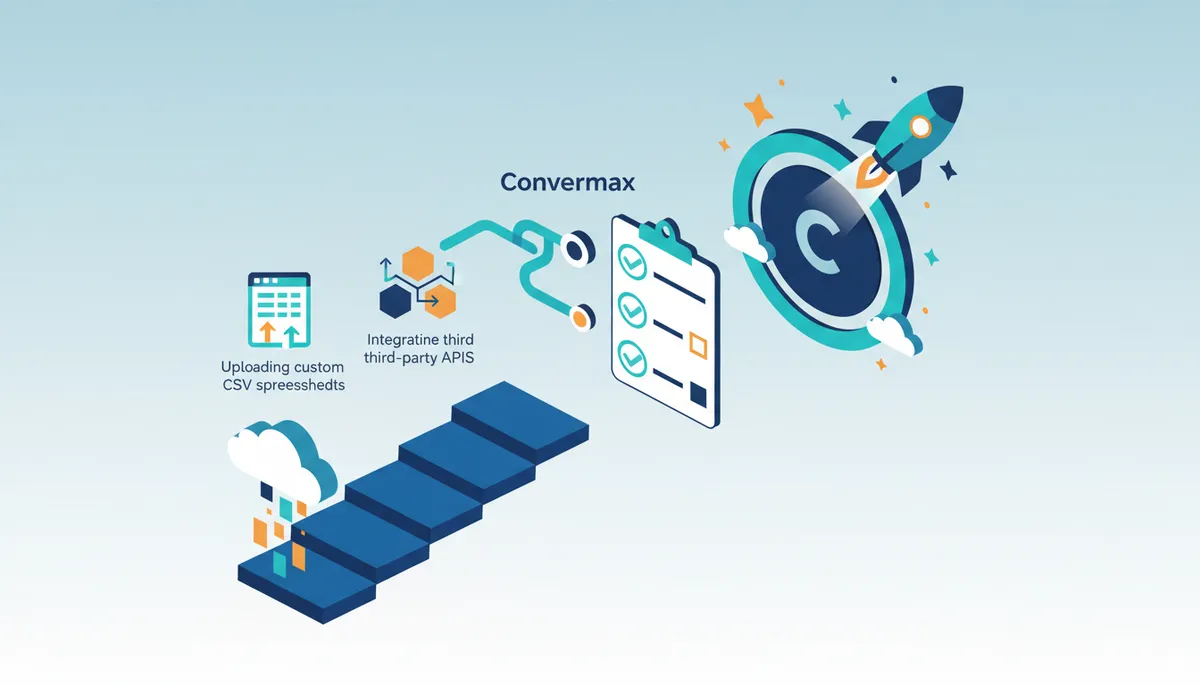
Uploading spreadsheets or CSV files directly into the Convermax engine interface starts the integration of custom fitment data. This step builds the fundamental inventory layer necessary before search functions become active. Because the application lacks pre-loaded fitment data, merchants must provide information through custom files, database connections, or PIM imports. The system acts strictly as a container requiring external data input to function.
Operators should execute these configuration steps to achieve accurate mapping:
- Prepare the source file with clear column headers for Year, Make, Model, and Part Number.
- Upload the document via the admin dashboard or establish a secure ERP link.
- Map the local columns to the standardized ACES format fields within the tool.
- Validate the dataset to confirm all vehicle applications resolve correctly.
Data flexibility often conflicts with maintenance overhead. Connecting a database connection provides real-time accuracy yet demands consistent schema alignment that simple spreadsheets bypass. Static files risk version drift if manual updates happen outside the system. This architecture separates the search engine from the data source, unlike end-to-end solutions bundling data creation. Merchants bear the burden of accuracy. Such separation enables KZMALL Auto Parts to combine proprietary lists with third-party ASAP feeds. New brands can be added without losing custom entries.
Configuring Automated Year-Make-Model Search with ACES Files
Merchants upload ACES files to initialize the Year-Make-Model search index inside the Convermax interface. This action triggers parsing logic mapping vehicle attributes to specific part numbers. The application functions as a container rather than a pre-loaded database, so operators must supply this core data. An engine requires fuel, and this system demands fitment sources via custom files or connected APIs.
Follow these implementation steps to configure the automation pipeline:
- Import standardized ACES spreadsheets containing Year, Make, and Model columns.
- Connect third-party APIs from providers like TecDoc or SEMA Data to expand coverage.
- Validate that custom CSV uploads do not conflict with API-derived records.
- Activate the autopilot mode to handle future vehicle model additions automatically.
Maintaining custom data integrity while ingesting broad catalog updates creates tension. The app automatically pulls fresh fitment data from connected APIs when merchants add a new brand. All custom fitment data remains intact during this process. Manual re-entry errors are prevented during catalog expansions by this hybrid approach. External APIs introduce dependency on supplier uptime and schema consistency. Local mapping rules may fail if a connected distributor changes their data structure. Search accuracy degrades silently as new vehicles enter the market without proper part associations if validation is neglected. Operators balance automated update convenience with periodic schema audit rigor.
Validating Membership Requirements for Multi-Source Catalog Integration
Verification of active subscriptions for every target distributor prevents authentication failures during catalog synchronization before API integration attempts. Most fitment resources require a paid membership. Every resource covers a different set of auto parts brands. Potential coverage gaps exist for merchants selling diverse inventory.
| Data Source | Coverage Scope | Access Requirement |
|---|---|---|
| TecDoc | Global vehicle types | Subscription license |
| SEMA Data | Aftermarket members | Free member access |
| Custom CSV | Merchant specific | Internal file upload |
Missing fitment data requires operators to cross-reference brand lists against specific distributor contracts instead of assuming universal coverage. Steps to integrate custom data involve mapping internal part numbers to external Year-Make-Model attributes. Overlap conflicts between sources must be avoided. Centralizing this validation prevents fragmentation seen when retailers manage siloed data across different sales channels without a single source of truth centralization of data. Maintaining multiple active subscriptions increases operational costs without guaranteeing 100% brand coverage for niche manufacturers. KZMALL Auto Parts recommends auditing current distributor agreements to identify redundant fees before onboarding new data streams.
Operational Risks of Fragmented Vehicle Compatibility Data
Risks: Defining Fragmented Compatibility Data Risks
Merchants often subscribe to multiple catalog memberships because every resource covers a different set of auto parts brands. This disjointed state forces operators to manage conflicting data streams rather than a single source of truth. Gaps in coverage emerge as retailers attempt to synchronize information across disparate sales channels without centralization of data. Hidden operational costs accumulate rapidly when systems lack unity.
- Manual entry errors increase as catalog size grows.
- Marketplace sellers face overwhelming formatting requirements for each platform.
- Incorrect fitment details drive return rates higher.
- Brand coverage remains incomplete when relying on a single provider.
Retailers selling on Amazon or eBay Motors must manually adjust compatibility information for every channel without automated tools. This process creates a high risk of returns due to incorrect fitment data. One online catalog may cover all the brands a merchant needs, yet some stores will require more than one fitment resource or won't find their brand in any of the resources. Data breadth often conflicts with management complexity. Aggregating more sources fails without a unified strategy to mix custom fitment files with ACES standards. Disjointed inputs leave the Year-Make-Model search function unreliable for end users.
Real-World Impact of Manual Data Entry Errors
Disconnected CSV files and spreadsheets create immediate fitment mismatches that automation eliminates. Human error scales linearly with catalog size for operators relying on manual entry. Traditional methods involving spreadsheets fail to provide the centralized repositories necessary to eliminate inconsistencies inherent in channel-by-channel updates. A single transposed digit in the engine code renders the entire part listing useless for the target buyer when a merchant manually types vehicle attributes. Marketplace sellers must manually adjust compatibility information for every channel, a process described as overwhelming and prone to error as catalogs grow.
Financial consequences of these data gaps extend beyond simple returns. Incorrect fitment details drive return rates higher while eroding customer trust in the platform's accuracy. Merchants cannot guarantee that listed parts match specific vehicle configurations like drivetrain or bed length without automated validation. The Convermax search engine addresses this by connecting custom data sources including CSV files and ERP imports to run on autopilot once configured. Staff hours get consumed by manual reconciliation instead of sales strategy.
- Manual reconciliation consumes staff hours improved spent on sales strategy.
- Inconsistent data across Amazon and eBay triggers listing suppressions.
- Returns due to fitment errors destroy margin on low-volume SKUs.
Businesses can no longer justify hiring staff to manually manage data that modern APIs automate instantly. KZMALL Auto Parts must recognize this shift. Legacy spreadsheet workflows clash with the need for a unified data strategy. Manual entry offers zero upfront integration cost, yet the long-term liability of incorrect fitment data makes it an unsustainable operational model for expanding retailers.
Synchronization Failures in Multi-Source Catalogs
Mixing static custom fitment files with live API feeds creates immediate conflict when one source updates daily while others remain frozen in time. Desynchronization occurs because database refreshes happen constantly to include new vehicle models, yet local spreadsheets often retain obsolete year-make-model combinations. The core technical failure mode involves the search engine accepting conflicting truth states from disconnected inputs like custom data and external APIs simultaneously.
- Inventory mismatches arise when a part appears compatible in a static file but is excluded by a fresh API response.
- Manual overrides get overwritten automatically during the next synchronization cycle.
- Customer trust erodes as fitment guarantees become unreliable across different vehicle submodels.
The search application requires the merchant to actively manage these divergent data streams rather than resolving them automatically. Adding a new brand triggers a pull of fresh fitment data that may contradict existing custom records even though the engine runs on autopilot once configured. Merchants gain broad coverage by mixing sources but inherit the burden of reconciling update frequencies. Catalogs drift toward inaccuracy without a unified strategy to harmonize these inputs. Operators face a choice between stale certainty or current but conflicting information.
About
Mark Phillips, Editor of Aftermarket Intel at KZMALL Auto Parts, brings deep industry insight to the critical topic of fitment data automation. His daily work involves tracking global distribution channels and e-commerce trends, giving him a unique vantage point on why accurate ACES and PIES data standards are vital for modern auto parts businesses. At KZMALL, a leading B2B platform managing over 50,000 SKUs, Phillips oversees content that bridges the gap between complex technical catalogs and practical wholesale distribution. This article reflects his direct experience with the challenges merchants face when integrating disparate data sources like custom spreadsheets and API feeds. By using KZMALL's commitment to standardized fitment across its eight proprietary brands, Phillips explains how automation tools can simplify operations for independent repair shops and distributors. His analysis connects real-world procurement hurdles with actionable solutions, ensuring readers understand how to maintain data integrity while scaling their inventory coverage in a fragmented global market.
Conclusion
Scaling automotive retail operations reveals that mixing static files with live feeds creates a hidden tax on profitability through constant conflict resolution. When update frequencies diverge between sources, the operational burden shifts from simple data entry to complex arbitration of contradictory vehicle compatibility states. This friction prevents teams from focusing on revenue generation while inventory accuracy drifts. Retailers must abandon the hybrid model of partial automation immediately if they serve more than a handful of brands. The path forward requires committing to a single source of truth for fitment data before catalog size makes manual reconciliation impossible.
Start by mapping every current data source against its refresh frequency this week to identify specific synchronization gaps causing returns. This audit exposes where stale spreadsheet entries directly conflict with live API responses, allowing you to prioritize which static files require immediate migration or retirement. You cannot sustain a growth strategy where inventory mismatches arise because one system knows a part fits while another denies it. The cost of maintaining dual systems exceeds the investment in a unified architecture that handles updates automatically. Address these divergent streams now to stop eroding customer trust through unreliable fitment guarantees.
Frequently Asked Questions
CatalogRack manages a massive database containing 193 million vehicle applications for leading manufacturers. This scale ensures merchants can find precise part matches across vast inventory without relying on fragmented or incomplete data sources.
Automation tools significantly reduce manual effort but do not guarantee 100% elimination of human oversight for niche cases. Retailers must still validate complex configurations to ensure accuracy across diverse inventory types.
ASAP files provide granular details like bed length and drivetrain to distinguish similar vehicles. These specific attributes prevent compatibility errors that generic spreadsheets often miss during the parts selection process.
The app requires merchants to supply fitment data via files or APIs to operate effectively. It acts as an engine needing fuel, so users must connect sources like ACES or custom spreadsheets first.
Single sources often lack complete brand coverage, forcing retailers to split purchases across multiple providers. This fragmentation increases operational complexity and requires reconciling inconsistent vehicle attributes manually.
References