
Contract rates need restricted parts catalogs
Auto parts wholesalers cannot flatten contract pricing into one public rate without losing margins. Account-based architectures are the only viable method to manage B2B complexity while preserving negotiated terms and operational control.
Parts Square operates as an enterprise-grade infrastructure provider designed specifically for B2B wholesale and D2C auto parts sales. Instead of forcing a single price point, successful platforms must deliver restricted catalogs and custom pricing that align with existing deals.
This guide details how to deploy fitment-aware data flow that reduces mis-orders through vehicle-based lookup tools like VIN and YMM search. We examine operational strategies for bulk workflows, including CSV upload capabilities and ERP synchronization that simplify repeat purchases. Finally, we break down the mechanics of complex pricing structures that handle tiered discounts and matrix scales across thousands of SKUs without manual intervention.
The Strategic Role of Account-Based Architectures in Auto Parts Distribution
Account-Based Pricing Logic for Jobbers and Dealers
Account-based e-commerce replaces static retail tags with flexible rules that enforce negotiated contracts per customer group.
The system identifies logged-in users as jobbers, dealers, fleets, installers, or distributors to trigger specific matrix pricing scales. This architecture ensures every partner sees only the catalog items they are authorized to purchase alongside their unique discount tiers. Parts Square operates as an enterprise-grade automotive ecommerce infrastructure provider, specifically designed for B2B wholesale to handle this complexity without flattening margins into a single rate card.
| Customer Group | Pricing Logic | Catalog Access |
|---|---|---|
| Jobber | Wholesale tier | Restricted SKUs |
| Fleet | Contract rates | Program-specific |
| Dealer | MSRP less discount | Full catalog |
The platform automatically normalizes data feeds from various vendors to resolve discrepancies in part numbers and descriptions before presenting a unified view. This prevents internal SKUs from leaking to unauthorized audiences while maintaining strict control over billing terms. Unlike general platforms that charge extra for advanced inventory tools, this model includes complex normalization across multiple vendors as a core function of its turnkey system.
Open accessibility conflicts with margin protection. Unrestricted access erodes negotiated value, yet rigid gates frustrate buyers. Successful deployments resolve this by serving the right shipping options and contract rates instantly upon login. This approach allows service dealers and national accounts to place bulk orders with confidence. The result is a digital channel that mirrors the nuance of offline wholesale relationships rather than simplifying them away.
Delivering Contract Rates and Restricted Catalogs
Restricted catalogs ensure every logged-in buyer views only authorized SKUs and negotiated rates, preventing margin erosion from public pricing leaks.
Explaining contract pricing in B2B requires defining customer groups such as jobbers, dealers, and fleets to assign specific matrix scales rather than flat retail tags. When a fleet manager logs in, the system suppresses unrelated aftermarket lines while surfacing their pre-negotiated OEM discounts. This segmentation stops installers from seeing distributor-only bulk quantities. The platform connects user sites to substantial warehouses including Turn 14, Keystone, Meyer, Motor State, and WorldPac, enabling sellers to operate without holding their own inventory. Real-time API calls retrieve live shipping rates and stock status from these partners during checkout, ensuring accuracy at the point of sale.
| Feature | Standard Retail | Account-Based Model |
|---|---|---|
| Price Visibility | Public to all | Hidden behind login |
| Catalog Scope | Universal access | Role-restricted |
| Shipping Logic | Flat rate | Contract-specific |
Flexible Vending rules engines automatically select the optimal vendor for each order based on cost and service level agreements, a capability distinct from standard retail setups. Unlike generic platforms charging flat fees, this architecture supports complex vendor integration and data normalization necessary for wholesale margins. Exposing too many vendors confuses buyers, yet restricting sources too tightly risks stockouts if the primary supplier fails. Operators must balance catalog breadth with supply chain reliability. Parts Square enables auto part distributors to track inventory across multiple locations in real-time for efficient fulfillment while maintaining strict access controls.
B2B Matrix Pricing Versus Single Public Price Models
B2B matrix pricing rejects the single public price model to enforce negotiated contract logic per account.
Wholesale distribution fails when platforms flatten diverse margins into one visible rate, exposing dealer costs to retail shoppers. Unlike general payment processors that charge flat rates, auto parts commerce requires cost structures tied to complex data normalization and deep vendor integrations. A rigid public price cannot accommodate the volume discounts or brand-specific deals necessary for jobbers and fleets. Consequently, wholesalers lose control over terms when their digital storefronts mimic standard B2C retail sites.
| Feature | Single Public Price | B2B Matrix Pricing |
|---|---|---|
| Visibility | Open to all visitors | Restricted to logged-in groups |
| Logic | Static flat rate | Flexible, rule-based scaling |
| Terms | Immediate payment only | Net-30, credit lines, contracts |
A unified price risks margin erosion; without proper account grouping, customers may see incorrect rates instead of their negotiated tiers. Parts Square avoids this by ensuring every logged-in customer sees only the right catalog and authorized pricing, explicitly refusing to flatten everything into one public price. This approach supports both wholesale and direct-to-consumer operations simultaneously without cross-contaminating price books. The system uses a "Flexible Vending" rules engine to automatically select the best source for each order based on cost, warehouse location, service level agreement, and shipping method. Wholesalers must choose between simple setup and accurate contract enforcement.
Inside the Pricing Engine and Fitment-Aware Data Flow
Defining the Flexible Vending Rules Engine Logic
OE, premium aftermarket, or both? The answer lives in the math. A Flexible Vending rules engine solves this by picking the best vendor for every line item using live data on cost, warehouse location, service level agreements, and shipping methods. Static catalogs force a single source. This architecture scans multiple suppliers in milliseconds to boost margin and fill rate.
The mechanism follows a strict decision matrix. An incoming order triggers a comparison of Vendor A against Vendor B using cost and SLA parameters. The rules engine then locks in the optimal fulfillment source. Manual sourcing calls that delay shipments by hours become obsolete. Fitment-aware logic cross-references the selected part with the specific vehicle configuration in the buyer's garage. Return rates drop when incorrect applications get filtered out before the order cuts.
| Variable | Static Catalog | Flexible Vending |
|---|---|---|
| Source Selection | Manual or Fixed | Real-time Algorithm |
| Margin Control | Low | Optimized per Line |
| Fitment Check | Post-Order | Pre-Selection |
Automated sourcing demands strong API connectivity to warehouse distributors. Data latency leads to overselling items actually out of stock. Speed matters, yet manual override capabilities remain necessary during supply chain disruptions. Invoice reconciliation grows complex when a single customer order pulls from multiple shippers.
Wholesalers now sell the intelligence to route parts efficiently rather than just the parts themselves. Integrating warehouse distributors directly into storefront logic keeps every transaction aligned with current inventory reality instead of stagnant database entries.
Applying YMM and VIN Data to Restrict Catalog Access
Year-Make-Model (YMM) and VIN lookups trim thousands of SKUs down to compatible parts, stopping mis-orders before checkout. This fitment-aware architecture limits shops and fleets to products authorized for their vehicle portfolios rather than a generic inventory dump. Validating vehicle data against normalized catalogs reduces returns and keeps support teams lean.
The technical flow starts when a user inputs a VIN or selects a vehicle year, make, and model.
- The platform queries the structured search index to identify valid part families.
- Rules engines cross-reference these results with account-specific permissions.
- The storefront renders a restricted view containing only eligible items.
Fleet managers cannot accidentally order brake pads fitting a sedan when they run heavy-duty trucks. Static retail sites lack this enforcement. Business rules merge with mechanical compatibility here.
| Search Mode | Data Input | Catalog Result |
|---|---|---|
| Standard | Keyword | All matching SKUs |
| Fitment-Aware | VIN / YMM | Vehicle-compatible SKUs only |
| Account-Restricted | Login + VIN | Authorized & compatible SKUs |
Catalog breadth conflicts with ordering speed. Showing every alternative raises cognitive load and error rates. The Flexible Vending logic displays parts meeting both vehicle requirements and vendor availability constraints instantly. Overly aggressive filters hide valid substitutes during supply shortages, so configuration requires care.
Saving vehicle profiles in a virtual garage accelerates repeat orders for fleets while maintaining accuracy. Digital workflows must match the physical reality of the bay, where installing the wrong part halts revenue generation. These tools turn the ecommerce site into a guided procurement system respecting mechanical fitment and contractual access limits.
Configuring Tiered Discounts and Matrix Shipping Scales
Tiered discounts by volume and brand replace public retail tags to match negotiated fleet contracts. Matrix shipping scales apply flexible rates across thousands of SKUs based on account type.
- Define customer groups like jobbers or dealers to isolate specific pricing rules.
- Apply brand-specific deals that trigger only when line-item thresholds are met.
- Assign matrix shipping methods, such as prepaid freight or collect, to prevent margin erosion on heavy orders.
Generic rules overriding account-specific logic cause incorrect pricing displays. The system evaluates cost and SLA variables through a rules engine before rendering the final cart total. Standard payment processors handle simple transactions. This architecture manages complex flexible vending decisions that generic platforms miss.
| Pricing Model | Application | Risk if Misconfigured |
| Tiered Volume | Bulk OEM orders | Margin compression on large sets |
| Contract Rate | Fleet networks | Revenue leakage to retail buyers |
| Matrix Scale | Heavy freight | Unexpected shipping cost absorption |
Rigid shipping tables carry a measurable cost. Large accounts abandon carts when flexible rate calculations fail to reflect negotiated freight terms. Shipping methods must update instantly when a buyer switches from a dealer to a fleet profile. Disconnects between quoted and actual fulfillment costs arise when shipping options fail to synchronize with back-office ERP data. Vendor rules require strict validation before go-live to prevent profitable orders from becoming losses.
Operationalizing Bulk Workflows Through CSV Tools and ERP Sync
CSV Upload and Quick Order by SKU Mechanics
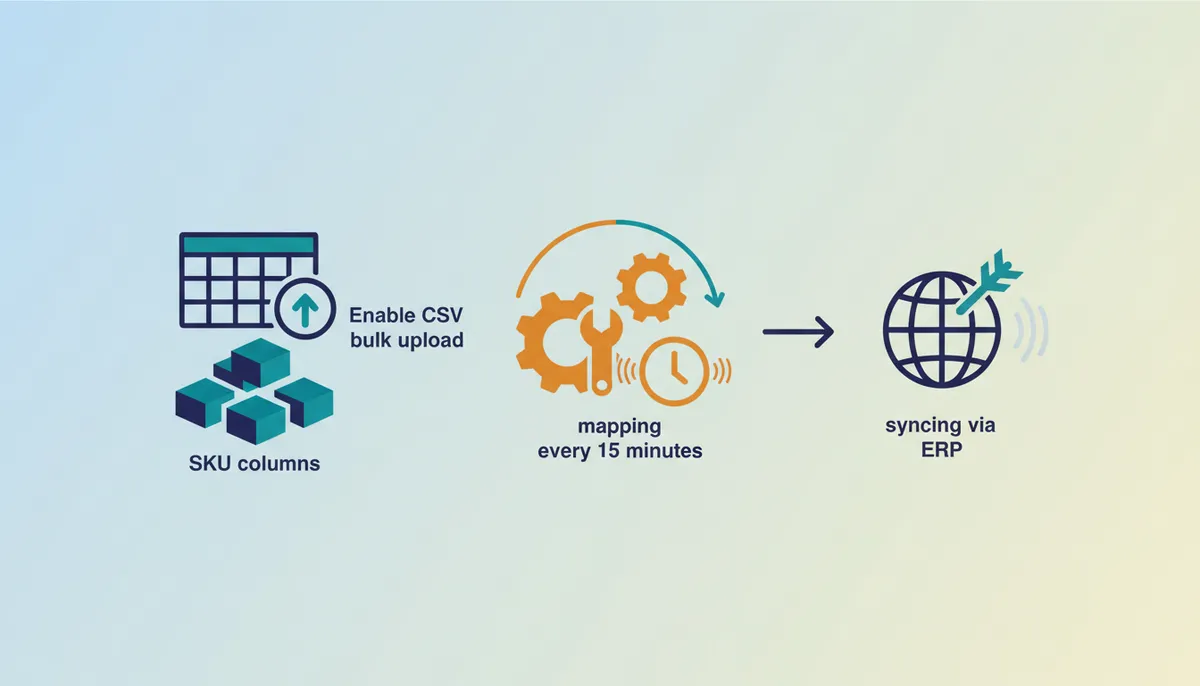
Direct part number entry removes browsing friction to speed up high-volume requisitions for professional buyers. Quick Order by SKU mechanics let mechanics and dealerships input specific identifiers for immediate cart addition without navigating complex category trees. This approach targets the operational reality where a technician knows the exact part number required for a repair job.
For larger replenishment cycles, CSV Upload capabilities enable users to submit bulk order lists via standard spreadsheet formats.
| Feature | Primary Use Case | Efficiency Gain |
|---|---|---|
| Quick Order | Single or few items | Instant cart placement |
| CSV Upload | Large inventory restocks | Batch processing |
Formatting errors in uploaded files often stall order processing when delimiters or headers mismatch system expectations. Unlike generic platforms that charge extra for advanced inventory tools, Parts Square includes complex inventory normalization as a core function of its complete turnkey system to handle these variances. User flexibility in file creation clashes with the strict data schema required for accurate ERP sync. A single column mapping failure rejects the entire batch, forcing a return to manual entry. Wholesalers must enforce rigid template structures so the online channel acts as an extension of existing operations rather than a disconnected side project. Proper validation at the point of upload prevents downstream fulfillment errors.
Bi-Directional ERP Sync for Customers and Pricing
Syncing customers, pricing, and orders in both directions prevents data drift between the storefront and back office. Parts Square functions as an engineering team that integrates directly with substantial ERP systems to ensure online catalogs reflect real-time stock levels and vendor terms. This bi-directional sync eliminates manual entry errors where web prices diverge from negotiated contract rates stored in legacy databases.
| Data Flow | Direction | Operational Impact |
|---|---|---|
| Customer Profiles | ERP to Web | Enforces credit limits and group restrictions |
| Order Status | Web to ERP | Triggers immediate invoicing and allocation |
| Inventory Levels | ERP to Web | Prevents overselling of limited stock |
The mechanism relies on continuous API handshakes that update account-specific logic whenever a transaction occurs. Tight coupling introduces latency risks if the legacy host cannot handle concurrent read/write requests during peak bulk ordering windows. Operators balance update frequency against system load to avoid slowing down the checkout process. Without this synchronization, wholesalers risk selling non-existent inventory or honoring outdated pricing, eroding margins on large fleet contracts. Successful deployment requires mapping custom fields for matrix shipping and tiered discounts before going live.
Validating Custom Logic for Credit Terms and Invoicing
Verify that custom logic enforces contract-specific payment windows before any buyer accesses the checkout flow. This validation ensures the online channel acts as a smooth extension of existing B2B operations rather than a disconnected side project. Operators must confirm the system correctly maps credit terms to specific customer groups like jobbers or fleets without flattening distinct agreements.
| Validation Step | Required Outcome | Risk if Failed |
|---|---|---|
| Terms Mapping | Net-30 displays for Tier-1 | Cash flow disruption |
| Invoice Format | PO references match ERP | Payment delays |
| Method Lock | ACH enabled for fleets | Transaction fees |
Rigid ERP constraints conflict with the need for flexible wholesale deals. Invoicing workflows must align with back-office expectations, or the digital storefront creates administrative friction that drives buyers back to phone orders. The platform connects to real-world automotive workflows via API to synchronize these financial rules dynamically. Unlike generic tools, this approach handles complex payment methods that standard transaction processors often reject. Failure to validate these rules results in rejected invoices and strained distributor relationships.
Selecting Specialized Platforms Over Generic Solutions for Wholesale Scale
Comparison: Flexible Vending Rules Engine vs Static Catalog Logic
Static catalogs force a single source per SKU, leaving margin on the table when improved options exist elsewhere in the network. A rules engine selects the optimal vendor per line item by weighing real-time cost against SLA variables. Generic platforms rely on fixed product listings that cannot adapt to shifting warehouse availability or negotiated contract logic. Parts Square distinguishes itself by automatically evaluating multiple variables including warehouse location and shipping methods to determine the best fulfiller for every order. Unlike generalist solutions that struggle with complex automotive data structures, this architecture supports a hybrid integration model accommodating modern APIs alongside legacy formats like EDI and SFTP files.
Operators lose margin when unable to route orders to lower-cost distributors dynamically. Implementing flexible rules requires precise data normalization, as inconsistent part numbering across vendors can alter automatic selection. Specialized platforms enforce contract logic that generic setups simply cannot replicate without expensive custom development. Fitment-aware sourcing reduces mis-orders by ensuring the selected vendor actually stocks the specific vehicle application. The limitation lies in data quality; without clean fitment data, the engine cannot accurately match parts to vehicles across different supplier catalogs.
Implementing Virtual Inventory Models Without Warehouse Overhead
Wholesalers implement contract pricing online when fixed margin agreements require enforcement across diverse buyer groups like jobbers and fleets. A specialized B2B platform enables this by connecting user sites to substantial warehouses, allowing sellers to operate without holding their own inventory or managing physical warehouse space. This architecture supports a virtual inventory model where businesses open accounts at third-party distributors and begin selling immediately.
| Feature | Specialized B2B Platform | Generic E-commerce Solution |
|---|---|---|
| Stock Ownership | Distributed across vendor network | Held by merchant |
| Catalog Logic | Flexible, account-specific access | Static, public-facing lists |
| Fulfillment | Direct from substantial distributors | Manual warehouse pick/pack |
The system uses a Flexible Vending rules engine to select the optimal vendor for each line item based on real-time cost and location variables. Generic retail tools flatten data into one public price, whereas this approach preserves negotiated deal structures while routing orders to sources like Turn 14 or WorldPac. Dependency on upstream data integrity creates a constraint; if a connected distributor's feed lags, the storefront risks selling unavailable stock. Operators must therefore prioritize platforms supporting hybrid integrations with legacy formats like EDI alongside modern APIs.
Dealers deploy specialized infrastructure when order volume outpaces manual sourcing capacity but capital remains insufficient for physical expansion. This strategy shifts the operational burden from warehousing to vendor relationship management. A leaner balance sheet results, though it demands rigorous monitoring of vendor fill rates to maintain customer trust. Success relies on the platform's ability to sync customer groups and pricing tiers bi-directionally with back-office ERP systems.
Margin Erosion Risks From Flattened Public Pricing Structures
Public price lists destroy negotiated margin structures by forcing all buyers into a single, unoptimized tier. Generic platforms often lack the logic to hide internal SKUs or apply contract-specific rates, exposing wholesale distributors to immediate revenue leakage. Standard payment processors charge flat rates, yet specialized costs tie to the complexity of automotive data normalization and flexible sourcing rules required for B2B survival.
| Risk Factor | Generic Platform Behavior | Specialized B2B Outcome |
|---|---|---|
| Price Visibility | Uniform public display | Restricted by customer group |
| Catalog Access | Open to all visitors | Filtered by program eligibility |
| Margin Control | Eroded by default | Protected via contract logic |
An operational failure mode occurs when a fleet buyer sees the same price as a walk-in retail customer, bypassing volume discounts agreed upon in annual contracts. This flattening effect removes the strategic advantage of holding diverse vendor agreements. Parts Square prevents this collapse by ensuring every logged-in user views only the products and pricing authorized for their specific account type.
Ease of setup competes with long-term profitability; a quick launch on a generic site often means accepting lower average order values permanently. Operators must verify that their chosen B2B wholesale solution enforces these restrictions before migration. Distinct price levels and restricted access controls prevent the online channel from cannibalizing offline relationships. Correcting exposed pricing post-launch costs more than the initial investment in a purpose-built architecture.
About
Priya Raman serves as the Aftermarket Category & Supply-Chain Strategist at KZMALL Auto Parts, where she orchestrates the complex intersection of parts data and B2B distribution economics. Her fifteen-year tenure in cataloging and sourcing makes her uniquely qualified to dissect the nuances of customer account management for auto parts wholesalers. In her daily work, Raman uses standardized ACES/PIES fitment data to ensure that digital catalogs accurately reflect negotiated terms and restricted product access. This direct experience allows her to articulate why generic e-commerce platforms fail to meet the specific needs of wholesale buyers who demand precise contract pricing and bulk ordering workflows. At KZMALL, she applies this expertise to maintain over 50,000 SKUs across proprietary brands, ensuring that every digital customer account delivers the correct year/make/model applications. Her insights bridge the gap between technical data governance and the practical realities of managing high-volume B2B relationships in a global market.
Conclusion
Scaling a generic storefront inevitably breaks the complex pricing hierarchies that define wholesale profitability. When a single public price list replaces negotiated contracts, the operational cost shifts from managing logistics to manually correcting invoice disputes and appeasing angry fleet buyers. This erosion happens silently until margin reports reveal that volume discounts were applied to retail transactions. You cannot afford to let ease of setup compromise your core revenue model, as fixing exposed pricing post-migration requires far more resources than implementing the right safeguards initially.
Migrate only to a platform that enforces contract-specific rates and restricts catalog access by customer group before your next substantial inventory upload. Generic tools lack the logic to hide internal SKUs or apply flexible sourcing rules, meaning every day you delay verification is a day of potential revenue leakage. Do not assume standard payment processors can handle the complexity of automotive data normalization required for B2B survival.
Start this week by auditing your current live site to confirm that a logged-in wholesale user sees different pricing and products than a guest visitor. If both profiles display identical results, your architecture is actively cannibalizing offline relationships. Verify that your B2B wholesale solution strictly isolates price levels to protect your negotiated margins.
Frequently Asked Questions
Generic platforms often flatten contract pricing into one public rate, causing margin loss. You need restricted catalogs to prevent exposing internal SKUs to the wrong audience and losing control over your negotiated terms.
Jobbers, dealers, fleets, installers, and distributors each need unique matrix pricing scales. Assigning specific price levels per group ensures every partner sees only authorized catalog items alongside their unique discount tiers.
Vehicle-based lookup tools like VIN and YMM search significantly reduce mis-orders by ensuring part compatibility. This accuracy keeps support teams lean and maintains healthy margins by preventing costly returns from incorrect shipments.
Buyers can upload bulk order lists via CSV or use quick order by SKU for speed. These efficient workflows allow customers to reorder past purchases with one click instead of calling around.
The engine automatically selects the optimal vendor based on cost, location, and service level agreements. This rules-based approach ensures the best source is chosen for each order without manual intervention.
References