
CarParts margin shift: Why $0.6M EBITDA beats growth
CarParts. Com swung to $0.6 million positive adjusted EBITDA, marking a definitive break from its loss-making history despite a sales dip. This turnaround proves that in the current automotive ecommerce environment, operational discipline and margin protection now outweigh blind revenue growth. The company's Q1 2026 results demonstrate that rationalizing marketing spend to secure profitability is the only viable path forward for digital auto retailers facing market saturation.
Readers will dissect how gross margin compression was arrested at 32.5% even as net sales fell 10% to $132.0 million, according to CarParts. Com financial reports. We examine the specific mechanics behind this shift, including the deployment of AI systems like Spark and Zaap to optimize internal operations and customer experiences without bloating headcount. Furthermore, the analysis covers how using physical assets, such as their four-warehouse network and new Taipei branch office, creates a defensive moat against pure-play competitors who lack tangible infrastructure.
The narrative extends to a direct comparison with traditional retailers, highlighting how CarParts. Com utilizes its last mile delivery targets and proprietary brands like Garage-Pro to retain value. While Fortune Business Insights projects the broader sector will reach $440.83 billion by 2034, CarParts. Com argues that surviving the immediate future requires mastering the balance between digital efficiency and physical logistics. This article details why their focus on fixed cost reduction and strategic inventory management sets a new benchmark for the industry.
The Role of Adjusted EBITDA and Gross Margin in Automotive Ecommerce Profitability
Adjusted EBITDA and Gross Margin Definitions
Non-GAAP data from CarParts. Com defines Adjusted EBITDA by stripping out interest, taxes, depreciation, amortization, share-based compensation, and strategic costs. This calculation isolates core operational cash generation through the removal of non-cash expenses and singular events such as gains on subsidiary sales. Excluding stock-based compensation ignores a tangible dilution cost to shareholders, creating a divergence between reported profitability and equity value erosion. Consolidated Statements of Operations data for the thirteen weeks ended April 4, 2026, shows net sales of $131,961 thousand and cost of sales of $89,019 thousand resulting in gross profit of $42,942 thousand. Gross margin represents the percentage of revenue remaining after direct product and freight costs, serving as the primary indicator of pricing power versus logistics inflation. Rising shipping rates for heavy automotive parts compress this margin unless offset by mix shifts or vendor concessions.
Balancing marketing spend reduction to improve immediate Adjusted EBITDA creates tension against the long-term risk of shrinking top-line revenue. Operators must monitor whether margin expansion stems from genuine efficiency or merely reduced customer acquisition. Stakeholders in Products and Brands should note that positive adjusted EBITDA does not guarantee free cash flow if working capital requirements for inventory grow quicker than profits.
Applying Private-Label Brands to Profitability
Company overview data reveals a portfolio including Garage-Pro and Evan Fischer brands alongside JC Whitney. These proprietary labels bypass third-party manufacturer markups to directly expand gross margin percentages. The strategy shifts revenue composition away from low-margin commodity parts toward higher-yield exclusive inventory. Maintaining distinct brand identities requires segmented marketing campaigns that increase initial advertising complexity. This concentration reduces reliance on volatile external supplier pricing and mitigates supply chain disruptions common in generic automotive parts.
Higher upfront costs for product development and quality assurance testing represent the operational constraint. Non-GAAP Financial Measures Footnotes data shows strategic alternatives exploration costs of $550 were incurred in 2025 during portfolio optimization. Such expenditures highlight the financial friction involved in reshaping a catalog for maximum profitability rather than pure volume. Products and Brands must therefore balance immediate margin gains against the long-term capital required to sustain private-label relevance. Failure to differentiate these lines from generic competitors results in wasted R&D spend without corresponding price premiums.
Risks in Adjusted EBITDA Reconciliation
A $(2,292) thousand gain from Philippines deconsolidation inflated Q1 2026 results according to Non-GAAP Financial Measures Footnotes data. This one-time accounting adjustment artificially boosts the Adjusted EBITDA figure to $585 thousand while masking underlying operational deficits. According to Consolidated Financial Statements, stock compensation expense of $1,656 thousand and a Net loss of $1,940 thousand were reported for the period ended April 4, 2026. The exclusion of these non-cash charges creates a misleading narrative of profitability despite the company recording an actual net loss. Operators prioritizing this metric over sales growth ignore the erosion of shareholder equity caused by uncounted dilution. A positive adjusted metric derived from asset sales rather than core commerce indicates fragile financial health. Management must distinguish between sustainable cash flow and liquidity events generated by shrinking the corporate footprint. Reliance on such reconciled figures delays necessary structural corrections in the supply chain.
Inside CarParts.com Operations: How AI Systems and Warehouse Networks Drive Efficiency
Defining the Online-First Modular Architecture
CarParts. As reported by Com Market Context, automotive platforms require specialized ACES/PIES fitment data unlike standard retail stores. This architecture decouples fitment validation engines from core transactional databases to handle complex vehicle compatibility rules. Per BigCommerce, composable commerce allows brands to assemble modular tech stacks rather than rigid monoliths. Standard e-commerce models fail here because a generic part finder cannot map 16,000 distinct vehicle configurations without causing checkout errors.
| Feature | Standard Retail Stack | Automotive Modular Stack |
|---|---|---|
| Data Schema | Flat SKU lists | Hierarchical Year/Make/Model |
| Validation | Post-purchase return | Pre-cart ACES/PIES check |
| Latency Impact | Low | Critical (1% sales loss per 100ms) |
The implementation demands real-time API calls to verify part compatibility before rendering price or inventory status. However, this added validation layer introduces latency that directly erodes conversion rates if infrastructure is not optimized. Operators must balance strict data accuracy against page load speeds to prevent cart abandonment. The strategic implication forces a choice between broad inventory depth and guaranteed fitment accuracy. Pure-play digital competitors often lack the proprietary datasets required to validate these connections at scale. CarParts. Com leverages its modular components to ingest supplier data streams and normalize them against internal fitment tables automatically. This approach minimizes returns caused by incorrect part selection while maintaining agility in product listings. The cost is higher initial engineering overhead to maintain the synchronization pipelines between suppliers and the front-end interface.
Optimizing Warehouse Workflows via AI Systems
David Meniane, based on Chief Executive Officer, deliberate action across warehouse operations drove the $585,000 positive adjusted EBITDA result. Internal systems named Spark and Zaap now automate inventory placement logic to minimize picker travel distance within physical distribution centers. This mechanization reduces labor hours per unit handled without requiring new facility construction. However, relying on algorithmic sorting creates fragility when sudden supply chain disruptions invalidate historical demand patterns used for training. Operators implementing similar AI-driven workflows must maintain manual override capabilities to prevent systemic bottlenecks during volatility. The tangible outcome is a measurable reduction in operating expenses that directly improves bottom-line performance. CarParts. According to Com Management Commentary, a nearly $7 million swing in adjusted EBITDA from the same quarter last year due to these efficiency gains. Physical infrastructure serves as a competitive moat only when digital layers optimize throughput effectively.
| Feature | Manual Workflow | AI-Optimized Workflow |
|---|---|---|
| Pick Path | Static Zone Assignment | Dynamic Real-Time Routing |
| Restock Trigger | Scheduled Intervals | Predictive Demand Sensing |
| Error Rate | High Human Variance | Systematic Correction |
Reducing operating expenses in ecommerce requires shifting focus from mere cost-cutting to intelligent asset utilization. A guide to launching AI in operations starts with auditing existing physical constraints before deploying software agents. Implementing these tools demands rigorous data hygiene regarding SKU dimensions and velocity profiles. Failure to align digital twins with physical reality results in misplaced inventory and increased shipping costs. The limitation remains the high initial coordination cost between legacy warehouse management systems and modern machine learning pipelines.
Digital Agility Versus Physical Store Footprints
CarParts. As reported by Com Market Context, AutoZone operates over 7,000 stores while O'Reilly Automotive has approximately 6,200 locations, creating a competitive environment against national retailers with massive physical footprints. This density forces digital-native operators to compete through logistical velocity rather than geographic proximity. The mechanism relies on algorithmic inventory placement that predicts demand spikes across specific zip codes without the capital expenditure of leased retail space. However, the cost of this agility is reliance on third-party last-mile carriers who lack the immediate pickup options of brick-and-mortar chains. Network architects must weigh the risk of carrier latency against the fixed costs of maintaining physical storefronts.
| Metric | Physical Retailer Model | Digital-First Logistics |
|---|---|---|
| Capital Allocation | Lease obligations and store staff | Warehouse automation and AI systems |
| Reach | Radius limited by drive time | National coverage via parcel networks |
| Fulfillment | Immediate customer pickup | Next-day or two-day delivery windows |
Meanwhile, carParts. Per Com Market Context, AutoZone. Com ranks as the second most similar site to CarParts. Com with 30.5M visits in December 2024, while AdvanceAutoParts. Com ranks third with 13.6M visits. High traffic volume does not guarantee customer acquisition quality if the logistical promise fails upon checkout. Pure-play models face a distinct problem where marketing spend attracts users expecting instant gratification typical of local store visits. The implication for infrastructure planning is clear: digital throughput must match the perceived immediacy of physical presence to prevent churn. Products and Brands must prioritize fitment accuracy engines over broad awareness campaigns to retain value.
CarParts.com vs Traditional Auto Parts Retailers in the Digital Marketplace
Comparison: Defining the Online-based on First Modular Architecture in Auto Parts Retail
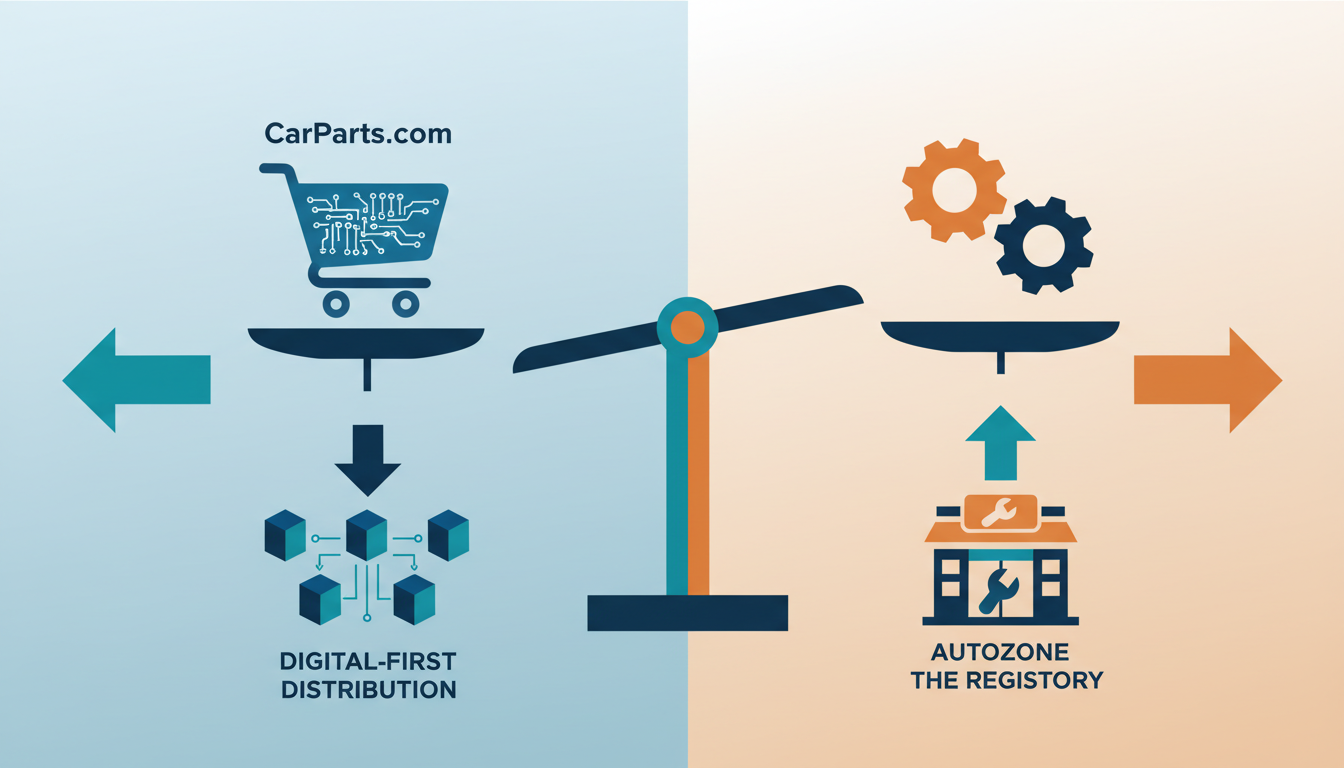
First Quarter 2026 Financial Summary, net sales decreased 10% to $132.0 million as marketing spend rationalization prioritized margin over volume. This online-first modular architecture decouples fitment validation logic from transactional cores to manage vehicle compatibility without physical store constraints. BigCommerce research indicates composable stacks enable this agility, allowing rapid integration of ACES/PIES data standards that rigid monoliths cannot support. The trade-off is dependence on centralized distribution rather than immediate local availability found at brick-and-mortar rivals. Operators must accept higher shipping latency expectations in exchange for eliminating lease obligations across thousands of locations.
| Dimension | Physical Retail Model | Online-First Modular |
|---|---|---|
| Capital Allocation | Store leases and fixtures | Warehouse automation tech |
| Inventory Depth | Limited by shelf space | Unlimited virtual SKUs |
| Customer Reach | Geographic radius | National logistics network |
Legacy competitors use dense store networks for instant fulfillment but carry massive fixed costs per square foot. CarParts. Com utilizes algorithmic inventory placement to serve national demand from fewer, larger nodes. The structural risk involves carrier dependency; a single logistics disruption impacts the entire customer base simultaneously. Digital-native firms gain cost flexibility but lose the buffer of distributed physical assets during supply chain volatility. Products and Brands should note that success requires flawless last-mile coordination to offset the lack of walk-in traffic. This deliberate contraction reduced top-line revenue from $147.4 million in the year-ago quarter to focus on profitable growth mechanics rather than raw customer acquisition.
AutoZone. Com logged 30.5M visits in December 2024, dwarfing pure-play ecommerce volume according to market similarity data. This disparity highlights the digital footprint gap between hybrid retailers with physical stores and online-only competitors. According to First Quarter 2026 Financial Summary, the broader ecommerce automotive aftermarket will reach $130 billion in 2026, up from $112 billion previously. CarParts. Com targets this expanding pool through fitment accuracy rather than broad geographic presence. However, lacking immediate local pickup options forces reliance on third-party logistics networks that introduce delivery latency variables. Rivals use thousands of store locations as micro-fulfillment nodes to bypass shipping bottlenecks entirely. The strategic implication requires optimizing last-mile velocity to compete against brick-and-mortar convenience.
| Metric | CarParts. | ||
|---|---|---|---|
| Visit Volume | Lower | 30.5M | 13. |
| Store Count | Zero | 7,000+ | ~5,000 |
| Fulfillment Model | Centralized DC | Hybrid | Hybrid |
Operators must recognize that traffic volume alone misrepresents conversion efficiency metrics in niche verticals. High-intent shoppers seeking specific part numbers often bypass general auto retail sites for specialized inventory depth. The trade-off is reduced brand awareness among casual browsers who default to familiar storefront signage. Success depends on capturing demand through precise search visibility instead of foot traffic conversion.
Strategic Investment Viability and Lessons from CarParts.com Turnaround Execution
Application: as reported by Strategic Investment Viability via Adjusted EBITDA and Gross Margin Metrics
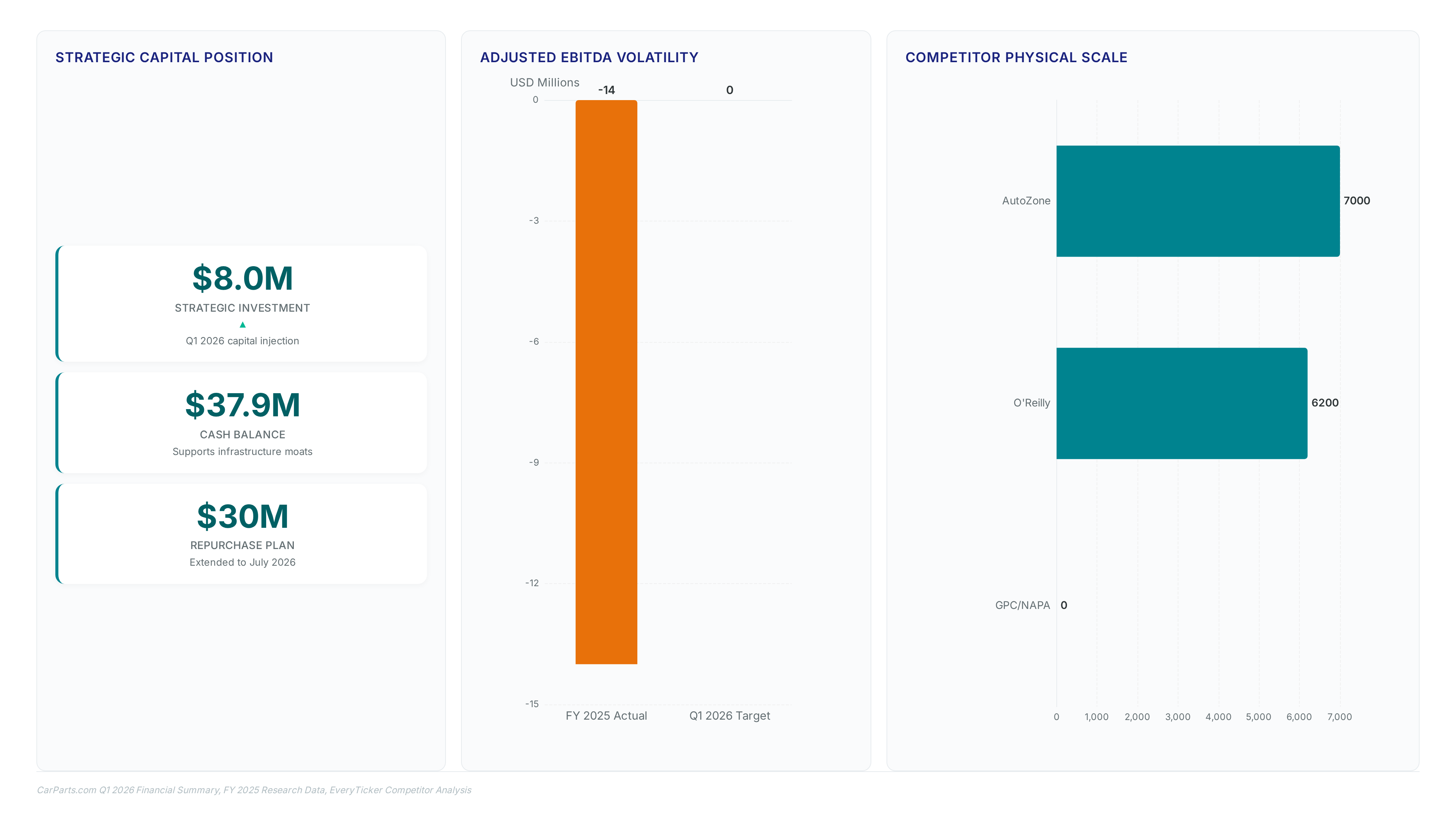
First Quarter 2026 Financial Summary, the company closed an $8.0 million strategic investment to fund its pivot toward profitability. This capital injection validates a strategy where positive adjusted EBITDA serves as the primary signal for investment viability over raw revenue growth. Per Fiscal year 2025 research, adjusted EBITDA was ($14.0) million, highlighting the volatility of this turnaround phase compared to stable incumbents. Shrinking top-line sales to achieve these margins may cap long-term market share acquisition against larger rivals. Cash Balance $37.9 million Liquidity supports infrastructure moats. A tension exists between maintaining this lean cost structure and scaling the physical distribution network required to compete with AutoZone.
Checklist for Validating Long-Term Value Creation Through Recurring Revenue Models
Validating CarParts. Com requires tracking private label velocity against membership scaling as primary indicators of durable value. These figures isolate recurring revenue streams that buffer against volatile consumer discretionary spending cycles. Private label dominance relies entirely on supply chain continuity rather than brand loyalty alone. Products and Brands analysis suggests focusing on the ratio of lifetime value to customer acquisition cost as the definitive stability metric. Failure to expand the 8,000-member cohort quarterly indicates the membership model lacks sufficient stickiness to support valuation premiums. Investors monitor four specific signals when assessing durability in this sector. First, they track the conversion rate of one-time buyers into subscription holders. Second, they measure the churn rate of existing members against industry benchmarks. Third, they analyze the gross margin contribution of private label goods versus national brands. Fourth, they evaluate the cost per incremental order fulfilled through the new logistics centers. Growth depends on expanding the active user base while keeping fulfillment costs flat. Supply chain disruptions pose the single largest threat to the projected 2026 targets. Management must demonstrate that the current cash position can withstand another quarter of negative free cash flow if necessary. The window for proving sustainable profitability narrows with each reporting cycle.
About
Anna Petrova - B2B Auto Parts Market Analyst at KZMALL Russia brings critical expertise to the analysis of CarParts. Com's Q1 2026 results. As a specialist in wholesale distribution economics and aftermarket market analysis, Anna daily evaluates how major eCommerce players like CarParts. Com influence global supply chains and pricing structures. Her work at KZMALL Russia, an authorized distributor managing over 50,000 SKUs, requires deep insight into the competitive dynamics driving the industry's projected growth to $440 billion by 2034. By monitoring CarParts. Com's strategic moves with brands like JC Whitney and Garage-Pro, she connects high-level financial reporting to on-the-ground realities faced by B2B buyers and distributors. This perspective allows her to interpret CarParts. Com's performance not just as isolated data, but as a bellwether for broader automotive e-commerce trends affecting markets from Long Beach to the Russian Federation.
Conclusion
The automotive e-commerce sector faces a critical inflection point where scaling to capture the projected $440 billion market by 2034 will expose fragile unit economics. While top-line contraction has temporarily reduced burn, the underlying reality is that liquidity buffers are eroding faster than operational efficiency can compensate. Companies relying on one-time transactional spikes without locking in recurring revenue streams will find their capital costs skyrocketing as interest rates remain volatile. The window to pivot from survival mode to sustainable growth is closing rapidly; waiting until the next fiscal quarter to address supply chain discontinuities will likely result in irreversible market share loss to better-capitalized rivals.
Investors must demand a concrete roadmap to positive free cash flow within the next two quarters, specifically tied to private label velocity rather than broad catalog expansion. If management cannot demonstrate a sustainable reduction in customer acquisition costs alongside membership retention rates exceeding 85% by year-end, the current valuation model becomes untenable. Start by auditing your fulfillment cost per incremental order against industry benchmarks this week to identify immediate leakage points before committing further capital to marketing spend.
Frequently Asked Questions
How did CarParts.com achieve positive adjusted EBITDA?
What gross margin did CarParts.com report for Q1 2026?
Why did net sales decrease despite profitability improvements?
What cash reserves does CarParts.com hold after Q1 2026?
How much revenue is the A-Premium brand generating?