
Fitment data drives sales with six attributes
Fitment data is not optional; it is the inevitable part determining whether a customer buys or bounces. You will learn how centralized databases function as the backbone of compatibility, why attribute granularity dictates search success, and how to measure the direct measurable ROI from eliminating fitment errors.
Most online retailers do not aggregate this information internally, relying instead on third-party centralized databases that adhere to strict industry standards. As noted by PartsConnect, the quality of your compatibility results depends entirely on the source database, which compares technical part information against vehicle specifications simultaneously. Without this precise functional relationship between parts and vehicles, customers cannot verify accuracy, leading to abandoned carts and costly logistical failures.
The complexity of managing these vast resources often overwhelms standard inventory systems, requiring specialized tools to handle the sheer volume of vehicle data points. Ignoring the structural integrity of your fitment data means accepting a high rate of incompatible orders, while mastering it ensures your catalog remains a reliable resource for every search query.
The Role of Fitment Data in Modern Auto Parts Ecommerce
Fitment Data as the Functional Link Between Parts and Vehicles
Think of fitment data as the connective tissue binding a static SKU to a specific chassis. It is the umbrella term for the dataset that links parts data with vehicle data to establish a functional compatibility matrix. Accuracy here is binary: you either match across six specific attributes, year, make, model, trim, engine, and other vehicle-specific details, or you fail. Industry analysis identifies this linkage as the primary mechanism determining whether a component fits a car accurately.
Without this structured validation, digital catalogs cannot filter incompatible inventory during customer searches. The result is a spike in return rates driven by customer error rather than product defects. Precise attribute matching eliminates the guesswork in online purchasing decisions. Unlike generic product descriptions, fitment records transform a part into a verified solution for a specific configuration. The limitation lies in the sheer complexity of maintaining current records across thousands of vehicle combinations without automated tools. Retailers relying on manual entry struggle with data freshness as new models enter production cycles. Implementing rigorous compatibility standards ensures search results reflect only physically viable options. This structural integrity directly correlates to reduced logistical costs and higher transaction confidence.
Driving Sales by Validating Part Compatibility for Customers
Validating part compatibility converts shopper queries into confirmed orders by removing uncertainty. The data environment requires cross-referencing thousands of specific vehicle builds against hundreds of thousands of components to verify exact matches. This rigorous process provides the knowledge customers need to confirm a part fits, aiding the decision-making process and closing sales.
Shoppers face high risks of ordering incorrect items without this precision. Costly returns and exchanges erode retailer margins. Companies using specialized inventory solutions address the specific problem of customers ordering wrong parts by defining fitment through engine type and specific model attributes.
The Complexity of Managing Vast Fitment Resources Without Tools
Manual management of fitment data collapses when scaling beyond simple catalogs. Applying this complex dataset without an accurate tool creates a fragile operational state where errors multiply silently. Retailers often manually enter and adjust information for car part compatibility across sales channels. This task becomes overwhelming with thousands of SKUs. The sheer scale involves cross-referencing thousands of specific vehicle builds against hundreds of thousands of components.
Human error penetrates the process without automation. Modern product data management systems are required to support industry standards to ensure inventory data remains accurate and up to date. Inaccuracy drives high return rates. Inaccurate part fitment information remains a leading reason for returns and subsequent cart abandonment. Effective fitment data management solves these issues by ensuring high compatibility across platforms like Amazon and eBay Motors. Deploying specialized data management tools mitigates the risks of manual entry and maintains competitive standing.
Inside Fitment Data Architecture and Attribute Granularity
ACES Standard and the Six-Attribute Granularity Rule
The Aftermarket Catalog Exchange Standard mandates a relational structure linking distinct part SKUs to vehicle datasets rather than simple one-to-one mappings. This architecture requires matching across six specific dimensions: year, make, model, trim, engine, and other vehicle-specific attributes to guarantee functional compatibility. Omitting deep granularity like trim level or engine type results in components that physically mount but fail to function as intended within the specific vehicle configuration.
Precise matching across these six vehicle attributes stops parts from failing after installation. Basic Year/Make/Model filtering removes obvious mismatches yet cannot distinguish between engine variants sharing a chassis code. A large number of specific vehicle builds exist alongside hundreds of thousands of components, creating a massive cross-referencing task.
Operators managing vast catalogs face significant challenges without precise data, as errors lead to costly returns and exchanges. The shift to relational data structures addresses the complexity of modern vehicle builds where a single model year contains multiple distinct configurations. Accurate matching requires precision across these attributes to prevent costly logistical failures. Industry solutions prioritize this depth to eliminate ambiguity in digital catalogs and support customer trust.
Real-Time Vehicle and Part Data Cross-Checking Mechanics
Modern systems employ intelligent algorithms to compare technical part specifications against vehicle attributes, filtering incompatible SKUs before display. This simultaneous evaluation of product data and available vehicle information ensures result lists capture every valid application. By validating the relational data structure, these systems prevent customers from selecting components that physically mount but fail to function due to missing trim or engine details.
High return rates often stem from neglected cross-checking processes where inaccurate fitment details remain prevalent. Precise matching eliminates the risk of ordering wrong parts by ensuring the displayed inventory aligns with specific vehicle fitment requirements. Unlike static lists, automated tools simplify data management and reduce the volume of errors, adapting to new catalog entries efficiently. Implementing this logic helps guarantee that every displayed SKU meets the strict functional needs of the end user.
Third-Party Database Dependency and Quality Risks
Retailer inventory accuracy depends heavily on the quality of external centralized databases containing vehicle attributes. Most auto parts eCommerce sites source fitment logic from third-party repositories rather than aggregating data internally, making local search quality entirely dependent on upstream database fidelity. Omitting deep granularity like trim level or specific engine types causes parts to physically mount but fail to function as intended. This structural reliance means that maintaining accurate data is critical for success on substantial eCommerce marketplaces.
Operators must ensure data providers adhere to industry standards like ACES to maintain compliance. Relying on unverified external lists introduces risk where missing attributes can compromise compatibility checks. The cost of inaccurate fitment data manifests as costly returns and exchanges that accurate data seeks to eliminate. Network architects should treat external fitment feeds as critical inputs requiring rigorous validation layers to ensure old inventory data remains accurate and up to date.
Measurable ROI from Accurate Fitment Data in Sales
Defining ROI Through Fitment-Driven Return Reduction
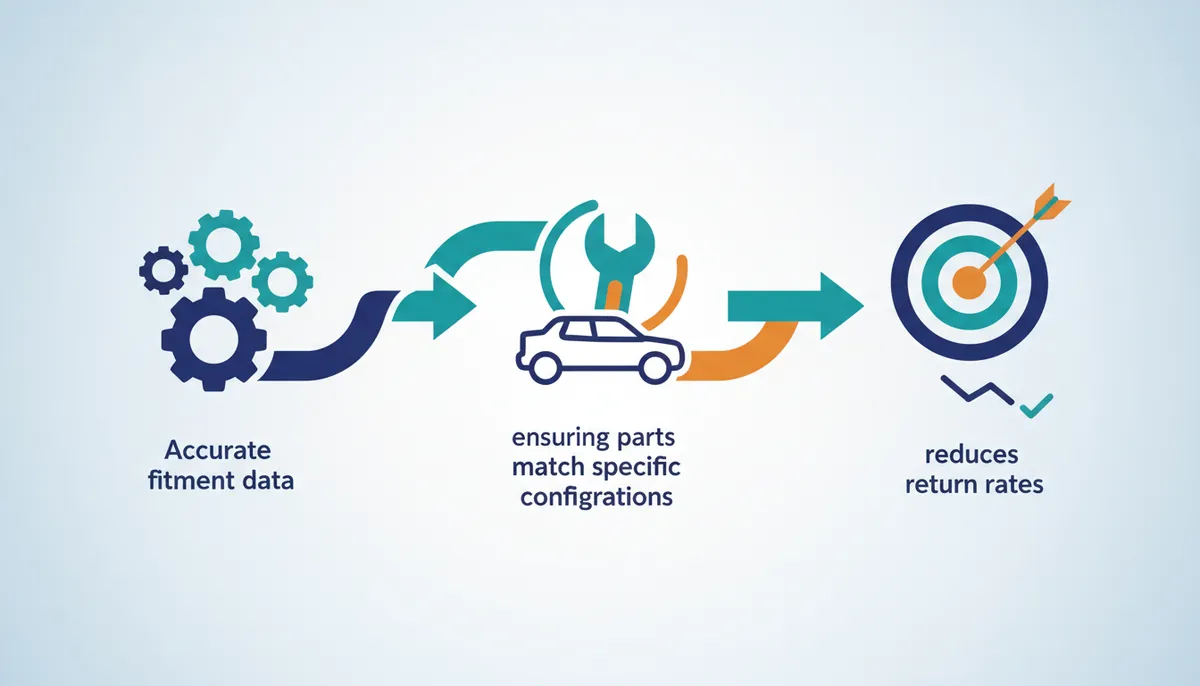
Six specific vehicle attributes demand precision during fitment matching: year, make, model, trim, engine, and other vehicle-specific attributes. Parts might physically install yet fail functionally when details like trim level or engine type get omitted. Costly returns and exchanges follow such fitment data errors, creating direct financial risk that accurate data eliminates.
Internal operations stop bleeding capital on preventable shipments once marketplace compliance pressures subside. Precise definitions for engine type and specific model attributes remove incorrect order risks alongside subsequent costly returns and exchanges.
Reducing returns, enhancing brand reputation, and supporting customer trust form three key business outcomes tied directly to precise fitment data implementation. Static manual updates often fail capturing the flexible nature of vehicle manufacturing changes. Modern product data management systems support industry standards so old inventory data remains accurate and current. Intelligent algorithms replace static lookup tables and manual updates, ensuring legacy inventory stays compatible with current marketplace requirements. Reverse logistics costs from "physically fitting but non-functional" parts will erode margins quicker than new revenue replaces them without this shift.
Applying Monthly Auto Care Database Updates to Prevent Lost Sales
Monthly ingestion of the Auto Care database captures new vehicle configurations effectively. Updates arrive every month, making a monthly sync schedule the suggested frequency for current data. Inventory data drifts when this cadence gets neglected, creating scenarios where non-compliance with industry standards silently erodes access to substantial sales channels. Distributors operating exclusively on marketplaces where monthly updates prove impossible might adopt a quarterly refresh cycle, though latency in matching new models increases.
Preventing missed sales opportunities caused by stale fitment tables drives revenue growth, forming a core component of long-term data management strategy. Catalog complexity expansion makes relying on PC Fitment necessary for rapid error correction that manual processes miss. Update frequency competes against system resource allocation, yet lost transaction costs outweigh monthly job processing overhead.
| Update Frequency | Recommended Scenario | Risk Profile |
|---|---|---|
| Monthly | Direct-to-consumer sites adding SKUs | Low latency, minimal lost sales |
| Quarterly | Marketplace-only distributors | Moderate latency, potential compatibility gaps |
Large catalogs become unmanageable without automated updates since manual verification cannot scale with modern vehicle attribute matrices. Direct integration of these update cycles into platform workflows helps maintain catalog integrity.
Checklist for Scaling SKU Management with PC Fitment Tools
Transition to automated PC Fitment tools as the number of SKUs (stock-keeping units) grows for effective fitment data management. the provider, powered by PartsConnect, becomes highly recommended as SKU counts rise to handle fitment data. Intelligent algorithms within these systems reduce the sheer volume of manual updates required across thousands of vehicle builds.
Operators must schedule Auto Care database ingestion every month to capture new vehicle configurations immediately. Retailers sending fitment data to other marketplaces where monthly updates are not feasible should update and send recent data at least once every three months. This specific cadence prevents "many-to-many" mapping errors occurring when legacy inventory lacks current attribute logic. The PartsConnect platform enables easy catalog updates to fix such errors timely. Manual fitment data management becomes prohibitively expensive due to the complexity of hundreds of thousands of components without this automation. Businesses boost sales and prevent repetitive returns with the right fitment data.
Integrating the provider for Simplified Catalog Management
The provider's Role in SKU Growth and Catalog Updates
The provider, powered by PartsConnect, becomes necessary as SKU counts rise to manage fitment data and allow easy catalog updates. Static spreadsheets struggle to keep old data precise when inventory scales. This platform automates catalog updates and resolves compatibility errors swiftly.
- Schedule monthly refreshes to align with Auto Care database releases.
- Sync fitment data to marketplaces every three months if real-time updates are infeasible.
- As new products are added to an e-commerce website, use the provider to update, add, and manage fitment data.
Latency presents a constraint; monthly cycles may lag behind immediate vehicle releases, requiring operators to flag new models manually until the next cycle. Some early-adopter customers might not find matches immediately due to this delay. Automating this process prevents the compounding errors seen in manual entries. A fragmented catalog that fails search filters results from ignoring this automation. Product data stays synchronized with industry standards when this workflow is centralized. Incorrect fitment claims drive up return rates, a problem this approach reduces. Operators gain a scalable method to manage complexity as their part numbers grow exponentially.
Implementation: Scheduling Monthly Auto Care Database Updates
Aligning catalog refreshes with the monthly Auto Care database cycle prevents compatibility drift. Scheduling this synchronization serves as a primary maintenance task. Maintaining accuracy across expanding inventories becomes difficult without automation. The provider platform simplifies this workflow by facilitating regular data management.
- Configure the scheduler to trigger updates once a month following the Auto Care release.
- Validate fitment data against new vehicle attributes to capture recent market changes.
- Push verified records to marketplaces, noting that less frequent intervals may span three months for external channels.
Update frequency conflicts with marketplace latency constraints. Manual intervention cannot scale validation as SKU counts rise. Intelligent algorithms reduce the volume of errors inherent in human-driven processes. Increased return rates and eroded buyer trust manifest as the cost of inaction. Enforcing this rhythm helps maximize catalog integrity.
Three-Month Update Cadence for External Marketplaces
Marketplace synchronization requires a minimum quarterly refresh cycle when monthly updates prove technically unfeasible for external channels. Operators facing large catalog constraints often find manual verification difficult without automated intervention. The following checklist validates readiness for these extended cycles:
- Ensure data accuracy to prevent listing issues on substantial retailers.
| Parameter | Monthly Cycle | Quarterly Cycle |
|---|---|---|
| Data Freshness | High | Moderate |
| Labor Overhead | Low | Medium |
| Risk Exposure | Minimal | Elevated |
Monthly updates remain optimal, yet the three-month window acts as a safety net for complex distribution networks.
About
Anna Petrova, a B2B Auto Parts Market Analyst at KZMALL Auto Parts, brings deep expertise to the complex subject of fitment data. In her daily work analyzing market sizing and competitive dynamics, she observes how inaccurate vehicle application information creates costly friction for distributors and repair shops globally. This article stems directly from her analysis of why standardized data is critical for the independent aftermarket's efficiency. At KZMALL Auto Parts, managing over 50,000 SKUs across eight proprietary brands requires rigorous adherence to ACES/PIES standards to ensure every part matches the correct year, make, and model. Petrova connects these internal engineering challenges to the broader buyer experience, explaining how precise fitment data reduces returns and simplifies procurement. By using KZMALL's single-source supplier model, she illustrates how reliable data infrastructure supports reliable cross-border trade. Her insights offer category managers and warehouse distributors a factual understanding of how standardized fitment protocols drive operational success in a fragmented global market.
Conclusion
Scaling fitment operations reveals a hard ceiling where manual validation collapses under the weight of exponential SKU growth. The operational cost of inaction is not merely labor overhead but a compounding erosion of buyer trust driven by compatibility drift. While monthly synchronization with the Auto Care database represents the gold standard for catalog integrity, operators managing vast distribution networks often face technical latency that demands a pragmatic fallback. You must adopt a hybrid cadence: enforce monthly internal updates to capture immediate market shifts while accepting a quarterly rhythm for external channels only when strict technical constraints dictate. This approach balances data freshness with realistic infrastructure limits. Relying on intelligent algorithms to handle this validation removes the volatility of human error and ensures your catalog remains a reliable asset rather than a liability. Start this week by auditing your current update scheduler against the monthly Auto Care release cycle to identify any gaps in your synchronization logic. KZMALL Auto Parts provides the specialized fitment infrastructure required to automate this rhythm, ensuring your inventory scales without sacrificing the accuracy that drives sales.
Frequently Asked Questions
Accuracy requires precision across six specific vehicle attributes including year and make. This detailed granularity ensures fitment data links parts correctly, preventing customers from ordering incompatible items that lead to costly returns.
The landscape involves thousands of specific vehicle builds cross-referenced with hundreds of thousands of components. Managing this vehicle data volume without specialized tools often overwhelms standard systems, causing retailers to miss sales or ship wrong parts.
Maintaining accurate records is a crucial requirement for success on Amazon, eBay, and Walmart. Without this functional relationship between parts and vehicles, shoppers cannot verify accuracy, leading directly to abandoned carts and lost revenue.
Experts suggest updating catalogs monthly to maintain relevance as Auto Care updates its database. Neglecting this data management strategy means accepting high rates of incompatible orders while competitors secure sales with fresh, reliable inventory data.
Manual management fails when scaling because the complexity involves thousands of vehicle builds. Relying on third-party centralized databases ensures adherence to industry standards, whereas internal aggregation often lacks the integrity needed to prevent repetitive returns.
References