
Winter icept evo 4: 15% More Mileage
Hankook delivers a 15% mileage increase with the Winter i*cept evo 4, directly addressing tread wear concerns in cold climates. Readers will examine the specific silica dispersion techniques used to lower rolling resistance and analyze how the reworked tread geometry reduces noise while maintaining snow braking performance.
The manufacturer attributes these gains to a reduced curing temperature and improved compound consistency, which collectively enhance fuel economy and driving stability. Unlike previous iterations that focused solely on soft compounds for grip, this design uses diagonally cut tread blocks and redesigned central grooves to manage wear patterns more effectively. Jongho Park, president and COO of Hankook Tire Europe, frames this release as a continuation of their winter family success, emphasizing the balance between safety characteristics and uncompromising efficiency.
The analysis covers the availability across 93 sizes for passenger vehicles and 75 sizes for SUVs, ensuring broad applicability for diverse fleets. By focusing on these tangible engineering adjustments, the discussion reveals how modern winter tires are evolving to meet stricter efficiency demands while retaining necessary cold-weather capabilities.
Defining the Winter i*cept evo 4 Architecture for Passenger Cars and SUVs
Winter i*cept evo 4 Architecture and Softer Compound Design
The Winter i*cept evo 4 uses a specialized softer compound to maximize road contact in freezing conditions. This architectural choice allows the tread strip to conform more effectively to irregular road surfaces. By maintaining flexibility, the tire creates a larger contact surface that enhances grip. The inclusion of silica within the mix supports this efficiency by lowering rolling resistance while contributing to driving stability. The tread geometry is designed to improve braking performance on snow and traction in adverse conditions. Operators selecting winter tires must recognize that this tread geometry prioritizes cold-weather pliability. The result is a component that combines safe driving characteristics with maximum comfort. The design confirms that material science, rather than just pattern depth, dictates modern performance ceilings.
Passenger Car and SUV Variant Availability Across 93 and 75 Sizes
Hankook distinguishes the Winter i*cept evo 4 line through dedicated engineering for distinct vehicle classes. The passenger car variant is available in 93 sizes for passenger cars, covering a broad spectrum of compact and performance sedans. Conversely, the Winter i*cept evo 4 SUV addresses the specific mass and center-of-gravity challenges inherent to heavier crossovers. This dedicated SUV model is available in 75 sizes, ensuring fitment for popular utility vehicles. Market analysis confirms the product line is available in two distinct variants: one specifically engineered for passenger cars and a dedicated version for SUVs. This segmentation reflects a broader industry shift where ultra-high-performance winter tires diverge from standard options to match expanding performance SUV populations.
Rolling Resistance and Noise Reduction Versus Predecessor Models
The Winter i*cept evo 4 prioritizes rolling resistance reduction through optimized silica dispersion and lower curing temperatures. Both models offer improvements in rolling resistance and noise reduction compared to their predecessors. The design specifically targets rolling noise reduction via diagonally cut tread blocks and redesigned central grooves. This efficiency gain supports stricter environmental regulations while maintaining the soft compound flexibility required for winter traction.
| Feature | Predecessor Focus | Evo 4 Optimization |
|---|---|---|
| Efficiency | Standard winter compound | Reduced curing temperature |
| Acoustics | Basic groove pattern | Diagonal block cuts |
| Mileage | Baseline wear rates | Extended tread life |
Meanwhile, the UHP category placement means these tires target performance vehicle owners who value low emissions alongside safe driving characteristics. The new model combines these safe driving characteristics with maximum comfort, meeting the requirement for uncompromising efficiency.
Mechanics of Silica Dispersion and Tread Geometry in Cold Weather Performance
Silica Dispersion and Curing Temperature Mechanics
Reduced curing temperatures enable optimized silica distribution within the tire compound, directly lowering rolling resistance. This rolling resistance metric quantifies the energy loss as a tire deforms under load, where lower values translate to reduced fuel consumption.
The technical relationship between curing and performance involves specific chemical bonding. The manufacturing process enhances the bond between filler and rubber polymer through improved silica dispersion. This structural consistency reduces the energy required to flex the tread block during rotation. Consequently, drivers experience enhanced driving stability alongside fuel savings, as the tire maintains consistent contact with the road surface. The company states that optimized silica distribution and precise thermal management during manufacturing are the primary factors contributing to lower fuel consumption and driving stability. The design prioritizes a balance between material science and manufacturing precision to achieve these results.
| Factor | Impact on Performance |
|---|---|
| Curing Temperature | Contributes to lower rolling resistance |
| Silica Dispersion | Reduces internal friction losses |
| Tread Compound | Influences cold weather flexibility |
In practice, the silica compound technology cited here illustrates how material science drives modern efficiency standards without sacrificing grip.
Tread Geometry Noise Reduction via Diagonal Cuts
Diagonally cut tread blocks function as a key element in disrupting acoustic resonance patterns within the tire cavity. When a tire rotates, air trapped in the grooves compresses and expands, generating sound waves that propagate through the vehicle structure. The Winter i*cept evo 4 employs diagonally cut tread blocks to break up these uniform sound waves, effectively scattering energy frequencies that would otherwise coalesce into a noticeable drone. This geometric rearrangement targets rolling noise reduction by ensuring that the pitch sequence of the blocks does not create repetitive harmonic peaks. Redesigned central grooves further assist this process by altering airflow dynamics at the contact patch.
Softer winter compounds maximize the contact surface between the tread strip and road to reduce wear. This physical expansion allows the tire compound to conform to micro-irregularities in the asphalt, distributing mechanical stress more evenly across the footprint. Engineers use this effect to extend service life, as the tread plays a particularly necessary role in this process by remaining pliable in cold conditions. Key engineering checkpoints for optimizing contact surface include:
The combination of a softer compound and optimized tread geometry allows for a larger contact surface, which engineers utilized to increase mileage compared with the predecessor model. The silica compound must maintain dual functionality by reducing noise while enabling this critical surface expansion.
Comparative Analysis of Generation Four Efficiency Against Predecessor Benchmarks
Defining the 15% Mileage Increase and Efficiency Gains
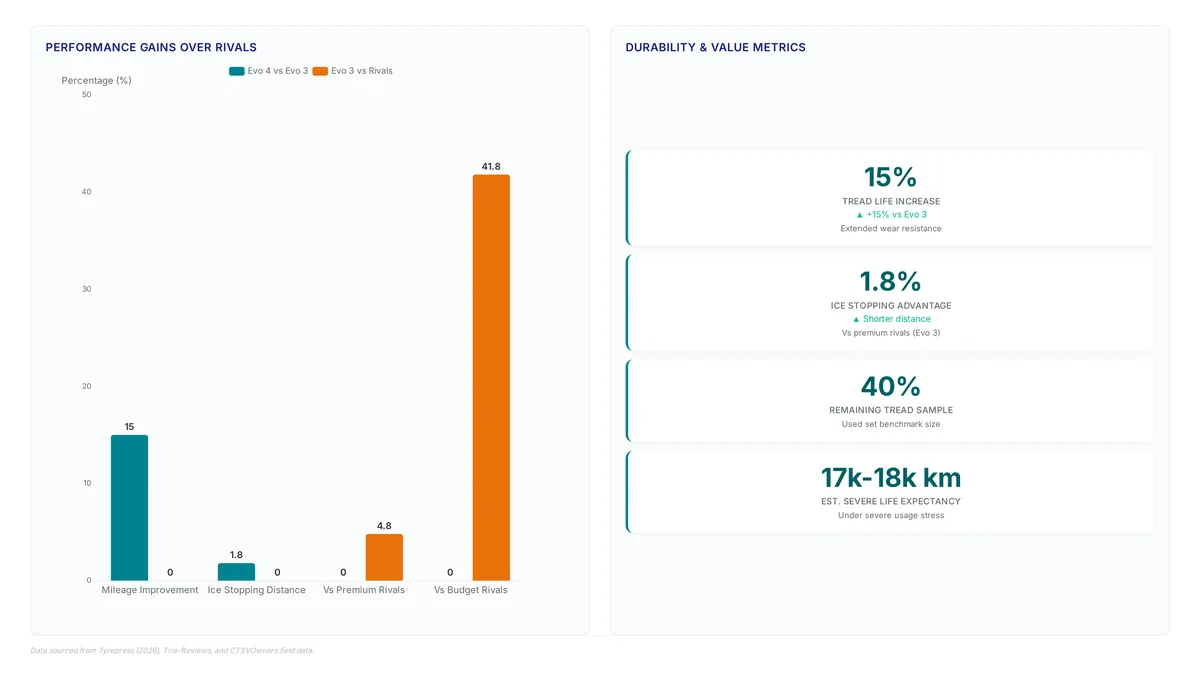
The 15% mileage increase quantifies the extended tread life of the Winter i*cept evo 4 versus the evo 3 predecessor. This metric specifically measures wear resistance rather than fuel economy, though both benefit from reduced curing temperatures. Lower thermal processing enhances silica dispersion within the compound, creating a more uniform matrix that resists abrasion while maintaining flexibility. The result is a tangible reduction in rolling resistance without sacrificing the soft contact patch required for winter grip. Independent reviews of the previous generation established a high baseline, noting a 1.8% advantage over premium rivals in specific ice tests. The current generation builds on this by refining the internal structure to delay wear patterns that typically shorten tire life. This definition of efficiency prioritizes longevity alongside energy conservation, distinguishing the model from competitors focusing solely on one attribute.
Applying Snow Braking Metrics to Real-World Winter Driving
Real-world braking assessment requires measuring stopping distances on packed snow rather than relying solely on laboratory ice tests. The tread geometry of the new Hankook model translates diagonally cut blocks into tangible traction gains during adverse conditions. Drivers navigating icy roads should prioritize this mechanical grip over noise reduction when local temperatures frequently drop below freezing. Field data from severe usage suggests a total life expectancy of 17,000, 18,000 km under such stress, indicating that aggressive siping does not necessarily compromise durability. However, the performance gap between premium winter compounds and entry-level options remains stark, often exceeding 40% in critical ice traction scenarios. This thermal characteristic means drivers in regions with fluctuating temperatures face a choice between maximum snow safety and warm-weather stability.
Evo 4 Versus Premium Rivals and Entry-Level Winter Tire Gaps.
Market positioning analysis reveals that the Winter i*cept evo 4 targets a specific performance tier between budget options and established premium competitors. The stopping distance advantage is not merely theoretical but a quantifiable gap in safety margins during critical braking events. Such a disparity implies that operators choosing based solely on initial purchase price may face disproportionate risks in severe conditions. Consequently, the strategic value of the evo 4 lies in closing the safety deficit found in budget segments while maintaining cost parity with mid-range options. Previous market data suggests a full set of four tires could be purchased for under a competitive price in certain promotional contexts, positioning the brand as a value-oriented premium option. This pricing structure forces a reevaluation of total cost of ownership when factoring in the potential for increased accident liability with inferior tires. The new model relies on the proven architecture of the previous generation to deliver these performance characteristics.
Application Framework for Selecting Fuel-Efficient Winter Tires Based on Driving Needs
Defining Winter Tire Efficiency Through Rolling Resistance and Compound Softness
Efficient winter traction begins when a softer compound expands the contact surface to grip cold pavement while reducing wear. This balance defines rolling resistance, where lower values directly correlate to reduced fuel consumption and extended range for electric vehicles. The industry trend toward efficiency drives engineers to optimize silica dispersion, ensuring the tread remains flexible in freezing conditions while minimizing heat generation. Advanced geometries can lower resistance while maintaining grip, a state achieved through precise manufacturing controls such as reduced curing temperatures. Operators selecting tires can realize tangible efficiency gains by choosing designs that use these specific engineering improvements. The result is a tread geometry that supports safe braking distances while meeting strict environmental standards.
Applying Mileage Metrics and SUV Variant Data to Real-World Upgrade Decisions.
Drivers evaluating an upgrade should calculate total cost per kilometer rather than comparing initial purchase prices alone. A critical tension exists between immediate replacement costs and long-term value; owners should note that the new Winter i*cept evo 4 SUV is available in 75 sizes, while the passenger car variant offers 93 sizes, ensuring broad coverage for various rim diameters. Operators must verify fitment to ensure compatibility across all trim levels.
Checklist for Validating Fuel Consumption Claims and Snow Traction Geometry.
Start validation by confirming the manufacturer attributes low rolling resistance to specific processes like reduced curing temperature and improved silica dispersion.
- Inspect technical documentation for diagonally cut tread blocks that claim to reduce noise while maintaining snow traction.
- Verify that the tread geometry design explicitly targets braking performance in adverse winter conditions.
- Cross-reference size availability, as the passenger variant offers 93 options while the SUV version provides 75 distinct fitments.
| Feature | Validation Target | Operational Benefit |
|---|---|---|
| Compound | Silica distribution method | Lowers fuel consumption |
| Tread Design | Diagonal block cuts | Reduces road noise |
| Contact Patch | Soft compound depth | Improves snow braking |
Consumers often overlook that softer winter compounds expand the contact surface to reduce wear, a geometric lever engineers use to increase mileage without sacrificing grip. The new model combines these safe driving characteristics with maximum comfort, using low rolling resistance to meet the requirement for uncompromising efficiency. KZMALL Auto Parts recommends prioritizing verified tread geometry over generic efficiency labels when selecting tires for unpredictable climates.
About
Anna Petrova is a B2B Auto Parts Market Analyst at KZMALL Auto Parts, where she specializes in market sizing and demand trends across the global independent aftermarket. Her daily work involves dissecting competitive dynamics and evaluating product performance data to guide sourcing strategies for wholesale buyers. This expertise makes her uniquely qualified to analyze the launch of Hankook's Winter i*cept evo 4, as she constantly assesses how technical improvements like reduced rolling resistance and enhanced mileage impact inventory value for distributors. At KZMALL, a leading multi-brand platform offering over 50,000 SKUs including the JOYGROUND tire line, Anna bridges the gap between manufacturer specifications and practical procurement decisions. Her analysis connects Hankook's engineering advancements directly to the operational needs of repair shops and fleet operators seeking reliable winter solutions. By using standardized fitment data and industry certifications, she ensures that technical claims regarding fuel efficiency and noise reduction are contextualized for professional buyers navigating a fragmented market.
Conclusion
Scaling winter tire adoption reveals that initial purchase price often masks the true operational cost of reduced traction and premature wear. While promotional pricing creates an attractive entry point, the performance gap exceeding 40% in critical ice scenarios defines the real risk profile for fleet operators and individual drivers alike. Relying on generic efficiency labels without verifying the underlying silica distribution or tread geometry invites failure when temperatures drop. You must prioritize verified mechanical advantages over marketing claims to ensure safety does not degrade as the compound ages.
Commit to a replacement strategy based on total cost per kilometer rather than upfront expense alone. If your current tires lack diagonally cut tread blocks or documented low rolling resistance processes, schedule an immediate upgrade before the next severe weather window closes. Do not wait for visible wear bars to appear; the 1.8% advantage over premium rivals diminishes rapidly once the soft compound hardens.
Start by inspecting your current technical documentation for specific curing temperature data and silica dispersion methods this week. Cross-reference these findings against the 93 available passenger sizes or 75 SUV fitments to confirm your vehicle requires an update. Verify that your chosen part variant matches these strict geometric standards before finalizing any purchase order.
Frequently Asked Questions
The new tire delivers a 15% mileage increase over the prior model. This extended life means drivers replace tires less frequently, reducing long-term ownership costs while maintaining winter safety standards throughout the season.
A reduced curing temperature optimizes silica dispersion to lower rolling resistance. This mechanical adjustment directly decreases fuel consumption, allowing vehicles to travel further on a single tank during cold weather commuting conditions.
Diagonally cut tread blocks and redesigned central grooves minimize rolling noise. This acoustic improvement provides a quieter cabin environment, making long winter journeys more comfortable without sacrificing the soft compound needed for traction.
Distinct variants address specific mass and center-of-gravity challenges for each vehicle class. The dedicated SUV model ensures proper load handling, while the passenger version optimizes performance for lighter sedans across their respective size ranges.
The softer compound increases the contact surface between the tread and road. This larger footprint enhances grip on irregular surfaces, directly improving braking performance on snow and stability in adverse winter driving scenarios.
References