
Wheel fitment data: Stop costly guesswork now
Covering 53,000 specific modifications, a reliable wheel fitment database eliminates costly compatibility errors immediately. Relying on imprecise measurement methods is obsolete; modern cloud architectures have rendered it unnecessary. Thorough data structures manage vehicle wheel specs across 15 different global regions to prevent physical interference. We need practical methodologies for selecting optimal wheel and tire package configurations without physical trial and error.
Industry leaders like DriveRightData position these cloud-based systems as the market standard for global vehicle classification. Platforms such as Wheel-Size.com demonstrate the required scale, hosting data for 199 distinct vehicle makes. Ignoring verified aftermarket rim specifications invites mechanical failure and liability. The path forward demands strict adherence to validated tire diameter compatibility metrics, not estimation.
The Role of Thorough Fitment Data in Vehicle Compatibility
Defining Wheel Fitment: Offset, Bolt Pattern, and Center Bore
Geometry dictates the interface between a rim and the vehicle hub assembly. Offset (ET) quantifies the millimeter distance from the mounting surface to the vertical centerline, governing suspension clearance and track width directly. Precise offset records position the wheel correctly relative to surrounding suspension components.
Bolt Pattern, or Pitch Circle Diameter (PCD), identifies the lug hole count and the diameter of their circular arrangement. Proper alignment here allows the wheel to seat flat against the hub face. Technical resources document these PCD parameters to guide accurate selection.
Center Bore diameter decides whether the wheel centers on the hub or depends entirely on lug nuts for positioning. Matching this bore to hub specifications achieves true rotational centering. Fitment databases compile offset and bore figures to enable correct choices.
| Attribute | Function | Failure Mode |
|---|---|---|
| Offset | Positions wheel laterally | Improper clearance |
| Bolt Pattern | Secures wheel to hub | Will not mount |
| Center Bore | Centers wheel rotationally | Vibration or hub damage |
Correct bolt spacing means little if the center bore or offset creates physical interference. Industry professionals apply detailed PCD and offset metrics to prevent incompatibility before purchase occurs.
Applying Thorough Fitment Data Across Global Markets
Global datasets validate OE wheel specifications against local market variants effectively. Coverage spans fitment data across 15 different global regions, accounting for manufacturing differences and distinct vehicle classifications. This geographic scope aids aftermarket wheels lookup by cross-referencing modifications and trim levels. Distinguishing original equipment from custom rims demands such depth to verify tire size notation accuracy. Generic charts often miss the clearance failures resulting from misread values.
| Feature | OEM Validation | Aftermarket Fitment |
|---|---|---|
| Scope | Factory standard | Custom modification |
| Risk | Low deviation | High variance |
| Data Need | Exact match | Tolerance range |
Global availability frequently conflicts with local specification adherence. Sourcing wheels requires strict attention to vehicle-specific hubcentric requirements. Mismatches here generate vibrations that balance weights cannot correct. Detailed records beat visual estimation every time. Precise technical parameters stop costly returns and road safety hazards.
Validating Wheel Compatibility Using Standard Fitment Attributes
Wheel fitment establishes part compatibility based on make, model, year, and engine type. Validation requires checking standard attributes beyond basic diameter and width to guarantee safe installation.
Operators must verify Load Index and Speed Rating against requirements to prevent structural failure under stress. The Center Bore diameter must match the hub exactly to avoid vibration, while the Offset value (ET) determines suspension clearance. Fastener specifications matter equally; the database includes Wheel Fasteners detailing the correct lock type, such as lug nuts or bolts, alongside precise Wheel Torque Tightening specifications. The platform contains data for over 53,000 specific vehicle modifications.
| Attribute | Function | Risk of Error |
|---|---|---|
| Load Index | Supports vehicle weight | Tire deformation or blowout |
| Center Bore | Centers wheel on hub | Vibration and bearing wear |
| Torque Specs | Secures fasteners properly | Loose wheels or stud shear |
Distinguishing OEM vs aftermarket wheels often hinges on these granular data points rather than visual appearance alone. Aftermarket options may share bolt patterns but fail on hub diameter or load capacity. Ignoring the thread size or torque settings can lead to catastrophic fastener failure regardless of visual fit. Cross-referencing every attribute against the vehicle description ensures full compatibility. Neglecting the wheel torque tightening values specified in the data creates a high probability of fastener loosening during operation. A complete fitment check validates every technical parameter to eliminate the risk of ordering incompatible parts.
Inside the Architecture of Global Wheel Specification Databases
Mapping Vehicle Generations to Engine Codes and Trim Levels
Precise fitment requires linking vehicle records to specific attributes rather than relying on model names alone. Standard fitment data attributes include production years, fuel type, and engine type to distinguish between variants that share a platform. Operators searching by rim size often overlook that trim levels function as distinct data fields necessary to refine accuracy for part compatibility.
Parts compatibility and fitment refers to the system of matching automotive parts and accessories to the specific vehicles they're designed to fit, encompassing year, make, model, trim, engine, and other vehicle-specific attributes that determine compatibility. Fitment data works by matching the precise details of a vehicle with the corresponding auto parts that fit perfectly and function as intended.
| Data Hierarchy Level | Determines Primary Constraint | Secondary Impact |
|---|---|---|
| Vehicle Generation | Platform identification | Production timeline |
| Engine Code | Fuel type classification | Drivetrain configuration |
| Trim Level | Feature specification | Option package validation |
Broad compatibility searches clash with engineering reality. Fitment search engines make precise suggestions based on a customer's vehicle make, model, year, engine type, transmission, and other factors. Ignoring these specific identifiers leads to incompatibility where parts do not function as intended. Validating against the full attribute chain helps avoid returns caused by mechanical mismatches invisible to visual inspection.
Retrieving Original Equipment and Aftermarket Optional Tire Fitments
The database distinguishes Original Equipment specifications from Aftermarket and optional sizes by cross-referencing vehicle data with specific trim level constraints. Users finding vehicles by tire diameter rely on markers that explicitly identify various fitment configurations.
| Query Type | Primary Filter | Distinction Target |
|---|---|---|
| Find by Diameter | Tire Dimensions | OE vs Optional Fitment |
| Search by Rim | Wheel Diameter | Standard vs Custom Specs |
| Package Lookup | Combined OD | Seasonal vs All-Season |
This distinction prevents the installation of wheels that physically mount but fail under load due to specification mismatches. DriveRightData offers a thorough tire fitments database which includes OE, OE Optional, and Aftermarket fitments linked to vehicle trim levels for precise matching. Maximizing wheel diameter for aesthetics often conflicts with maintaining sufficient sidewall height for road resistance.
Verifying Wheel Torque, Thread Size, and Fastener Lock Types
Necessary verification data includes center bore dimensions and the specific wheel fastener lock type, distinguishing between lug nuts and bolts required for the hub interface.
| Specification | Verification Target | Failure Mode |
|---|---|---|
| Thread Pitch | Metric vs Imperial | Stripped stud threads |
| Fastener Type | Lug nut vs Bolt | Hub face gap |
| Torque Value | Nm vs ft-lb | Loose wheel incident |
Validating these mechanical constraints before purchase helps ensure structural integrity.
Practical Strategies for Selecting Optimal Wheel and Tire Packages
Defining Winter-Wheel Downsizing and Aftermarket Upsteps
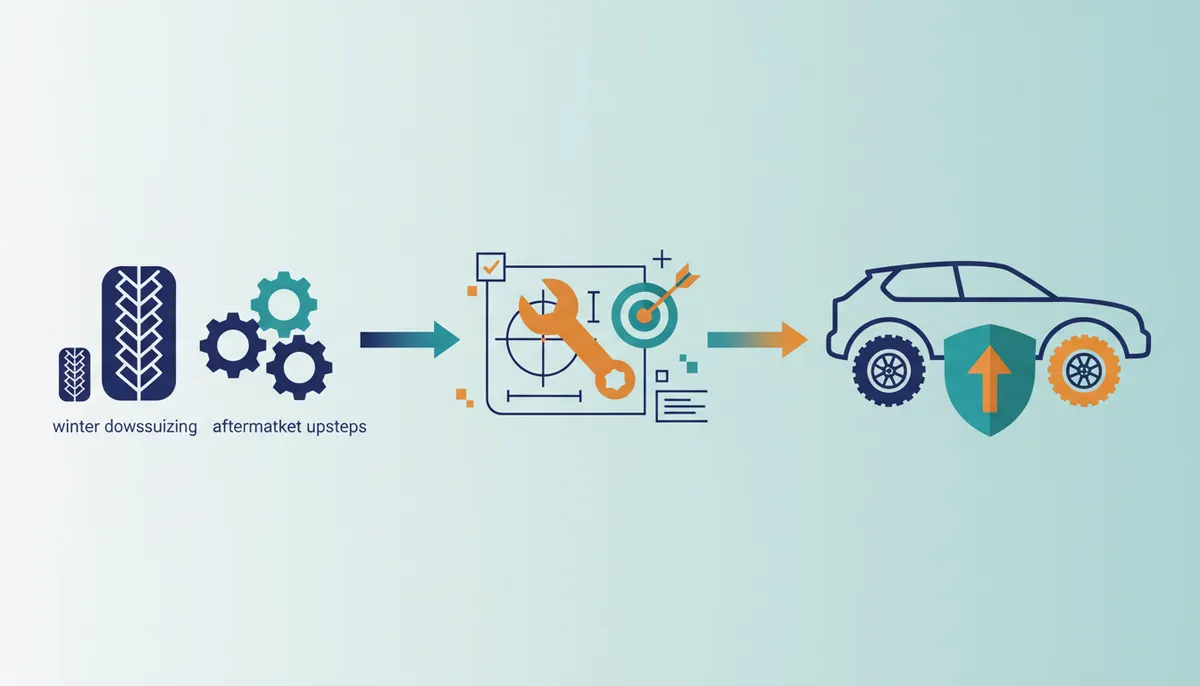
Winter-wheel downsizing reduces rim diameter to increase sidewall height, a common strategy for improving traction in adverse conditions. This approach contrasts with aftermarket upsteps that expand wheel diameter to enhance aesthetic presence and dry-pavement handling. Fitment databases distinguish between Original Equipment (OE), OE Optional, and aftermarket fitments linked to specific vehicle trim levels to guide these selection paths. Operators addressing the query "should I change tire size" must evaluate whether their priority is seasonal performance or visual modification.
Choosing between OEM and aftermarket wheels creates friction between guaranteed clearance and custom offset specifications. Original equipment ensures perfect factory alignment. Aftermarket options require precise verification of bolt patterns and center bore dimensions. Detailed wheel and tyre fitment information validates these non-standard configurations. Enthusiasts often seek packages that balance function with unique directional designs, relying on data that matches precise vehicle details with corresponding auto parts that function as intended.
Load index ratings demand verification before any diameter change occurs. Incorrect fitment leads to parts that do not fit accurately, impacting the decision-making process and potentially affecting vehicle safety. Operators must cross-reference trim levels because a wheel that fits one generation may fail on another due to brake caliper changes. Accurate matches for auto parts simplify search and inventory management, ensuring components function correctly.
Executing Targeted Searches by Tire Width, Aspect Ratio, and Rim Diameter
Operators fix incorrect wheel fitment by filtering directly on Tire Width, Aspect Ratio, and Rim Diameter rather than browsing generic vehicle lists. This targeted approach resolves the "should I change tire size" dilemma by isolating packages that maintain overall rolling diameter while altering contact patch geometry. Fitment data presents information about the parts and the vehicle itself, as well as the relation between these two sets of data, ensuring search results match the physical constraints of the wheel well. The platform supports specific tire measurement systems including ISO Metric and LT-High Flotation.
| Search Parameter | Function | Critical Constraint |
|---|---|---|
| Tire Width | Defines contact patch | Must clear suspension components |
| Aspect Ratio | Controls sidewall height | Affects speedometer accuracy |
| Rim Diameter | Sets wheel size | Limited by brake caliper clearance |
Users can search by specifying exact values for these dimensions alongside Tire Diameter to validate clearance before purchase. A common oversight occurs when operators prioritize width without adjusting aspect ratio, inadvertently increasing overall diameter beyond factory tolerance. Such miscalculations can result in parts that do not fit perfectly or function as intended. Narrowing the search to precise dimensional inputs prevents costly trial-and-error installations. Verifying these three metrics against suspension travel limits helps guarantee compatibility.
Checklist for Validating OE Only Filters and Custom Rim Attributes
Filtering searches for OE only isolates Original Equipment specifications to prevent fitment errors caused by unverified aftermarket claims. This step addresses the root cause of incorrect wheel fitment where generic databases conflate factory standards with optional upgrades. Operators must distinguish between mandatory factory dimensions and aftermarket wheels that require manual validation of bolt patterns and rim widths. Fitment data works by cross-referencing vehicle details with thorough databases to ensure accurate matches.
| Attribute | OE Filter Behavior | Custom Input Requirement |
|---|---|---|
| Bolt Pattern | Matches factory database | Type custom values manually |
| Rim Width | Fixed to trim level | User-set range allowed |
| Data Source | Verified Original Equipment | Aftermarket supplier catalogs |
Users can browse available specs or input custom values to verify compatibility when factory data is insufficient. Leading data providers link complex fitments to specific vehicle trim levels, ensuring that selections align with thorough automotive standards. Optional factory wheels often share dimensions with aftermarket parts; relying solely on size metrics may overlook variances hidden in trim-specific data. Cross-referencing trim-level VIN data before finalizing any package is recommended to avoid fitment issues. This validation gap often leads to returns when visual compatibility masks mechanical incompatibility.
Implementing Fitment Widgets and API Integration for Automotive Platforms
Wheel Fitment API Demo Portal and Web Service Architecture
The Wheel Fitment API Demo Portal shows how external platforms fetch live vehicle wheel specs without hosting local catalog data. Integration starts by requesting access to the web service, which links directly to the global modification database.
- Register for API credentials to enable secure authentication for your application.
- Configure your backend to query rim size compatibility and bolt pattern parameters dynamically.
- Embed the provided code snippet to render OE wheel specifications on your frontend interface.
Developers installing the fitment widget gain immediate access to precise offset ET value and center bore fitment details. This architecture removes the need for merchants to keep static tables that often become outdated. Latency presents the main constraint; real-time lookups rely on network stability between the client and the database server. KZMALL Auto Parts recommends validating response times during peak traffic to prevent user timeouts. Unlike static downloads, this live connection ensures every displayed tire size by vehicle matches current inventory availability. A dependency on external uptime creates operational risk, making service-level agreements necessary for high-volume retailers.
Deploying the Customizable Wheel Fitment Widget on Webshops
Adding the widget script connects webshop visitors directly to the world's largest fitment database. This integration swaps static charts for flexible tire size lookup capabilities that update instantly.
- Download the widget code snippet from the KZMALL Auto Parts developer portal.
- Modify the configuration object to match your brand colors and font weights.
- Embed the script before the closing body tag of your product pages.
Operators must verify that the rim size compatibility engine loads before user interaction begins. A delayed load causes shoppers to abandon the aftermarket wheels selection process entirely. Deep customization competes with query speed; excessive skinning can increase latency. Unlike the API demo which targets developers, this widget requires no backend mapping for bolt pattern logic. Retailers using DriveRightData standards ensure their displayed offset ET value data remains globally consistent. Failure to test on mobile viewports often hides critical center bore fitment warnings on small screens. Successful deployment means users never guess if a wheel fits their specific vehicle generation.
Validating Real-Time Data Updates Across 199 Vehicle Makes
Developers must verify that backend scripts successfully poll for daily database updates to maintain rim size compatibility.
- Authenticate requests using credentials issued by KZMALL Auto Parts to secure the connection.
- Compare timestamps on returned vehicle wheel specs against the latest known modification dates.
- Trigger cache invalidation immediately when new models appear in the global registry.
The integration must handle continuous additions of new vehicle years without manual intervention.
| Check Type | Target Parameter | Failure Signal |
|---|---|---|
| Temporal | Update Frequency | Stale timestamp |
| Scope | Make Coverage | Missing entity |
| Precision | Bolt pattern | Mismatched count |
Relying on static snapshots risks serving obsolete offset ET value data to end users. The extensive database supports real-time queries, yet local caching layers often mask upstream changes. A failure to refresh causes the interface to display unavailable aftermarket wheels as valid options. This discrepancy erodes user trust quicker than slow load times. Operators should treat data freshness as a primary health metric rather than a background task.
About
Mark Phillips serves as Editor of Aftermarket Intel at KZMALL Auto Parts, where he analyzes global distribution channels and e-commerce trends. His daily work involves evaluating how standardized ACES/PIES fitment data drives accuracy across KZMALL's catalog of over 50,000 SKUs. This direct exposure to the complexities of matching aftermarket wheels and tires to specific vehicle applications makes him uniquely qualified to address the critical need for reliable wheel fitment databases. Phillips understands that incorrect bolt patterns, offset values, or center bore measurements lead to costly returns and safety risks for B2B buyers. By using KZMALL's engineering support and digital catalog tools, he highlights how precise tire size lookup and rim compatibility data eliminate guesswork for wholesalers and repair shops. His analysis connects rigorous data standards to real-world procurement efficiency, ensuring that vehicle wheel specs align perfectly with customer needs in a fragmented global market.
Conclusion
Scaling a wheel fitment database from a demo to production reveals that static snapshots collapse under the weight of daily vehicle registry changes. The operational cost of ignoring real-time updates is not merely technical debt but a direct erosion of consumer confidence when aftermarket wheels appear available but are physically incompatible. Relying on cached offset ET value data creates a false sense of security that leads to costly returns and support tickets. You must treat data freshness as a critical uptime metric rather than a background maintenance task.
Implement a strict validation protocol this week by comparing returned vehicle wheel specs timestamps against the latest global registry modification dates before any user query hits the cache layer. If your system cannot invalidate the cache immediately upon detecting a new model entry, you are actively serving obsolete bolt pattern logic to your customers. Do not wait for a quarterly review to address this latency gap between your upstream source and local storage.
Start by auditing your current cache invalidation triggers against the extensive database update frequency today to ensure stale timestamps do not dictate your inventory visibility.
Frequently Asked Questions
Mismatched bores cause dangerous vibrations and hub damage. Precise records prevent these failures, yet generic charts miss a portion of clearance issues leading to unsafe driving conditions.
Incorrect offset values create immediate physical interference with suspension parts. Validated data structures manage specs across regions to stop a portion of fitment errors before purchase occurs.
Wrong bolt patterns prevent the wheel from seating flat on the hub.
Visual estimation often leads to costly returns and safety hazards.
Matching center bore and offset stops rotation issues that balance weights cannot fix.
References