VIN specs lookup: Stop guessing engine and trim data
A VIN specs lookup decodes a 17-character VIN into factory specifications using the ISO 3779 structure instantly. This precision is the only reliable method to distinguish between identical marketing names that hide critical mechanical differences. Relying on year, make, and model descriptions is a futile exercise in ambiguity when the VIN code provides definitive proof of configuration.
The Vehicle Descriptor Section at positions 4 through 8 encodes specific body, engine, and trim data that sales listings often omit. Position 9 holds the mathematical check digit, validating the authenticity of the remaining characters to prevent fraud. Position 10 locks in the model year, eliminating confusion caused by overlapping production cycles.
Misidentified drivetrains or engine families destroy profit margins in used car transactions. Data from NMVTIS and NHTSA powers these lookups, ensuring the reported assembly plant and country of manufacture match the physical unit. Tools like the 17vin.com API for parts searching prevent the costly error of ordering components for the wrong trim level. This technical rigor transforms a simple string of characters into an irrefutable record of automotive identity.
The Role of VIN Specs Lookup in Modern Vehicle Verification
Decoding the 17-Character VIN Factory Specification
Generic tools stop at year, make, and model, leaving mechanics guessing about the actual build. A VIN specs lookup transforms a 17-character string into verified factory data using ISO 3779 standards. This 17-character format has been mandatory for all new cars since 1981. Professional databases dig deeper to reveal engine families and drivetrain configurations that marketing names hide. Digits four through eight, known as the Vehicle Descriptor Section, hold the specific engine characteristics. Trim levels live in this same segment, distinguishing a base model from a sport version even when they share a name. Free decoding services frequently skip these mechanical details, creating real risk for buyers who need exact parts.
Using NMVTIS Data for Instant Parts Fitment Verification
NMVTIS data validates vehicle identity to prevent costly trim mismatches during parts selection. A standard listing often omits the specific engine code or drivetrain configuration required for a correct order. Professional platforms use this federal database alongside NHTSA records to deliver structural specifications that generic searches miss. Advanced decoding platforms like the provider claim a parts fitment accuracy rate of 99.8% by using professional-grade databases such as TecDoc. Precision matters because the Vehicle Descriptor Section encodes the specific body, engine, and trim. Even small spec differences change the answer between a base trim versus a sport trim or front-wheel versus all-wheel drive. Relying solely on seller descriptions risks ordering components for the wrong engine family. Inventory turns suffer when return rates rise due to avoidable specification errors. Buyers must apply professional-grade databases to confirm the exact factory configuration before purchasing. This step eliminates ambiguity between similar trims that share a model name but differ mechanically. Secure your supply chain by trusting the encoded data over the marketing description.
VIN Decode Structural Specs Versus Window Sticker MSRP
Operators often confuse structural mechanics with pricing records, yet they serve distinct verification purposes. A VIN decode reveals structural mechanics, while the window sticker displays the as-built MSRP and option packages. The standard decode reliably returns the structural spec, covering the engine family and drivetrain encoded in digits 4 through 8. Industry analysis highlights this precision for verifying emissions compliance and fuel economy data. Conversely, the original window sticker remains the sole authority for pricing and cosmetic choices. Not every factory option appears in a database query; the lookup returns the structural spec, not the feature list. Advanced databases allow for the decoding of over 100 specific vehicle specifications, extending beyond basic make and model data. However, this depth still excludes monetary values. Mechanics need the build sheet for parts, while buyers need the sticker for value. Relying on the decode for price verification creates a blind spot in valuation workflows. The service allows users to enter a VIN or a U.S. License plate to decode specs for free.
Inside the 17-Character Code: Architecture and Data Flow
ISO 3779 Structure: Mapping Positions 4, 8 and 10 to Factory Specs
Position 10 of the 17-character code fixes the model year, anchoring the vehicle's timeline against rolling production changes. Decoders extract this digit to resolve cross-generational ambiguities where a single model name spans multiple calendar years. Parts catalogs risk conflating late-year production runs with early next-year builds without this fixed temporal marker. The Vehicle Identifier Section occupies positions 10 through 17, containing this year code alongside the assembly plant and unique serial sequence. Positions 4 through 8 constitute the Vehicle Descriptor Section, encoding the motor type, transmission, and specific body attributes. Specific engine characteristics often reside within these five digits, defining the mechanical heart of the spec sheet.
| VIN Segment | Positions | Encoded Data |
|---|---|---|
| VDS | 4, 8 | Body, engine, trim, transmission |
| VIS Year | 10 | Model year identifier |
| VIS Plant | 11 | Assembly location |
Some decoding tools present these attributes as a flat list, whereas structured outputs separate the descriptor and identifier sections for clarity. Manufacturer inconsistency creates a limitation; while the position is fixed, the specific alpha-numeric mapping for a V6 engine varies by brand. Operators must cross-reference the decoded character against the correct manufacturer table rather than assuming universal values. This variability means a generic lookup might return a code that requires a secondary database pass to translate into human-readable specifications.
Resolving Trim Ambiguity: Extracting Drivetrain and Assembly Plant Data
Should you stock OE, premium aftermarket, or both for this application? Here's the math. The same year/make/model often shipped in several trims with different engines, drivetrains, and equipment, making generic searches insufficient for precise fitment. Decoding the assembly plant and WMI characters confirms the exact configuration, transforming a vague model name into a verified build sheet. Position 11 identifies the specific factory location, while the World Manufacturer Identifier anchors the vehicle's origin. Modern tools instantly return these factory specs and build plant details upon entry of the 17-character code. This precision resolves ambiguity between a base trim versus a sport trim or front-wheel versus all-wheel drive configurations that share a model designation.
| Data Point | Generic Search Result | VIN Decode Result |
|---|---|---|
| Engine | Family Name Only | Displacement & Code |
| Drivetrain | Assumed Standard | Verified 2WD/AWD/4WD |
| Plant | Unknown | Specific Factory ID |
The standard decode returns the structural spec rather than every individual factory option or the original MSRP. Operators must recognize that while the decode confirms the mechanical heart, the window sticker remains the authority for cosmetic packages. This distinction prevents costly returns where a sensor fits the engine family but not the specific trim-level housing. Integrating this logic allows retailers to filter parts databases to show only compatible options, drastically reducing fitment errors. The constraint is reliance on accurate data entry; a single transposed character yields a valid but incorrect vehicle profile.
Validation Checklist: Verifying Authenticity via Check Digits and NMVTIS
In North American VINs, the 9th position is a mathematically calculated check digit used to validate the authenticity of the other 16 characters. This specific position triggers a formula that detects tampering before any database query occurs, flagging invalid strings immediately.
- Calculate the expected value for position nine using the standard transliteration weights.
- Compare the result against the provided character to detect mismatches.
- Cross-reference the structural data with NMVTIS records to access title brands and accident history.
| Step | Validation Target | Failure Consequence |
|---|---|---|
| 1 | Character Count | Rejects incomplete strings |
| 2 | Check Digit Math | Identifies forged VINs |
| 3 | NMVTIS Match | Reveals title brands |
Mathematical validation of the format cannot confirm the vehicle exists without external data sources. Platforms emphasize this dual-layer approach where mathematical validity precedes historical lookup. The real risk lies in assuming a correct checksum equals a clean title. Decoders apply this verified string to extract the engine family and drivetrain details encoded in positions four through eight. This precision prevents ordering parts for a V6 when the build specifies a V8, a common error in generic searches.
Measurable ROI from VIN Verification in Used Car Transactions
Defining Structural Specs Versus Factory Options in VIN Data
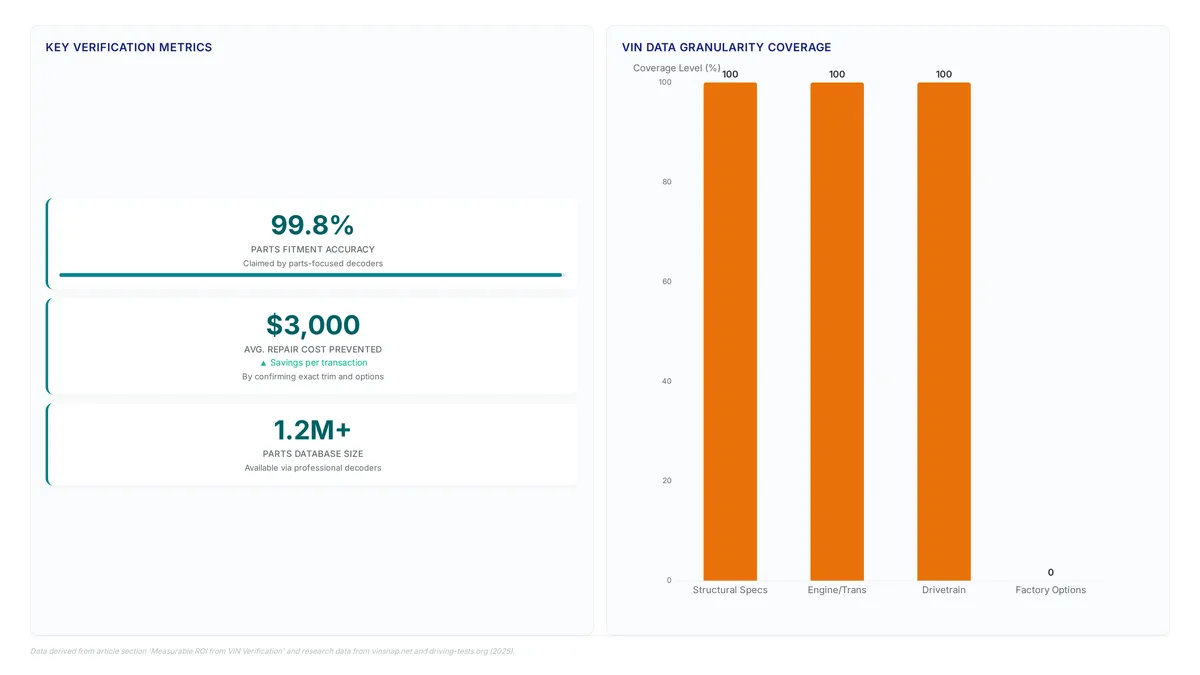
A VIN specs lookup reliably returns the structural spec, defining the engine, transmission, and drivetrain encoded within the descriptor section. Digits 4 through 8 hold these mechanical identifiers, which remain fixed for the vehicle's life regardless of added accessories. This data layer confirms the core build but does not list every individual factory option or cosmetic package installed at the plant.
| Data Type | Source Authority | Coverage Scope |
|---|---|---|
| Structural Spec | VIN Decode | Engine, transmission, trim level |
| Option List | Window Sticker | Packages, MSRP, specific colors |
| Color Codes | Door Jamb Label | Interior and exterior paint IDs |
Operators often mistake a decoded trim code for a complete equipment manifest, yet a high-line audio system or specific tow package rarely alters the base engine family or transmission type. The consequence is a parts mismatch where structural fitment is correct, but functional compatibility fails due to missing option data. To verify the complete as-built configuration, the original window sticker remains the required authority. While the 17-character string provides precise trim and configuration details, it does not provide option-level granularity for every factory-installed feature. The same model year often shipped with multiple powertrains, making the distinction between base and sport trims critical for accurate identification. This granularity prevents the installation errors common when optional equipment packages alter mounting points or sensor types.
| Search Method | Data Depth | Return Risk |
|---|---|---|
| Generic YMM | Base Model Only | High |
| VIN Specific | Trim, Engine, Plant | Minimal |
However, the decode reveals structural specifications rather than every individual factory option, leaving some edge cases dependent on physical inspection. The standard decode returns the structural spec, while the window sticker or build sheet keyed to the same VIN provides the fuller record of factory options. The financial implication is clear: verifying structural specs ensures the correct core components are identified before ordering. Relying on professional-grade decoding tools transforms a potential mismatch into a confirmed fit before shipping. Integrating these high-fidelity checks helps align stock with the rolling fleet's actual configuration by confirming the precise trim where year, make, and model alone leave it ambiguous.
Risk of Relying on Decode Alone for Color Codes and MSRP
Relying solely on standard decode outputs risks valuation errors because the process omits original MSRP and authoritative color codes. While a decode confirms structural specs like engine and drivetrain, it does not list the original MSRP found on the window sticker. For exterior and interior color codes, the door-jamb or trunk service label remains the authoritative source, not the database entry.
| Data Element | Standard Decode | Authoritative Source |
|---|---|---|
| Original MSRP | Not Listed | Window Sticker |
| Color Codes | Generic Name | Door-Jamb Label |
| Factory Options | Partial List | Build Sheet |
Generic listings often mask trim differences that significantly impact price, leading buyers to overpay for base models mislabeled as premium. A seller claiming a vehicle is a high-value sport trim based only on year and model invites costly disputes during final inspection. Universal decoders may lack proprietary option codes for specific manufacturers compared to brand-specific tools. The cost of this oversight extends beyond paint matching; incorrect trim identification skews resale value estimates used in financing. Because the standard decode does not include every factory option, cross-referencing the decoded trim against the physical build sheet ensures the complete configuration is understood before finalizing a purchase agreement.
Executing a Free VIN Check and Correcting Spec Errors
Decoding ISO 3779 Positions 4-8 and 10 for Trim Verification
Positions 4 through 8 form the Vehicle Descriptor Section, encoding the body, engine, and trim that differentiate a base model from a sport variant. This segment resolves the ambiguity inherent in generic year-make-model searches where identical shells house divergent powertrains. Position 10 subsequently fixes the model year, a critical anchor because manufacturer model years often diverge from calendar production dates. Basic tools often stop at make and model, whereas advanced platforms apply deeper datasets to reveal specific vehicle attributes. The operational risk lies in assuming visual identity equals mechanical identity; two trucks may look identical externally while possessing different drivetrain configurations encoded strictly within these ISO 3779 positions.
- Extract characters at positions 4, 5, 6, 7, and 8 to identify the engine family and body code.
- Isolate the character at position 10 to confirm the specific model year cycle.
- Use the decoded structural spec to confirm the precise trim and configuration before ordering parts.
Operators must validate these specific indices because a single character variance in the descriptor section alters the required replacement part entirely. For precise inventory planning, users should run a free VIN check to ensure the decoded structural spec matches the physical asset before ordering.
Cross-Referencing Door-Jamb Labels Against Decoded Structural Specs
Physical door-jamb labels provide the authoritative color codes that digital structural decodes frequently omit or generalize. While a decode reliably identifies the engine and transmission, it often lacks the specific paint ID required for exact touch-ups. Follow this workflow to align physical reality with database records:
- Locate the service label on the driver-side door jamb or trunk lid.
- Record the exterior and interior color codes printed on the sticker.
- Compare these codes against the generic color name returned by the lookup.
This discrepancy creates a tangible risk where a "Red" vehicle might have three distinct factory variations that a generic search cannot distinguish. The cost of this assumption is a returned part or a mismatched repair that degrades customer trust. For exterior and interior color codes, the door-jamb or trunk service label is the authoritative source.
| Validation Target | Digital Decode Reliability | Physical Label Authority |
|---|---|---|
| Engine Type | High | None |
| Paint Code | Low | Definitive |
| Trim Level | High | Secondary |
Only by cross-referencing the door-jamb label can users fix incorrect vehicle specs that stem from database generalizations. This step ensures the parts ordered match the physical vehicle rather than a statistical average of its model line.
Limitations of VIN Decode Data for MSRP and Individual Factory Options
Structural VIN decode outputs confirm the engine and drivetrain but exclude individual factory options and original Manufacturer's Suggested Retail Price. Operators relying solely on digital results risk pricing errors because the standard report omits the specific equipment packages that define market value. While basic tools return the trim level, they rarely list the original MSRP found on the window sticker. Verifying original pricing requires the physical window sticker rather than a database query. Premium services are often necessary to access deep option lists, as free tiers typically limit data depth to core mechanical attributes.
Follow this verification workflow to mitigate trim mismatch risks:
- Run the initial VIN specs lookup to lock in the year, make, model, and engine.
- Consult the original window sticker or build sheet to reveal missing option codes.
- Cross-reference the physical vehicle against the digital record before finalizing parts selection.
Blind trust in structural data alone leaves revenue exposed to trim-level discrepancies that only a complete option list can resolve.
About
Priya Raman serves as the Aftermarket Category & Supply-Chain Strategist at KZMALL Auto Parts, where she oversees the critical intersection of parts data and distribution logistics. With fifteen years of experience specializing in ACES/PIES fitment standards, she is uniquely qualified to explain the mechanics of VIN specs lookup. Her daily work involves governing catalog accuracy and ensuring that 17-character VINs correctly map to specific engine and trim configurations across KZMALL's 50,000+ SKUs. Because incorrect fitment data directly impacts inventory turns and buyer trust, Priya understands that precise VIN decoding a technical feature but a business imperative. At KZMALL, a global B2B platform serving independent repair shops, accurate vehicle identification prevents costly returns and ensures parts compatibility. This article uses her deep expertise in data governance to help buyers apply VIN tools effectively, turning raw vehicle data into reliable procurement decisions within the complex automotive aftermarket.
Conclusion
Scaling automotive operations reveals that 99.8% accuracy still leaves critical gaps when dealing with rare trims or complex option packages. The operational cost here is not merely a returned part, but the erosion of customer trust when a digital promise conflicts with physical reality. As the industry shifts toward thorough vehicle intelligence platforms, relying on static decoding alone becomes a bottleneck that slows down garage management and maintenance tracking. Professionals must treat digital decoding as a starting hypothesis rather than a final verdict, especially when high-value components are involved.
Organizations should mandate a dual-source verification policy for any order exceeding a specific value threshold or involving safety-critical systems. This approach balances speed with the necessary precision required for modern aftermarket demands. Do not wait for a mismatched shipment to alter your workflow; instead, integrate physical label checks into your standard operating procedure immediately.
Start by auditing your current return logs this week to identify how many errors stem from missing option codes rather than core engine mismatches. You can then cross-reference those specific failure points against the professional platform data you currently apply to see where deeper attribute lookups would have prevented the error. This targeted review prepares your infrastructure for the integrated data ecosystems emerging in the sector.
Frequently Asked Questions
Professional platforms claim a 99.8% fitment accuracy rate by using grade databases. This high precision prevents costly returns caused by ordering components for the wrong engine family or trim level.
No, the decode returns structural specs but not every individual factory option. You must check the window sticker or build sheet for the complete list of installed packages.
The standard decode does not include the original MSRP or pricing data. Buyers need the original window sticker to see the as-built price and specific option costs.
Positions four through eight encode the specific body, engine, and trim data. This detail resolves ambiguity when marketing names hide critical mechanical differences between base and sport models.
Yes, decoding a vehicle full specifications from its VIN is completely free. Users can access instant results with no signup required to verify the factory configuration.
References