
Shared OEM Numbers: Why Fitment Fails
Shared OEM numbers like XXX2 do not automatically guarantee universal part compatibility across all linked vehicles. Databases often treat these identifiers as transitive keys, assuming that if Part A fits Vehicle X and shares a number with Part B, then Part B must fit Vehicle X. This logic fails in the physical world.
The breakdown occurs in how part variants are structured. Data from Motor Vehicle Maintenance & Repair Stack Exchange illustrates the trap: a component carrying XXX1 and XXX2 might fit models C1 and C2. A second variant sharing XXX2 could fit C1 and C4. The shared code XXX2 does not merge these lists; the first part remains incompatible with C4. Treating them as cumulative ignores engineering realities like production date cuts or regional spec changes.
Reliable cross-referencing demands more than a string match. While tools exist to instantly view compatible lists by inputting a part number, they depend entirely on the accuracy of underlying data structures (https://autovehicleparts.com/auto-parts-cross-reference/). Mechanics cannot afford to assume vehicle fitment data structures support simple transitive logic. Skipping strict verification steps invites installation failure. Accuracy requires dissecting part variants rather than trusting a unified OEM label.
The Role of Shared OEM Numbers in Defining Part Compatibility
Defining Shared OEM Numbers and Aftermarket Equivalents
Manufacturers assign a shared OEM number to components from a single production line supplying multiple platforms. This commonality rarely guarantees universal fitment across every listed application. The identifier serves as a primary anchor for part compatibility, allowing distributors to map one Original Equipment specification against a vast catalog to find aftermarket replacements. Major players like Bosch, Mahle, and Mann produce components sharing these physical characteristics, acting as direct replacements while keeping unique brand identifiers. An interchange part number specifically signals that an aftermarket or remanufactured unit matches the original factory component, serving as a critical cross-reference guide interchange.
Market confusion persists regarding why parts sharing OEM numbers exhibit different vehicle compatibilities, highlighting a significant educational gap gap. Relying solely on a shared identifier creates a false sense of security. Minor revision changes often alter mounting points or electrical thresholds without updating the base number. Technicians must verify specific variant data rather than assuming interchangeability based on the primary OEM reference. This distinction prevents costly installation errors and ensures the selected component matches the precise engineering requirements of the target vehicle.
Using ACES and PIES Standards for Flexible Part Matching
Shared OEM numbers indicate common manufacturing origins but fail to confirm specific vehicle fitment without standardized data validation. The industry relies on ACES to govern fitment data for over 60,000 vehicle combinations, ensuring physical compatibility across diverse platforms 60,000 vehicle combinations. Meanwhile, PIES manages distinct product attributes and lifecycle information, separating dimensional data from application logic. Modern tools apply these protocols alongside artificial intelligence to map a single Original Equipment part number against vast digital catalogs. This flexible matching prevents the error of assuming shared OEM references imply universal interchangeability.
Rigid adherence to static number matching ignores variant-specific Engineering Change Orders that alter mounting points. Return rates for mislabeled inventory measure the cost of ignoring this distinction. Operators must recognize that flexible part matching requires continuous updates rather than one-time database imports. A part sharing an OEM reference with a sedan component might physically bolt onto a truck but fail under different load stresses. Legacy systems treat part numbers as immutable truth rather than pointers to complex attribute sets, creating a significant constraint. Accurate attribute management demands verifying the specific ACES record for the target Year/Make/Model rather than trusting the base number alone.
Validating Fitment Data Through Cross-Referencing Tools
Instant validation requires inputting specific identifiers into databases to reveal equivalent parts lists. Operators must distinguish between OEM vs aftermarket parts by verifying that a shared number maps correctly to the target vehicle application. Online cross reference databases allow users to input a part number, vehicle model, or manufacturer and instantly view a list of compatible or equivalent parts. This process clarifies what is OEM part compatibility by exposing variant-specific fitment that static labels obscure. Relying solely on shared numbers risks installing components with incompatible mounting points or electrical characteristics.
- Input the exact OEM identifier or vehicle model into the search field.
- Review the generated list for brand equivalents like Bosch or Mahle.
- Confirm physical dimensions match the original component specifications.
- Verify ACES data aligns with the specific year, make, and model.
- Check for any 2025 revision notes affecting electrical thresholds.
AI-driven matching can propagate dataset errors if the source catalog lacks granularity. A part marked compatible for a base engine often fails on high-performance variants sharing the same block. Technicians must treat digital matches as hypotheses requiring physical verification before installation. This rigorous approach prevents costly returns and ensures safety systems function as designed.
Mechanics of Part Variants and Vehicle Fitment Data Structures
OEM Number Overlap and Variant Logic in Part Databases
One OEM identifier frequently points to several distinct part variants containing non-identical vehicle fitment lists. This database structure generates ambiguity whenever an OEM number appears across different physical components. Consider a scenario where PART n°1 carries OEMs XXX1 and XXX2, fitting cars C1 and C2. Conversely, PART n°2 shares OEM XXX2 but pairs it with XXX3, fitting only C1 and C4. The shared identifier XXX2 does not merge these compatibility lists; PART n°1 remains incompatible with C4, and PART n°2 cannot service C2. Physical reality dictates that shared numbering does not equal shared application.
| Part ID | Shared OEM | Unique OEM | Compatible Cars |
|---|---|---|---|
| PART n°1 | XXX2 | XXX1 | C1, C2 |
| PART n°2 | XXX2 | XXX3 | C1, C4 |
This overlap explains why aftermarket parts sharing an OEM number frequently exhibit different vehicle compatibilities. The industry now relies on online cross reference databases to input specific numbers and instantly view valid equivalents rather than guessing based on shared identifiers. Cross-referencing tools apply fitment data protocols to confirm physical compatibility with specific vehicles, preventing the sale of wrong parts. Accuracy depends on verifying the exact variant rather than assuming universal fit.
Mechanics: Mapping Single OEM Numbers to Multiple Aftermarket Equivalents
Resolving incorrect fitment assumptions requires mapping a single OEM identifier against a digital catalog to reveal distinct aftermarket brands building the replacement. This technical process prevents the error of assuming shared manufacturing origins guarantee universal vehicle compatibility. Modern tools apply artificial intelligence to match these numbers against vast datasets, moving beyond static lists that often obscure subtle variant differences. Operators input one code to instantly view a list of compatible or equivalent parts by manufacturer, ensuring the selected aftermarket equivalent matches the specific vehicle model. Speed and precision define the modern workflow.
| Input Type | Output Data | Verification Standard |
|---|---|---|
| Single OEM Number | Multiple Brand Equivalents | Fitment Data Protocols |
| Vehicle Model | Compatible Part List | Product Attributes |
Despite available technology, an ongoing educational gap persists regarding why parts sharing OEM numbers differ in vehicle compatibility. The primary limitation is that dual-numbering on packaging does not merge fitment lists; a component fitting Car C1 and C2 may share an OEM code with a variant fitting Car C1 and C4, yet remain mutually exclusive for C2 and C4. Free cross-reference lookup services help identify these distinctions, but the operator must verify the specific application rather than trusting the shared number alone. The industry shift toward flexible matching systems aims to eliminate this human error by enforcing strict database logic over intuitive but flawed part number assumptions. Trusting the data prevents costly mistakes.
Fitment Errors from Static Lists Versus AI-Driven Matching
Manual tables fail to capture detailed differences in engine codes or trim levels that distinguish one application from another. A part sharing an OEM reference with a compatible unit may physically fit a different chassis yet fail under specific operating conditions. The industry is shifting from these rigid compilations to flexible, AI-driven matching systems that analyze rigorous data protocols. Static references simply cannot handle the complexity of modern vehicle manufacturing variations.
Modern solutions apply standardized data frameworks to validate physical compatibility against precise year, make, and model attributes. This approach prevents the shipment of incorrect parts by confirming that matched numbers actually fit the specific drivetrain configuration. Verification happens before the part leaves the warehouse.
| Feature | Static List | AI-Driven Matching |
|---|---|---|
| Update Frequency | Manual | Real-time |
| Data Depth | Shallow | Deep |
| Error Rate | High | Low |
The cost of maintaining obsolete tables is measurable in returned inventory and wasted labor hours. Operators who depend on outdated databases risk installing components that lack necessary clearance or thermal ratings. This dual-layer verification ensures that product lifecycle details align with vehicle requirements. Failure to adopt these methods results in tangible financial loss and operational inefficiency for repair shops.
Executing Accurate Part Cross-Referencing and Verification Steps
Implementation: Defining Cross-Reference Logic for Shared OEM Numbers
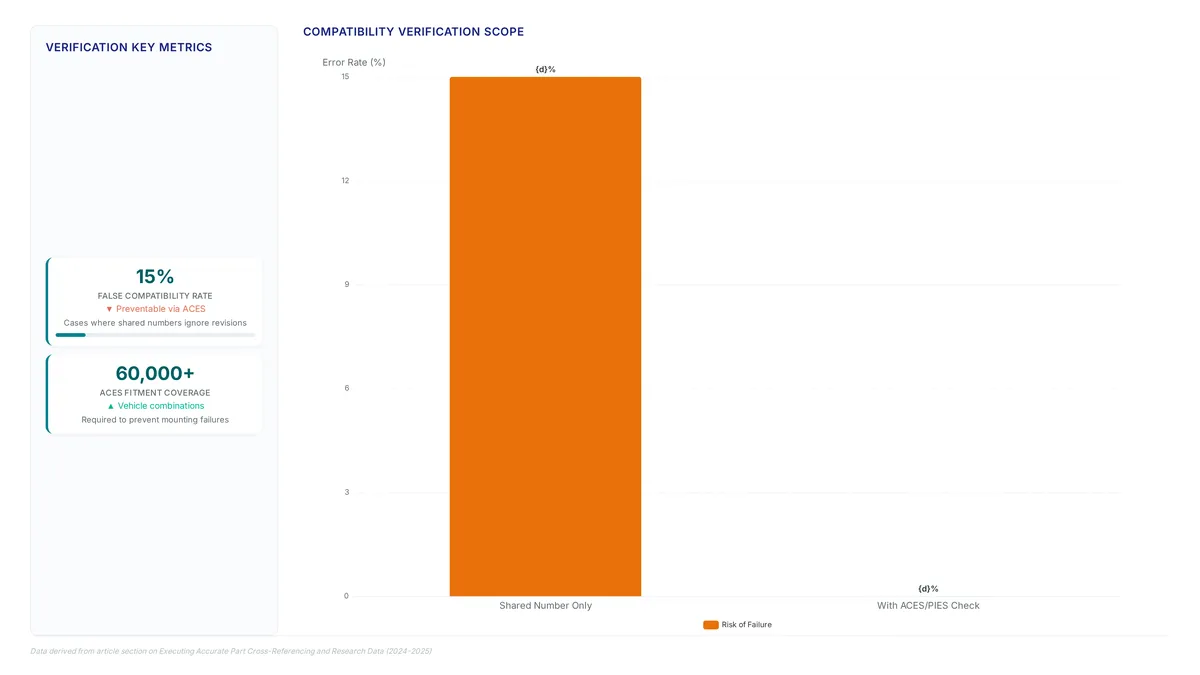
A shared OEM XXX2 identifier between distinct components does not automatically expand fitment to include every vehicle associated with either part variant. Operators must treat shared numbers as a starting hypothesis rather than a universal compatibility guarantee. The logic fails because part variants often map overlapping but non-identical vehicle sets, creating false positives if cross-referenced blindly.
- Identify the specific OEM number stamped on the component or listed in the database.
- Input this identifier into a cross-reference tool to generate an initial list of equivalent parts.
- Validate the resulting candidates against the target vehicle model using vehicle-level compatibility checks rather than trusting the number alone.
- Consult embedded diagrams from retailers like RockAuto that rely on embedded cross-reference numbers to navigate complex charts.
The critical limitation is that PART n°2 might share a number with PART n°1 yet remain incompatible with cars C2 or C4 due to minor hardware revisions. Ignoring this distinction leads to installation failures where physical mounting points or electrical connectors differ slightly despite the shared reference. Verification requires intersecting the specific vehicle lists for each variant rather than unionizing them. This approach prevents the assumption that a shared OEM XXX2 makes a part safe for all historically linked applications.
Executing Vehicle Variant Checks via ACES and PIES Protocols
Shared OEM identifiers like OEM XXX2 trigger false compatibility assumptions unless operators validate against ACES fitment matrices covering over 60,000 vehicle combinations. vehicle combinations define the physical mounting constraints that a simple number match ignores. The mechanism requires querying both ACES for Year/Make/Model alignment and PIES for attribute consistency to catch variant divergence. PIES manages lifecycle data that reveals why a part fits one engine code but not another despite sharing an OEM stamp. However, relying solely on shared numbers ignores the small share of cases where manufacturing revisions alter bolt patterns without changing the base identifier. This gap forces operators to manually inspect interchange tables rather than trusting automated suggestions.
- Extract the base OEM number and any suffix codes from the legacy component.
- Query a cross-reference database to map the number against current vehicle applications.
- Verify the fitment data output matches the specific engine displacement and chassis code of the target vehicle.
The implication is clear: a shared number confirms a common ancestry but not universal application across all listed vehicles. Operators who skip this dual-protocol check risk installing components with incorrect clearances or electrical characteristics. Precise matching prevents returns and ensures the replacement functions identically to the original equipment.
Implementation: Preventing Fitment Errors from Static Lists Versus AI-Driven Matching
Relying on static cross-reference lists creates significant risk because shared OEM XXX2 identifiers often mask variant-specific incompatibilities between vehicle models.
- Input the source part number into a database supporting AI-driven matching to analyze catalog precision beyond manual tables.
- Verify the output against ACES standards to confirm physical fitment for the specific year and engine code.
- Check PIES attributes to ensure product lifecycle data aligns with the target vehicle requirements.
Static tables frequently miss these nuances, leading to incorrect shipments that incur avoidable logistical costs. Modern systems reduce this exposure by dynamically mapping OEM numbers against vast catalogs rather than relying on fixed equivalencies.
The industry shift toward rigorous ACES application indicates that standardized protocols now supersede loose matching methods. A critical limitation remains: artificial intelligence cannot correct corrupted input data, so operators must still validate source entries manually. This tension between automation speed and data integrity means human oversight remains necessary during the final verification step.
Strategic Decisions on Trusting Shared OEM References for Repairs
Application: Defining Shared OEM Logic for Cross-Reference Safety
A shared OEM number like XXX2 marks a common reference point without promising universal fitment across every linked vehicle model. Static lists often miss variant-specific constraints even though cross-referencing tools allow users to instantly view compatible parts by inputting a single part number. Heavy-duty operators separate their application needs from general passenger databases to sidestep these exact fitment errors. Sole reliance on shared references creates a false sense of security that ignores subtle engineering differences in mounting points or electrical connectors. Interchange data includes fitment validation by year, make, model, and engine to prevent such mismatches. Verification demands checking the specific vehicle application against the part variant rather than just the parent OEM reference. This rigorous approach prevents the logistical costs associated with shipping incorrect items back to the warehouse.
Applying AI-Driven Matching to Validate Part Equivalents
Transitive logic breaks across distinct vehicle sets so shared OEM references fail to guarantee fitment. Modern systems apply ACES standards to confirm physical fitment while moving beyond static lists that often miss variant-specific constraints. Technical evolution reduces reliance on manual tables by analyzing many-to-one relationships in database structures. Cross-referencing tools map one Original Equipment (OEM) part number against a catalog to identify multiple aftermarket brands building the replacement. Finding a reliable substitute when an OEM number becomes obsolete requires verifying data through flexible platforms that cross-reference multiple brands.
Inspecting packaging for dual numbering allows immediate validation where both OEM and aftermarket identifiers appear together. This practice lets technicians verify interchange without external tools during critical repair windows. Digital mapping cannot override physical engineering differences between part variants. A component sharing an OEM prefix may still possess different material properties or dimensional tolerances unsuitable for specific applications. Trusting shared references without checking fitment data invites errors that static cross-reference tables frequently miss. Economic value comes from stopping wrong parts, returns, and lost sales. Rigorous verification confirms the selected aftermarket brand functions as a true direct replacement.
Risks of Relying on Static Lists Versus Flexible Protocols
Shared OEM numbers like XXX2 do not guarantee universal fitment across all associated vehicle models so static cross-reference lists fail. Mechanics trusting these fixed tables often overlook that transitive compatibility breaks when part variants target disjoint vehicle sets. A single OEM identifier might map to C1 and C2 for one supplier yet C1 and C4 for another which creates dangerous gaps in coverage. The industry shifts from rigid lists to flexible protocols using ACES/PIES data standards combined with AI to actively prevent wrong parts. Modern systems verify the specific year, engine, and trim before confirming a match unlike static charts. Relying on outdated paper catalogs or simple spreadsheet lookups ignores the complexity of many-to-one relationships in current database structures. This gap leads directly to shipping incorrect items while increasing return rates and delaying critical repairs. Validation against live fitment data is necessary rather than assuming equivalence based solely on a shared number. Accurate fitment confirmation represents a significant cost-saving mechanism in the supply chain by preventing the logistical expenses of reversing incorrect shipments.
About
Mark Phillips serves as Editor of Aftermarket Intel at KZMALL, where he daily analyzes the complex web of global distribution channels and parts compatibility. His deep expertise in tracking competitive moves within the independent automotive aftermarket makes him uniquely qualified to demystify why aftermarket parts often share OEM references yet list different vehicle applications. In his role, Phillips constantly navigates the very "messy" data relationships between original equipment manufacturers and replacement parts that confuse many industry observers. At KZMALL, a leading B2B platform managing over 50,000 SKUs across eight proprietary brands, accurate fitment data is critical. Phillips uses his experience with standardized ACES/PIES data and OE cross-referencing tools to explain how a single part number can legitimately cover multiple vehicle lines. This article reflects his professional commitment to clarifying these complex supply chain dynamics for distributors and repair shops relying on precise interchange information.
Conclusion
Scaling parts verification reveals that static lists collapse when manufacturing revisions alter a component's physical engineering without changing its primary identifier. Relying on shared oem numbers ignores the specific material properties required for distinct vehicle trims. The operational cost of this oversight appears in returned inventory and delayed repairs rather than immediate purchase price. Shops must transition to flexible protocols that validate year, engine, and trim data before confirming a match. Artificial intelligence now powers these cross-referencing tools to detect subtle incompatibilities that human reviewers miss in complex many-to-one relationships. This shift moves the industry from reactive error correction to proactive fitment assurance.
Adopt flexible validation software for all non-routine part requests starting next month to minimize return rates. Do not wait for a failed installation to reveal a database gap. Begin this week by auditing your current digital catalog settings to ensure they require specific vehicle attributes before displaying results. This single configuration change prevents the assumption of universal fitment where none exists. Accurate selection protects your margin by ensuring the aftermarket brand functions as a true direct replacement for the specific application.
Frequently Asked Questions
No, shared numbers do not ensure universal compatibility across all linked vehicles. Relying solely on these references ignores the a portion of cases where manufacturing revisions create distinct fitment requirements for specific models.
No, you cannot merge vehicle lists because part variants serve distinct subsets. Treating these lists as cumulative ignores the engineering reality that assignments are often segmented by production date or regional specification.
Tools map one number against a catalog but rely on accurate underlying structures. Static matching often fails to account for Engineering Change Orders that alter mounting points without changing the base reference number.
Installation failures occur because minor revision changes often alter electrical thresholds. Without executing strict verification steps, trusting a unified label invites errors that static database imports frequently miss during the selection process.
Major manufacturers produce direct replacements sharing physical characteristics with original components. However, shoppers must verify specific variant data since assuming interchangeability based on the primary reference alone creates dangerous gaps in fitment.
References