
Sailun tire shift: Local Egyptian manufacturing
Sailun's $1.14 billion commitment funds a massive new Egyptian tire plant with 10 million unit capacity. This greenfield facility represents a calculated pivot by Chinese manufacturer Sailun Group to bypass trade barriers and dominate emerging markets through localized industrial scaling. The move highlights a broader shift where mid-tier giants aggressively target regional supply chains rather than relying solely on export-heavy models from Asia.
The investment lands squarely within Egypt's push to become a chemical and manufacturing hub, shadowing the government's concurrent approval of $1.291 billion in sector projects. Sailun isn't just adding capacity; it is attempting to erode the dominance of premium incumbents like Michelin in regions previously deemed too volatile for such heavy capital expenditure.
While the U. S. Tire Manufacturers Association projects domestic shipments hitting a record 338.9 million units in 2026, Sailun's focus remains firmly on capturing growth in under-served territories. This $1.14 billion wager is a definitive statement on the changing geography of global tire manufacturing.
The Strategic Scope of Sailun's Egyptian Manufacturing Investment
Defining the $1.14 Billion Greenfield Tire Facility Scope
A $1.14 billion capital commitment funds a greenfield industrial complex designed for 10 million annual tire units. This specific allocation targets passenger, truck, and OTR segments to capture value-tier market share through localized production. The facility requires distinct curing presses and mixing lines for each tire category, preventing simple capacity shifts between passenger and OTR lines during demand shocks. Operators cannot repurpose truck tire molds for passenger runs without costly retooling downtime. This rigidity forces precise demand forecasting across three separate supply chains rather than one aggregated volume target. Such separation ensures that a surge in mining activity does not alter consumer tire output. The financial scale reflects a long-term bet on regional stability despite global volatility.
Strategic Application of Passenger Truck and OTR Tire Production
The facility applies Sailun capacity to produce passenger, truck/bus, and off-the-road tires for regional markets. Off-the-road (OTR) tires serve heavy machinery and mining equipment, distinct from standard highway vehicles due to reinforced sidewalls. This production mix directly addresses the Egyptian government's strategy to change tire manufacturing into an industrial growth driver. By localizing these specific assets, the investment positions the company to serve the expanding Middle East and African regions efficiently. Regional access cuts shipping costs notably for inland destinations.
Operational scope targets three distinct vehicle classes under one roof:
- Passenger car radial tires for consumer markets.
- Truck and bus radials for logistics corridors.
- Off-the-road units for extractive industries.
- Specialized agricultural tires for farming sectors.
- Industrial machinery tires for construction sites.
Diversification mitigates reliance on single-segment demand cycles. However, maintaining triple-segment tooling increases initial complexity compared to single-focus plants. Simultaneous ramp-up across three technical specifications strains quality assurance teams more than phased rollouts. Network planners serving this sector must anticipate varied traffic profiles from a single site. Logistics flows will differ sharply between high-volume passenger shipments and low-volume, high-weight OTR movements. Such geographic targeting reduces transit times for landlocked African customers.
Operational Mechanics of Global Tire Plant Expansion
Sailun's Greenfield Expansion Timeline and Facility Scope
Sailun initiated its international manufacturing footprint by opening a plant in Tay Ninh Province in 2015, establishing a baseline for subsequent radial truck and bus tire capacity. This initial Vietnam facility demonstrated the viability of offshore production before the company pursued further geographic diversification. The strategic timeline advanced notably with the completion of a €230 million greenfield project in Demak, Central Java. Commercial operations at this Indonesia site commenced on January 18, 2026, marked by a full-category product launch event.
The progression from the 2015 Vietnam opening to the 2026 Indonesia start date illustrates a deliberate pacing mechanism for capital deployment. Unlike the earlier Vietnamese expansion which added capacity incrementally, the Demak facility introduced a fixed 3 million unit annual output for passenger tires immediately upon activation.
| Facility Location | Start Year | Primary Output Focus |
|---|---|---|
| Tay Ninh, Vietnam | 2015 | Passenger and Radial Truck |
| Demak, Indonesia | 2026 | Passenger Tires |
| SCZONE, Egypt | 2026+ | Passenger, Truck, OTR |
Gaps between substantial completions suggest a constraint on simultaneous large-scale execution. Deploying capital across multiple continents requires staggered timelines to manage supply chain integration risks effectively. The commercial production start in Java validates the model before committing resources to the African theater. This sequencing minimizes operational friction while maximizing market share acquisition in distinct regional zones.
Deploying 140 Technology Patents in New Production Lines
Sailun applies its 140 technology patents to replicate EcoPoint3 Technology performance standards across new greenfield facilities without inflating capital expenditure. This approach transfers proprietary material science directly into the production line configuration, ensuring consistent output quality regardless of geographic location.
Operators at the new Egypt site apply identical machine settings and compound recipes validated in earlier deployments. This uniformity reduces the learning curve typically associated with launching complex chemical production lines in new regions. Transferring patents requires strict adherence to local raw material constraints which may vary by region. Sourcing specific chemical precursors locally could alter the compound consistency if suppliers do not meet exact purity specifications. The limitation lies in supply chain validation rather than the patent architecture itself. Failure to vet local inputs risks degrading the final product below the rated A/A EU Tyre Labeling standard despite correct machinery setup.
New facilities cannot instantly absorb existing volume shocks. Operators must manage dual supply chains during the transition, increasing logistical complexity. Consequently, the Vietnam precedent from 2015 proves necessary for navigating current trade barriers. Without established non-Chinese entities, manufacturers face locked markets despite competitive unit costs. Capital expenditure buys market access, but only after significant delay.
Market Positioning Against Premium Competitors Like Michelin
Sailun's Value-Tier Positioning vs Premium Brand Pricing
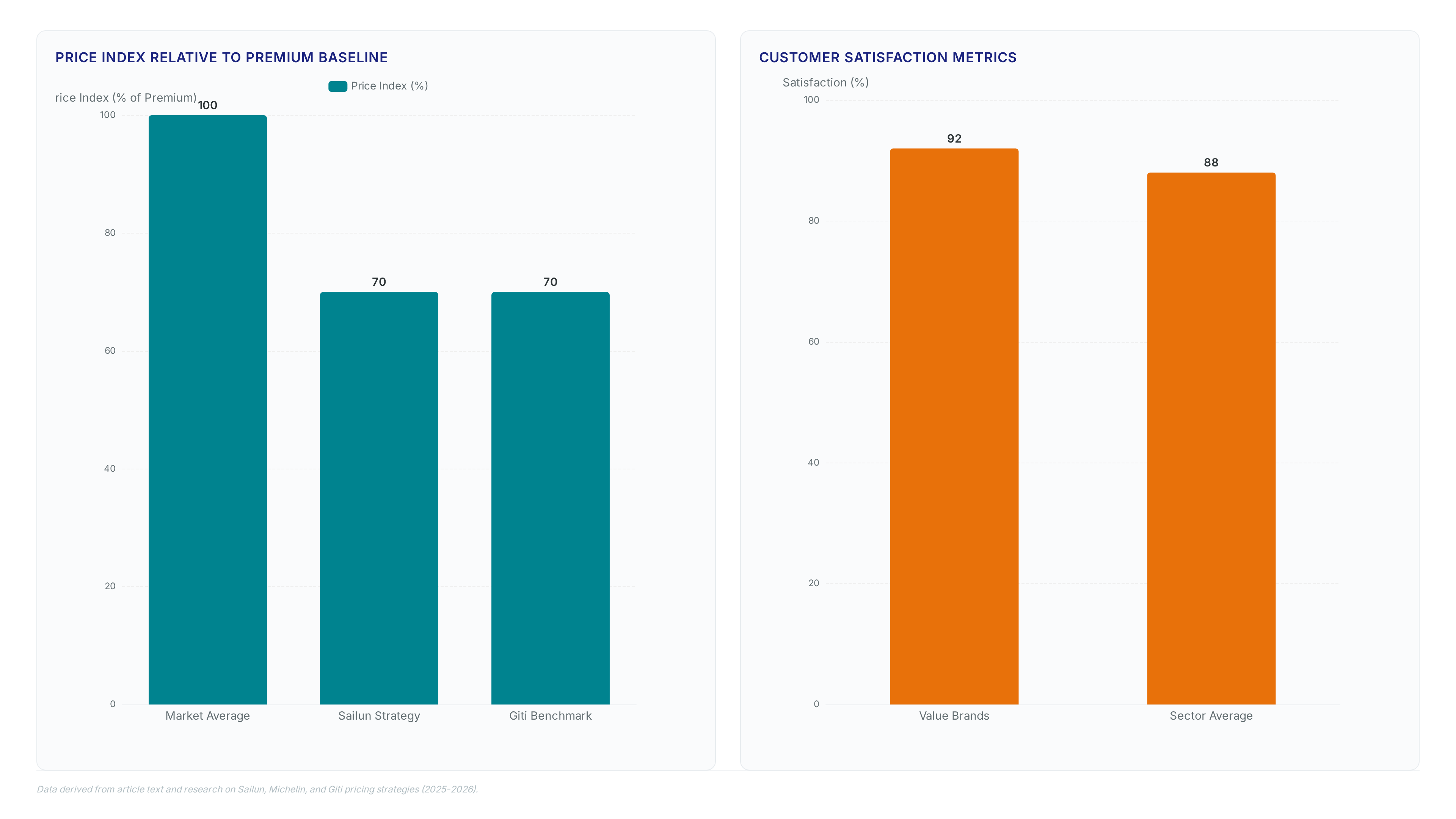
Sailun targets price-sensitive fleets by selling specific tire models at 30% below the average market rate for similar specifications. This strategy positions the Atrezzo line as a direct alternative to Michelin, with independent data suggesting some units cost nearly one-third less than comparable premium options. While Michelin commands higher margins through brand heritage, Sailun uses aggressive pricing to secure volume in the commercial sector. Blind tests indicate performance parity, yet the cost disparity remains the primary differentiator for procurement officers managing large inventories.
| Metric | Premium Brands | Sailun Strategy |
|---|---|---|
| Price Index | 100% Baseline | ~70% of Premium |
| Target Sector | OEM / Luxury | Replacement / Value |
| Perception Gap | High Cost | high-value |
The value market demands consistent quality without the premium markup, a niche Sailun fills by engineering Tier One qualities at reduced costs. Customer satisfaction metrics for value brands often reach 92%, surpassing the sector average of 88% despite lower price points. However, this model relies on high volume to offset thinner per-unit margins compared to competitors like Bridgestone. Operators must weigh the risk of perceived lower durability against immediate capital savings. The price point dominates the decision matrix for regional carriers where tire replacement frequency is high. Ultimately, Sailun captures share by proving that functional performance does not require premium expenditure, forcing established players to justify their cost premiums.
Real-World Performance Parity in Blind Tests Against Michelin
Blind evaluations confirm Sailun Atrezzo tires achieve performance metrics comparable to premium Michelin alternatives despite lower pricing tiers. The mechanical reality is that silica compounds in modern value tires now match the grip levels previously exclusive to expensive proprietary blends. This bias forces operators to choose between verified performance parity and the perceived insurance of a legacy brand name. Relying on brand heritage over quantifiable test results leads to inflated procurement costs without measurable safety gains. Operators prioritizing total cost of ownership must validate specifications against blind test data rather than marketing narratives. The price index disparity offers a tangible arbitrage opportunity for large-scale deployments where volume outweighs brand prestige.
Warranty Confidence and Brand Value Growth Versus Competitors
Sailun backs its durability claims with a standard 5-year warranty, signaling manufacturing confidence despite value-tier pricing. This guarantee supports a 37% year-on-year surge in brand value during 2026, outpacing the steady growth of established rivals. Premium manufacturers like Michelin rely on decades of heritage to justify cost, whereas Sailun uses rapid validation cycles to alter market perception. The limitation remains that warranty length does not equate to global service network density, a gap competitors exploit in remote regions. Independent reviews confirm these tires deliver Tier One quality at fractionated costs, driving the shift in buyer behavior.
Prioritize modular line configurations that allow rapid switching between radial truck and passenger molds. This flexibility mitigates the risk of inventory overhang when regional consumption patterns shift unexpectedly. The cost of rigid production scheduling often exceeds the price of flexible tooling in volatile economies. Expanding manufacturing operations requires balancing high-volume passenger units with specialized OTR lines to serve Middle East and African markets effectively. Tire Manufacturers Association forecasts 338.9 million total unit shipments for 2026, signaling strong global demand for value-tier exports. However, achieving this scale demands synchronized supply chains that many initial filings overlook during the permitting phase. Operators ignoring the full chemical manufacturing scope risk falling short of the industrial deployment metrics required for long-term tax abatements.
About
Dmitry Volkov serves as a Senior Automotive Technical Writer at KZMALL Auto Parts, where he specializes in translating complex engineering data and manufacturing processes into clear industry analysis. His deep understanding of global supply chains and production standards makes him uniquely qualified to examine Sailun's massive $1.1 billion investment in a new Egyptian tire plant. In his daily work, Volkov evaluates how shifts in upstream manufacturing, such as Sailun's planned 10-million-tire capacity expansion, directly impact downstream availability for the independent aftermarket. This article connects those high-level production moves to practical implications for distributors and repair professionals. By using KZMALL's extensive catalog of over 50,000 SKUs and standardized fitment data, Volkov provides a technical perspective on how new greenfield facilities in emerging markets like Egypt stabilize the global flow of necessary passenger and commercial vehicle tires.
Conclusion
Scaling this manufacturing model reveals that supply chain latency becomes the primary bottleneck, not production capacity. While unit economics look favorable on paper, the operational reality of synchronizing raw material delivery with three distinct production lines creates hidden friction that erodes margins. Rigid scheduling in a volatile market guarantees inventory overhang, turning initial capital advantages into stranded assets.
Investors must mandate modular line configurations before finalizing any expansion permits. Do not commit to fixed tooling layouts that lock you into a single product category; instead, require designs that allow rapid transitions between radial truck and passenger molds within a six-month window. This flexibility is the only hedge against unexpected changes in fleet turnover rates or logistics demand. If your current blueprint does not explicitly account for chemical manufacturing scope integration to secure tax abatements, pause immediately.
Start by auditing your vendor contracts for raw material lead times against your proposed production schedule this week. Identify any single-point dependencies that exceed fourteen days and negotiate staggered delivery clauses before breaking ground.
Frequently Asked Questions
The project requires a $1.14 billion capital commitment to fund the entire greenfield industrial complex. This massive investment enables the facility to reach its targeted annual production capacity of 10 million tire units efficiently.
The new greenfield industrial complex is designed specifically for 10 million annual tire units. This substantial volume supports the broader $1.14 billion capital commitment aimed at dominating emerging regional markets effectively.
The government approved $1.291 billion in sector projects, exceeding Sailun's specific $1.14 billion capital commitment. This larger national figure highlights the country's aggressive push to become a major chemical and manufacturing hub soon.
The total U.S. automotive aftermarket is forecast to grow 5.4% in 2026 due to fleet changes. This contrasts with Sailun's focus on underserved territories rather than domestic shipments hitting record highs.
Domestic shipments are projected to hit a record 338.9 million units in 2026 according to industry data. Meanwhile, Sailun's $1.14 billion wager focuses firmly on capturing growth in under-served international territories instead.