
Rock radial tires: LDMaster L5 three-star casing specs
Continental unveils the LD-Master Rock L5 for extreme rock applications at Hillhead 2026. This launch marks a pivot. Raw rubber volume no longer dictates earthmoving efficiency. Survival in harsh quarry environments now hinges on the marriage of reinforced casings and integrated sensor technology. The goal is simple: stop costly operational downtime before it starts.
We need to talk about the three-star casing. These aren't just thick walls; they are engineered architectures designed to withstand severe cut-and-chip resistance where generic tires shred. Paired with massive lugs, this unit is built for the facework that kills standard inventory. But the hardware is only half the story. Intelligent sensors come fitted as standard across the radial range, feeding real-time data on tire pressure and tread wear analysis directly to the fleet manager. This isn't reactive repair; it's predictive asset management.
The real strategic shift appears when selecting tires for mixed fleets. We are contrasting the new L5 traction model against the versatile MPT 91. One defends against the quarry; the other bridges the gap between the pit and the highway. Using Digital Solutions displayed in Buxton, operators convert raw telemetry into maintenance alerts. Hardware durability is now just the entry fee. Software defines performance.
The Role of Advanced Radial Design in Modern Earthmoving Operations
LD-Master Rock L5 Definition and Three-Star Casing Specs
Standard casings die quickly in extreme rock. Abrasive stress tears them apart. The LD-Master Rock L5 exists specifically for these hostile zones. It is a specialized radial earthmover tire built where generic rubber fails. The core is a reinforced 3* carcass, satisfying the highest load-carrying capacity requirements found in severe mining environments.
Generic construction tires lack the structural density for jagged surfaces. They leave fleets vulnerable to premature failure. The L5 differs. Its extra deep L5 tread provides maximum protection under harsh facework conditions. Massive lugs work with reinforced sidewalls to resist cutting and chipping during high-productivity cycles. There is a cost, however. Operators prioritizing rock defense accept higher fuel consumption. That is the price of preventing catastrophic downtime.
The three-star specification indicates a tier of protection exceeding baseline industry expectations for loader operations. Deploying this asset class shifts maintenance windows from reactive repairs to predictable intervals. It fundamentally alters total cost of ownership calculations for quarry managers. Failure to match tire architecture to site geology results in rapid asset depletion.
MPT 91 Versatility in Mixed On- and Off-Road Conditions
Static quarry faces demand one approach. Shifting terrains demand another. The MPT 91 is a specialized radial tire engineered for versatile performance across mixed on- and off-road conditions. This dual-purpose design eliminates the traditional compromise between highway fuel efficiency and rough-terrain durability.
Operators deploying this model gain excellent traction and high mileage without switching assets when moving from public roads to job sites. The tread composition resists cutting while maintaining low rolling resistance. This balance is necessary for mixed-fleet logistics. Unlike the rock-specific LD-Master, this tire addresses the operational reality where fleets cannot justify separate inventory for short transit distances.
| Feature | MPT 91 Benefit | Operational Impact |
|---|---|---|
| Tread Design | Balanced on/off pattern | Reduces tire changes |
| Casing Strength | Dependable in mixed use | Lowers total cost |
| Sensor Integration | Factory-fitted monitoring | Prevents unplanned stops |
LD-Master L5 Traction Size Evolution: 35/65 R33 vs 26.5 R25
Standard casings fail in extreme rock applications where the LD-Master Rock L5 excels. Continental initially launched this radial range in the 35/65 R33 size to address large wheel loader requirements during its 2022 debut. The portfolio expanded in May 2024 with the addition of the 26.5 R25 dimension. This was a strategic move reflecting iterative product expansion based on specific loader needs rather than a universal fitment approach.
This evolution from a single initial specification indicates manufacturers are broadening application scope for niche high-performance tires post-launch.
| Feature | Initial Launch (35/65 R33) | New Addition (26.5 R25) |
|---|---|---|
| Launch Timing | 2022 Debut | May 2024 Release |
| Target Strategy | Large Wheel Loaders | Specific Loader Requirements |
| Expansion Goal | Market Entry | Broaden Application Scope |
Fleets relying solely on the original large diameter may face compatibility gaps with mid-sized loaders that the newer size rectifies. Inventory complexity is the trade-off. Operators managing mixed fleets must now track two distinct high-performance profiles instead of one standardized solution. This divergence forces procurement teams to evaluate whether the performance gains in specific rock conditions justify maintaining separate stock for different machine classes.
Inside the Architecture of Reinforced Casings and Intelligent Sensor Integration
Intelligent Sensors and Real-Time Data Transmission Mechanics
Aftermarket retrofits introduce latency and physical vulnerability. Standard intelligent sensors fitted ex-factory across the radial earthmover range avoid these pitfalls. They capture internal pressure and temperature to prevent catastrophic casing failure. Operators receive immediate maintenance alerts and tread wear analysis rather than relying on manual inspection intervals.
The Conti CrossTrac system processes these signals to balance on-road fuel efficiency with off-road cut resistance.
| Monitoring Parameter | Operational Impact | Data Frequency |
|---|---|---|
| Internal Pressure | Prevents uneven wear patterns | Continuous |
| Casing Temperature | Detects overheating before blowout | Continuous |
| Tread Depth | Schedules replacement proactively | Event-based |
Real-time transmission allows fleets to coordinate logistics without halting production for physical checks. However, compatible telematics infrastructure becomes necessary to decode these proprietary streams. Without proper gateway configuration, the rich dataset remains siloed within the tire assembly. Shifting from calendar-based to condition-based maintenance cycles offers a strategic benefit. This approach reduces unexpected downtime by identifying thermal anomalies before they compromise the reinforced sidewalls. Data value diminishes if operational protocols do not mandate immediate response to digital alerts. Static dashboards alone cannot replace disciplined fleet management practices.
Operational Impact of Real-Time Insights on Downtime Reduction
Quarry fleets change reactive maintenance into proactive asset management using real-time sensor data. Operators gain real-time insights to improve efficiency, extend tire life, and reduce unexpected downtime by monitoring internal conditions before catastrophic failure occurs. The integrated tire sensor ex-factory enables this continuous surveillance without aftermarket retrofitting risks.
Mixed terrain operations face a specific tension regarding tread design. Aggressive off-road tread patterns increase rolling resistance on highways. Highway-optimized designs cut quickly on rock. The Conti CrossTrac digital monitoring system resolves this conflict by analyzing pressure and temperature trends to recommend optimal inflation adjustments for shifting job site conditions.
| Application Focus | Primary Benefit | Monitoring Priority |
|---|---|---|
| Extreme Rock | Casing protection | Temperature spikes |
| Mixed On/Off-Road | Fuel efficiency | Pressure variance |
Organizations ignoring alert thresholds face a clear limitation; the technology provides visibility but cannot force operational changes. Maintenance teams must act on tread wear analysis immediately to prevent minor irregularities from evolving into unplanned stoppages. The cost of ignoring these digital signals often exceeds the price of premature tire replacement. Unexpected downtime in construction environments typically stems from slow response to early warning signs rather than sudden material defects. Site managers schedule interventions during natural breaks instead of emergency halts by using maintenance alerts. This shift from calendar-based to condition-based servicing maximizes the utility of the three-star casing design. The ultimate operational gain lies not merely in preventing blowouts but in synchronizing tire health with production schedules to eliminate costly idle time.
Conti CrossTrac On-Road Mileage Versus Off-Road Traction Balance
Compound optimization resolves the engineering conflict between highway rolling resistance and off-road cut resistance within the Conti CrossTrac range. Standard carcass constructions often sacrifice load capacity for flexibility. This system uses a reinforced 3* carcass to sustain heavy payloads without compromising the structural integrity needed for mixed-terrain transit.
| Feature | On-Road Impact | Off-Road Impact |
|---|---|---|
| Tread Compound | Reduces fuel consumption | Resists cut-and-chip damage |
| Casing Design | Lowers rolling resistance | Maintains load capacity |
| Sensor Integration | Monitors pressure drift | Detects thermal spikes |
Fleets operating solely on paved surfaces gain less value from the aggressive lug geometry required for quarry traction. This reality reveals a clear limitation in universal application. The inclusion of intelligent sensors as standard equipment allows operators to validate this balance dynamically rather than relying on static tread depth estimates. Single-terrain solutions force a binary choice between mileage and durability. This architecture enables a single asset to traverse public roads and job sites efficiently. Hybrid design eliminates the need for separate inventory. Fuel efficiency gains diminish if the vehicle remains exclusively in extreme rock environments where a dedicated L5 pattern would offer superior protection. The tread wear examination provided by the digital monitoring suite becomes the deciding factor for rotation schedules in these mixed fleets. Maximizing the lifecycle of these assets requires strict adherence to pressure maintenance protocols enabled by the onboard telemetry.
Strategic Tire Selection for Mixed Condition Fleet Environments
Comparison: LD-Master Rock L5 Three-Star Casing and MPT 91 Mixed-Use Engineering
Heavy earthmover tires face immediate failure when operators mismatch casing architecture to ground hazards. The LD-Master Rock L5 uses a reinforced three-star casing explicitly engineered for abrasive surfaces where standard carcasses fail. This structural rigidity prioritizes cut resistance over ride comfort, creating a distinct operational boundary compared to the versatile MPT.
Highway transit demands differ sharply from pit operations. Operators selecting the L5 for predominantly paved routes encounter stiff sidewalls that increase rolling resistance, whereas the MPT 91 is built for versatile on- and off-road applications. Fleet standardization creates tension here because a single tire type cannot optimize both extremes without compromising total cost of ownership.
Tom Godwin notes these solutions address specific daily challenges rather than offering a universal fitment. Fleets operating in variable geologies must segment assets by task severity to avoid the durability traps of mixed-use compromises. The L5 is developed for extreme rock applications, while the MPT 91 serves as an ideal solution for construction and industrial fleets facing mixed operating conditions. This targeted approach ensures that aggressive treads designed for quarries are utilized in their intended environment, while versatile patterns handle public roads.
Extreme Quarry Durability Versus MPT 91 On-Road Mileage Trade-Offs
Selection between the LD-Master Rock L5 and MPT 91 depends on whether cut resistance or transit mileage drives total cost of ownership calculations. The L5 uses an extra deep L5 tread specifically engineered to protect the carcass in severe quarry facework where sharp rocks threaten structural integrity. This design prioritizes longevity in abrasive zones, offering maximum protection in harsh conditions.
Conversely, the MPT 91 balances on-road efficiency with off-road capability, suiting fleets that cannot sacrifice fuel economy for maximum protection. Tom Godwin noted these solutions address challenges whether operating in extreme quarry environments or balancing on-road and off-road performance. Maximizing defense against cuts requires a strong construction distinct from compounds optimized for high-speed road travel.
Deploying the wrong tire creates unnecessary expense. Operators should not deploy the L5 as a universal tire if vehicles spend significant time on paved surfaces. The reinforced sidewall construction that prevents catastrophic failure in pits is designed for extreme durability in harsh conditions. Fleets with mixed routes risk suboptimal performance by over-specifying protection where traction suffices. Choose the L5 when the environment demands the highest load-carrying capacity requirements and cut resistance exceeds all other concerns.
Deploying LD-Master L5 and MPT 91 Tires in Construction and Industrial Fleets
Mapping tire architecture to specific ground hazards solves the deployment question for mixed-condition fleets. Operators deploy the LD-Master Rock L5 in harsh quarry zones where an extra deep L5 tread shields the casing from sharp rock cuts that destroy standard patterns. This selection minimizes costly downtime in extreme rock applications. Conversely, the MPT 91 serves industrial fleets requiring frequent road transit, delivering high mileage without sacrificing off-road traction.
Tom Godwin notes these solutions address distinct challenges, from extreme quarry environments to balancing performance profiles. Selecting the L5 for general industrial use may not align with its design for extreme rock applications. The integrated tire sensor ex-factory allows managers to monitor pressure and temperature, validating that the chosen compound matches the actual operating cycle. Misalignment between tire type and terrain depth leads to premature failure or excessive cost. Continental positions the MPT 91 for fleets requiring versatile on- and off-road performance across mixed operating conditions.
Operationalizing Real-Time Data to Minimize Costly Downtime
Defining the Workflow from Sensor Installation to Maintenance Alerts
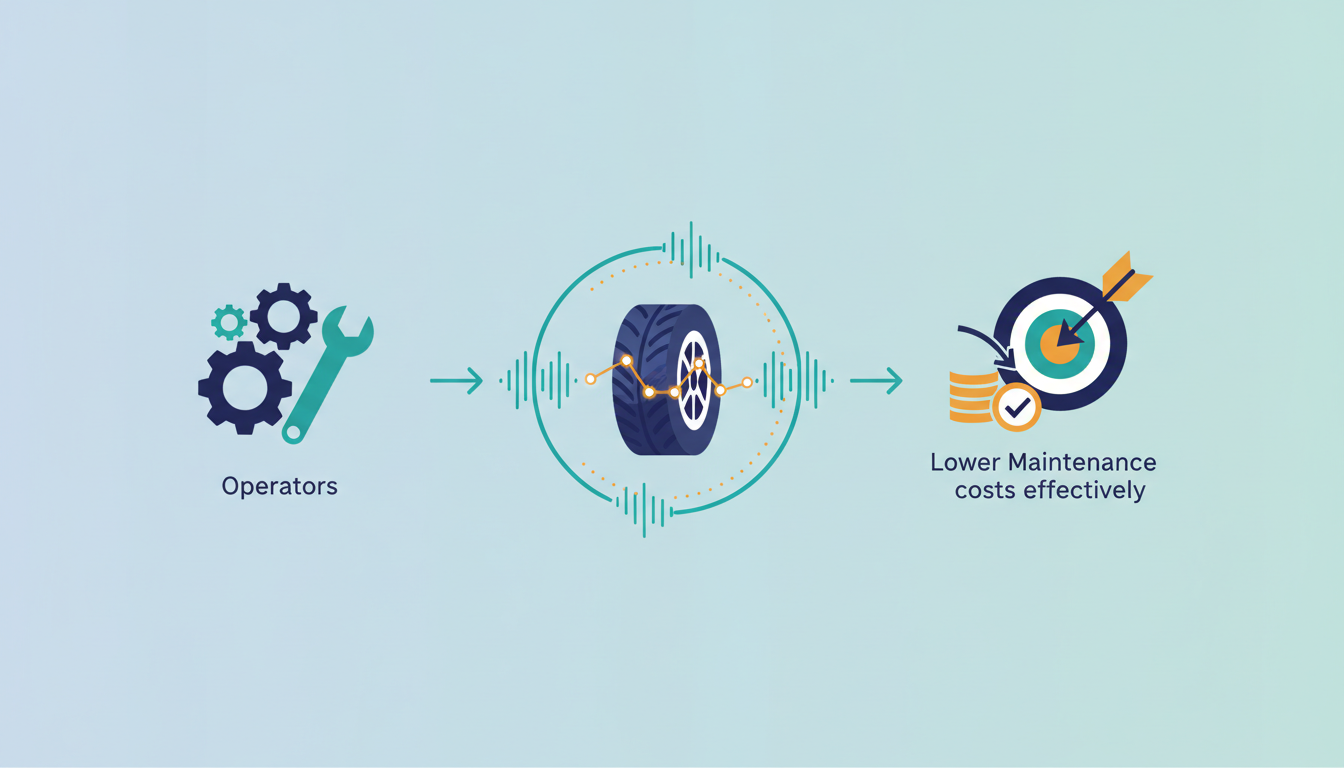
The operational sequence begins because an integrated tire sensor ex-factory eliminates manual hardware fitting during fleet onboarding. This factory integration ensures the telemetry stream activates immediately upon vehicle deployment without aftermarket modification delays. Data flows continuously from the embedded unit to the cloud platform, capturing pressure and thermal metrics necessary for safety.
This data-driven approach transforms reactive repairs into scheduled interventions.
| Step | Action | Outcome |
|---|---|---|
| 1 | Factory sensor activation | Zero-install telemetry |
| 2 | Continuous data transmission | Live pressure visibility |
| 3 | Algorithmic threshold breach | Automated alert generation |
| 4 | Technician dispatch | Targeted maintenance only |
Intelligent sensors are fitted as standard across Continental's radial earthmover tire range, allowing operators to gain real-time insights to improve efficiency. These technologies, including tire pressure and temperature monitoring, are designed to help operators minimize costly downtime and extend tire life. Stakeholders can explore these digital capabilities further through Continental's evolving Digital Solutions technologies.
Applying Real-Time Insights to Reduce Downtime in Quarry and Construction Fleets
An integrated tire sensor ex-factory enables this immediate visibility without aftermarket installation delays. Maintenance teams receive automated alerts for tread wear evaluation, allowing them to schedule repairs during planned stops rather than reacting to roadside failures. This approach minimizes idle time through precise control and serviceability features inherent to the design.
| Sensor Metric | Operational Risk | Action Trigger |
|---|---|---|
| Temperature | Heat buildup | Rotate tire |
| Pressure | Under-inflation | Re-inflate |
| Wear Rate | Premature failure | Replace unit |
The LD-Master Rock L5 tire was developed specifically for extreme rock applications, engineered for exceptional durability in harsh conditions. It features a strong three-star casing and reinforced sidewalls designed to deliver maximum productivity. The inclusion of real-time monitoring capabilities as a standard feature distinguishes this product line, providing operators with the data needed to manage assets effectively in demanding off-road applications. Real-time monitoring transforms reactive replacement into predictive asset management.
Checklist for Validating Tire Monitoring Systems at Hillhead 2026
The upcoming Hillhead 2026 event in Buxton provides the necessary venue to stress-test these digital claims against physical hardware.
| Validation Step | Required Capability | Risk if Missing |
|---|---|---|
| Sensor Origin | Factory integration | Aftermarket latency |
| Data Stream | Real-time thermal | Delayed reaction |
| Alert Logic | Automated thresholds | Human error |
Continental will showcase its technologies for quarrying, construction, and industrial operators at the event, highlighting how intelligent sensors provide real-time insights to reduce unexpected downtime. The displayed technologies include tire pressure and temperature monitoring, maintenance alerts, and tread wear assessment, all aimed at addressing challenges in extreme quarry environments.
About
Dmitry Volkov is a Senior Automotive Technical Writer at KZMALL, where he specializes in translating complex engineering specifications into actionable industry insights. His daily work involves rigorous analysis of component standards and manufacturing processes, making him uniquely qualified to evaluate the LD-Master Rock L5. This new tire from Continental demands a deep understanding of durability metrics and harsh-condition performance, areas central to Volkov's technical expertise. By examining features like the three-star casing and reinforced sidewalls, he connects raw engineering data to real-world productivity gains for fleet operators. At KZMALL, a global B2B platform known for its 50,000+ SKUs and standardized fitment data, Volkov constantly assesses how premium innovations like Continental's enhance the independent aftermarket. His analysis bridges the gap between manufacturer claims and the practical needs of repair shops and distributors, ensuring readers grasp the true value of extreme rock applications technology in minimizing costly downtime.
Conclusion
Integrating sensors directly into the casing eliminates the latency gaps inherent in retrofit solutions, fundamentally shifting maintenance from reactive repair to predictive asset management. At scale, the operational cost is no longer just about tire replacement but the idle time incurred when data streams fail to trigger timely interventions. Operators must treat factory-integrated telemetry as a mandatory specification for any new procurement in extreme rock environments, ensuring that thermal and pressure metrics drive service schedules before heat buildup causes catastrophic failure. This transition requires fleets to update their acquisition criteria immediately to mandate ex-factory sensor integration for all heavy-duty replacements starting in the next purchasing cycle.
Start by auditing your current fleet's telemetry gaps against the three critical metrics of temperature, pressure, and wear rate to identify which assets lack real-time visibility. Prioritize replacing units that rely on manual inspection or aftermarket add-ons where data latency remains a risk factor. By aligning procurement with these digital capabilities, sites can use automated alerts to schedule repairs during planned stops rather than reacting to roadside breakdowns. This approach ensures that the three-star casing durability is matched by equally reliable monitoring protocols, maximizing productivity without introducing new mechanical complexities.
Frequently Asked Questions
The manufacturer added the 26.5 R25 size to the traction range. This expansion allows fleets to equip smaller loaders with the same reinforced 3* carcass technology designed for extreme rock protection.
The reinforced structure satisfies the highest load-carrying capacity requirements for severe mining. This design utilizes an extra deep L5 tread to provide maximum protection against cutting and chipping during high-productivity cycles.
The MPT 91 optimizes performance for mixed on- and off-road conditions rather than extreme rock. Unlike the Rock L5, it balances highway fuel efficiency with durability, reducing the need for separate inventory when transit distances are significant.
Standard sensors deliver real-time insights on tire pressure and temperature conditions. This telemetry enables maintenance alerts that transform raw data into actionable decisions, helping operators extend asset life through predictive strategies.
The range launched initially in the 35/65 R33 size to target large earthmoving operations. This specific dimension supports the massive lugs engineered to withstand severe cut-and-chip resistance found in hostile quarry zones.
References