
Prologis expansion targets auto parts exporters
Prologis is deploying Rs 3,300 crore across Tamil Nadu to capture the China Plus One manufacturing surge. As global firms flee concentration risks, these facilities now serve as the physical backbone for both domestic distribution and international trade compliance.
Readers will examine how regions like Chennai are outperforming traditional hubs by integrating circular logistics capabilities directly into facility design. We analyze Prologis's specific expansion into Redhills, a 51-acre site adding 1.1 million square feet to a portfolio that already spans 6.5 million square feet in the state. This growth reflects a broader shift where companies in automotive and electronics sectors demand assets capable of handling reverse flows and repairs.
The narrative also explores the strategic necessity of Digital Product Passports, which force exporters to track materials from entry to recycling. Ziegler Group notes that by 2027, verifying this data upfront is no longer optional but a baseline for competitiveness. Consequently, the definition of prime industrial real estate has shifted permanently toward high-capacity, tech-enabled ecosystems that support complex regulatory requirements alongside sheer volume.
The Strategic Role of Modern Logistics Parks in India's Supply Chain Diversification
China Plus One Strategy and Modern Logistics Infrastructure Set
China Plus One describes global supply chain diversification away from single-source manufacturing dependence. Vineet Sekhsaria confirms India benefits as companies build export and domestic chains. Mitigating geopolitical risk and economic volatility cited by 51% of leaders mandates this supply chain diversification. Older industrial stock fails modern requirements, creating a measurable infrastructure gap. According to Prologis, customer expectations now prioritize power capacity, layout, and throughput for larger facilities. Legacy warehouses cannot support the high-specification demand driving growth in corridors like Chennai.
The technical definition of modern logistics infrastructure includes clear-height storage, reinforced flooring, and automated readiness. A disconnect exists between available Grade-B stock and the precise needs of electronics or automotive exporters. Legacy sites offer lower rents yet lack structural integrity for heavy automation deployment. Operational rigidity restricts conveyor installation and robot density within older layouts. Tenants face higher long-term costs retrofitting inadequate buildings versus leasing compliant space. Global logistics markets project expansion from $12.68 trillion in 2026 toward $24.36 trillion by 2035. This growth trajectory forces operators to upgrade assets to meet throughput standards or face obsolescence. The shift is fundamentally structural regarding facility specification rather than merely geographic.
Deploying High-Specification Assets in Chennai and Tamil Nadu Corridors
High-specification asset deployment in Chennai requires enhanced slabs and power capacity that legacy industrial stock cannot support. Prologis data shows robot shipments increasing 23.9% in 2026, demanding flooring engineered for heavy automation loads. Older facilities often lack the structural steel reinforcement necessary for such robotic density. The gap between modern parks and vintage warehouses widens as operational needs shift toward cubic efficiency.
Automation drives this infrastructural divergence. According to Prologis, 93% of organizations now explore or deploy generative AI within supply chains, up from 6% in 2023. These digital tools require reliable, high-voltage connections and floor plates rated for dynamic loads. Legacy buildings frequently fail to meet these electrical and structural thresholds.
Retrofitting old structures often costs more than greenfield development. Operators ignoring this reality face stranded assets as tenants migrate. Supply chain infrastructure expansion in India now favors purpose-built corridors over adaptive reuse. Companies must prioritize sites with verified utility capacity to avoid costly delays. Failure to secure compliant space risks obsolescence in a competitive market.
Inside Prologis India: Scaling High-Capacity Facilities Across Tamil Nadu and Beyond
Defining High-Capacity Facility Specifications for Modern Logistics
The new Redhills project delivers 1.1 million sq ft potential across a 51-acre site to meet surging demand. Modern specifications require elevated clear heights, enhanced concrete slabs with structural steel, and wide column spacing for robotics. These physical attributes directly enable the automation density that legacy warehouses cannot support due to floor load limits. Specialized construction increases upfront capital expenditure compared to standard sheds. Operators must weigh higher initial costs against long-term throughput gains driven by automated storage systems.
Land acquisition strategy now prioritizes large contiguous parcels near manufacturing clusters like Hosur and Sriperumbudur over cheap, fragmented plots. This approach ensures sufficient scale for campus-style developments that attract global tenants seeking supply chain durability. Rapid deployment speed conflicts with the lengthy due diligence required for such complex sites. Securing well-located land early prevents future bottlenecks as competition for prime industrial real estate intensifies in Tamil Nadu. Prologis focuses on these corridors to build a core platform rather than chasing speculative opportunities elsewhere. Skipping this rigorous site selection creates an asset that becomes obsolete before reaching full lease-up.
Executing Large-Scale Land Acquisition Across Tamil Nadu Corridors
Collective Redhills, Hosur, and Sriperumbudur sites represent 6.5 million sq ft and an investment of Rs 3,300 crore. This aggregation strategy targets manufacturing corridors where automotive and electronics supply chains concentrate rather than scattered industrial zones. The approach aggregates fragmented land parcels into contiguous blocks capable of supporting large-format facilities. Global competitors often lack the local capital depth to execute such multi-site consolidation within a single state. Extended due diligence timelines are required to clear title on aggregated plots compared to single-owner transactions. Operators must balance speed of deployment against the strategic necessity of securing sufficient acreage for future expansion phases.
Acquiring 400 acres across six Indian sites created 9 million square feet of development potential in 18 months. This rapid scaling addresses the land acquisition strategy gap where older parks cannot accommodate modern column spacing requirements. A tension exists between acquiring cheap peripheral land versus expensive established corridors; the latter offers immediate tenant access but delays ROI. Developers prioritizing immediate yield often miss the long-term value of controlling strategic nodes in export-heavy regions like Chennai. Three distinct market forces drive this shift toward consolidated, high-specification campuses. Global firms demand durability alongside speed. Local zoning laws favor large-scale integrated parks over small sheds. Technology partners require specific power capacities that only new builds can provide. Five key metrics now define success in this sector. Location matters most. Column spacing determines robot viability. Power capacity limits server density. Floor loads dictate storage height. Lease duration reflects tenant confidence in the structure.
Developing Industrial Real Estate Assets for Export and Domestic Supply Chains
Application: Defining High-Throughput Facility Specifications for Robotics
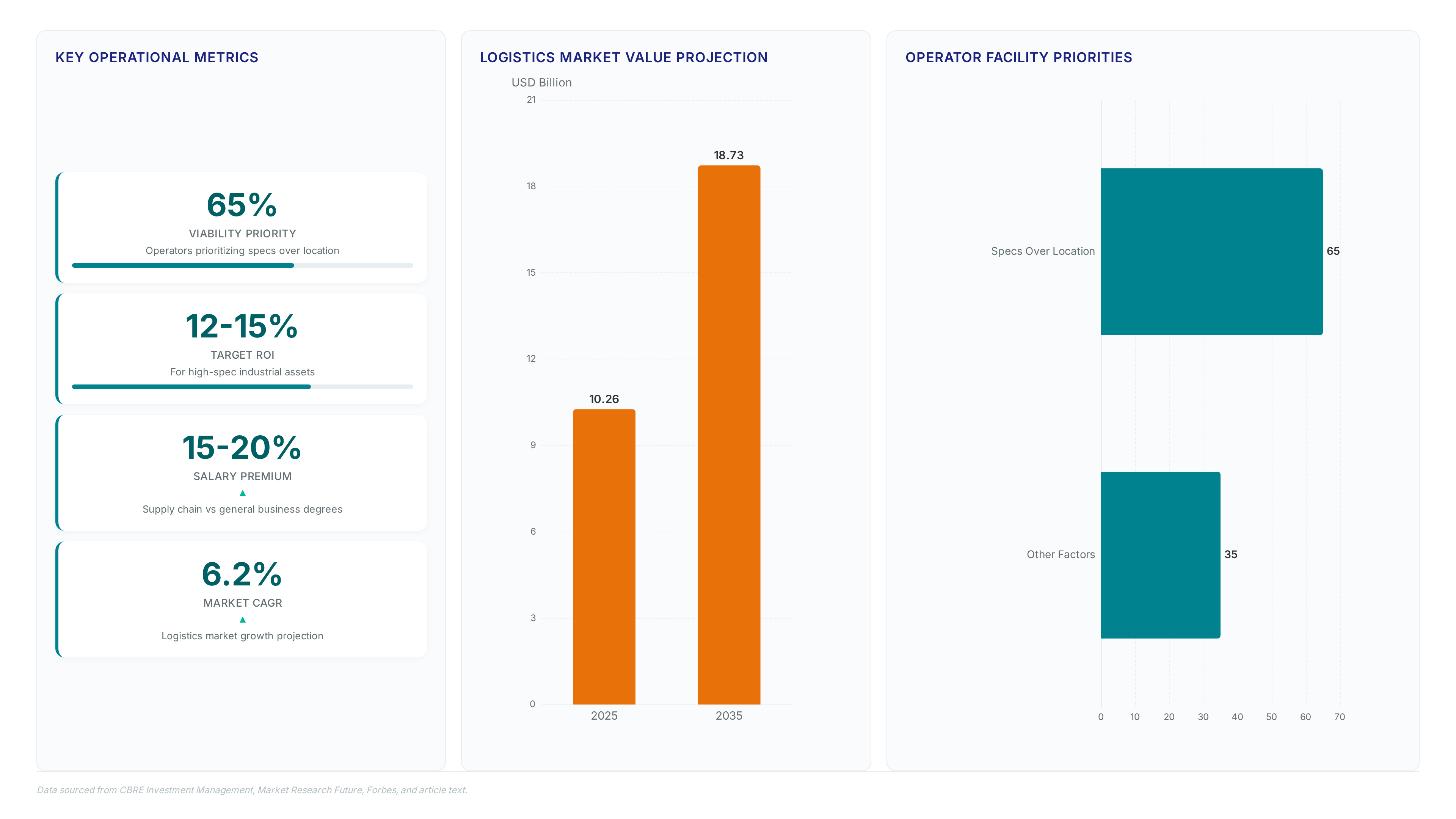
Robotics deployment fails without enhanced concrete slabs engineered to absorb dynamic point-loads from automated guided vehicles. CBRE Investment Management data confirms modern specifications require elevated clear heights, reinforced flooring, and optimized column spacing to enable equipment movement. These physical constraints dictate facility viability more than location for 65% of high-throughput operators according to industry benchmarks. The limitation is that retrofitting legacy structures often exceeds new construction costs due to core inadequacies. Operators must prioritize sites with pre-approved power capacity and structural steel density before committing capital.
| Attribute | Legacy Constraint | Robotics Requirement |
|---|---|---|
| Floor Load | Uniform distribution only | High point-load tolerance |
| Column Grid | Irregular, narrow spans | Wide, predictable spacing |
| Clear Height | Under 9 meters | 12+ meters for cubic density |
A tension exists between rapid site acquisition and the rigorous geotechnical analysis required for heavy automation floors. Rushing due diligence risks discovering soil instability too late, halting robotics deployment entirely. Investors should consult Products and Brands for validated site selection frameworks that align physical specs with automation roadmaps. Failure to match floor specifications to robot weight profiles results in costly structural failures or operational downtime.
Application: Executing Land Acquisition Strategies in Tamil Nadu Corridors
Prologis committed Rs 3,300 crore across three Tamil Nadu sites to secure contiguous land blocks for export supply chains. The mechanism consolidates fragmented parcels into large-format facilities capable of supporting high-throughput operations. However, aggregating plots extends due diligence timelines significantly compared to single-owner transactions because title clearance complexity increases with each added parcel.
| Factor | Aggregated Sites | Single-Owner Plots |
|---|---|---|
| Scale Potential | High (6. | |
| Due Diligence | Extended timeline | Quicker closure |
| Infrastructure Cost | Shared burden | Sole developer cost |
Land evaluation now prioritizes power capacity and layout throughput over simple proximity to ports. Customer expectations drive demand for high-specification logistics that legacy warehouses cannot physically support without prohibitive retrofit costs. The limitation is that suitable large-scale sites in prime corridors like Chennai are becoming scarce as competition intensifies. Developers who delay acquisition face higher entry barriers and reduced feasibility for mega-parks. Products and Brands offers targeted intelligence on available corridors matching these strict technical criteria for institutional investors.
About
Dmitry Volkov - Senior Automotive Technical Writer at KZMALL Russia brings critical technical expertise to the discussion on logistics parks and supply chain evolution. While the article highlights India's rise under the 'China Plus One' trend, Volkov's daily work analyzing brake systems and suspension components for over 50,000 SKUs provides a ground-level view of why reliable logistics infrastructure is vital. As KZMALL Russia operates as a major B2B wholesale platform distributing automotive parts across the Russian Federation, Volkov understands that efficient supply chains rely entirely on modern warehousing and strategic park locations to move goods like VIC EAGLE oils or KZWON brakes effectively. His technical background in parts compatibility and fleet maintenance optimization allows him to connect high-level global manufacturing shifts to the practical realities of automotive distribution. By examining how regions like Tamil Nadu are adapting, Volkov illustrates the direct link between industrial policy and the operational success of automotive distributors managing complex, multi-brand inventories in a changing global market.
Conclusion
The market is reaching an inflection point where physical floor tolerance becomes the primary bottleneck for generative AI and robotics integration, not just software latency. As robot shipments surge, facilities engineered only for static pallet storage will face catastrophic structural fatigue within three years, rendering them obsolete regardless of location. The true operational cost hiding in plain sight is the energy density gap; high-throughput automation demands power grids that older industrial zones simply cannot supply without massive, time-prohibitive upgrades. Investors must shift focus immediately from acquiring land based on proximity to ports toward securing sites with verified megawatt-scale power capacity and reinforced load-bearing specifications.
Commit to a strict acquisition moratorium on any site lacking pre-validated utility headers capable of supporting 24/7 automated sorting by Q4 2027. The window to secure these high-spec assets before institutional capital fully saturates the remaining corridors is closing rapidly. Start this week by auditing your current pipeline's power purchase agreements against the specific energy draw of modern autonomous mobile robots, rejecting any plot that requires grid enhancement timelines exceeding six months. This immediate technical filter will prevent costly stranded assets and ensure your portfolio remains viable as the industry transitions from manual labor hubs to autonomous execution centers.
Frequently Asked Questions
Why do older warehouses fail to support modern robotics and automation?
How rapidly are companies adopting generative AI within their supply chains recently?
What specific investment is Prologis deploying in Tamil Nadu for new parks?
How much total development potential has Prologis acquired across its Indian sites?
What portion of leaders cite economic volatility as a key supply chain risk?