
Longmarch tire expansion bypasses cost spikes
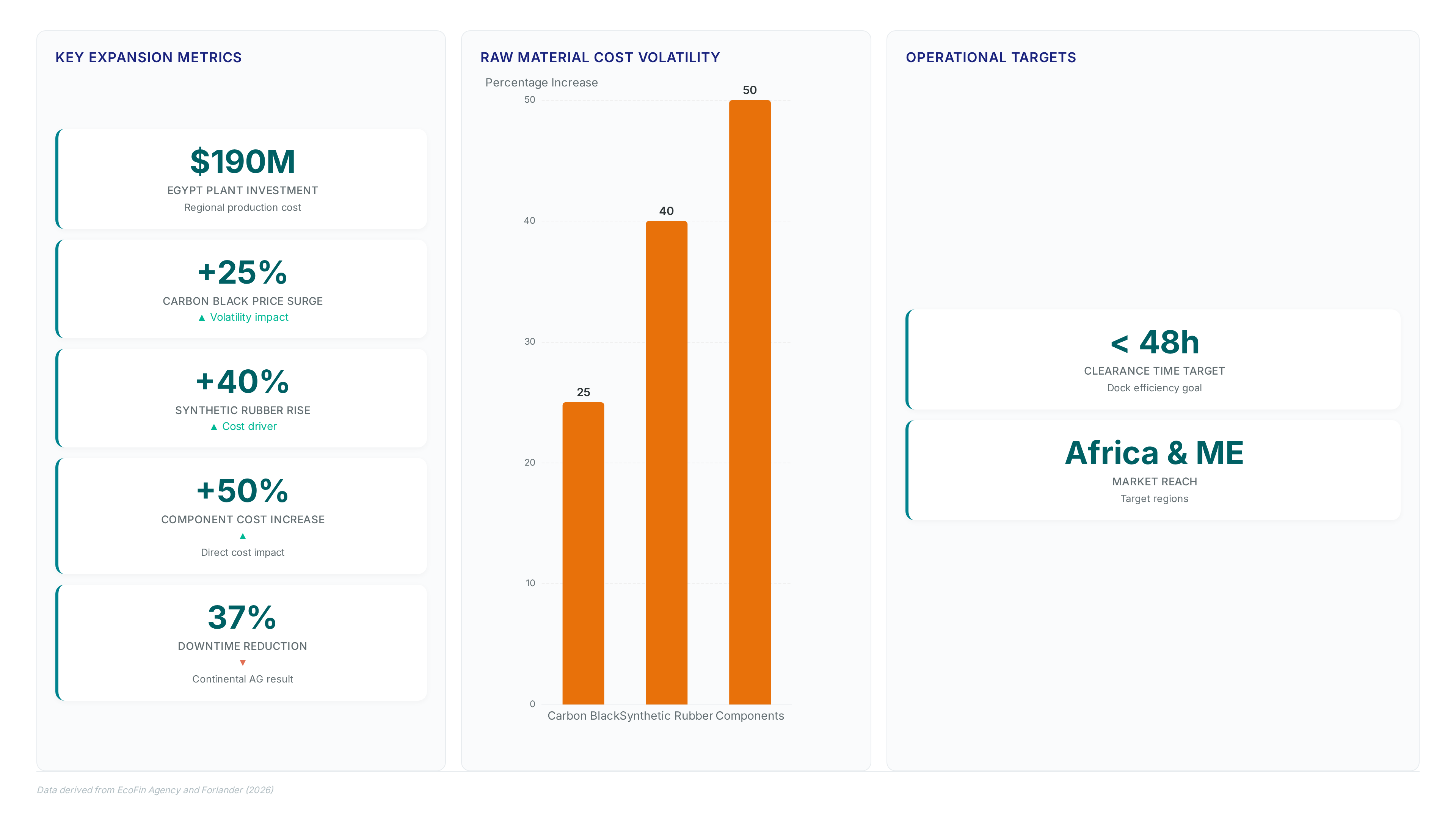
Longmarch's $190 million Egyptian ground-breaking signals a desperate pivot to bypass soaring input costs. This facility represents not merely expansion, but a survival tactic where geographic arbitrage replaces shrinking profit margins. As carbon black prices climb 25% and synthetic rubber jumps 40%, per European Rubber Journal Report, traditional manufacturing models are collapsing under inflationary pressure.
Industrial relocation is now the primary lever for maintaining competitiveness, superseding incremental efficiency gains. While competitors like ZC Rubber use AI agents to slash development cycles by 50%, Longmarch bets on proximity to raw materials and emerging consumers. This single plant is part of a massive $1.5 billion Chinese investment surge into the region, aiming to circumvent trade barriers that have already forced 70 manufacturers to issue price hike notices.
Longmarch Group's specific strategic footprint in global supply chains reveals how a company with substantial annual revenue navigates this volatile environment. The operational mechanics required to launch greenfield projects in North Africa expose the harsh realities of executing cross-border industrial expansion when crude oil remains 50% higher than historical averages. The age of strategic migration has begun.
Longmarch Group's Strategic Role in Global Tire Manufacturing
Longmarch Group Profile and 2003 Origins
Chaoyang Long March Tyre Co. Ltd. operates as the legal entity behind Longmarch Group, having formed in January 2003 through acquisition of Liaoning Tyre Group assets. The company currently maintains an annual production volume of 4.5 million tire sets, generating revenue exceeding a substantial amount in yuan. This operational scale supports the brand portfolio of LONGMARCH, ROADLUX, and SUPERCARGO across global markets. Recent capital deployment includes a $190 million facility in Egypt, intended to bypass trade barriers and reduce logistics latency for African Distribution. Such direct foreign investment contrasts with competitors using AI agents to compress development cycles rather than expanding physical footprints.
Industrial investment in the automotive sector requires substantial fixed capital to secure market access, a strategy evident as Chinese manufacturers commit over $1.5 billion to regional facilities. The regionalization of supply chains mitigates exposure to global freight disruptions, yet it introduces complexity in managing foreign regulatory environments. Operators shifting production locally often face higher initial overhead compared to centralized manufacturing models, trading scale economies for proximity. Serving African and Middle Eastern markets from within Egypt eliminates specific import duties that erode margin on finished goods. The cost of establishing regional production remains high, driven by the need for localized infrastructure and skilled labor procurement. However, the alternative involves continued exposure to carbon black price spikes, which have risen 25% globally. Network engineers and logistics planners alike recognize that distributed nodes reduce single-point failure risks, even if the total cost of ownership initially exceeds centralized alternatives. The strategic value lies in durability rather than immediate yield optimization.
Longmarch Group prioritizes volume and variety while rivals quantify AI-driven efficiency gains with hard metrics. Competitors use automated agents to compress development cycles, whereas Longmarch relies on broad specification coverage across 77 patterns. This divergence creates a measurable gap in operational agility between mass-market expansion and digital optimization strategies. Nexen Tire America uses a database of 190,000 tires linked to real test data for predictive modeling. These quantified advantages contrast with Longmarch's focus on deploying capital toward physical asset expansion in new regions.
The reliance on physical scale exposes operators to raw material volatility without the buffer of algorithmic cost control. Longmarch mitigates this through geographic diversification rather than process innovation. Manufacturers must choose between capitalizing on emerging market access or investing in digital twins for yield improvement. The cost of ignoring AI integration is a widening efficiency delta against automated peers. Physical expansion alone cannot offset the compounding advantage of data-driven production floors. Strategic clarity regarding core competencies determines long-term survivability in volatile markets.
Operational Mechanics of Modern Tire Production Facilities
Raw Material Volatility and Fixed Cost Structures in 2026
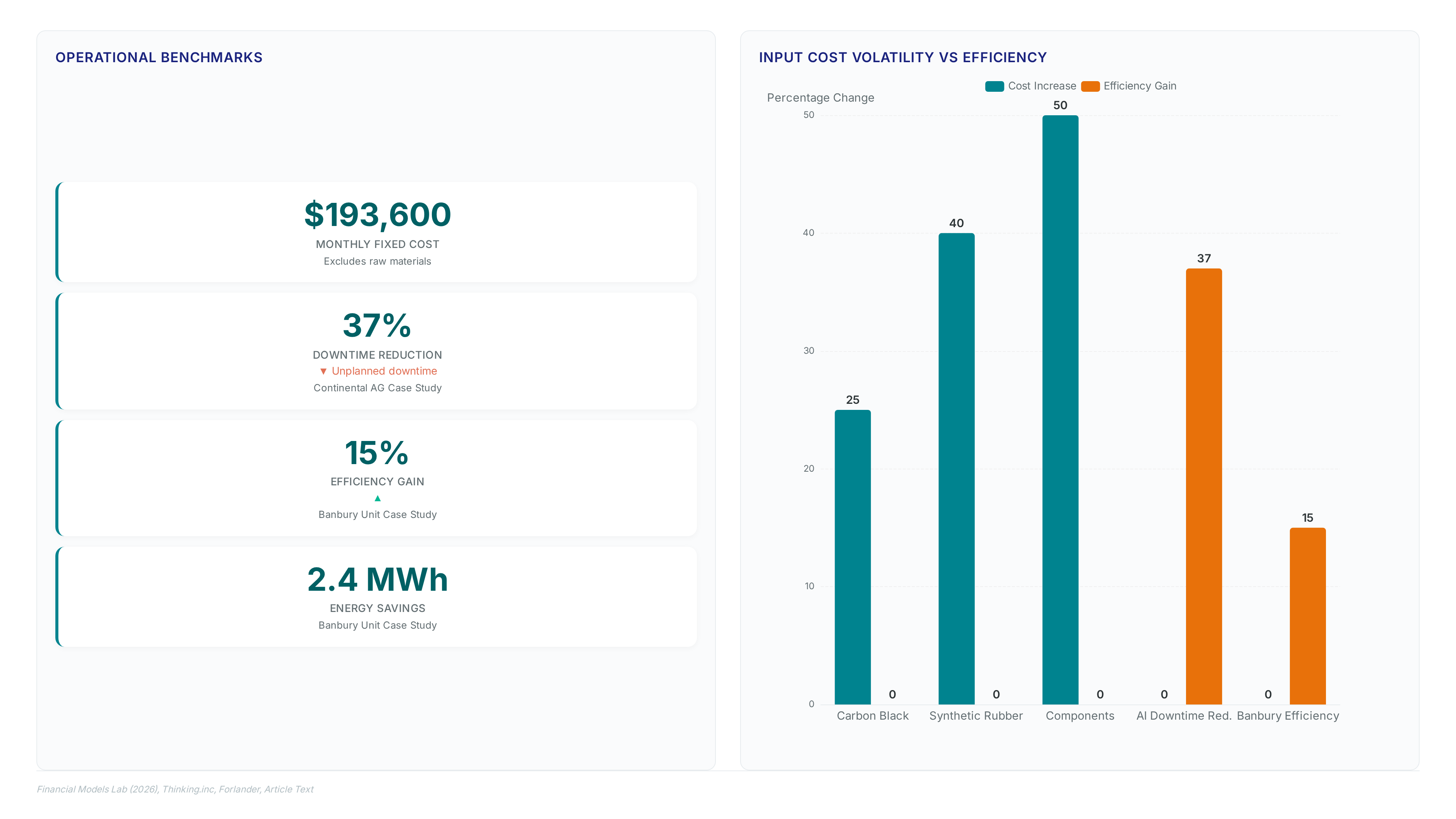
Fixed monthly operating expenses for a tire plant reach $193,600 in 2026, creating a rigid cost floor independent of production volume. This baseline figure excludes direct inputs, meaning facilities must generate sufficient gross margin just to cover fixed monthly operating costs before addressing commodity surges. The economic mechanism relies on spreading these static overheads across maximum output, yet input volatility disrupts this calculus. Operators face a binary choice: absorb the shock and erode working capital, or risk volume loss via price hikes. Most plants operate on thin margins where a sustained 15% rise in feedstock costs without offsetting price increases forces operational shutdowns.
Global output reached nearly two billion units in 2024, straining raw material procurement against vehicle assembly rates of tens of millions. This volume forces manufacturers to secure regional production hubs that bypass cross-border tariffs while anchoring supply near consumption zones. Scaling curing presses and mixing lines requires precise synchronization; a single bottleneck in polymer delivery halts the entire production floor. The mechanism fails when logistics cannot match the throughput of automated molding cells, creating inventory gaps that delay plant commissioning.
| Constraint | Impact on Scale | Mitigation Strategy |
|---|---|---|
| Polymer Shortage | Lines idle at 40% capacity | Dual-source synthetic rubber |
| Port Congestion | Lead times extend by weeks | Localized supply chains |
| Labor Gaps | Shift coverage drops | Automated curing monitoring |
Seventy manufacturers issued price hikes due to input volatility, yet fixed costs remain rigid regardless of output levels. The limitation of physical expansion is that new facilities like the Egypt plant add capacity but do not instantly resolve upstream material constraints. Operators face a tension between building massive volume and maintaining liquidity during construction delays. High-volume strategies risk overextension if global vehicle demand softens before the new manufacturing lines reach full utilization. The consequence is a narrower margin for error in project timelines compared to niche producers.
Executing Cross-Border Industrial Expansion in Africa
Defining the Cross-Border Feasibility Framework for Tire Plants
A viable feasibility study prioritizes regional production. The mechanism requires validating market access against supply chain volatility before breaking ground. Operators must weigh fixed infrastructure costs against the flexibility of localized assembly to serve African and Middle Eastern demand effectively.
- Audit logistics corridors for tariff exposure and port congestion risks.
- Model fixed operating costs against projected regional sales volumes.
- Validate raw material sourcing proximity to the proposed manufacturing site.
- Assess labor availability for specialized tire curing and mixing roles.
The cost of ignoring these factors is measurable downtime and stranded assets in volatile markets.
Operators must secure industrial growth driver status early to mitigate these risks. Formalizing these checks before committing capital is essential.
Strategic Viability of Egyptian Manufacturing Hubs
Strategic Viability Set by Logistics Mitigation in Egypt
Strategic viability in Egyptian hubs now prioritizes logistics cost mitigation over pure labor arbitrage to serve African and Middle Eastern markets. While digital tools optimize output, physical proximity remains the primary defense against supply chain volatility.
| Factor | Labor Arbitrage Model | Logistics Mitigation Model |
|---|---|---|
| Primary Driver | Wage differential | Tariff avoidance |
| Risk Profile | Currency fluctuation | Infrastructure delay |
| Market Focus | Global export | Regional consumption |
Investors asking should I invest in African manufacturing must recognize that regionalization of supply chains creates immediate liquidity pressure versus sustained market access. Validating port clearance times before committing to site selection is critical. Without verified logistics corridors, the capital investment becomes stranded assets rather than productive capacity. Investors analyzing when to expand production overseas must subtract this fixed burden from unit margins to determine the minimum volume required for profitability. The mechanism relies on converting annual capacity into monthly throughput that exceeds the fixed monthly operating costs threshold before variable inputs are considered.
Geographic expansion does not insulate manufacturers from global commodity markets. Unlike ZC Rubber, which uses data to reduce development cycles, traditional plants rely on sheer throughput to offset rising inputs. This model fails when sourcing costs outpace production volume growth. Prioritizing supply chain durability over mere capacity expansion is mandatory. Ignoring this flexible risks turning new factories into stranded assets before full commissioning.
About
Dmitry Volkov serves as a Senior Automotive Technical Writer at KZMALL Auto Parts, where he specializes in translating complex engineering data and manufacturing processes into clear industry analysis. His daily work involves dissecting component standards and supply chain dynamics across KZMALL's extensive catalog of over 50,000 SKUs, making him uniquely qualified to evaluate the strategic implications of Longmarch Group's new tire plant in Egypt. By analyzing how substantial manufacturers like Longmarch mitigate logistics costs through regional production, Volkov connects high-level investment trends to practical realities faced by distributors in the independent aftermarket. Through his role at Hangzhou Kuaizhun Auto Parts E-Business Co. Ltd., Volkov provides critical insights on how such manufacturing shifts impact global parts availability and fitment accuracy for professional technicians worldwide.
Conclusion
Scaling physical manufacturing in regions like Egypt exposes a critical vulnerability: fixed-cost rigidity cannot absorb the velocity of global commodity shocks. When feedstock prices spike, the traditional model of maximizing throughput to dilute overhead fails because the margin floor disappears quicker than volume can compensate. This flexible forces a pivot from capacity-led growth to durability-led operations, where the ability to switch material formulations instantly matters more than total annual output. Manufacturers relying solely on geographic arbitrage without digital integration will find their capital deployment trapped by inflexible supply chains that cannot adapt to weekly price fluctuations.
Executives must mandate a hybrid sourcing protocol within the next two quarters, specifically requiring dual-source validation for all synthetic rubber inputs before approving new line commissions. Do not expand facility footprints until your digital twin can simulate a significant sustained increase in carbon black costs without breaching cash flow covenants. Start this week by auditing your current compound mixing recipes against real-time polymer pricing to identify immediate substitution opportunities that reduce dependency on single-source volatile inputs. This specific operational tweak preserves liquidity improved than delaying construction, ensuring that new assets remain viable even when global markets tighten.
Frequently Asked Questions
Fixed monthly operating expenses reach a rigid floor of $193,600 in 2026. This figure excludes direct production inputs like raw materials which are currently experiencing significant global price volatility.
Carbon black prices have climbed 25% globally, pressuring traditional manufacturing models. Simultaneously, synthetic rubber costs jumped 40%, forcing companies to seek geographic arbitrage rather than relying on incremental efficiency gains alone.
Chinese manufacturers are committing over $1.5 billion to regional facilities to bypass trade barriers. This massive surge aims to circumvent logistics issues and establish local production capacity within target consumption zones.
Longmarch Group generates revenue exceeding 4 billion yuan annually through its global brand portfolio. This operational scale supports their strategic pivot toward direct foreign investment and physical expansion in markets like Egypt.
ZC Rubber leveraged AI agents to slash development cycles by 50%. This technology-driven approach contrasts with Longmarch's capital-intensive strategy of building new physical factories to mitigate upstream cost pressures.