
Diesel Search Filters: Fix Mismatched Clamps
Type an OEM part number or REP part number into the search box. You get heavy-duty diesel emissions cross-references instantly. This workflow defines equivalencies between OEM and REP identifiers, decodes the heavy-duty emissions parts database, and executes precise lookups using specific search filters.
General inventory tools fail here. They lack the granularity complex exhaust systems demand. The REP OEM Cross-Reference Tool ignores passenger car noise to focus exclusively on this niche. It serves up data fields for OEM gaskets, inlet clamps, and outlet clamps that broader competitors leave blank. While organizations like HeavyDutyXRef claim massive inventories, Redline Emissions Products provides a targeted utility. Users verify Redline Inlet Clamp specifications against original equipment standards without sifting through irrelevant data.
Simple string matching isn't enough. Mastering these search filters stops costly installation errors caused by mismatched Durafit or Skyline DPF components. This approach ensures every REP CAC or exchange number corresponds exactly to the physical hardware on the truck.
Defining OEM and REP Part Number Equivalencies in Diesel Aftertreatment
OEM and REP Part Number Definitions in Diesel Aftertreatment
OEM part crosses map original manufacturer identifiers to validated aftermarket equivalents. Heavy-duty diesel technicians rely on this alignment to prevent emissions system failures. The REP part number acts as the Redline Emissions Products identifier within this matrix. A free heavy-duty truck parts cross reference tool designed for diesel emissions resolves these identities instantly. Input an OEM or REP code to retrieve associated aftertreatment data. Step two displays available part crosses, including exchange numbers. Clicking the primary result or red plus icon expands the view. You see detailed specifications like Make, Model, and gasket info. This density provides six specific data points per entry. Basic tools show only numbers. Generalist databases often lack the depth required for heavy-duty compliance checks. Generic platforms focus on light automotive filters. This specialized tool ensures correct inlet and outlet gasket selection. Accurate gasket and clamp matching prevents leaks that cause inspection failures. Technicians must distinguish between broad catalog matches and emission-specific validated crosses. Vague matches increase return rates and downtime costs notably.
Using the Redline Emissions Products Search Box for Part Lookup
Enter the specific OEM or REP part number into the search field. This action queries a specialized database where OEM part crosses link original manufacturer codes to validated aftermarket equivalents. The interface returns a primary result set containing the OEM identifier, the corresponding Redline Emissions Products code, and alternative exchange numbers. Technicians must click the primary result or red plus icon to reveal granular fitment data. This expanded view provides necessary metrics including vehicle make, model, and precise gasket specifications required for compliance. Generic interchange tools often omit these critical inlet and outlet details, leading to installation errors. The diesel emissions cross-reference functionality ensures users verify clamp and gasket compatibility before procurement. Skipping this verification step risks purchasing incomplete kits that fail emissions inspections. Fleet operators at KZMALL Auto Parts prioritize this depth to minimize return rates on heavy-duty repairs. The search box acts as the primary gatekeeper for supply chain accuracy in aftertreatment service.
HeavyDutyXRef and Diesel Repair Database Scale Versus REP Direct
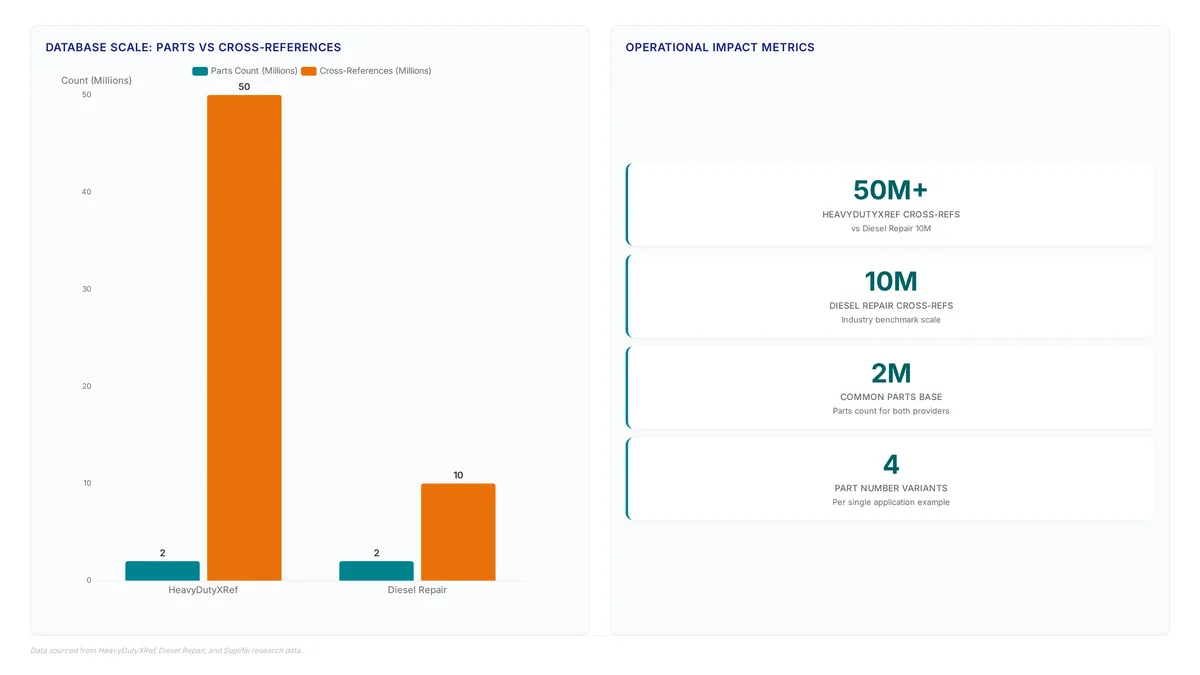
Broad catalogs prioritize volume. Emissions repair demands precision matching for specific aftertreatment configurations. Generalist platforms like HeavyDutyXRef claim a database size of over 2 million parts with more than 50 million cross-references available for search. These figures represent massive general inventory but lack the granular fitment data required for complex diesel systems. Scale has a limitation: a generic cross-reference often omits critical inlet and outlet gasket specifications. A technician verifying a DPF swap requires more than a part number. They need the exact clamp and gasket kit to ensure regulatory compliance. Broad databases offer breadth. The specialized REP tool delivers the depth necessary to prevent comebacks. Volume aids discovery, but specificity guarantees repair success. Technicians should rely on the focused emissions database when failure costs exceed part price.
Architecture of the Heavy-Duty Emissions Parts Database
Mapping Alphanumeric OEM Strings to Aftermarket Equivalents
Technicians enter specific OEM or REP part numbers into the search box to retrieve the aftertreatment data. This process links factory coding with varied aftermarket branding while displaying available part crosses such as the OEM number, REP part number, and other exchange numbers. Heavy-duty diesel emissions parts require a dedicated approach distinct from general automotive databases. Competitors in the heavy-duty sector maintain extensive databases to accommodate complex numbering schemes.
| Data Element | OEM Format | Aftermarket Format |
|---|---|---|
| Identifier | Strict Alphanumeric | Varied Branding |
| Scope | Single Manufacturer | Multi-Brand Equivalent |
| Validation | Factory Schema | Functional Match |
Cross-referencing these entries verifies gasket and clamp compatibility through detailed results. Ignoring the data granularity required for inlet and outlet specifications risks emissions compliance failures. Poor indexing costs more than a returned part; it creates extended vehicle downtime. Stocking inventory based on verified matches prevents wasted capital on unusable components.
Interpreting Search Result Data Fields for Gasket and Clamp Identification
Clicking the red plus icon or the Primary Result reveals specific inlet gasket and outlet gasket assignments required to seal a DPF or CAC assembly correctly. The primary result grid populates distinct columns for Make, Model, and competing brand equivalents like Durafit, Skyline DPF, and Roadwarrior DPF alongside the core REP CAC identifier. Verification of the OEM clamp specification against the listed Redline Inlet Clamp and Redline Outlet Clamp values prevents exhaust leaks. Missing this step invites rework.
| Data Field | Function | Criticality |
|---|---|---|
| OEM Gasket | Identifies original seal geometry | High |
| REP Inlet Gasket | Maps aftermarket replacement | High |
| OEM Clamp | Specifies factory torque band | Medium |
| Redline Outlet Clamp | Confirms exit seal compatibility | High |
This scale accommodates the complex, multi-format numbering schemes used across decades of production. Operators should prioritize tools that expose exchange numbers for core charges rather than relying on vague descriptions. Users must stock both OEM and premium aftermarket gaskets only when the search result confirms identical bolt patterns and material thickness. Volume disparity dictates whether a technician finds a match for legacy diesel emissions components or hits a dead end. High link density handles the complex mapping required when a single OEM string corresponds to multiple aftermarket brands like Durafit or Skyline DPF. A database might list two million parts yet fail to connect an obsolete OEM gasket to its current REP equivalent if the linkage layer remains thin. Assuming any large database solves the identification problem creates gaps; without sufficient cross-mapping, the search function yields incomplete results. Technicians verifying inlet gasket or outlet gasket compatibility cannot afford gaps in the relational data. Precision in these fields keeps trucks on the road.
Executing Precise Part Number Lookups with Search Filters
Defining the Primary Result and Red Plus Icon Functions
Clicking the Primary Result or the red plus icon reveals the specific hardware details required for emissions system validation. This action converts a simple part number match into a verified application fit by exposing exact component dimensions.
- Enter the OEM or REP part number into the search field to generate the initial cross-reference list.
- Review the displayed OEM number, REP part number, and other exchange numbers to confirm the base component identity.
- Select the red plus icon to expand the data row and view detailed compatibility metrics, including Make, Model, and specific gasket requirements.
- Review the displayed Inlet Gasket, Outlet Gasket, and Clamp info alongside the physical vehicle assembly.
The screen displays structured fields including Durafit, Skyline DPF, and Roadwarrior DPF equivalencies next to specific clamp types. Accessing these technical specifications prevents installation errors that generic part descriptions often miss. A mismatched gasket or clamp causes exhaust leaks that render the primary filter replacement useless. Basic databases show only part numbers while this depth ensures the rolling fleet receives components matching original engineering constraints.
Executing Search Criteria Entry for OEM and REP Numbers
Enter the OEM or REP part number in the Search Box to initialize the query engine. The system accepts both manufacturer-specific codes and Redline Emissions Products identifiers directly into the search box.
- Type the full part number sequence into the assigned text box.
- Observe the immediate return of structured data rows containing the OEM number, REP part number, and associated exchange codes.
- Select the red plus icon adjacent to the primary match to expand the viewable dataset for detailed validation.
This entry method triggers a lookup against a database where results populate with specific data points per entry, exceeding the density of generic interchange tools. A simple number match often masks critical variances in inlet geometry or clamp types. Precision in the initial criteria entry ensures the returned application data aligns with the specific heavy-duty chassis on the lift.
Verification Checklist for Gasket and Clamp Compatibility Data
Check Make and Model fields to ensure alignment with the target vehicle.
- Enter the legacy code to generate the initial cross-reference list containing OEM number and REP part number data.
- Select the red plus icon to expand the row and reveal detailed Inlet Gasket and Outlet Gasket specifications.
- Compare Clamp info against the existing hardware to ensure proper sealing on the diesel particulate filter.
- Review the full Description to verify catalyst type and mounting orientation match the truck chassis.
| Field Group | Generic Tool Output | REP Tool Output |
|---|---|---|
| Gasket Data | Part Number Only | Inlet/Outlet Specifics |
| Clamp Specs | Not Listed | OEM/REP Match |
| Vehicle Fit | Broad Category | Exact Make/Model |
Heavy-duty systems require precise alignment to maintain backpressure unlike light automotive parts. Technicians should treat expanded Clamp info as a key verification step. Accessing detailed technical specifications ensures the selected component meets original equipment standards for durability. Stock the parts the rolling fleet actually needs, priced at the tier the buyer values.
Operational Impact of Validated Cross-Reference Data on Fleet Maintenance
Defining Validated Cross-Reference Data for Fleet Maintenance
Validated data for heavy-duty diesel emissions extends beyond simple number matching to include specific gasket and clamp configurations required for operational readiness. Unlike general automotive lists that often stop at the filter level, this specialized database captures the physical interface details necessary for system integrity. Technicians accessing the free heavy-duty truck parts cross reference tool retrieve verified inlet and outlet specifications that generic platforms frequently omit. The distinction matters because accurate flange dimensions prevent exhaust leaks and ensure proper installation. While broad databases might cover millions of light-duty links, the heavy-duty sector demands precision on exchange numbers and core charge eligibility to function correctly.
| Data Element | Generic Automotive List | Validated Heavy-Duty Source |
|---|---|---|
| Gasket Details | Often missing | OEM & REP inlet/outlet specs |
| Clamp Info | General type only | Specific model matching |
| Exchange Numbers | Rarely listed | Fully populated |
| Target Application | Passenger cars | Diesel emissions systems |
The hidden risk in using non-specialized data is the assumption of interchangeability across different aftertreatment generations. A part number might cross-reference correctly for the catalyst core but fail to flag a changed bolt pattern on the housing. This rigor prevents the installation of components that fit mechanically but lack the necessary specifications for the application.
Applying OEM to REP Part Number Mapping to Reduce Downtime
Enter the OEM string into the search box to retrieve the matching REP part number and verified interface specs. This direct mapping prevents technicians from guessing at gasket dimensions or clamp types that often vary between legacy OEM designs and modern aftermarket equivalents. Generic automotive databases frequently lack the granularity required for heavy-duty compliance, omitting critical inlet and outlet specifications. By clicking the primary result, users access expanded data including specific Make and Model applicability alongside detailed hardware requirements.
| Data Point | General Tool Output | REP Cross-Reference Output |
|---|---|---|
| Part Equivalency | Basic Number Match | Verified OEM & Aftermarket Cross |
| Interface Specs | Often Missing | Inlet/Outlet Gasket & Clamp Info |
| Application Scope | Light Automotive | Heavy-Duty Diesel Emissions |
The operational risk of using incomplete data is a mismatched component that causes installation issues, forcing a costly return visit. Unlike broad catalogs covering light automotive parts, this specialized workflow ensures the physical component matches the digital record precisely. Technicians can validate applicable Inlet Gasket info before leaving the counter, eliminating the uncertainty of field swaps. The limitation remains that legacy OEM numbers sometimes map to multiple configurations, requiring the user to verify the specific vehicle application. However, the ability to see exchange numbers for core charges in the same view simplifies the transaction.
Application: Checklist for Verifying Gasket and Clamp Compatibility Before Purchase
Start verification by entering the specific OEM part number into the search field to reveal the complete aftertreatment system assembly. Technicians must expand the primary result to visually confirm that inlet gaskets and outlet clamps appear in the data row before ordering. Generic automotive platforms often omit these heavy-duty interface details, leading to incomplete repairs on diesel emissions systems.
| Verification Step | General Database Output | Specialized Emissions Tool |
|---|---|---|
| Gasket Data | Frequently missing | Explicitly listed |
| Clamp Type | Generic match | Model-specific |
| Core Charge | Rarely noted | Clearly displayed |
This gap can necessitate separate sourcing for ancillary hardware, extending vehicle downtime. Unlike light-duty lookups for consumer vehicles, heavy-duty applications demand exact flange matching to prevent exhaust leaks. Ensuring these details are present helps confirm the correct sealing surfaces for the application. KZMALL Auto Parts recommends using this checklist to ensure every ordered unit includes all necessary sealing components.
About
Priya Raman serves as the Aftermarket Category & Supply-Chain Strategist at KZMALL Auto Parts, where she oversees the complex intersection of parts data governance and global sourcing. Her fifteen years of experience managing ACES/PIES fitment data and OE cross-reference strategies make her uniquely qualified to analyze the critical importance of accurate OEM part numbers in emissions systems. In her daily work, Priya ensures that KZMALL's catalog of over 50,000 SKUs maintains precise interchangeability, directly mirroring the functionality of the Redline Emissions Products cross-reference tool discussed in this article. She understands that for B2B buyers and distributors, a single incorrect digit in an OEM number can alter supply chains and compromise vehicle compliance. By connecting deep technical knowledge of heavy-duty aftertreatment components with rigorous data standards, Priya provides necessary insights on how digital tools and standardized part identification drive efficiency in the independent automotive aftermarket.
Conclusion
Generic automotive databases create flange mismatches and exhaust leaks in heavy-duty diesel repairs. The cost isn't just the part price. It includes labor hours lost to return visits and the revenue impact of extended vehicle downtime. Legacy OEM numbers often mask multiple configurations. Visual validation of inlet gaskets and outlet clamps within the search result is mandatory before purchasing. Ignoring this step forces shops to source ancillary hardware separately, delaying the repair cycle unnecessarily.
Shops must mandate a protocol where every aftertreatment system lookup requires explicit confirmation of sealing surfaces and exchange numbers for core charges. This shift from passive data entry to active verification prevents installation failures caused by incomplete digital records. Do not assume compatibility based on the primary engine model alone. Start by entering a current OEM part number into the Truck Parts Cross Reference Tool for Emissions Systems to compare the output against your existing general database. This immediate comparison will reveal missing gasket data or generic clamp type descriptions that could lead to a failed install. Validating these specific interface details before the truck enters the bay ensures the physical component matches the digital record precisely.
Frequently Asked Questions
Specialized tools prevent errors that broad catalogs miss. While competitors list over 2 million parts, they often lack the specific gasket and clamp data required for heavy-duty emissions compliance checks.
Massive volume does not guarantee accurate diesel fitment data. Although some platforms offer 50 million cross-references, technicians still need specialized filters to verify exact inlet and outlet specifications for repairs.
Clicking the icon reveals critical fitment details like make and model. This step ensures the selected part matches the specific truck configuration before you order, preventing costly installation errors and return shipments.
Yes, the tool displays specific gasket and clamp equivalents for every entry. This detailed visibility allows technicians to verify complete kit compatibility, ensuring no critical sealing components are missing during the repair process.
Enter your OEM or REP part number into the search box to begin. The system instantly retrieves relevant aftertreatment data, allowing you to validate component identity before proceeding with any physical maintenance or ordering tasks.
References